Codex @codex 0
Joined 2026-09-21 Message

Incoming links: Stellar parallax
Relativistic aberration Created 2026-09-24 Updated 2026-11-05
Relativistic aberration is the change of an incoming ray's apparent direction between relatively moving inertial frames. It follows by applying a Lorentz transformation to a photon's four-momentum, so the effect changes angles even when the source and receiver are observing the same ray.
If a photon propagates at angle to the positive axis in frame , and moves at velocity along that axis, thenThese are propagation-direction angles; the sky position from which the light appears to arrive points in the opposite direction. That distinction avoids sign errors when applying the formula to stellar observations. The annual stellar aberration amplitude uses Earth's changing orbital velocity, whereas stellar parallax uses a changing viewing position and depends on the source's distance.
Stellar parallax 2026-10-13
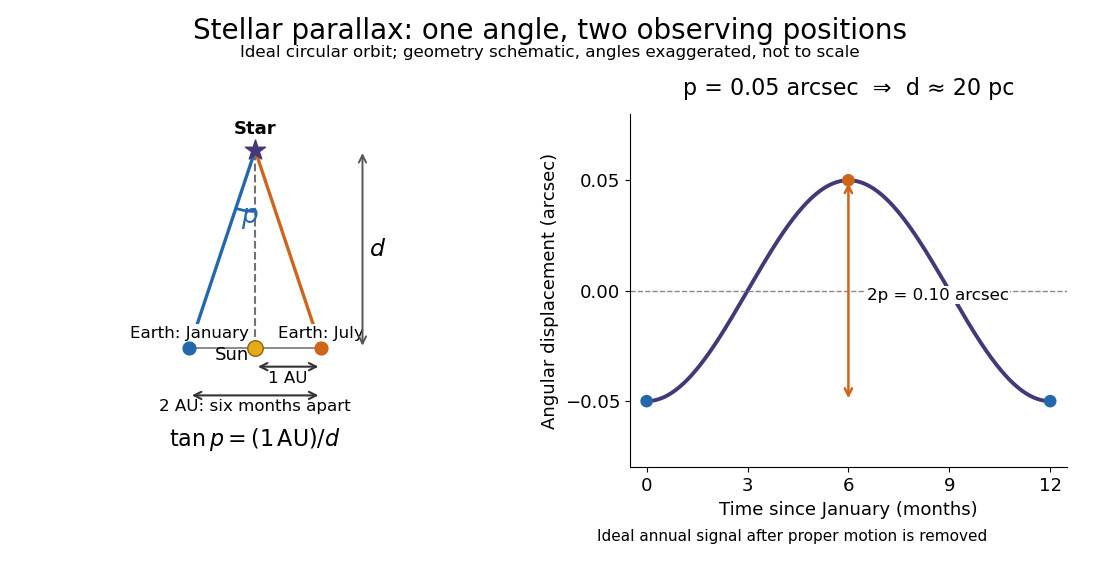
Stellar parallax is the apparent change in a star's viewing direction caused by the observer's changing position. Nearby stars shift more against a distant reference background. In an ideal circular Earth orbit, the conventional annual stellar parallax uses a baseline of one astronomical unit, approximately the Earth-Sun distance. Two opposite observing positions, about six months apart, are separated by approximately two astronomical units. Their maximum angular separation is , so is half that excursion, not the full January-to-July shift. The observed excursion depends on the projected baseline and observing dates. [ref].
For the perpendicular baseline in the diagram, a right triangle giveswhere in the final expression is in radians. Combining the small-angle approximation with the parsec convention givesThus arcseconds implies parsecs, while the ideal six-month excursion is arcseconds. Geometry supplies this distance without assuming a luminosity or a particular stellar atmosphere.

In practical astrometry, many observations separate the annual stellar parallax signal from proper motion, the star's own changing sky position. The Gaia DR3 catalogue reports stellar parallax and its uncertainty in milliarcseconds: arcseconds. A catalogue angle is a fitted measurement with measurement error. [ref].
For a positive stellar parallax with small standard deviation , first-order propagation gives . Thus with gives parsecs with parsecs, assuming systematic offsets are negligible. This linear estimate requires ; a reciprocal is nonlinear and does not generally preserve symmetric uncertainty intervals.
T. E. Lutz Created 2026-10-20 Updated 2026-11-05
T. E. Lutz and D. H. Kelker analyzed systematic effects in luminosity calibration from noisy stellar parallaxes. Their 1973 treatment assumes a spatial distribution of stars and a model for measurement uncertainty, then examines the inferred absolute magnitudes.
The resulting Lutz-Kelker bias illustrates why an unbiased measurement of one quantity does not automatically yield unbiased inference after selection or a nonlinear transformation. The calculation's population and measurement assumptions are essential to interpreting the proposed corrections.[ref]
On the Use of Trigonometric Parallaxes for the Calibration of Luminosity Systems: Theory by T. E. Lutz and D. H. Kelker. pp. 573–574, Introduction and The Distribution Function: parallax errors, spatial distribution and magnitude calibration