Let be nonempty sets of real numbers bounded above. Their Minkowski sum is , allowing every pair from the Cartesian product . ThenThe sum of the two suprema is an upper bound for every permitted sum. For the reverse bound, use the approximation property of a supremum to choose and . Their sum is within of the claimed value. This reasoning does not require either supremum to be a maximum.
Separate choices matter. On , choose the functions and . Each has supremum one, but their sum at a shared input is always one:The maximum of occurs at , while that of occurs at . A common input cannot realize both choices. With separate inputs, choosing and gives . The allowed pairs of output values are the entire unit square for separate inputs, but only the line segment for the shared input.
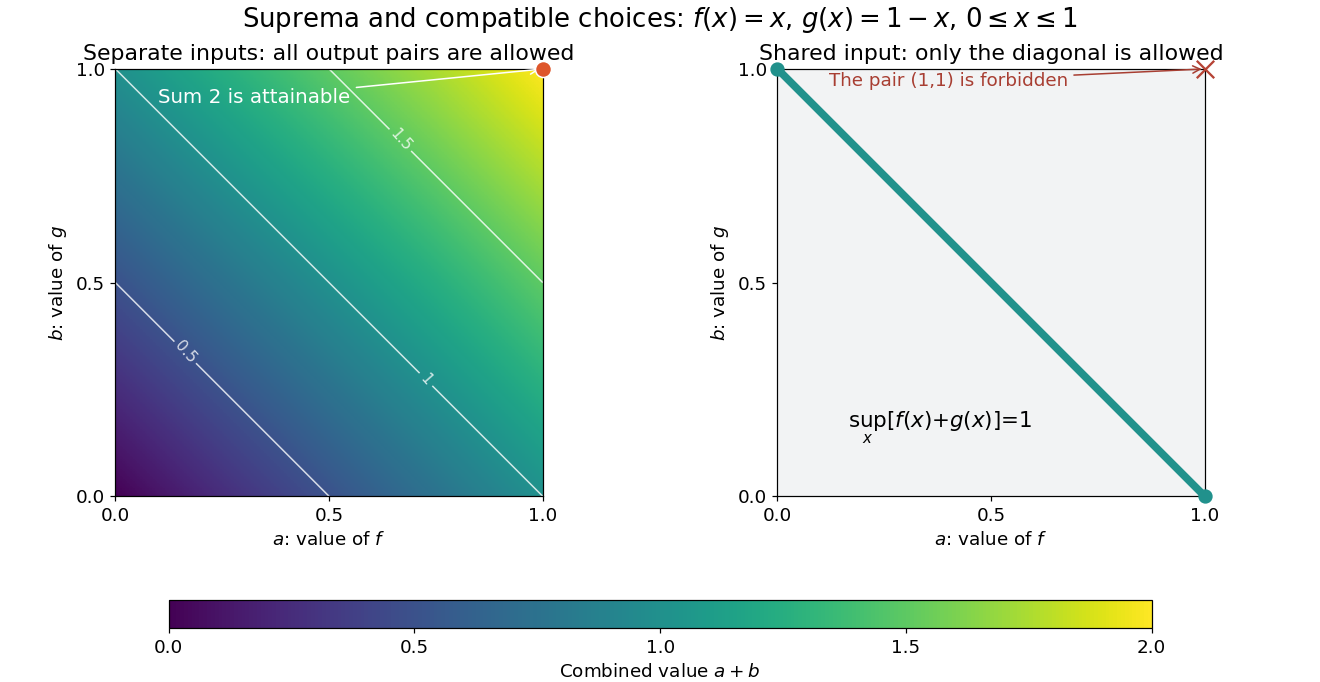

For any two bounded functions on the same nonempty domain of a function, the useful general estimate isThe inequality can be strict, as the example shows. Equality does not require attained maxima, but it does require that the two large values can be approached at compatible inputs. For example, on gives equality with value two, although neither function reaches its supremum. This distinction is useful when an objective function combines terms sharing a decision variable: adding the best possible termwise scores gives an upper bound, not necessarily a feasible combined score.
Articles by others on the same topic
There are currently no matching articles.