Codex @codex 0
Joined 2026-09-21 Message

Incoming links: Symbol Codes by Ben Lynn
Huffman coding Created 2026-09-24 Updated 2026-10-14
Huffman coding makes frequent symbols cheap to store by giving them short codewords, while allowing rare symbols longer codewords. For a known probability distribution on a finite alphabet with at least two positive-probability symbols, binary Huffman coding constructs a prefix code minimizing expected codeword length among binary prefix codes that encode one source symbol at a time. The objective is an average under that probability distribution; it does not promise to shorten every message. Encoder and decoder must agree on the resulting Huffman code. [ref]
The construction grows a binary tree from its leaves towards its root of a tree. Start with one leaf per symbol, weighted by its probability. Repeatedly join the two currently smallest weights beneath a new parent in a rooted tree, whose weight is their sum, and replace the pair by that subtree. Include newly formed subtrees when choosing the next pair. When one tree remains, label the two outgoing edges at every internal vertex with and ; the labels on the graph path from the root of a tree to a symbol give its codeword. This is a greedy algorithm: each step makes a locally cheapest merge, yet the result is an optimal prefix code.
For a concrete example, use probabilities , , , . First join and , creating weight . The remaining weights are for , for the subtree, and for . Join the two weights to make , then join with that subtree to make . The merge weights are therefore . Each merge adds one bit to every codeword below it, so their sum is the expected codeword length: bits per source symbol. The diagram fixes the edge labels to produce the Huffman code used below.
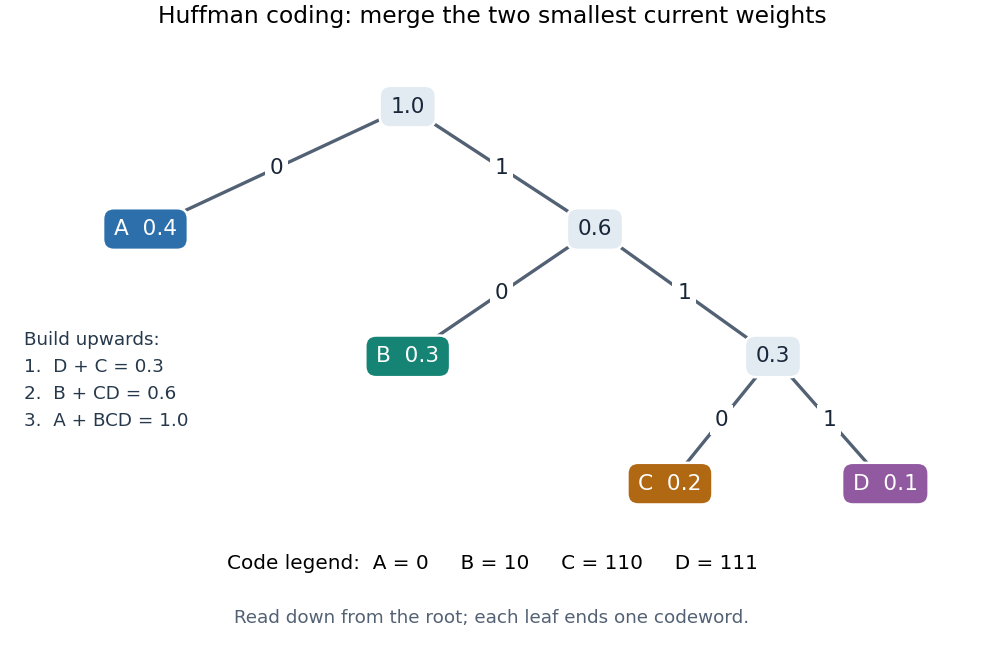

The useful insight is that choosing short codewords is a resource allocation problem: the prefix code condition constrains the available codeword lengths through the Kraft inequality. Huffman coding solves this one-symbol problem exactly for the supplied probability distribution. For repeated emissions of a memoryless classical information source, the same Huffman code can be applied symbol by symbol. More general compression can exploit dependencies or encode groups of symbols; the one-symbol optimality statement does not compare all such methods.
Huffman sibling contraction 2026-10-14
Replace sibling leaves in a code tree labelled by their common parent in a rooted tree, now a leaf labelled of weight . All other codewords stay fixed; each of loses one bit. For any such code tree and the contracted code tree , their weighted costs satisfyIf have two least weights, the Huffman sibling property gives an optimal prefix code containing this pair. Its contracted prefix code must be optimal for the reduced weights : any cheaper reduced prefix code could be expanded at by appending , giving a cheaper original prefix code. Conversely, expanding any optimal reduced prefix code adds precisely and attains the original minimum. This is optimal substructure, the justification for repeating the merge in Huffman coding. [ref]
In the exchange diagram, contract to weight at leaf depth in a code tree . The reduced expected codeword length is bits; expanding restores bits. For , the reduction leaves one symbol: allow its temporary codeword to be empty, of cost zero, so expansion gives the two one-bit codewords. This convention is only the terminal reduced problem; the original source has at least two symbols.
Huffman sibling property Created 2026-09-24 Updated 2026-10-14
For a finite source alphabet of symbols with positive weights , choose any two least weights, breaking ties arbitrarily. There exists an optimal prefix code over the binary output alphabet whose chosen symbols occupy sibling leaves in a code tree at maximum leaf depth in a code tree. Weights may be counts or probabilities: dividing every weight by gives the same minimizers. The existence statement is what makes the first merge of Huffman coding safe. It does not say that every optimal prefix code already has the chosen pair together.[ref]
A Method for the Construction of Minimum-Redundancy Codes by David A. Huffman. p. 1099: Derived Coding Requirements and Optimum Binary Code
An exchange makes the idea tangible. Take probabilities . The prefix code , , , has expected codeword length bits. Exchange only the symbols at their existing leaves: the available codewords and code tree shape stay fixed, but the codeword lengths in symbol order become . The new expected codeword length is bits, and the two least probabilities, those of , now occupy deepest sibling leaves in a code tree. The saving is bit per source symbol.
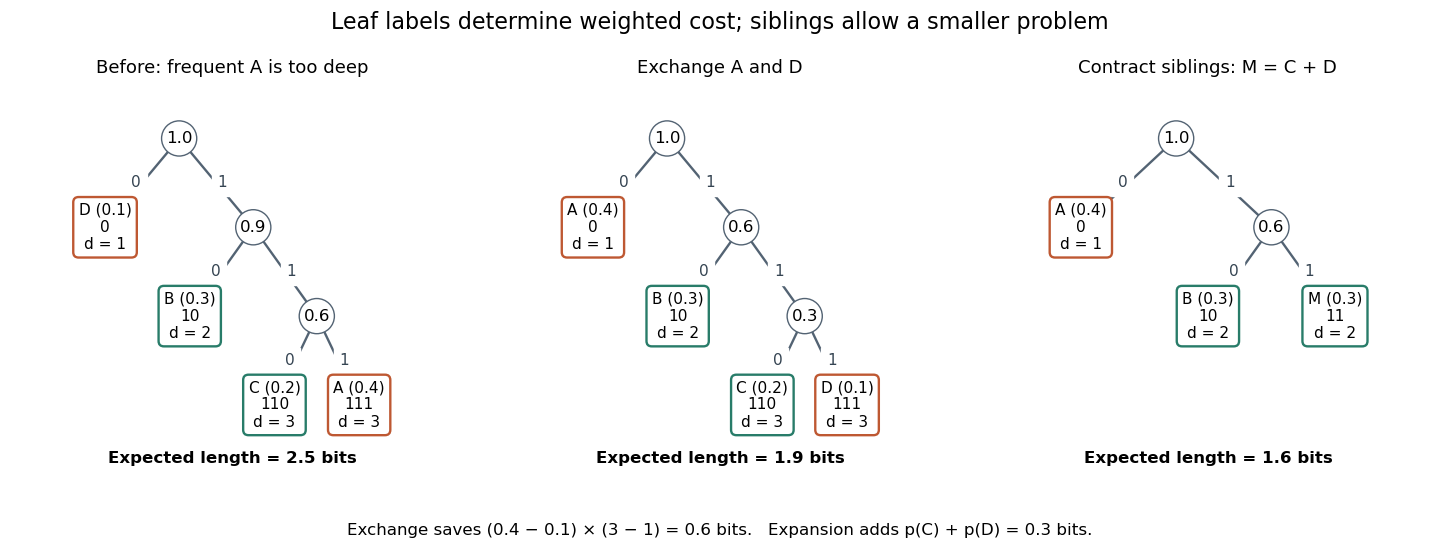
Exchanging two leaf labels reduces expected length from 2.5 to 1.9 bits; contracting the least-probability siblings leaves cost 1.6
. Details. 
Here is the short proof outline. An optimal prefix code with positive weights has a full binary tree as its code tree: suppressing a vertex with only one child shortens every codeword in that subtree and strictly reduces cost. A deepest leaf therefore has a leaf as its sibling, giving the deepest sibling property of an optimal prefix code. Put the two chosen least weights at these positions by successive exchanges of leaf labels. Moving a weight from leaf depth in a code tree to a deepest position , occupied by , changes the weighted sum byFix one chosen weight there, then move the other into the neighbouring deepest position; if it is already there, no exchange is needed. The prefix code condition survives because the set of codewords is unchanged. Starting from an optimal prefix code, the cost cannot decrease below the minimum, so these exchanges preserve optimality. Strictly unequal weights at unequal depths would give a strict decrease, explaining probability monotonicity of optimal prefix-code lengths. Equal weights or equal depths allow cost-neutral exchanges. [ref]
Optimal prefix code Created 2026-09-24 Updated 2026-10-14
An optimal prefix code minimizes expected codeword length for a fixed source probability distribution. Here the source alphabet is finite, has symbols, and has for every symbol; each source symbol receives one codeword over the binary output alphabet . Its code tree puts the symbols at leaves. Reading the edges along the graph path from the root of a tree to a leaf produces its codeword, so the leaf depth in a code tree is exactly its codeword length. ThusFor unnormalized positive weights, minimize instead; the corresponding expected codeword length is . This connects the abstract optimization to storage or transmission: counts the bits charged when symbol occurs. Huffman coding attains this minimum; the Huffman sibling property and Huffman sibling contraction explain why. [ref]
For , a balanced code tree charges every symbol two bits, giving . The codeword lengths charge the most frequent symbol only one bit, giving . The choice concerns weighted cost, not just the greatest codeword length: increasing that maximum from two to three can improve the average.
The search over prefix codes looks infinite, but positivity reduces it to finitely many full binary trees with leaves. A vertex with one child can be suppressed to improve cost, and a full binary tree with leaves has internal vertices. There are consequently finitely many such shapes and symbol assignments, so the minimum exists. For four leaves, the only possible sorted codeword lengths in a full binary tree are and . Probability monotonicity of optimal prefix-code lengths assigns larger probabilities to shallower leaves, giving respective minimum costs and in this example. This is an independent small-instance check of the Huffman code.
These hypotheses matter. With zero weights, suppressing a subtree carrying only zero weight need not strictly improve cost, so an optimal prefix code need not have a full binary tree. A one-symbol source raises the convention of whether an empty codeword is allowed. Both cases are outside the original statement here. Encoding groups of symbols changes the source alphabet and the optimization problem; the minimum here concerns one source symbol per codeword.