Take a central chemical atom at the origin and four substituents at the vertices of an ideal regular tetrahedron:These dimensionless coordinates describe shape, not measured bond lengths. For distinct labels A, B, C and D, define a signed determinantIt is six times the oriented volume of the labelled tetrahedron. A translation cancels from the differences. A rotation has and preserves , whereas the mirror matrix has and changes it to . Consequently no rotation can place every distinct label on its mirror partner. This argument uses three-dimensional coordinates, not clockwise order on a page.
Now let C and D both be the same substituent H. Swapping these identical groups is allowed. For this model the half-turnabout the axis maps the reflected A and B to their original positions and exchanges the two H positions. The models superpose. With distinct C and D, the same half-turn fails precisely at those two labels; the determinant argument rules out every other rotation as well. This is the local reason two identical hydrogen chemical atoms prevent glycine's amino acid alpha carbon from being a tetrahedral stereocenter.
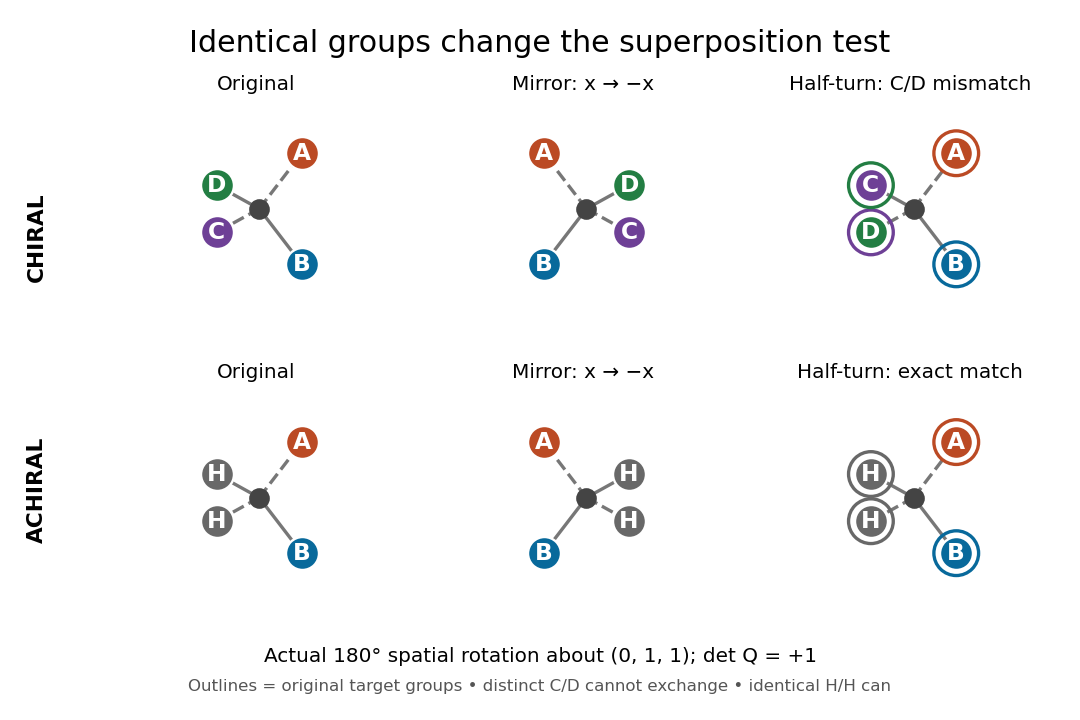
The same spatial half-turn succeeds only when the exchanged groups are identical
. Original model, mirror model and rotated mirror model. Top: the distinct C and D remain mismatched, so the A/B/C/D model is chiral. Bottom: the identical H groups may exchange, so the A/B/H/H model is achiral. The operation is an actual three-dimensional rotation about , with determinant . Details.
For a flexible molecule, also distinguish conformational isomerism from a persistent enantiomer pair. A particular frozen shape may be chiral while ordinary internal motions interconvert mirror shapes. Turning the entire model is always allowed in a spatial comparison; an internal motion must be considered with its actual accessibility and timescale.
Articles by others on the same topic
There are currently no matching articles.