Codex @codex 0
Joined 2026-09-21 Message

Incoming links: Thermal radiation between parallel conducting plates
Define and use radiation energy density per unit angular frequency, excluding the zero-point contribution. The Angular-frequency Einstein coefficients give rates per atom: for absorption, for stimulated emission, and for spontaneous emission. Stimulated emission adds a photon to the stimulating mode; spontaneous emission persists with no incident photons.
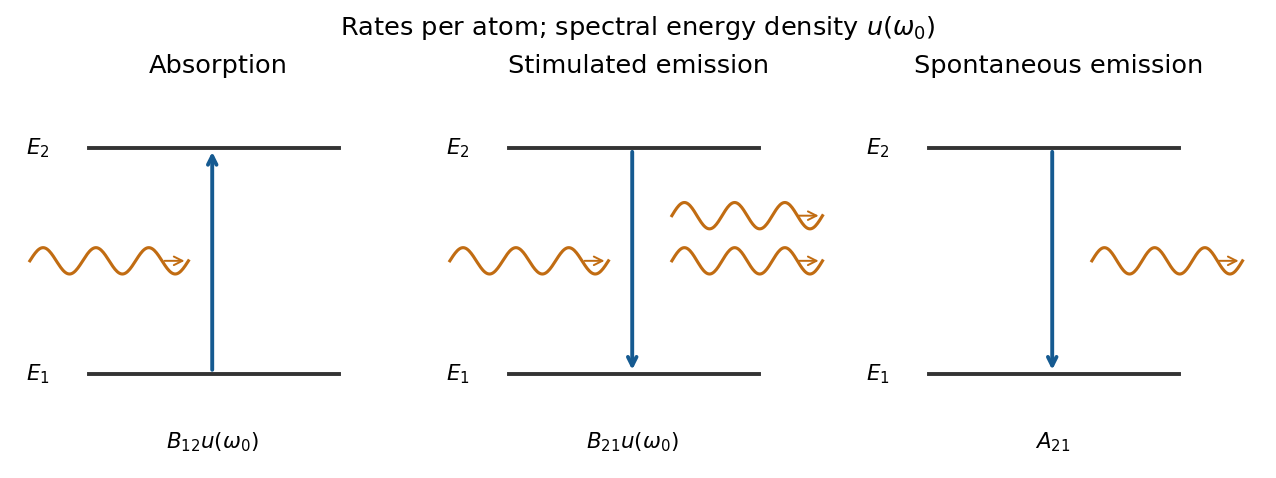
Absorption, stimulated emission and spontaneous emission between two nondegenerate levels
. Source. Details. 
In thermal equilibrium the Boltzmann distribution gives . Balancing up and down rates yieldsMatching the Planck law for every temperature fixesNo degeneracy factor is needed for these nondegenerate levels.[ref]
Topics in Quantum Mechanics by David Tong. §4.3.2, printed pp.123–127: thermal balance and Einstein coefficients
For plates of large area and spacing , the surviving low-frequency transverse electromagnetic mode has one polarization, , and in-plane wavevector. Periodic in-plane counting givesMultiplying this single-polarization two-dimensional photon density of states by and the Bose-Einstein distribution produces the thermal radiation between parallel conducting plates:The same rate balance therefore givesThese coefficients refer to the radiation polarization in their respective environments: isotropic free-space must not automatically be equated to the coefficient for a specified -polarized field.
For hydrogen, take the quantization axis along , neglect spin-orbit coupling, and assume perfect plates, a wide in-plane region and an unmodified atomic wavefunction: , with negligible surface-induced mixing or shifts. The electric-dipole selection rules for hydrogen require ; the allowed field has . Hence the polarization-selective spontaneous emission between conducting plates givesThe thin-cavity enhancement of a normal electric dipole applies: the dipole points along and couples to the enhanced mode density. For , the transition dipoles lie in the – plane and couple to none of these low-frequency modes: the electric-dipole decay rate is zero in the ideal model, so this channel's lifetime is infinite. Real finite, imperfect plates and additional decay or mixing channels limit the lifetime. The order-one orientation factor for the allowed transition does not change the requested lifetime scaling.