Consider an original ideal quantum system with positive scales andInterpret as one component of an electric dipole moment, so its coupling to the corresponding electric field is the electric-dipole interaction . The gaps are , but : this interaction has no direct first-order coupling. The nonzero squared matrix elements are and . These are coupling weights; actual spectral line intensities also depend on populations and radiation factors. In particular, there is no promise that an experiment populates the upper state of every allowed transition.
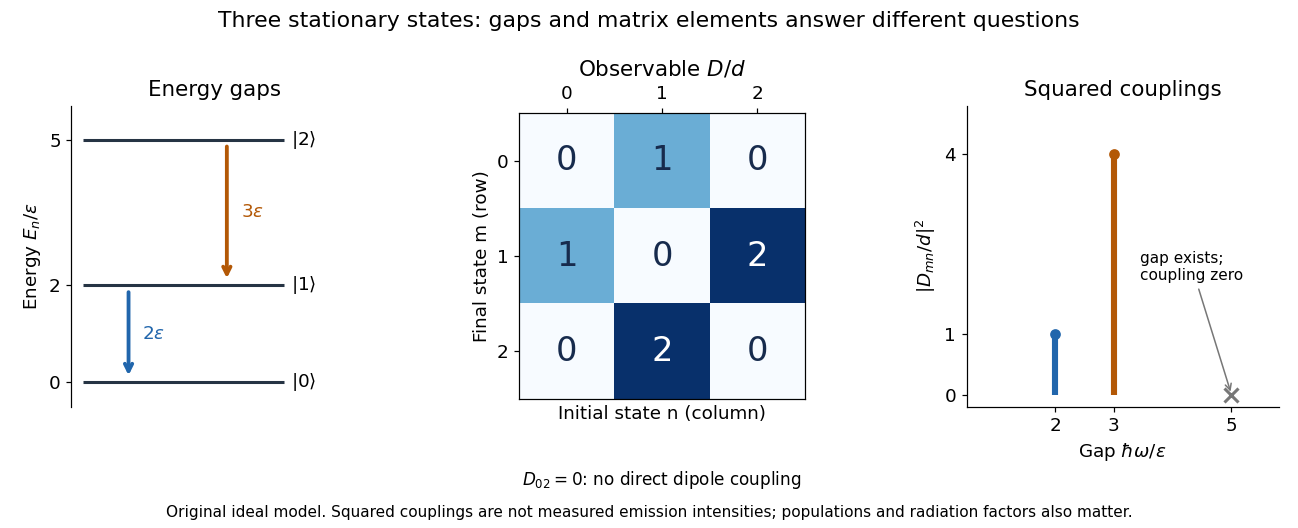

A measurement of itself has possible outcomes , sinceThese are eigenvalues of , not the energy eigenvalues . Moreover, although : two factors connect through . This algebraic statement does not turn into a nonzero direct coupling. Higher-order probability amplitudes for transitions require the appropriate dynamical calculation.
Articles by others on the same topic
There are currently no matching articles.