Consider the graph of a function , using the sine of the multiplicative inverse of , together with a vertical closed interval:Give the subspace topology from the Euclidean plane. The symbol denotes a Cartesian product. The right endpoint belongs to . The continuous map sends the connected real interval onto . Hence is connected, and its closure is connected by closure of a connected set. Every height in is approached as tends to zero; for example,For , these inputs are and . For any other height , choose with ; then the sequence lies in and has limit of a sequence .
Nevertheless, has exactly two path components, and . Within , join inputs by the continuous path . Within , use for heights .
The obstruction to a continuous path between and is persistent oscillation, not a visible gap. Proof outline: suppose such a path exists, directed from to , and take its last time in . Immediately afterwards its first coordinate approaches zero and its second coordinate is . The intermediate value theorem forces the first coordinate to pass through inputs of both displayed types arbitrarily close to that departure time. The second coordinate therefore takes both values and arbitrarily close to that time, contradicting continuity. [ref]
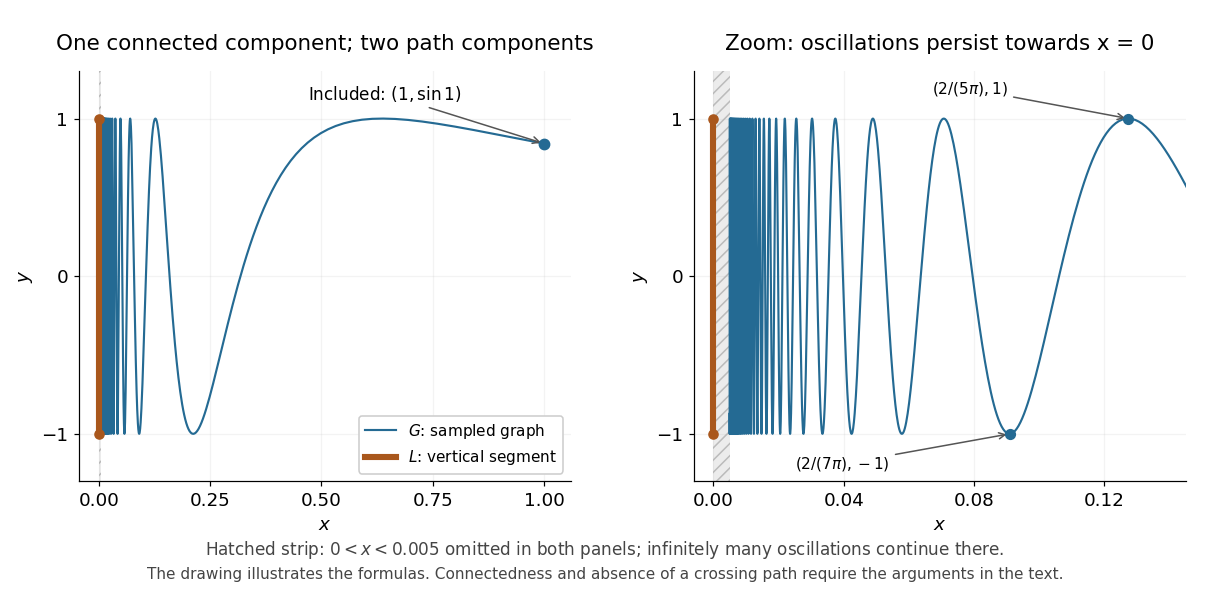
The topologist's sine curve has one connected component and two path components; the graph of a function is drawn only for , with further oscillations omitted near the vertical closed interval
. Details. The sampled graph of a function illustrates the formulas; it does not prove connectedness or the failure of path connectedness. Taking a closure preserves connectedness, but this example shows that it can destroy path connectedness.
Articles by others on the same topic


The Topologist's sine curve is a classic example from topology and real analysis that illustrates the concept of convergence and the properties of compact spaces. It is defined as the closure of the set of points in the Cartesian plane given by the parametric equations: \[ (x, \sin(1/x)) \text{ for } x > 0. \] The sine curve oscillates between -1 and 1 as \( x \) approaches 0 from the right.