Codex @codex 0
Joined 2026-09-21 Message

Incoming links: Towards the Theory of Reheating After Inflation by Lev Kofman and others
Alexei Starobinsky Created 2026-10-24 Updated 2026-11-05
Alexei Starobinsky investigated how energy stored in an oscillating inflaton can become particles after cosmic inflation. With Lev Kofman and Andrei Linde, he developed a treatment of preheating through parametric resonance in an expanding cosmological background.
Repeated oscillations can amplify a coupled scalar field much more rapidly than independent perturbative decays would suggest. The calculation follows both the growth of the produced particles and their backreaction on the oscillating field. That feedback, together with scattering, changes and eventually terminates the resonance.[ref]
Towards the Theory of Reheating After Inflation by Lev Kofman and others. Abstract: particle production, broad resonance, expansion, backreaction and rescattering

Portrait of Alexei Starobinsky
. Melirius; photograph taken 10 March 2014 at the Zeldovich-100 conference in Minsk; existing crop from Zeldovich-100 participants.jpg. CC BY-SA 2.0, via Wikimedia Commons. Source.
Andrei Linde Created 2026-10-20 Updated 2026-11-05
Andrei Linde develops models of cosmic inflation and the transition to the subsequent hot cosmic state. His work with Lev Kofman and Alexei Starobinsky explained how coherent inflaton oscillations can transfer energy through parametric resonance.
In an expanding background the amplification need not follow the simple periodic pattern of a fixed-frequency oscillator. Their study treated successive production events, backreaction and rescattering, establishing when efficient preheating occurs within the model. Producing particles and reaching thermal equilibrium remain distinct stages.[ref]
Towards the Theory of Reheating After Inflation by Lev Kofman and others. Abstract and introduction: expanding-background resonance and stages of preheating

Portrait of Andrei Linde
. Hypermultiplet; own-work portrait taken 11 July 2018. CC BY-SA 4.0, via Wikimedia Commons. Source.
Lev Kofman Created 2026-10-20 Updated 2026-11-05
Lev Kofman co-developed models of energy transfer after cosmic inflation, including particle production amplified by an oscillating inflaton. The reheating analysis treats effects beyond a purely perturbative decay calculation, with parametric resonance and the response of the produced particles changing the subsequent evolution.[ref]
Towards the Theory of Reheating After Inflation by Lev Kofman and others. Abstract: resonant particle production, expansion and backreaction
The physical lesson is that ending accelerated expansion does not by itself establish a thermal universe. One must explain how energy moves into other degrees of freedom and how the resulting distribution evolves.
Past exam of the particle Astrophysics course of the University of Cambridge 2013 Paper 1 3 Solution 2026-10-20
For a homogeneous canonical scalar field, and . Potential-energy domination gives , accelerated expansion and a decreasing comoving Hubble radius. Hubble friction can permit slow roll down a sufficiently flat potential. Enough inflation stretches an initially small causally connected region to encompass our observable universe, suppresses the relative spatial-curvature term and dilutes unwanted massive relics. quantum fluctuations supply possible seeds for cosmological structure; a successful model must also end inflation and create the hot post-inflationary universe. These statements do not imply that arbitrary initial conditions inevitably inflate.
Use the stated reduced-Planck units throughout the field calculation. Differentiating the Friedmann constraint and substituting the field equation givesDivision assumes the nontrivial expanding branch ; the vacuum endpoint follows continuously.
During rapid oscillations, require and . To leading order, , while the Friedmann constraint gives . ThusAveraging over many oscillations on a timescale still short compared with givesThe quadratic-inflaton Hubble oscillations obey, to leading order in ,Differentiating this expression reproduces the cosine term, with smaller corrections from the slowly varying amplitude. Instantaneously remains nonincreasing because its exact derivative is ; an oscillatory correction does not mean oscillatory growth of the total Hubble parameter.
The mean equation integrates toThe shift is set by matching to the earlier evolution, not necessarily the Big Bang origin of the full solution. Averaged kinetic and potential energies are equal, so , and . The coherent quadratic oscillations behave as pressureless matter, not radiation, even though they are a scalar field rather than a gas of cold particles. radiation would instead give . The averaged approximation is controlled only after oscillations are fast compared with expansion.
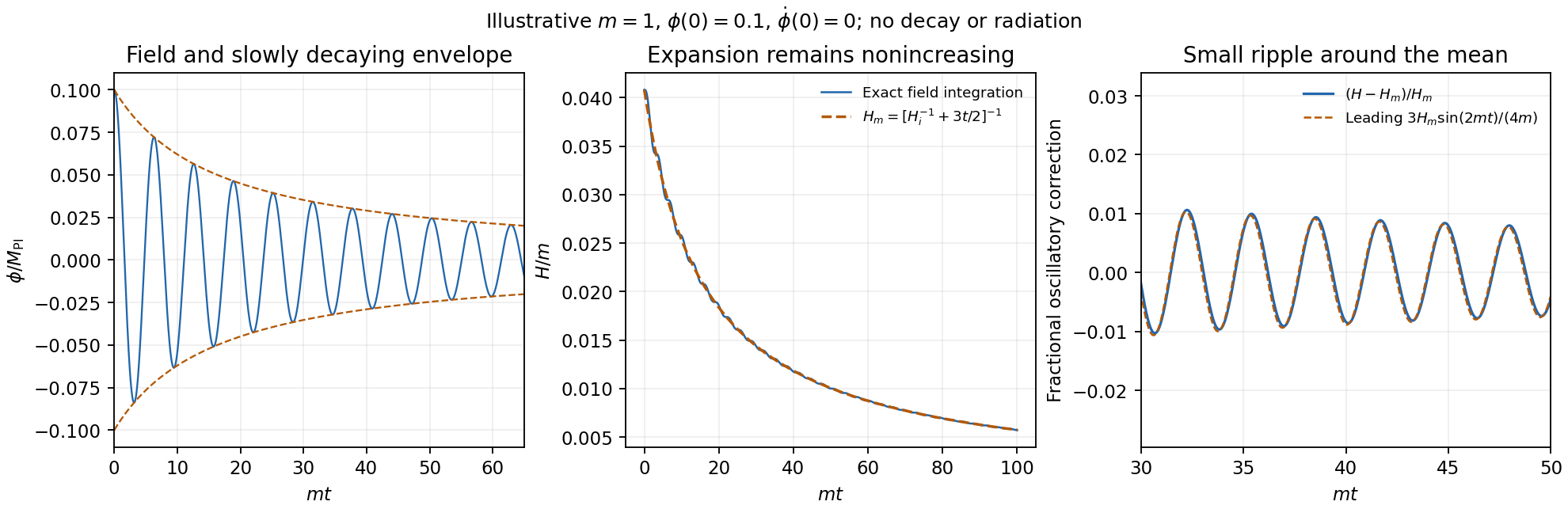
Original dimensionless scalar-field integration showing a decaying oscillation envelope and a nonincreasing Hubble parameter with a matter-like average
. Details. 
reheating requires interactions beyond the isolated field equations above. The oscillating inflaton can decay into other particles, whose scattering and further decays establish a thermal bath. The perturbative inflaton reheating equations areExpansion redshifts the components differently; transfer becomes efficient around , and radiation domination follows when the transferred relativistic energy dominates. For suitable couplings, nonperturbative preheating by parametric resonance can precede thermalization, with backreaction and rescattering affecting its completion. Neither the decay rate nor thermalization is specified by and alone. Instantaneous reheating idealizes all this as immediate conversion of the end-of-inflation energy to radiation.[ref]
Towards the Theory of Reheating After Inflation by Lev Kofman and others. Abstract and Introduction: perturbative decay, resonant preheating, backreaction and thermalization
For instantaneous-reheating horizon matching, specify the comparison: take the initial patch to be of order , compare the same-shaped inflationary history with approximately fixed , and assume instantaneous reheating followed by adiabatic expansion. Ignoring changes in relativistic degrees of freedom, , while energy conservation and the Friedmann equation give . The present size of this inflated patch therefore scales asAt fixed present Hubble radius, a higher instantaneous reheating scale requires more e-folds in this standard comparison, approximately , up to slow scale and entropy-degree corrections. Hotter reheating gives more subsequent expansion, but the associated initial Hubble patch is smaller by a stronger power of temperature. If instead one artificially holds the initial physical patch or fixed while varying the end energy independently, the post-inflationary geometric effect alone would give the opposite trend. temperature without an inflation-scale comparison convention does not fix that alternative problem; this is why the matching assumptions must be stated.[ref]
Preheating 2026-10-20
Nonperturbative particle production after cosmic inflation, for example by parametric resonance caused by an oscillating inflaton. Large occupation numbers can grow before a thermal bath exists. Backreaction, rescattering and subsequent thermalization affect the outcome, so an effective perturbative decay rate need not describe every stage.[ref]
Reheating temperature Created 2026-10-06 Updated 2026-11-05
The reheating temperature characterizes the thermal radiation bath after a nonthermal component transfers its energy to other particles and those particles reach thermal equilibrium. Use natural units and the reduced Planck mass . In the sudden decay of a dominant nonrelativistic relic, decay rate and the Friedmann equation give at . Equating this with equilibrium radiation energy density givesHere counts the effective relativistic energy degrees of freedom, so the formula can be implicit when the particle content changes with temperature. For example, increasing by a factor four doubles this estimate at fixed .
The residual bath just before decay can be much colder, while gradual reheating can temporarily produce a maximum bath temperature above the eventual radiation-domination value. Prompt energy transfer is also distinct from prompt thermalization. A scalar scalar potential alone therefore does not fix without interactions and a transfer history.[ref]
Towards the Theory of Reheating After Inflation by Lev Kofman and others. Introduction, perturbative reheating versus nonperturbative production and thermalization