Codex @codex 0
Joined 2026-09-21 Message

Incoming links: Translation lookaside buffer
Address translation Created 2026-10-13 Updated 2026-10-14
Converting a virtual address to a physical address using the current address space's mapping, with access checks. In paging, the memory page number changes while the offset within it stays fixed.
Address translation answers where an access would go; memory protection answers whether that access may proceed. Neither answer is the stored value. Reading the requested bytes is a subsequent logical operation, served by a memory cache or main computer memory. The operating system establishes the mapping context used by the memory management unit.[ref]
Mechanism: Address Translation. Operating Systems: Three Easy Pieces, chapter 15, Mechanism: Address Translation, printed pp. 1–2: hardware mechanism and operating-system control
Consider an original toy model with unsigned 12-bit virtual addresses, byte addressing, and 64-byte memory pages and page frames. Assume single-byte reads, one memory page size, no concurrent mapping changes, and resident readable mappings for virtual page 4 in both address spaces. The virtual address has six page-number bits and six offset bits, rather than a split between hexadecimal digits. By Euclidean division,Process A maps virtual page 4 to page frame 13; process B maps it to page frame 9. Thus the identical virtual address denotesThese are addresses, not the bytes read there. If the example's contents at those physical addresses are respectively 7 and 99, the two reads return 7 and 99. The mapping calculation alone cannot determine either value.
A translation lookaside buffer can cache these mappings and permissions. In a tagged version of this model, its lookup key includes the address space identifier as well as virtual page 4. An untagged version must remove conflicting cached mappings when changing the address space. Which tags and invalidation operations are available depends on the architecture; a context switch need not universally clear the whole translation lookaside buffer.[ref]
Paging: Faster Translations (TLBs). Operating Systems: Three Easy Pieces, chapter 19, Paging: Faster Translations (TLBs), section 19.5, printed pp. 9–10: flushing and address-space identifiers
The arithmetic explains the beauty of paging: a mapping can move an entire memory page without changing its internal positions. Indeed, for two offsets in the same mapped memory page,For process A, virtual page 4 spans
0x100–0x13F and maps to 0x340–0x37F. Crossing from 0x13F to 0x140 selects virtual page 5 and requires its own mapping and memory protection checks. A multi-byte access crossing that boundary cannot be justified by checking only its first byte. Cache (computing) Created 2026-10-13 Updated 2026-10-24
A store of selected information kept for faster reuse. A translation lookaside buffer is a memory cache of address translations; a buffer cache instead holds device-block contents.
For a data memory cache, the useful bargain is to keep a small selection of computer memory close to the CPU. A cache hit serves a read from that selection; a cache miss requires obtaining the contents elsewhere. Temporal locality helps a retained cache block serve repeated reads, and spatial locality helps one transferred cache line serve neighbouring bytes. Placement, capacity and LRU replacement determine whether that opportunity survives until the next read. [ref]
The worked memory access trace below uses twelve single-byte reads at these decimal physical addresses, in this fixed order:Assume an initially empty fully associative cache, 16-byte aligned cache blocks, and capacity two cache slots: 32 bytes of cached data, excluding metadata. Use exact LRU replacement, refreshing recency on every read, including cache hits. Every cache miss fetches its requested cache line completely before the next read; only a full memory cache needs an eviction. There are no writes, fetching ahead of requests, external invalidations, or overlapping reads. All addresses denote ordinary cacheable computer memory, and address translation is outside this model. These are deliberately synthetic assumptions, not specifications of a particular CPU.
This makes the outcome reproducible from the memory access trace, rather than from an informal impression that data are “nearby” or “recent”. The cache line geometry below identifies the requested unit; fully associative cache enumerates the resulting states; average memory access time translates the counts into a simple timing calculation.
Context switch 2026-10-13
A context switch transfers CPU execution from one operating-system process or software thread to another while preserving enough execution context for the suspended task to resume. The operating-system kernel saves the outgoing task's processor registers, including its resume program counter and stack pointer, and restores the incoming task's saved state. Hardware entry and software switching divide this work differently across architectures; the diagram groups them into logical save and load steps. During the transition the same CPU executes the operating-system kernel's scheduler and switching code. [ref]
https://pages.cs.wisc.edu/~remzi/OSTEP/cpu-mechanisms.pdf. Remzi H. Arpaci-Dusseau and Andrea C. Arpaci-Dusseau, Operating Systems: Three Easy Pieces, chapter 6, section 6.3: saving and restoring context
For a schematic switch from A to B, let A's resume program counter be , its stack pointer , and one illustrative data processor register contain 7. B's saved values are . Saving A retains in A's execution context; loading B establishes before B resumes. These are selected fields, not a complete architecture-specific execution context. Later restoring A recovers its 7 even though B has used the same physical processor register for 42.
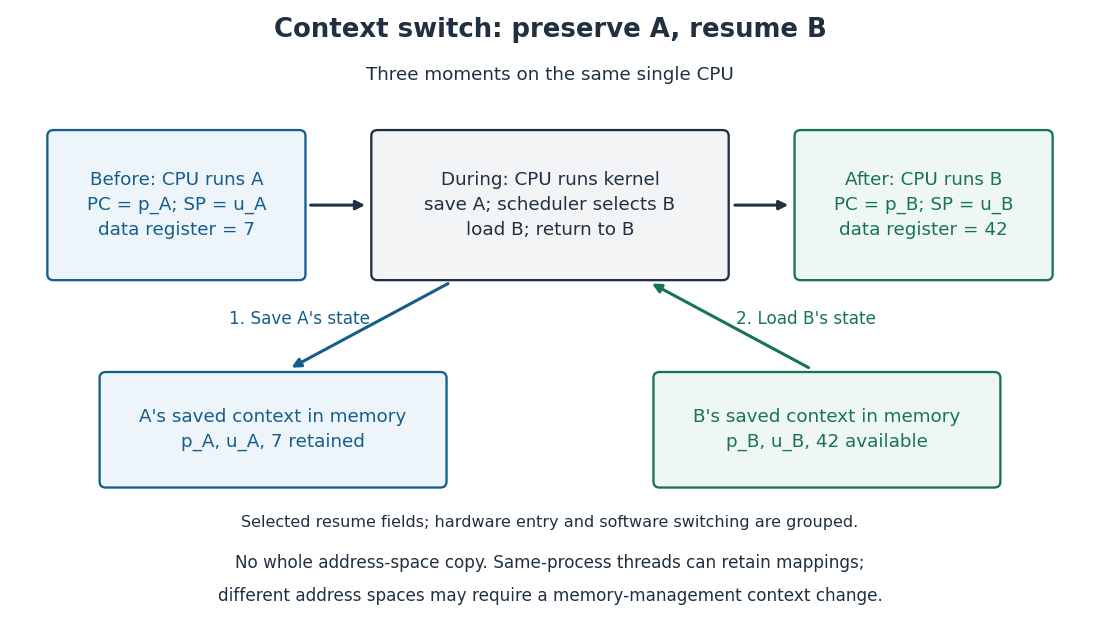
The useful invariant is that each suspended task retains its own resume state, so another task's use of the processor registers does not erase it. This is what makes repeated turns under round-robin scheduling possible. Saving an execution context does not copy the entire address space. Switching between software threads of one operating-system process can retain the same address space; switching between operating-system processes with different address spaces may also require changing the memory management unit's translation context, such as the active page table and associated address space identifier, depending on the architecture. Their contents remain in computer memory. [ref]
https://pages.cs.wisc.edu/~remzi/OSTEP/threads-intro.pdf. Remzi H. Arpaci-Dusseau and Andrea C. Arpaci-Dusseau, Operating Systems: Three Easy Pieces, chapter 26, introduction: thread contexts and shared address spaces
Entering the operating-system kernel through an interrupt, synchronous processor exception or system call does not automatically imply a context switch to another task. The handler may return to the same task; process scheduling determines whether another runnable task should take over. A context switch consumes time, and a changed memory cache or translation lookaside buffer working environment can add subsequent costs. Those costs are excluded from the toy process scheduling timelines, which are calculations rather than operating system benchmarks. [ref]
https://pages.cs.wisc.edu/~remzi/OSTEP/cpu-mechanisms.pdf. Arpaci-Dusseau and Arpaci-Dusseau, OSTEP chapter 6, section 6.3: continue the current process or switch
[ref]https://pages.cs.wisc.edu/~remzi/OSTEP/cpu-sched.pdf. Arpaci-Dusseau and Arpaci-Dusseau, OSTEP chapter 7, section 7.7: direct and indirect switching costs
David S. Miller Created 2026-10-13 Updated 2026-10-24

Portrait of David S. Miller
. James Morris. CC BY 2.0, via Wikimedia Commons. Source. Memory management unit Created 2026-10-13 Updated 2026-10-14
The hardware that performs address translation and access checks. Whether a TLB miss is resolved entirely by hardware or with operating system assistance depends on the architecture.
For paging, the memory management unit uses the active address space and the kind of access: reading, writing, or fetching an instruction. Processor privilege level can also affect permission. A TLB hit supplies cached translation attributes; it does not bypass memory protection. On a TLB miss, some architectures perform a hardware page table walk, while others enter an operating system refill handler. Both can resolve a resident mapping without a nonresident page fault.[ref]
Paging: Faster Translations (TLBs). Operating Systems: Three Easy Pieces, chapter 19, Paging: Faster Translations (TLBs), sections 19.1, 19.3–19.4, printed pp. 2, 6, 8: permission checks, refill ownership, and cached attributes
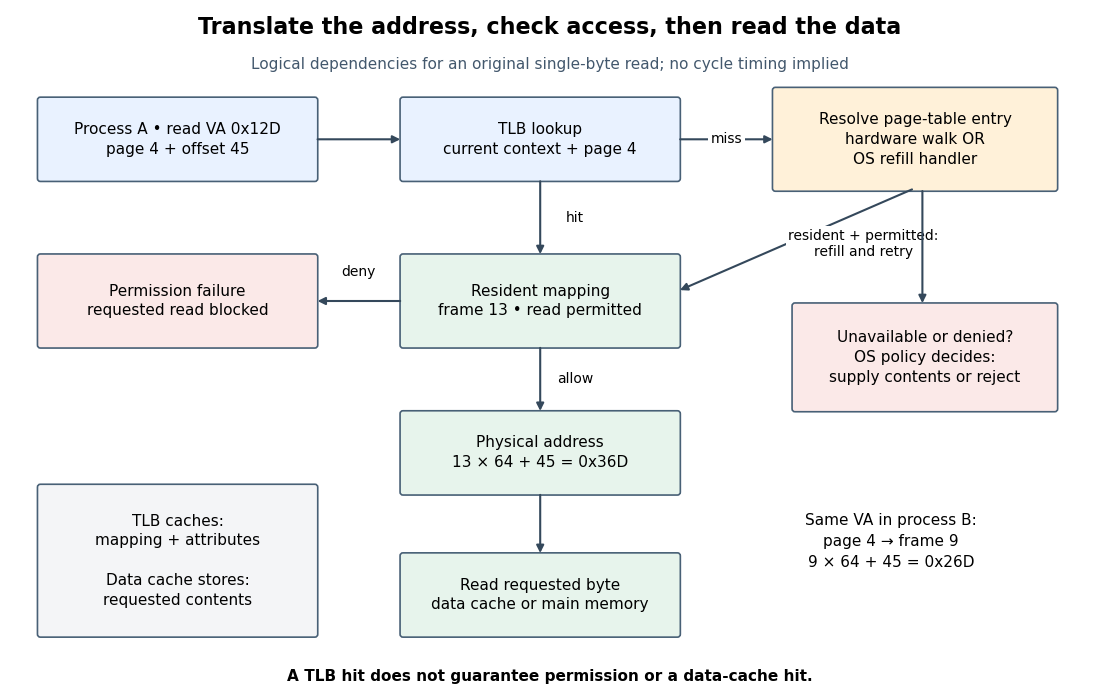
Logical address translation control path: a cached mapping, refill, permission check, and separate data read
. Details. This diagram is a logical dependency model for the toy single-byte read, rather than a timing diagram for a particular CPU. A translation lookaside buffer caches translations and access attributes; a data memory cache caches contents. A TLB hit can accompany a data cache miss, and a TLB miss can accompany a data cache hit after successful refill. Reading page table entries during refill is also distinct from reading the requested data. Actual implementations may overlap steps.
Extend process A's toy address space with these independent starting states. Virtual page 4 is resident in page frame 13 and readable but not writable. Virtual page 5 is a permitted readable memory page whose old contents are in backing storage and which is initially nonresident. Virtual page 6 has no mapping authorized by the operating system. Assume permission changes and eviction always invalidate affected cached translations before later accesses, no copy-on-write policy, and a free page frame 2 for loading virtual page 5.
- Read
0x12Dwith an empty translation lookaside buffer: a TLB miss discovers resident virtual page 4, caches its attributes, and reads physical address0x36D. There is no nonresident page fault. - Write
0x12Dwith that translation already cached: a TLB hit finds the mapping, but memory protection denies the write. The target byte remains unchanged even though its page frame is resident. - Read
0x16D: virtual page 5 and offset 45 are permitted but nonresident. A page fault lets the operating system load the contents into page frame 2, update the page table, and retry. Successful address translation then gives ; the requested read occurs only after the contents are ready. - Read
0x1AD: virtual page 6 and offset 45 have no authorized mapping. The operating system rejects the access in this model; finding a free page frame would not supply authorization.
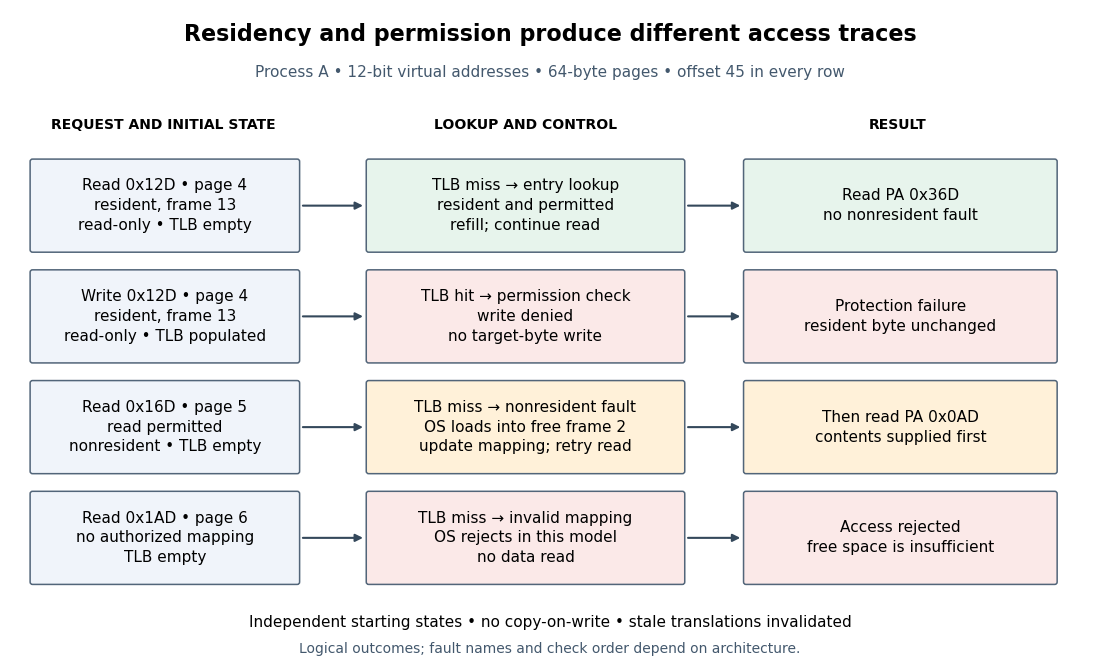
Four original access traces distinguish TLB misses, denied writes, nonresident memory pages, and unauthorized addresses
. Details. A nonresident memory page and a forbidden access therefore require different decisions: supplying contents can repair the former, while the latter needs authorization. Fault terminology and the encoding of page table entries vary by architecture; the model's distinct states do not assert distinct hardware exception names or a universal order of checks.[ref]
Beyond Physical Memory: Mechanisms. Operating Systems: Three Easy Pieces, chapter 21, Beyond Physical Memory: Mechanisms, sections 21.2–21.5, printed pp. 3–7, especially the terminology aside and Figures 21.2–21.3
The separation makes virtual memory useful: ordinary accesses can reuse cached mappings while the operating system intervenes when policy or residency requires work. It also makes failures easier to diagnose. A lost cached translation, unavailable contents, and denied permission are three different obstacles, even when all interrupt the same requested read.
Microkernel communication cost 2026-10-14
For the microkernel file-read example, distinguish system call entry/exit, security capability lookup, payload transfer, process scheduling and context switches from the service's actual file lookup and read work. Entering a privileged processor privilege level and switching to a different address space are different events. A change of address space can affect the translation lookaside buffer; running different code and touching different computer memory can cause cache misses. Neither event implies that every translation lookaside buffer entry or cache line must be discarded.
A larger copied payload requires more transfer work; sharing memory pages can avoid copying that bulk data but introduces mapping and synchronization work. A service that requests another service adds another IPC exchange. If the cached file data were absent, communication with a device driver and the input-output wait would also matter. Blocking behind other requests affects observed response time even when the individual IPC operations are cheap.
These are cost sources, not timings or a universal ranking against a monolithic kernel. Implementation and CPU details matter: the construction analysis separates protected entry costs, address space switching, translation lookaside buffer effects and memory cache effects. [ref]
On micro-kernel construction by Jochen Liedtke. Liedtke, On micro-kernel construction, section 4.1, pp. 241–244: kernel-user switches, address-space switches, and discussion of hardware-dependent cache and TLB effects
Page fault Created 2026-10-14 Updated 2026-10-14
A page fault transfers control to the operating system when an access cannot proceed under the current paging translation or protection rules. The term includes both unavailable translations and forbidden accesses on x86. Intel's manual distinguishes these causes; AMD's error code likewise distinguishes ordinary not-present faults from protection violations. Other architectural causes, including malformed page table entries, also exist. [ref]
https://cdrdv2-public.intel.com/671200/325462-sdm-vol-1-2abcd-3abcd.pdf. Intel SDM, volume 3A, section 4.7: Page-Fault Exceptions
[ref]https://docs.amd.com/api/khub/documents/sD1_QL~h4Afq2_tvzxqqSQ/content. AMD64 Architecture Programmer's Manual, volume 2, revision 3.44, section 8.4.2: Page-Fault Error Code
The illustrative page table in paging separates three situations:
- A read at virtual address
0x1434targets a permitted but nonresident memory page. The operating system may supply it and retry the access. - A write at virtual address
0x1234targets a resident, read-only memory page. The page fault is caused by missing write permission, not by missing contents. - A read at virtual address
0x1534targets an unmapped part of the address space. The operating system must reject it unless its policy authorizes creating a mapping.
A page fault is not necessarily a program error or a storage-device read. Demand paging can allocate a zero-filled page frame without reading secondary storage. A copy-on-write write deliberately encounters read-only permissions; the operating system supplies a private copy and enables the write. A truly forbidden access may instead terminate the operating-system process. The handler interprets the fault using both architectural fault information and its own mapping policy. [ref]
https://pages.cs.wisc.edu/~remzi/OSTEP/vm-complete.pdf. Arpaci-Dusseau and Arpaci-Dusseau, OSTEP chapter 23: demand zeroing and copy-on-write
For a nonresident memory page whose contents must be loaded, the handler obtains a page frame, possibly invokes page replacement, supplies the contents, updates the page table, arranges any necessary translation lookaside buffer invalidation, and resumes the operation. If no mapping or permission can legally be supplied, it reports failure. This mechanism lets ordinary accesses request work only when it becomes necessary. [ref]
Beyond Physical Memory: Mechanisms. Operating Systems: Three Easy Pieces by Remzi H. Arpaci-Dusseau and others; Arpaci-Dusseau and Arpaci-Dusseau, OSTEP chapter 21: Beyond Physical Memory, Mechanisms, sections 21.3–21.5
// Target: computer-science.bigb
Page table 2026-10-14
A page table is the data structure describing an address space's mappings from virtual page numbers to page frames, together with access and status information. A page table entry can describe a resident memory page and its permissions. Nonresident or unmapped memory pages require a representation that lets the operating system distinguish them; a hardware not-present flag alone need not make that distinction. On x86, additional operating system information determines whether a not-present mapping is legitimate. [ref]
https://pages.cs.wisc.edu/~remzi/OSTEP/vm-paging.pdf. Arpaci-Dusseau and Arpaci-Dusseau, OSTEP chapter 18, section 18.3: page-table contents and the x86 present bit
The four rows drawn under paging are an illustrative model, combining page table and operating system information: virtual page
0x12 is resident in physical frame 0x07 with read-only permission; 0x13 is resident in 0x02 with read/write permission; 0x14 is mapped read/write but nonresident; 0x15 is unmapped. The labels deliberately separate mapping policy, residency and permission. They are not a literal x86 entry layout. A translation lookaside buffer valid flag is a fourth, independent notion: it says that a cached translation can be considered, not that every resident memory page has a cached translation.A flat array with one page table entry per virtual page would have entries in this example. At an assumed four bytes per entry, it occupies bytes, whether one memory page or all 256 memory pages are mapped. A multi-level page table saves space in sparse address spaces by allocating lower-level tables only for the regions that need them. The tradeoff is extra dependent lookups during a page table walk; a translation lookaside buffer avoids repeating those lookups on a hit. [ref]
https://pages.cs.wisc.edu/~remzi/OSTEP/vm-smalltables.pdf. Arpaci-Dusseau and Arpaci-Dusseau, OSTEP chapter 20: Paging, Smaller Tables, section 20.3
Past exam of the mathematics course of the University of Cambridge 2006 ia Paper 5 7 a ii Solution Created 2026-09-24 Updated 2026-10-14
Emulate reference observations using page table protection and page faults. When resetting a page's reference state, temporarily revoke access to its resident mapping and invalidate any corresponding translation lookaside buffer entry. The first subsequent access traps. The handler recognizes an intentionally protected resident page, sets a software reference flag and restores the mapping without performing a disk read. A later CLOCK page replacement scan can use and clear this software flag.
One protection fault records the first access after each reset, rather than trapping on every access. All mappings that can access the frame must be considered. The method requires ordinary memory-protection traps, even though hardware reference bits are absent, and adds a fault cost that native reference flags avoid.
Past exam of the mathematics course of the University of Cambridge 2007 ia Paper 5 2 b Solution Created 2026-09-24 Updated 2026-10-14
Both kinds of context switch save and restore registers, a program counter, stack pointer and scheduler state. Switching between operating-system processes additionally changes the address-space and protection context, including the page-table root. Cached translations must be invalidated or distinguished by address-space identifiers, and the new process may have a different memory and cache locality.
Software threads of one process share its address space and most resources, so a thread switch normally preserves the page-table root and valid cached translations; only the execution context, stack and thread-specific state need change. Thus a process switch requires address-space management which a same-process thread switch usually avoids. Tagged translation caches can reduce the extra cost, so a complete translation lookaside buffer flush is not an inevitable feature of every process switch.
Past exam of the mathematics course of the University of Cambridge 2007 ia Paper 5 7 a Solution Created 2026-09-24 Updated 2026-10-14
A 4096-byte page has a 12-bit offset. Each 1024-entry page table needs a 10-bit index, so partition the virtual address asThe current process's page-table root points to the first-level directory. The processor first looks for a cached translation of the virtual page in the translation lookaside buffer. On a hit it checks the cached access permissions and combines the physical frame base with the unchanged byte offset.
On a miss, use bits 31--22 to select a directory entry. Its frame address identifies the relevant second-level page table. Bits 21--12 select the entry giving the data page's physical frame and permissions. With four-byte entries in the usual layout, the entry addresses are directory-base plus four times the first index, and second-level-table-base plus four times the second index. After validity and permission checks, formPopulate the translation cache so subsequent accesses avoid the two table reads. A missing or disallowed entry causes a page fault. The operating system can supply a valid absent page, update the mapping and restart the instruction, or reject a prohibited access. Table entries and processor state are protected from ordinary user modification. The address-space identifier or root-context rules prevent a cached translation from a different process being used accidentally.
seL4 verification scope 2026-10-14
Formal verification uses machine-checked formal proofs to establish functional correctness: the C implementation of verified seL4 configurations conforms to its formal specification. Binary correctness connects compiled machine code to that C behaviour where supported. Separate security formal proofs cover integrity, resource-access availability and confidentiality under their configuration requirements; these properties are not all available in every configuration. For example, the documented confidentiality theorem separates scheduler security domains rather than arbitrary pairs of software threads. [ref]
seL4 Proofs by seL4 Project. seL4 Proofs, High-level Proof Statements: Functional correctness; Binary correctness; Security; System initialisation; platform/configuration qualification
The documented assumptions include correct hardware, selected handwritten machine-interface code, correct boot state, translation lookaside buffer and memory cache management, and noninterfering or trusted DMA. The confidentiality result covers information channels in its model; the assumptions page explicitly excludes timing channels from that coverage. [ref]
What the Proofs Assume by seL4 Project. What the Proofs Assume, The Assumptions: Assembly, Hardware, Hardware management, Boot code, DMA, Information side-channels
Return to
READ(7, 9, 0, 4). Correct IPC delivery does not establish that the service looked up the right file, returned LIME, or ever replied. A service can produce an incorrect payload while the operating-system kernel exactly follows its formal specification. The formal proofs therefore do not automatically prove all user-space services, nor turn the resource-access availability theorem into a guarantee that this file read completes. The verified foundation supports further algorithm correctness and system reasoning; the service protocol and its recovery obligations still need their own justification.// Destination: computer-science.bigb
Sparse page table allocation 2026-10-14
Use the two-level address translation model and map exactly four resident virtual memory pages, numbered
0x12, 0x13, 0xa0, and 0xa1. Assign their data page frames to 0x07, 0x02, 0x05, and 0x06, respectively. Only two root indices occur: 1 and 10. Allocate exactly three table nodes: the root at 0x8000, the lower-level table for root index 1 at 0x9000, and the lower-level table for root index 10 at 0xa000. Root entries 1 and 10 reference those tables; all other root entries are absent. Lower-level entries 2 and 3 in the first table and entries 0 and 1 in the second table hold the four mappings; every other lower-level entry is absent. Use the read-only permissions already specified for virtual memory page 0x12; let the other three mappings permit user reads and writes, with no execution, and let both populated root entries permit user reads and writes.Each root index covers 16 virtual memory pages, hence bytes of the address space. A compact table node occupies bytes. The three nodes therefore require bytes of table storage, including the root and all absent entry slots in the allocated nodes. A single-level array requires bytes for the same address space, saving bytes in the compact model. Four data page frames occupy another bytes; those contents are separate from table storage.
If instead the allocator dedicates a whole 256-byte page frame to every table node, the three nodes consume 768 bytes, leaving bytes unused within those allocations. The single-level table fills four such page frames and still consumes 1024 bytes. Thus this example saves 256 bytes of allocated table storage under that alternative policy. Neither accounting includes allocator metadata, operating-system process records, or translation lookaside buffer storage; data allocations are the same in both designs.
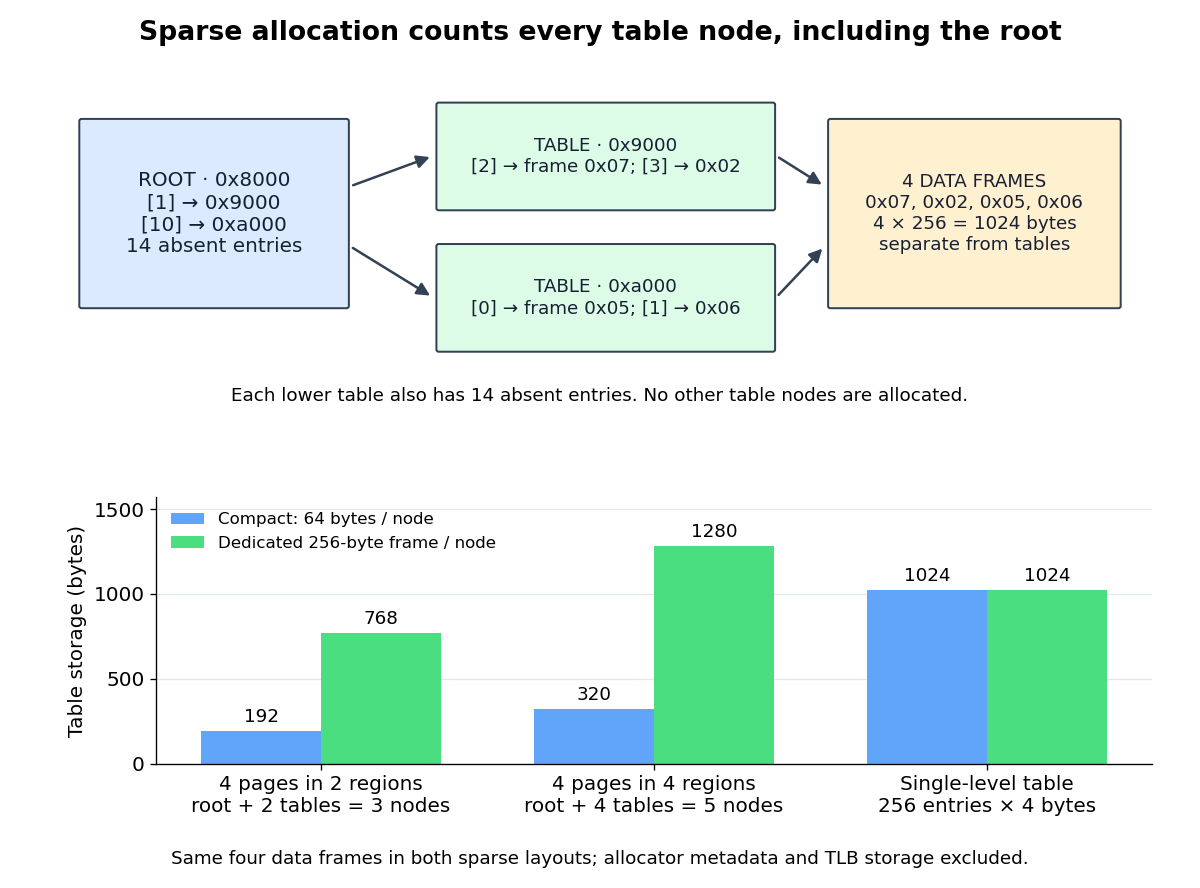
All table nodes for four mapped pages, and the footprint change when the same four pages occupy four root regions
. Details. Placement matters as well as mapping count. Four virtual memory pages
0x12, 0x42, 0x72, and 0xa2 require the root plus four lower-level tables: five nodes, 320 compact bytes, or 1280 bytes with a dedicated page frame per node. Only four data page frames are still required. Let be the number of distinct root indices represented by the mappings. With no retained empty lower-level tables, table storage is compact bytes or allocated bytes under the dedicated-page frame policy. Even an empty address space retains the root in this accounting, so costs 64 or 256 bytes.For a fully populated address space, : 17 nodes cost 1088 compact bytes or 4352 allocated bytes. The single-level table remains 1024 bytes. Sparse allocation is therefore a conditional space benefit; scattered mappings, node allocation granularity, and the root's overhead can reverse it. Additional dependent lookups on a TLB miss also have a cost, but node counts alone establish no universal execution-time ordering.
TLB miss Created 2026-10-14 Updated 2026-10-14
A lookup that fails to find the required cached address translation. A successful refill can leave the memory page resident throughout and cause no page fault.
For process A's resident virtual page 4 in address translation, discarding only its translation lookaside buffer entry makes the next read a TLB miss while its contents remain in page frame 13. Page replacement would instead remove the resident memory page; these operations invalidate different kinds of cached information.
Translation lookaside buffer Created 2026-10-14 Updated 2026-10-14
A translation lookaside buffer is a small hardware memory cache of virtual address to physical address mappings and their access attributes. A TLB hit finds a usable cached mapping for the current address space; access permissions still apply. A TLB miss means that mapping is absent from the translation lookaside buffer. It says nothing by itself about whether the memory page is resident. Evicting a translation lookaside buffer entry removes a cached translation, not the memory page's contents. [ref]
https://docs.amd.com/api/khub/documents/sD1_QL~h4Afq2_tvzxqqSQ/content. AMD64 Architecture Programmer's Manual, volume 2, revision 3.44, section 5.5: Translation-Lookaside Buffer
For the 256-byte example, a cached virtual page
0x12 to physical frame 0x07 mapping covers every offset from 0x00 to 0xff. Reads at virtual addresses 0x1234 and 0x1235 can reuse it to reach physical addresses 0x0734 and 0x0735. If the translation lookaside buffer is initially empty, the first read instead requires a page table walk; with a resident, readable mapping, it completes without a page fault. A write can fault even on a TLB hit because cached permissions deny it.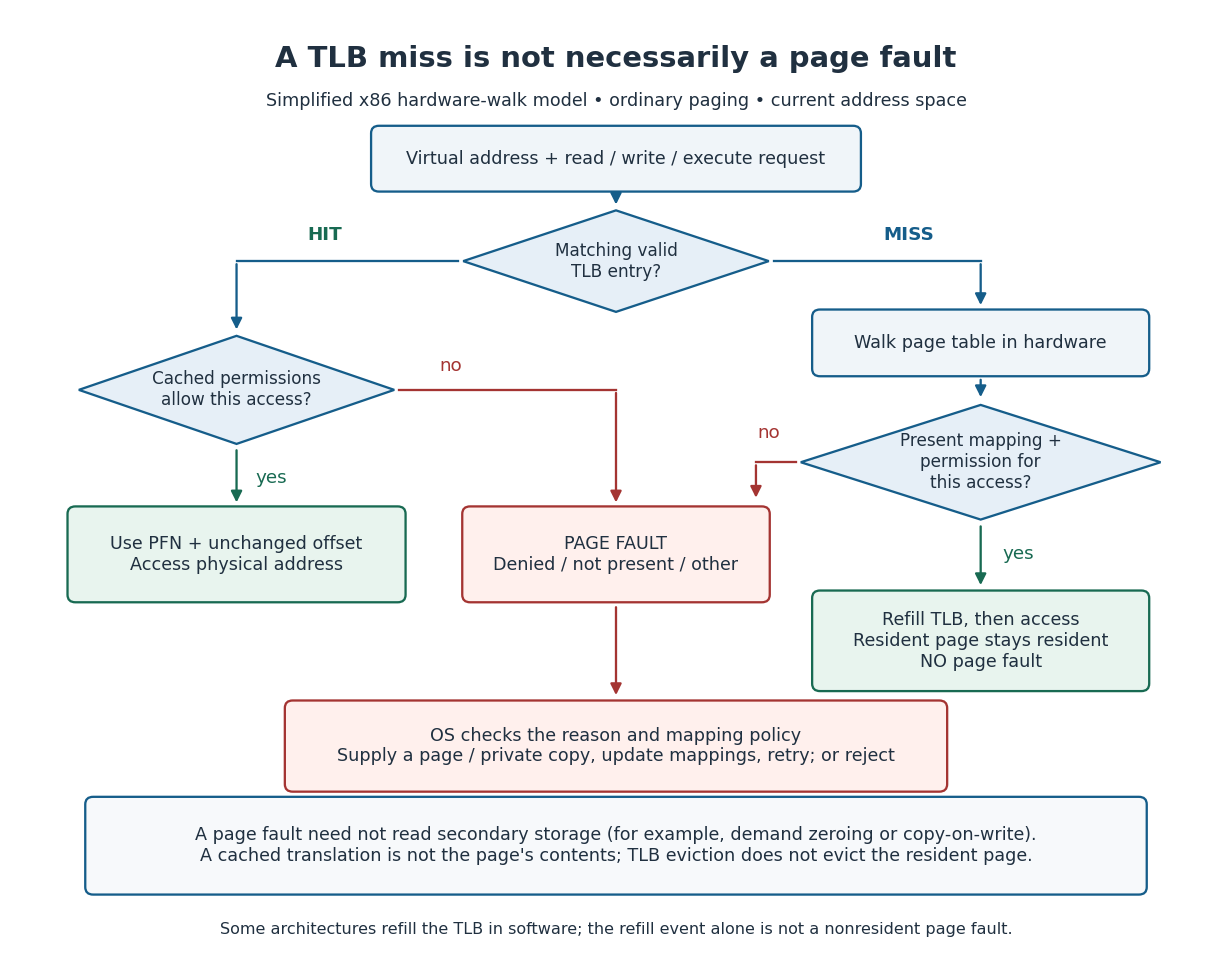
A TLB miss can refill a resident translation without a page fault; permission failures can fault on a TLB hit
. Details. The diagrams show an ordinary x86 model with hardware page table walks. Some architectures use an operating system handler to refill the translation lookaside buffer after a TLB miss; that refill event alone is not a nonresident page fault. Temporal locality helps a small translation lookaside buffer serve repeated accesses, and one entry can cover many bytes. [ref]
Paging: Faster Translations (TLBs). Operating Systems: Three Easy Pieces by Remzi H. Arpaci-Dusseau and others; Arpaci-Dusseau and Arpaci-Dusseau, OSTEP chapter 19: Paging, Faster Translations, sections 19.1 and 19.3
A context switch does not universally flush the whole translation lookaside buffer. An address space identifier can distinguish translations with the same virtual page number in different address spaces; Intel's PCIDs support retaining translations across appropriate switches. The operating system must still invalidate stale translations when mappings or permissions change, following the architecture's rules, including coordination with other processors that could use them. [ref]
Two-level address translation 2026-10-14
Choose an original teaching model with 16-bit virtual addresses, 16-bit physical addresses, and 256-byte memory pages and page frames. The eight high bits identify a virtual memory page; divide these into two four-bit indices. The eight low bits are the offset within the memory page. Thus each page table has 16 entries: the root selects a lower-level page table, and that table selects a data page frame. Every page table entry is four bytes, including its reference and flags. These are chosen model parameters, not a hardware entry encoding.
For a virtual address , extract the root index , lower-level index , and offset by Euclidean division:Here is the floor function and denotes the remainder in Euclidean division. Each index ranges from 0 to 15, and ranges from 0 to 255. In hexadecimal, virtual address
0x1234 splits into , , and ; its binary numeral system representation is 0001 | 0010 | 00110100.Fix the requested operation to be a one-byte user read. Assume both table nodes and the data page frame are resident, table reads are allowed, and no mapping changes during the page table walk. The model requires presence at both levels and takes the set intersection of the two entries' read, write, execute, and user-access permissions. This is an explicit memory protection rule for this model; Sv39 page tables use different rules. The root's physical address is
0x8000; the relevant entries are:| Record | Physical address of record | Reference held in the page table entry | Presence and permissions |
|---|---|---|---|
| Root entry 1 | 0x8000 + 1*4 = 0x8004 | Lower-level table at 0x9000 | Present; user; read/write; no execute |
| Lower-level entry 2 | 0x9000 + 2*4 = 0x9008 | Data page frame 0x07, base 0x0700 | Present; user; read-only; no execute |
The first lookup obtains a table reference, not the final data physical address. The second lookup obtains page frame number 7. Both entries permit a user read, so the original offset is added to the data page frame base:The page table walk therefore reads records at
0x8004 and 0x9008, then the requested read accesses data at 0x0734. All three are distinct physical addresses. These are two dependent table lookups followed by one data access, not a claim of three accesses to main computer memory: a memory cache can satisfy table lookups, and cached intermediate translations can skip them.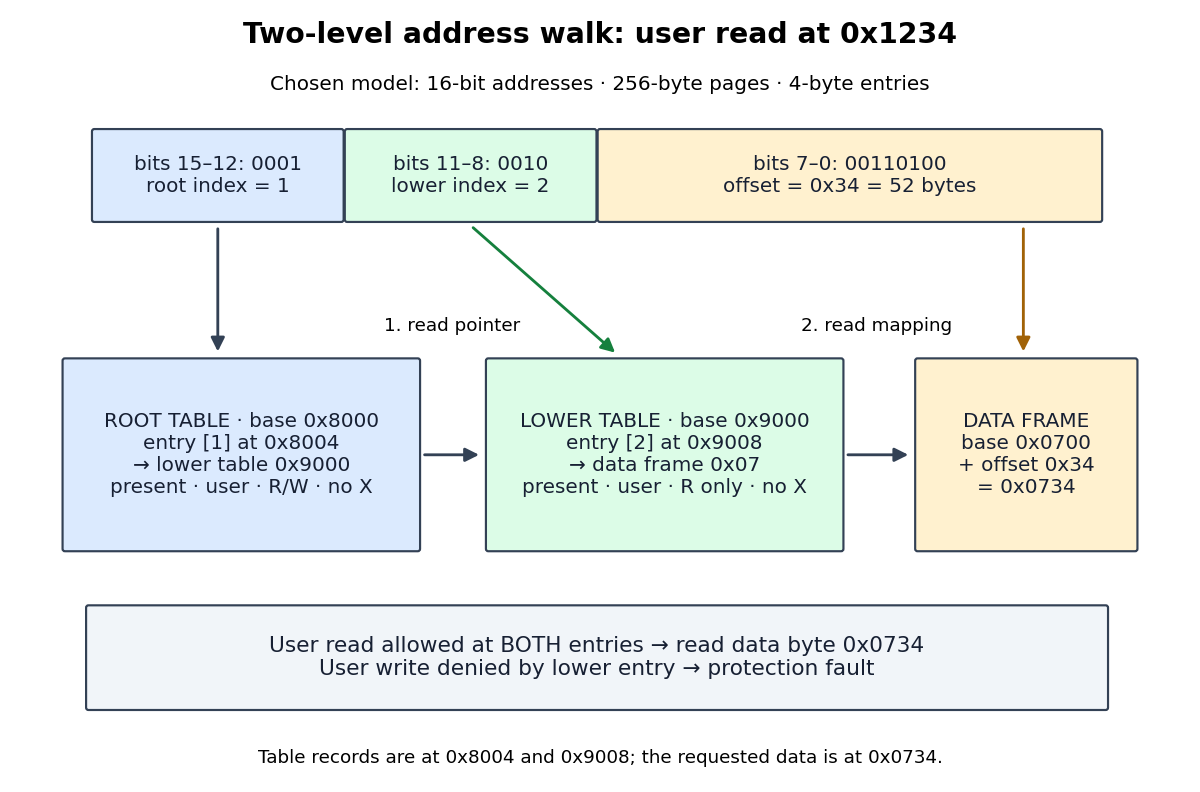


Under the same memory protection rule, a user write at
0x1234 fails because lower-level entry 2 denies writes, even though root entry 1 allows them. Clearing either entry's presence flag also prevents the access. An absent root entry stops the page table walk before any lower-level lookup. A page fault then requires the operating system to determine whether a permitted mapping needs storage or the access is invalid; absence alone does not establish demand paging eligibility.With an empty translation lookaside buffer, the permitted read causes a TLB miss and this successful page table walk, with no page fault. If the resulting mapping and permissions are cached for the current address space, a later read at
0x1235 can use a TLB hit to reach 0x0735. A later write can cause a protection page fault on a TLB hit because the cached mapping remains read-only. Assume cached permissions are current; changing them requires the architecture's prescribed invalidation. A TLB miss describes a missing cached translation, while a page fault describes an access that cannot proceed under the translation or protection rules. [ref]Page Tables by The kernel development community. MMU, TLB, and Page Faults: translation caches, page walks, and faults for missing or forbidden mappings