Consider the real matrixThe Cayley-Hamilton theorem gives . ConsequentlyThusAll four entries come from just two scalar coefficients. If , multiplying once by and replacing gives the linear recurrence relationEquivalently , with . The appearance of Fibonacci numbers is explained by , where advances the Fibonacci recurrence. No eigenvectors need to be computed.
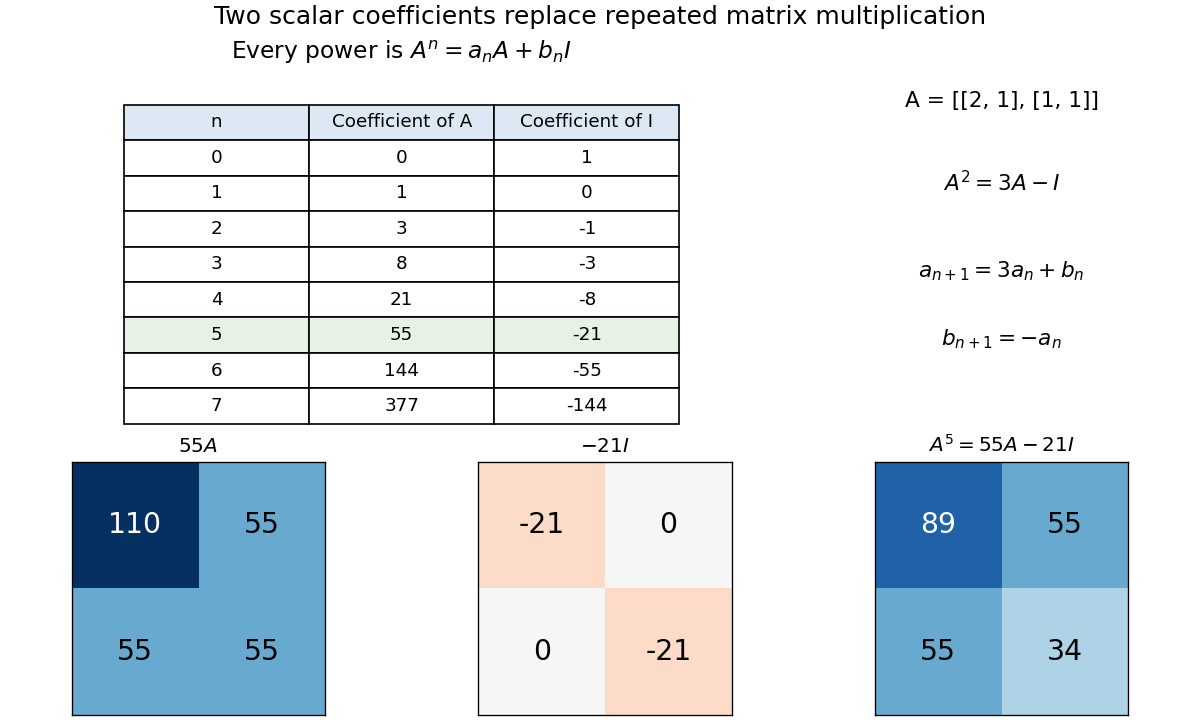
Cayley–Hamilton reduces powers of a chosen two-by-two matrix to two integer coefficients; the fifth power is 55A − 21I
. Details. 
The same identity computes an inverse. Rearrange it as , givingThis works because the constant term of this characteristic polynomial is nonzero and the coefficients lie in a field. Generally, when over a field, rearranging the Cayley-Hamilton theorem expresses as a polynomial evaluated at a matrix. Over a general commutative ring, a nonzero constant need not be a unit; invertibility requires that extra condition.
Articles by others on the same topic
There are currently no matching articles.