Every square matrix satisfies its own characteristic polynomial. More explicitly, for an -by- matrix over a commutative ring with identity, formThenHere is the zero matrix, and the constant term multiplies the identity matrix. This is a polynomial evaluated at a matrix; it is stronger than saying that each eigenvalue is a root of a polynomial. Neither diagonalizability nor distinct eigenvalues is required.[ref]
Universal Identities by Keith Conrad. §3, Theorem 3.4 and the universal-identity discussion, printed pp. 6–7: matrices over arbitrary commutative rings
The practical payoff is that arbitrarily high matrix powers can be reduced to a combination of . These powers arise when repeatedly applying a linear map, solving a linear recurrence relation, or evolving a finite state space model. The characteristic polynomial turns that repeated action into a fixed-order scalar recurrence. The minimal polynomial may reduce the number of required powers further.
For a polynomial , substitute a fixed square matrix for , taking . In particular, becomes , not with the scalar added separately to each entry. Polynomials in the same matrix commute with each other, even though arbitrary matrix multiplication is noncommutative.
Consider the real matrixThe Cayley-Hamilton theorem gives . ConsequentlyThusAll four entries come from just two scalar coefficients. If , multiplying once by and replacing gives the linear recurrence relationEquivalently , with . The appearance of Fibonacci numbers is explained by , where advances the Fibonacci recurrence. No eigenvectors need to be computed.
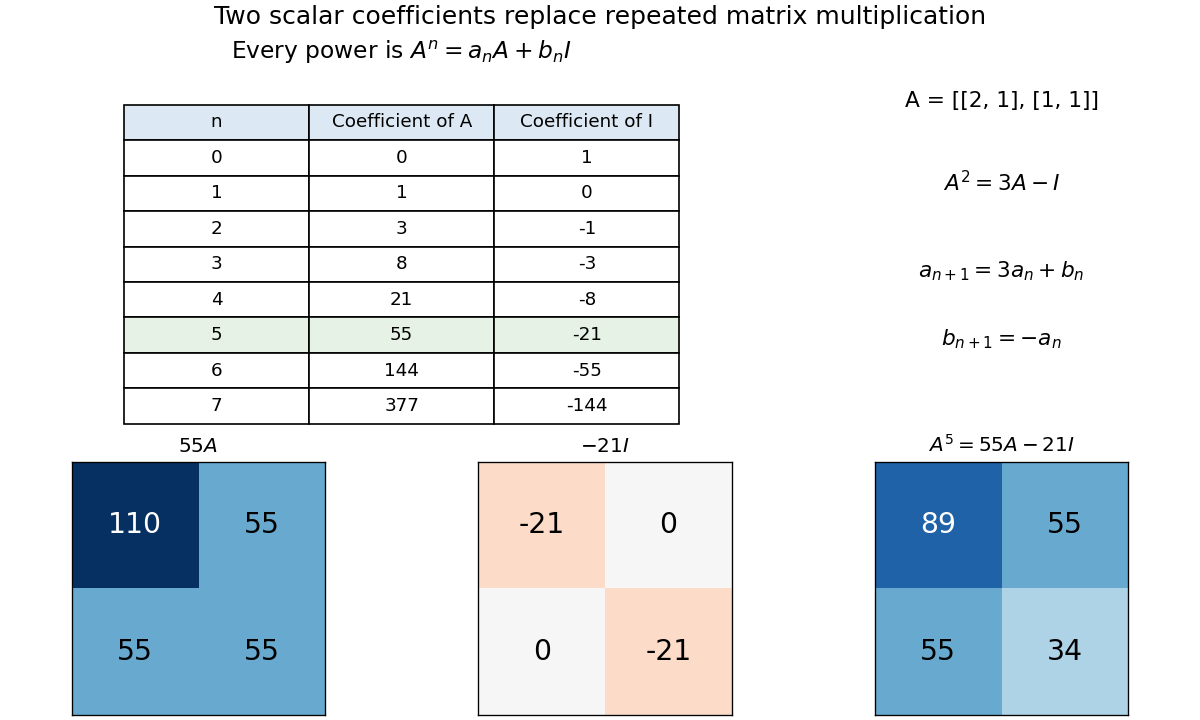
Cayley–Hamilton reduces powers of a chosen two-by-two matrix to two integer coefficients; the fifth power is 55A − 21I
. Details. The same identity computes an inverse. Rearrange it as , givingThis works because the constant term of this characteristic polynomial is nonzero and the coefficients lie in a field. Generally, when over a field, rearranging the Cayley-Hamilton theorem expresses as a polynomial evaluated at a matrix. Over a general commutative ring, a nonzero constant need not be a unit; invertibility requires that extra condition.
By polynomial division, write with . Because is a monic polynomial, this division works even over a commutative ring. Evaluating at makes the multiple of vanish, leaving . This explains the reduction in two-coefficient reduction of matrix powers without multiplying out every intermediate matrix.
Over a field, the minimal polynomial divides and gives the strongest such universal reduction: use the polynomial remainder modulo instead. For the scalar matrix , the characteristic polynomial is , while the minimal polynomial is only . Every matrix power is then a scalar multiple of .
Take a different real matrix,Its only eigenvalue is , with algebraic multiplicity two. However, the polynomial , which vanishes at that eigenvalue, gives . Merely checking values at eigenvalues cannot prove a matrix identity. The full characteristic polynomial does work:The matrix is a Jordan block, and its minimal polynomial is also .
The binomial theorem gives, for positive integers ,Terms containing or a higher matrix power vanish. After removing the common growth factor , the remaining linear map is the shear mapping . It moves to . The single eigenvalue controls the exponential scale, while the nilpotent matrix adds a factor growing linearly in .
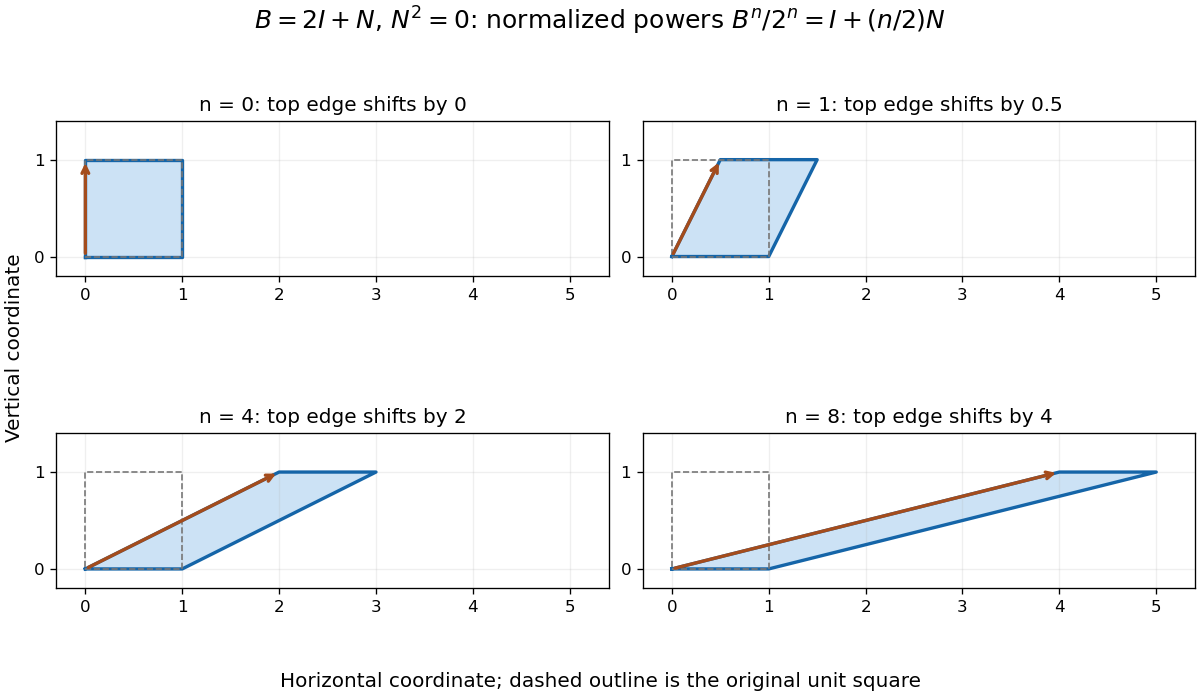
Normalized powers of a Jordan block retain a growing shear despite having only one eigenvalue; equal axes scales show the top edge moving by n/2
. Details. In terms of polynomial interpolation, reduction modulo retains both a value and a derivative:Indeed, polynomial division gives . This is a simple Hermite interpolation condition. For , it gives exactly the displayed matrix power. Repeated eigenvalues retain information about how a polynomial changes, not just where it vanishes.
Arthur Cayley's 1858 paper A Memoir on the Theory of Matrices motivates matrices as an abbreviated way to write systems of linear equations. Its opening already connects the characteristic equation with reducing polynomials in a matrix to lower degree. In §21 he works out the two-by-two identity; in §23 he says he has verified the three-by-three case but does not give a formal proof for every size. Thus this source distinguishes the general statement from a general proof.[ref]
A Memoir on the Theory of Matrices by Arthur Cayley. Printed pp. 17–18, opening motivation; pp. 23–24, §§21–25, characteristic equation and reduction of matrix functions; received 10 December 1857, read 14 January 1858, published 1858
The theorem's name also commemorates William Rowan Hamilton.Over a field, a cyclic vector gives a companion matrix, whose characteristic relation annihilates its generator and hence every iterate. If there is no cyclic vector spanning the whole space, a nonzero proper cyclic subspace is invariant. Induction annihilates the restriction and the quotient; the quotient polynomial first sends the whole space into the invariant subspace, and the restriction polynomial then kills it. The block-triangular characteristic polynomial is the product of these two polynomials.
Articles by others on the same topic



The Cayley–Hamilton theorem is a fundamental result in linear algebra that states that every square matrix satisfies its own characteristic polynomial.