The particle exchange operator swaps the complete particle slots, including spin. Its antisymmetric projector is . For orthonormal one-particle states , the normalized multiparticle quantum state isBut attempting the same construction with gives the zero vector:The zero vector cannot be normalized to a quantum state. This is exclusion as cancellation of probability amplitudes, rather than a repulsive force. More generally, for normalized the squared norm of the numerator divided by is ; the expression has unit norm only when are orthogonal. An overall quantum phase difference between describes the same one-particle state and also gives zero. Pauli explicitly connects exclusion with a vanishing antisymmetric wavefunction.[ref]
Exclusion principle and quantum mechanics by Wolfgang Pauli. p. 31, antisymmetric functions with repeated states
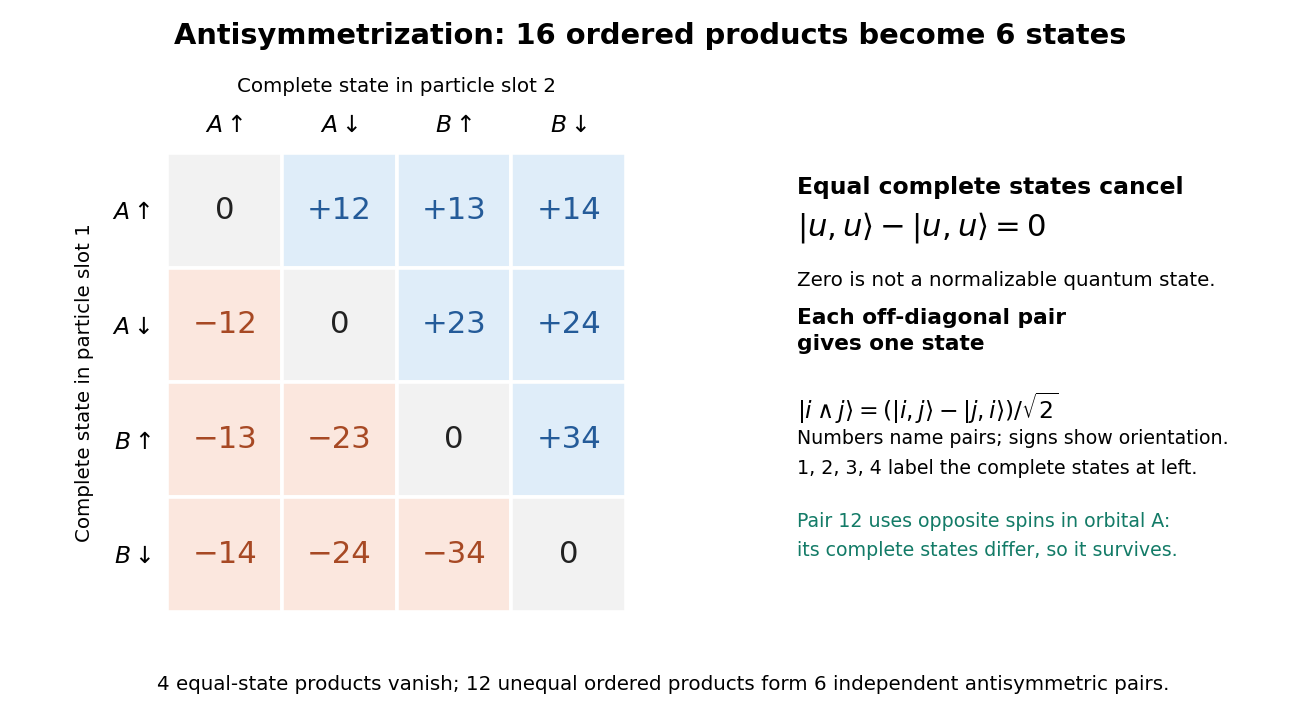
Antisymmetrization removes equal-state pairs and pairs the twelve remaining ordered products into six fermionic basis states
. Details. 
A Slater determinant extends two-particle antisymmetrization to fermions. Here contains position and spin or other internal variables. Distinct orthonormal one-particle states give the normalized wavefunction displayed in the title. Repeating a one-particle state repeats a column of the determinant, so the wavefunction vanishes. Exchanging particle slots exchanges rows and reverses its sign. A general fermionic quantum state can be a quantum superposition of Slater determinants; it need not be one Slater determinant.
Articles by others on the same topic
There are currently no matching articles.