Choose the one-particle states of a hydrogen atom, or a central-field description of a chemical atom, with labelsThe principal quantum number identifies the electron shell. The orbital angular momentum label identifies the electron subshell; the magnetic quantum number labels independent spatial orbitals. Each has two spin one-half along an axis choices, hence spin orbitals. Applying the Pauli exclusion principle once per spin orbital givesThese quantum numbers label wavefunctions and spin projections, not Electron trajectories. They need not resolve exact energy eigenstates in the presence of spin-orbit interaction; changing to coupled angular momentum eigenstates preserves the count of independent one-particle states within this shell model.
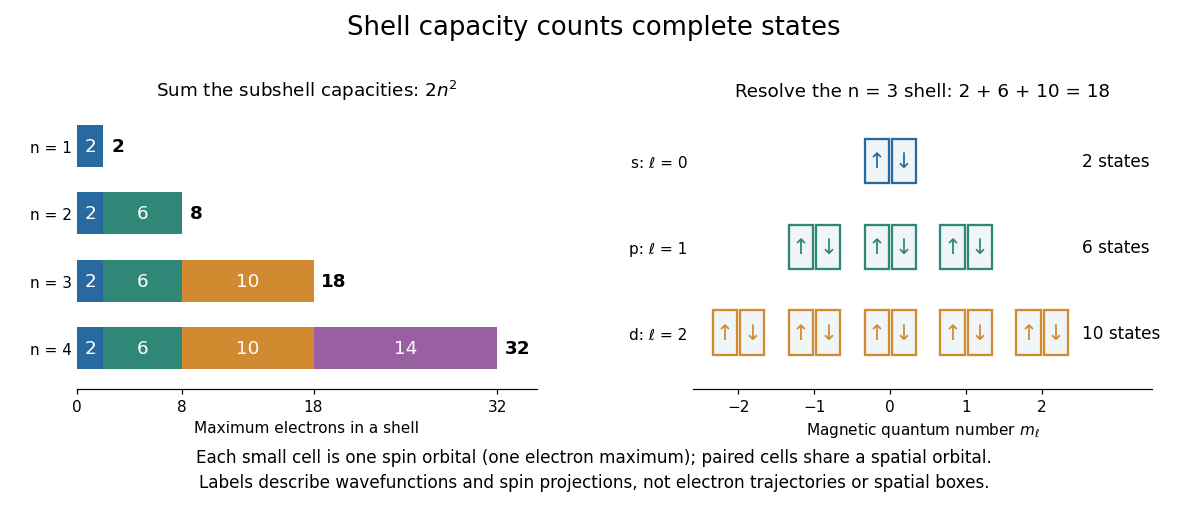

For example, allows , conventionally . Their spatial orbital counts are ; their spin orbital counts are . The sum is eighteen. The algebra behind “one per complete state” is short: two-particle antisymmetrization gives , and the zero vector cannot be a normalized quantum state. Opposite-spin Electrons in the same spatial orbital have distinct complete states, so their antisymmetric product survives.
This supplies a structural link to the periodic table: finite electron subshell capacities make repeated patterns of occupied electron configurations possible. It does not predict the exact ground state electron configuration or energy of a many-Electron chemical atom. Different electron subshells overlap in energy, and Electron interactions change their ordering. In particular, the periodic table period lengths are not simply successive values: the third periodic table period has eight chemical elements, although the full electron shell has eighteen available states. A capacity counts available spin orbitals; an actual filling order requires a Quantum Hamiltonian.
Articles by others on the same topic
There are currently no matching articles.