The ultrametric inequality, also called the strong triangle inequality, bounds a direct distance by the larger of the two distances through an intermediate point:A metric space satisfying this rule is an ultrametric space. For a Non-Archimedean absolute value, the corresponding inequality is , and the associated metric is . The ordinary triangle inequality follows because the maximum of two nonnegative real numbers is at most their sum.
For example, the 2-adic absolute value gives the three points distancesEach distance is bounded by the maximum of the other two. The two largest distances are equal: every triangle in an ultrametric space has this property. Otherwise its unique longest side would exceed the maximum of the other two, contradicting the ultrametric inequality. The drawn lengths of a triangle on paper need not represent these distances.
The ultrametric inequality gives a useful exact rule when :To see why, suppose . The upper bound is ; applying the ultrametric inequality to forces the reverse bound. Equal sizes can instead cancel: , but . This makes a uniquely largest term decisive in a sum, a principle used in the Newton polygon and in arguments about roots of a polynomial.
An ultrametric space is a metric space whose metric satisfies the ultrametric inequality. The rational numbers with , and their P-adic number completion, are examples. Their geometry organizes points into nested clusters rather than measuring separation along a number line.
For integers and , the definition of the P-adic valuation givesThus a closed ball of radius in the integers is a congruence class modulo . In the p-adic integers the same closed ball is . More shared low-order digits mean a smaller p-adic absolute value of the difference.
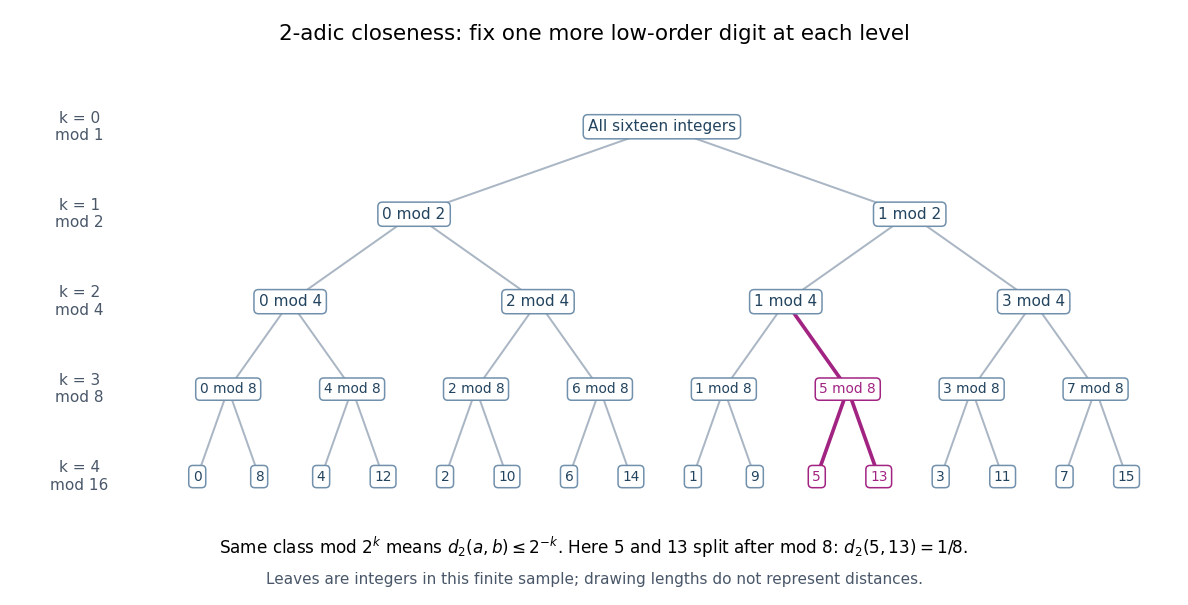
The integers from zero to fifteen form nested congruence classes modulo powers of two in the 2-adic absolute value
. Details. 
The binary tree first splits the sixteen integers into even and odd congruence classes, then refines modulo , , and . Each node fixes one more low-order digit. The leaves and share the class modulo , then separate modulo , so their distance is exactly . The leaves are deliberately ordered by their low-order digits; horizontal spacing and edge lengths are layout choices, not the metric. The singleton leaves describe this finite sample; a congruence class modulo in all p-adic integers remains infinite.
The ultrametric inequality also explains the unusual behavior of balls. Every point of an open ball can serve as its center: if , then if and only if . Two open balls that intersect are nested, since a point of their intersection serves as a common center and their radii can be compared. The same nesting rule holds for closed balls and for a pair consisting of one open ball and one closed ball.
Every open ball is a clopen set. For a point outside , the open ball stays outside : if , the ultrametric inequality forces . Hence the complement is an open set. Also every closed ball of positive radius is an open set, because lies in the closed ball of radius around whenever . A radius-zero closed ball is a singleton and need not be an open set. Distinct points can therefore be separated by a clopen set, proving that an ultrametric space is totally disconnected. These ball properties turn distance thresholds into a hierarchy of compatible clusters. [ref]
https://math.mit.edu/classes/18.785/2021fa/LectureNotes8.pdf. Andrew V. Sutherland, Number Theory I, Lecture 8, section 8.1.1
Articles by others on the same topic
There are currently no matching articles.