Fix a prime number . Write a nonzero rational number as , where and the nonzero integers are not divisible by . The exponent is uniquely determined. Its P-adic valuation is this signed exponent : equivalently, for any nonzero integer numerator and denominator ,Factors of in the numerator decrease the p-adic absolute value; factors in the denominator increase it. For the computations are:
| Rational number | Factorization | P-adic valuation | 2-adic absolute value |
|---|---|---|---|
| Not applicable | by convention |
This is an absolute value on a field measuring divisibility, rather than the magnitude on a real number number line. It satisfiesThe proof comes directly from P-adic valuations: exponents add in a product of numbers, and extracting a common power of from a sum gives . If the two P-adic valuations differ, the remaining term with smaller exponent cannot cancel modulo , so equality holds. Thus the p-adic absolute value is a Non-Archimedean absolute value. [ref]
The metric makes two rational numbers close when their difference contains a high power of . This packages successive modular congruences into a numerical error estimate, allowing convergence in a metric space and convergent series to encode exact arithmetic information.
The p-adic metric on the P-adic numbers is induced by the p-adic absolute value. Its ultrametric inequality is . On p-adic integers, digit agreement and p-adic distance expresses metric precision as shared low-order digits.
The 2-adic absolute value is the p-adic absolute value for the prime number . It is defined on the rational numbers by for and , and extends to their P-adic number completion . For a nonzero integer, count factors of two until the remaining factor is odd; for a rational number, subtract the denominator's count from the numerator's count.
The associated metric reverses a familiar comparison:Although is eight units from on the ordinary number line, it agrees with modulo , whereas already disagrees modulo . The 2-adic absolute value measures that agreement. The value also shows why this Non-Archimedean absolute value must be distinguished from the ordinary absolute value .
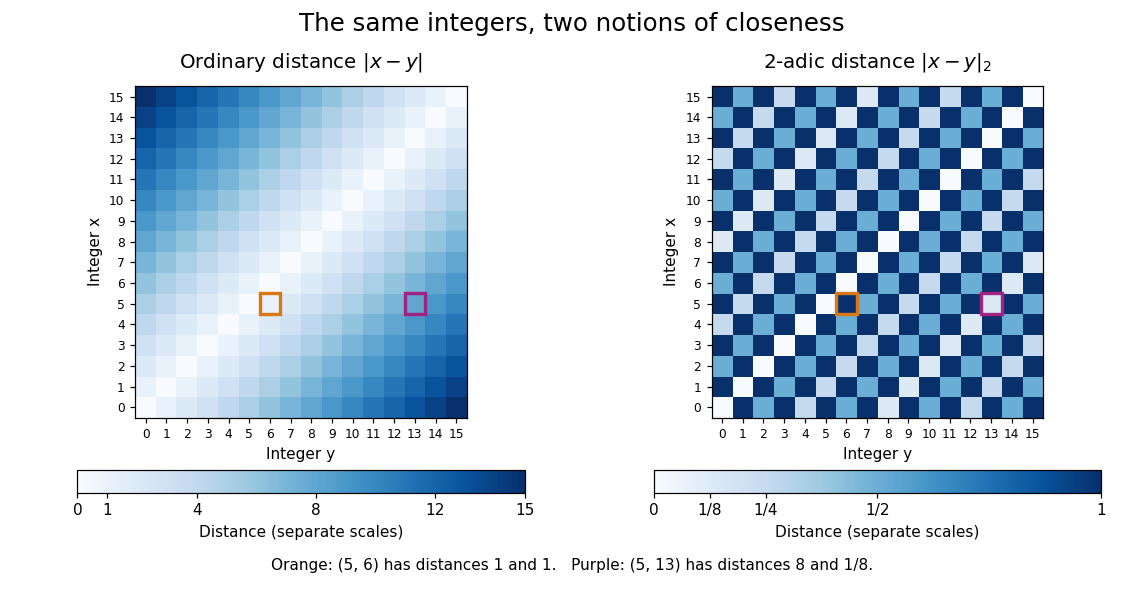
Ordinary absolute value and 2-adic absolute value give different distance patterns for the same sixteen integers
. Details. 
In the left panel, differences farther from the diagonal grow in ordinary absolute value. In the right panel, nonzero even differences are closer than odd differences, and each further factor of two halves the 2-adic absolute value. The highlighted pairs have opposite distance rankings. The repeated pattern is the nested congruence class structure of an ultrametric space, visible without adding any new points.
Every nontrivial absolute value on is equivalent either to the usual absolute value or to one -adic absolute value.
For a nontrivial Non-Archimedean absolute value on , every integer has absolute value at most one. Some prime must have value less than one, or the value would be trivial on every rational number. Two distinct such primes are impossible by a Bezout identity. Prime factorization then gives the displayed formula. Distinct primes give inequivalent topologies, since powers of tend to zero only for the -adic absolute value among these values.
The nontrivial non-Archimedean absolute values on a number field , up to equivalence, are indexed by the nonzero prime ideals of its ring of integers. The value associated with is a fixed exponential of the discrete valuation .
Articles by others on the same topic
There are currently no matching articles.