Non-Archimedean analysis studies fields whose distance is induced by an ultrametric absolute value, especially local fields and valued function fields.
The continuous functions from the p-adic integers to the P-adic numbers form a Banach space over with supremum norm . Compactness of the domain bounds the norm, and uniform convergence in the complete codomain proves completeness. Translation and the forward difference operator are bounded operators, with .
Every function in continuous functions on the p-adic integers has a unique uniformly convergent expansion in the binomial polynomials, with and . Conversely, any coefficient sequence tending to zero defines such a continuous function. To prove the expansion once is known, use for uniform convergence. Finite binomial inversion gives agreement with at each nonnegative integer, and density gives agreement everywhere. The coefficients recover successively from these integer values, proving uniqueness. Moreover , because finite differences bound each coefficient by the norm and the expansion gives the reverse inequality.
The Mahler coefficients tend to zero, so the displayed series defines a continuous function and has value zero at zero. The Pascal's identity and uniform convergence give . Thus the forward difference operator is surjective on continuous functions on the p-adic integers. Its kernel consists of constants: period one implies agreement on the dense nonnegative integers, and continuity then implies constancy. This selects the unique discrete antiderivative vanishing at zero.
There is also a direct construction on locally constant functions. If has period , put , , and . For with and , setThis is a continuous function on each residue class. Increasing gives ; at , the next point has residue zero and quotient , giving the same identity. The ultrametric inequality gives , and . The construction is independent of the chosen period, since two normalized discrete antiderivatives agree on the nonnegative integers and then on the p-adic integers by continuity. It is linear on the locally constant functions, which form a dense subset in the supremum norm. Completeness therefore extends it to every continuous function, retaining and the norm bound. This proves surjectivity without first using the Mahler theorem.
Let be linear and invariant under translation by one. For any , choose its continuous discrete antiderivative . Then . No continuity or boundedness of is assumed. In particular this applies to a form invariant under every translation by a p-adic integer.
For a continuous function , its nth Mahler coefficient isThis is the explicit iterate of the forward difference operator. These coefficients are exactly those of its Mahler expansion.
For the Mahler coefficients of a continuous function on the p-adic integers, finite binomial inversion gives . Equivalently their exponential generating function is the displayed identity in the formal power-series ring . Each coefficient involves only finitely many terms; no claim of convergence for every -adic value of is needed.
The locally constant function equal to one on and minus one on its other coset has Mahler coefficients : at nonnegative integers its values are , so the forward difference operator multiplies it by . Since and the binomial polynomials have absolute value at most one on the 2-adic integers, the series converges uniformly. The binomial theorem verifies its values on the nonnegative integers, and continuity extends the identity to the entire domain.
Approximate a continuous function on uniformly by a function constant on residue classes modulo . On this finite space, translation satisfies , so has every matrix coefficient divisible by . Hence , and the Mahler coefficients of a locally constant function tend to zero. Since , uniform approximation proves the assertion for every continuous function. This completes the coefficient-decay part of the Mahler theorem.
A non-Archimedean ordered field contains elements larger than every positive integer, equivalently positive infinitesimals smaller than every positive rational number.
An absolute value on a field is a nonnegative multiplicative function that vanishes only at zero and satisfies the triangle inequality.
For finitely many pairwise inequivalent nontrivial absolute values on a field, an element of the field can approximate independently prescribed targets in the associated completion of a valued field at each place to arbitrary positive accuracies. Equivalently the diagonal map has dense image in the finite product. Requiring finitely many inequivalent places is essential; the conclusion controls finitely many inequalities, not infinitely many independently prescribed bounds at once, or incompatible targets at one place. Weak approximation for number fields is the class-field-theoretic instance.
If two multiplicative absolute values on a field satisfy a comparison with fixed positive constants , apply it to and take th roots. Letting eliminates both constants. This stronger bounded comparison differs from equivalence merely as topologies: replacing an absolute value by its square generally preserves topology but not equality.
The metric completion of a field for an absolute value on a field is formed from Cauchy sequences modulo sequences tending to zero. Addition and multiplication extend continuously, and every nonzero completed element is invertible, so the result remains a field. The absolute value on a field extends uniquely. A place of a number field determines the corresponding completion .
Choose compatible primitive roots of unity . The partial sums form a Cauchy sequence. Each generates : for a nonidentity cyclotomic automorphism with , the first changed term has valuation , strictly below every later changed term. Thus the conjugate distance is at least . The tail bound is , strictly smaller. If the limit were algebraic, Krasner's lemma would place every one of these unbounded-degree cyclotomic fields in one finite extension, a contradiction.
The trivial absolute value on a field is zero at zero and one elsewhere. Its metric topology is discrete. Its valuation ring and residue field are both the field itself. This is why rational absolute-value classification and nontrivial discrete-value compactness criteria need a nontriviality hypothesis.
An absolute value on a field is non-Archimedean if and only if for every positive integer . Necessity follows from the ultrametric inequality. Conversely the binomial theorem gives , since every binomial coefficient has absolute value at most one. Take th roots and let . In particular an extension of an absolute value that is non-Archimedean stays non-Archimedean.
An absolute value on a field is non-Archimedean exactly when its values on the image of are bounded. The reverse implication follows by applying the ordinary triangle inequality to the binomial expansion of and taking th roots as .
The ultrametric inequality, also called the strong triangle inequality, bounds a direct distance by the larger of the two distances through an intermediate point:A metric space satisfying this rule is an ultrametric space. For a Non-Archimedean absolute value, the corresponding inequality is , and the associated metric is . The ordinary triangle inequality follows because the maximum of two nonnegative real numbers is at most their sum.
For example, the 2-adic absolute value gives the three points distancesEach distance is bounded by the maximum of the other two. The two largest distances are equal: every triangle in an ultrametric space has this property. Otherwise its unique longest side would exceed the maximum of the other two, contradicting the ultrametric inequality. The drawn lengths of a triangle on paper need not represent these distances.
The ultrametric inequality gives a useful exact rule when :To see why, suppose . The upper bound is ; applying the ultrametric inequality to forces the reverse bound. Equal sizes can instead cancel: , but . This makes a uniquely largest term decisive in a sum, a principle used in the Newton polygon and in arguments about roots of a polynomial.
An ultrametric space is a metric space whose metric satisfies the ultrametric inequality. The rational numbers with , and their P-adic number completion, are examples. Their geometry organizes points into nested clusters rather than measuring separation along a number line.
For integers and , the definition of the P-adic valuation givesThus a closed ball of radius in the integers is a congruence class modulo . In the p-adic integers the same closed ball is . More shared low-order digits mean a smaller p-adic absolute value of the difference.
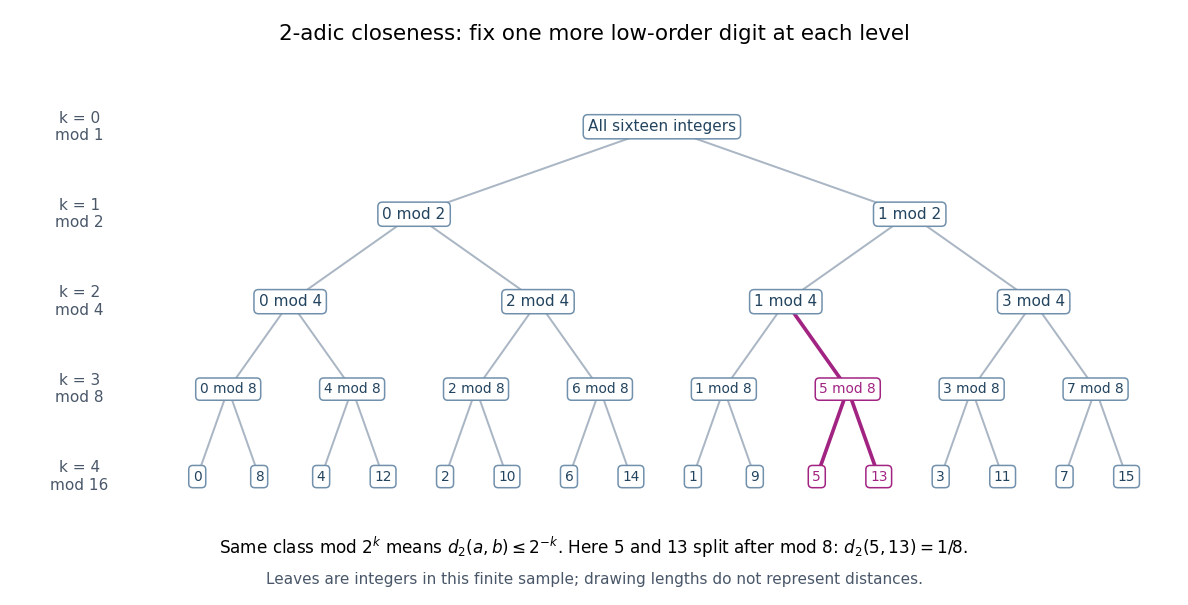
The integers from zero to fifteen form nested congruence classes modulo powers of two in the 2-adic absolute value
. Details. 
The binary tree first splits the sixteen integers into even and odd congruence classes, then refines modulo , , and . Each node fixes one more low-order digit. The leaves and share the class modulo , then separate modulo , so their distance is exactly . The leaves are deliberately ordered by their low-order digits; horizontal spacing and edge lengths are layout choices, not the metric. The singleton leaves describe this finite sample; a congruence class modulo in all p-adic integers remains infinite.
The ultrametric inequality also explains the unusual behavior of balls. Every point of an open ball can serve as its center: if , then if and only if . Two open balls that intersect are nested, since a point of their intersection serves as a common center and their radii can be compared. The same nesting rule holds for closed balls and for a pair consisting of one open ball and one closed ball.
Every open ball is a clopen set. For a point outside , the open ball stays outside : if , the ultrametric inequality forces . Hence the complement is an open set. Also every closed ball of positive radius is an open set, because lies in the closed ball of radius around whenever . A radius-zero closed ball is a singleton and need not be an open set. Distinct points can therefore be separated by a clopen set, proving that an ultrametric space is totally disconnected. These ball properties turn distance thresholds into a hierarchy of compatible clusters. [ref]
https://math.mit.edu/classes/18.785/2021fa/LectureNotes8.pdf. Andrew V. Sutherland, Number Theory I, Lecture 8, section 8.1.1
Two nontrivial absolute values on a field are equivalent when they induce the same topology. Equivalently, one is a positive real power of the other.
For a field extension , an extension of an absolute value on is an absolute value on whose restriction to is .
If is complete and is finite, an absolute value on extends uniquely to . With the normalization that it restricts exactly to the given absolute value,Every -automorphism of preserves this extended absolute value.
Let be complete for a Non-Archimedean absolute value and let be a finite-dimensional vector space with a norm satisfying and the ultrametric inequality. All such norms are equivalent to the maximum of coordinates in any basis. The upper bound is immediate. For the lower bound, induct on dimension. The span of all but the last basis vector is complete by induction, hence closed for the given norm. Thus . For , ; also . The induction bound on coordinates of now bounds all coordinates by a constant times . This proof needs no local compactness.
On a finite-dimensional vector space over , the triangle inequality gives an upper bound by a coordinate maximum norm. The coordinate unit sphere is compact. The other norm is continuous and nonzero there, so has a positive minimum. Scaling by powers of gives the lower bound. The resulting equivalence of norms in finite dimensions proves completeness of finite extensions, and applying the comparison to powers of a field element proves equality of two extending multiplicative absolute values on a field.
Suppose a Non-Archimedean absolute value extends uniquely to every finite extension. If is monic and irreducible, every root has absolute value at most one: otherwise its leading power dominates all lower terms, contradicting by the ultrametric inequality. In a splitting field, let be the minimal polynomial of an algebraic element of the residue of one root. Lift its coefficients to . The lift has absolute value less than one at that root and hence, by equal absolute values of algebraic conjugates, at every root. Consequently every root residue is a zero of . Since reduction preserves the product of the linear factors with multiplicities, every irreducible factor of is , proving the displayed identity for some .
Suppose a Non-Archimedean absolute value on has a unique extension to every finite field extension. Any K-isomorphism between conjugate roots pulls the absolute value back to an extension on the source field, which must be the given one. Thus for every . This argument includes inseparable irreducible polynomials: no transitive Galois action or completeness assumption is needed.
Let be complete for a discrete valuation and let be finite. The valuation ring is exactly the integral closure of in . One direction follows from a monic integral equation; for the other, the coefficients of the minimal polynomial are elementary symmetric polynomials in conjugates of absolute value at most one.
If is a finite normal extension, the Galois group acts transitively on the absolute values of extending a fixed absolute value of . For number fields, this is equivalent to transitivity on the prime ideals above a fixed prime.
Give its -adic valuation, take , and choose the extension associated with the prime . Then lies in the chosen valuation ring but has negative valuation at the conjugate prime. It is therefore not in the integral closure of in .
If is a finite separable extension and is an absolute value on , the extensions of to correspond to the irreducible factors of the minimal polynomial of over the completion of at .
This polynomial is Eisenstein at . Over , its Newton polygon has a single slope , so it is irreducible and a root generates a totally ramified extension of degree five. Over , its factor degrees are : the simple residue roots lift, and the remaining roots have valuation . Thus the degree-five number field generated by a root has one prime above and three above .
For a finite extension of number fields and a nonzero prime ideal of , the primes of above correspond to the orbits ofAn embedding determines a prime by pulling back the local absolute value on a field. Embeddings with the same prime extend to embeddings of the same completion and are conjugate. If , these orbits are the irreducible factors of its minimal polynomial over .
For a number field and a nonzero prime ideal , the completion is the completion for the -adic absolute value. It is a finite extension of , where .
For a number field and a rational prime , the natural diagonal map gives an isomorphism of -algebras
If is a finite Galois extension of number fields, its Galois group acts transitively on the prime ideals of lying above a fixed prime ideal of .
For a finite Galois extension of number fields, choose a nonzero residue field generator at and lift it to an integral element whose residues at the other primes above are zero, using the Chinese remainder theorem. The orbit polynomial has coefficients in the base ring of integers. Modulo , its nonzero roots are precisely the orbit of under the decomposition group. Its coefficients belong to , so finite-field Frobenius automorphism permutes these roots. Consequently some decomposition-group element acts as Frobenius on the generator, and therefore on the entire residue field. Frobenius generates the finite-field Galois group, proving surjectivity.
Let be a finite Galois extension, , and the decomposition group of a prime above . The bijectionfollows from transitivity on primes for both and .
If is the Galois closure of a finite extension , a prime splits completely in exactly when it splits completely in . Complete splitting means every right action of on fixes each coset, so lies in the subgroup core of . That core is trivial because the conjugates of generate .
Restriction to completions gives a canonical isomorphismConsequently the number of primes above is the index of the decomposition group.
For a prime of a finite separable extension above , completion preserves the ramification index and residue-field extension:
The polynomialsplits into three linear factors over . Over it is an Eisenstein polynomial, so adjoining a root gives a totally ramified cubic extension. Its splitting field over has decomposition group and inertia group .
A Hahn series over a field with exponents in an ordered abelian group is a formal sum whose nonzero exponents form a well-ordered set. Such series form the Hahn series field.
For an ordered abelian group , the Hahn series field consists of formal sums with well-ordered support in . The least exponent defines a valuation with value group .
For a prime number , a p-adic number is an element of the field obtained by completing the rational numbers for the metric . Here is the p-adic absolute value. The Cauchy-sequence construction of a metric completion supplies limits for every Cauchy sequence, and addition, multiplication, and the p-adic absolute value extend to this complete metric space. The rational numbers form a dense subset. [ref]
For a concrete example with , consider the partial sums of a geometric series:The first values have distances from in the 2-adic absolute value. ConsequentlyThis is a statement about convergence in a metric space with the 2-adic absolute value. In the ordinary real number absolute value, the same partial sums grow without bound. Choosing a metric changes which approximation errors shrink.
More generally every nonzero P-adic number has a unique digit expansionOnly finitely many negative powers occur, while positive powers can continue indefinitely. Written with the highest powers on the left, the digits extend infinitely to the left; for example the P-adic number at is written . The p-adic integers are exactly the elements with , whose digit expansions use only nonnegative powers. [ref]
https://math.mit.edu/classes/18.785/2021fa/LectureNotes8.pdf. Andrew V. Sutherland, Number Theory I, Lecture 8, section 8.2, Proposition 8.17
The construction can be understood through modular arithmetic. Successively choose the low-order digits to agree modulo , , and higher powers. After fixing digits below , the remaining error has p-adic absolute value at most ; the partial sums form a Cauchy sequence, so completeness supplies a limit. If two expansions first differ at position , their difference has P-adic valuation , proving uniqueness. This turns compatible finite congruence classes into one exact number. In particular, Hensel's lemma upgrades suitable approximate roots of a polynomial modulo powers of into roots in the p-adic integers.
A 3-adic number belongs to the completion of for the p-adic absolute value with prime three. Its nonzero elements have the form , with and . The cube-class group of the 3-adic numbers is generated by the classes of and .
Fix a prime number . Write a nonzero rational number as , where and the nonzero integers are not divisible by . The exponent is uniquely determined. Its P-adic valuation is this signed exponent : equivalently, for any nonzero integer numerator and denominator ,Factors of in the numerator decrease the p-adic absolute value; factors in the denominator increase it. For the computations are:
| Rational number | Factorization | P-adic valuation | 2-adic absolute value |
|---|---|---|---|
| Not applicable | by convention |
This is an absolute value on a field measuring divisibility, rather than the magnitude on a real number number line. It satisfiesThe proof comes directly from P-adic valuations: exponents add in a product of numbers, and extracting a common power of from a sum gives . If the two P-adic valuations differ, the remaining term with smaller exponent cannot cancel modulo , so equality holds. Thus the p-adic absolute value is a Non-Archimedean absolute value. [ref]
The metric makes two rational numbers close when their difference contains a high power of . This packages successive modular congruences into a numerical error estimate, allowing convergence in a metric space and convergent series to encode exact arithmetic information.
The p-adic metric on the P-adic numbers is induced by the p-adic absolute value. Its ultrametric inequality is . On p-adic integers, digit agreement and p-adic distance expresses metric precision as shared low-order digits.
The 2-adic absolute value is the p-adic absolute value for the prime number . It is defined on the rational numbers by for and , and extends to their P-adic number completion . For a nonzero integer, count factors of two until the remaining factor is odd; for a rational number, subtract the denominator's count from the numerator's count.
The associated metric reverses a familiar comparison:Although is eight units from on the ordinary number line, it agrees with modulo , whereas already disagrees modulo . The 2-adic absolute value measures that agreement. The value also shows why this Non-Archimedean absolute value must be distinguished from the ordinary absolute value .
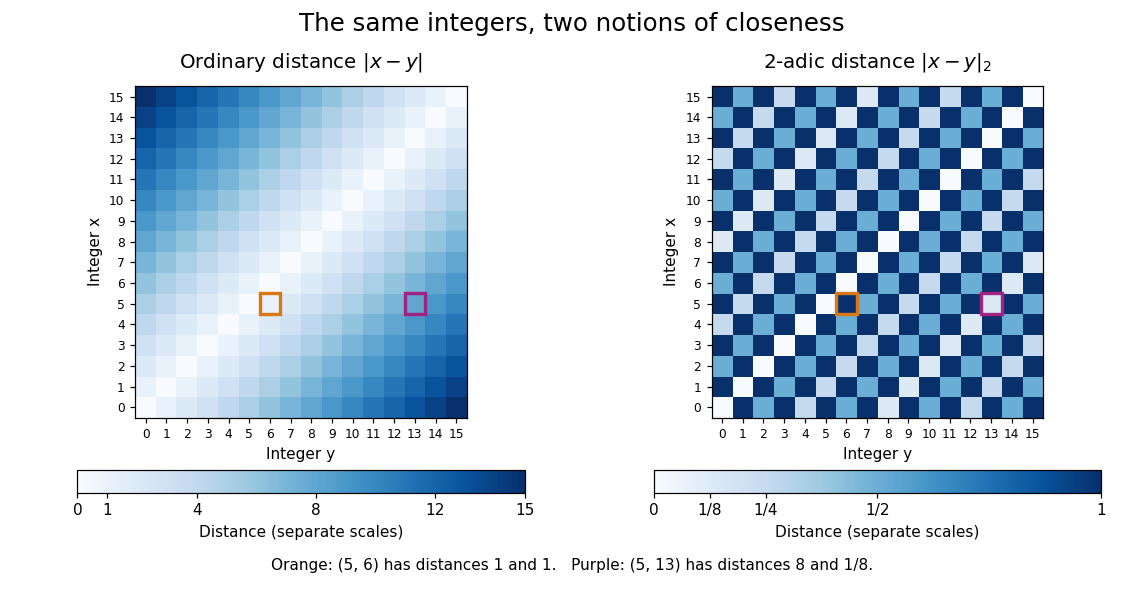
Ordinary absolute value and 2-adic absolute value give different distance patterns for the same sixteen integers
. Details. 
In the left panel, differences farther from the diagonal grow in ordinary absolute value. In the right panel, nonzero even differences are closer than odd differences, and each further factor of two halves the 2-adic absolute value. The highlighted pairs have opposite distance rankings. The repeated pattern is the nested congruence class structure of an ultrametric space, visible without adding any new points.
Every nontrivial absolute value on is equivalent either to the usual absolute value or to one -adic absolute value.
For a nontrivial Non-Archimedean absolute value on , every integer has absolute value at most one. Some prime must have value less than one, or the value would be trivial on every rational number. Two distinct such primes are impossible by a Bezout identity. Prime factorization then gives the displayed formula. Distinct primes give inequivalent topologies, since powers of tend to zero only for the -adic absolute value among these values.
The nontrivial non-Archimedean absolute values on a number field , up to equivalence, are indexed by the nonzero prime ideals of its ring of integers. The value associated with is a fixed exponential of the discrete valuation .
A local field is a nondiscrete locally compact topological field. A non-Archimedean local field is a finite extension of or of .
A p-adic field is a finite extension of the P-adic number field , equipped with its extended p-adic absolute value. Conversely every characteristic-zero, nontrivially valued, non-Archimedean locally compact field is such an extension. A finite quotient supplies finitely many generators of over by repeated reduction and completeness.
An integral lattice in a finite-dimensional -vector space is a free -submodule of full rank. Any two such lattices are commensurable: their intersection has finite index in each, because a sufficiently large power of multiplies either into the other. A finite group acting on the space admits invariant lattices by taking a sum of translates. This allows Herbrand quotient comparisons via finite quotient modules.
The degree of the residue field extension induced by a finite extension of complete discretely valued fields. Along with the ramification index, it satisfies . An unramified extension additionally has separable residue extension; a totally ramified extension has residue degree one.
The absolute residue degree is the degree of the residue field over its prime field. For a tower above , degrees multiply: . In a Galois extension over , the decomposition group has a cyclic quotient group of this order by its inertia group. This can exclude residue degrees even when the whole extension has that degree: has no cyclic quotient group of order six.
A complete field with a nontrivial Non-Archimedean absolute value is locally compact exactly when its valuation is discrete and its residue field is finite. In that case its valuation ring is the inverse limit of the finite rings and is compact. The nontrivial valuation in the local compactness criterion is essential.
Let a nontrivially valued local field have compact valuation ring , and choose any with . The quotient is finite. A fixed set of representatives containing zero gives every field element a unique convergent digit expansion, with finitely many nonzero negative-index terms. Recursive reduction modulo gives existence; comparing the first differing digit modulo this ideal gives uniqueness. The element need not be a uniformizer.
In a locally compact nontrivially valued field, the valuation ring is compact. A Cauchy sequence has a tail inside a translate of this compact set, hence a convergent subsequence. The Cauchy property forces the full sequence to converge.
For a locally compact field with a nontrivial Non-Archimedean absolute value, scaling a compact neighborhood makes its valuation ring compact. Its open maximal ideal gives a finite discrete residue field, so that ideal is also closed and compact. A nonzero element of maximal absolute value in the ideal generates it. Successive division by this uniformizer makes the value group discrete.
An infinite field with the trivial absolute value on a field is discrete, hence locally compact, but its residue field is the original infinite field. Thus local compactness forces a finite residue field and a discrete nontrivial value group only when the valuation is assumed nontrivial.
If a non-Archimedean local field has uniformizer , valuation ring , maximal ideal and residue field , thenThe first factor records the discrete valuation, the Teichmuller representatives split reduction , and is the group of principal units.
The groups form a compact-open neighbourhood basis at one inside the units of a non-Archimedean local field. A smooth character trivial on but nontrivial on cannot have a nonzero fixed vector under for . This elementary conductor comparison controls admissibility and smooth duals of direct sums.
If is finite of degree , then as a topological abelian groupwhere is the finite group of all roots of unity in whose orders are prime powers dividing a power of .
For a complete discrete valuation ring , a simple root of a polynomial modulo the maximal ideal lifts uniquely to a root in .
A monic polynomial over a complete discrete valuation ring factors with prescribed coprime monic residue factors. Given monic lifts correct modulo , the degree-bounded map is a bijection over the residue field, by coprimality and equality of dimensions. Solve it for the error , and replace the lifts by . Their coefficients converge by completeness and the limiting product is . The completeness assumption cannot be replaced just by localization.
For a complete discrete valuation ring , let and let be a unit. If , choose modulo solving and put . Taylor expansion gives . The sequence is Cauchy and its limit is a root. If two roots lift the same residue, factoring leaves times a unit, proving uniqueness.
Suppose a Non-Archimedean absolute value on has a unique extension of an absolute value to every finite extension. Factor a monic into monic irreducible factors over . All factors have integral coefficients because their roots have absolute value at most one. By pure-power reduction of a monic irreducible polynomial, each factor reduces to a power of a single irreducible polynomial. If is a coprime monic factorization, assign each whole irreducible factor of , with its multiplicity, to the unique side containing its residue factor. The resulting monic satisfy and reduce to the prescribed factors. Completeness of is not required for this proof.
For a non-Archimedean local field , an element of is an th power for infinitely many positive integers exactly when it belongs to . Valuations prove necessity; for sufficiency, choose infinitely many coprime to the residue characteristic and to , for which exponentiation by is an automorphism of the unit group.
The polynomial has three irreducible factors over , of degrees one, one, and two. Its quadratic in has one unit root congruent to one modulo eight, hence a square, and one root of valuation one, whose associated quadratic factor is Eisenstein.
Let be complete for a discrete valuation . If andthen Newton iteration over a valued field converges to a root with .
Starting from , Newton iteration sets . Under the strong form of Hensel lemma inequality, the correction valuations grow at least geometrically, so is a Cauchy sequence converging to a root.
Let be complete, let be separable over , and let be algebraic over . If is closer to than any other -conjugate of , then
Let be a finite Galois extension of a field complete for a Non-Archimedean absolute value. Suppose is uniquely closest to among the roots of a polynomial over lying in . Every element of preserves absolute values on a field and permutes these roots. It sends to an equally close root, hence fixes . The Fundamental theorem of Galois theory gives . The converse inclusion need not hold: for roots , the element is uniquely closest to zero but does not belong to .
A p-adic field has only finitely many extensions of a fixed degree up to isomorphism. There are finitely many possible residue degrees and a unique unramified extension of each such degree. Over each maximal unramified subfield, a totally ramified extension is generated by a root of an Eisenstein polynomial. The coefficient space of these polynomials of fixed degree is compact. Hensel lemma and Krasner's lemma show that sufficiently close polynomials generate isomorphic extensions, giving a finite cover by neighborhoods of a constant extension type.
The roots of a separable polynomial over a complete non-Archimedean field vary continuously with its coefficients after the roots are suitably matched. In particular, a sufficiently close coefficientwise approximation has one root in each sufficiently small disjoint ball around an original root.
Every finite extension of is isomorphic to the completion of some number field at a prime above . Approximate a primitive element's minimal polynomial by a polynomial over and use Krasner's lemma to preserve the generated local field.
The completion of an algebraic closure of is an algebraically closed field. Approximate a polynomial over by one over , use continuity of roots over a non-Archimedean field to obtain a nearby algebraic root, and then use Krasner's lemma to show that the original root already belongs to .
Over a complete local ring, a power series whose first unit coefficient has index is a unit times a unique monic distinguished polynomial of degree . Consequently its sufficiently small zeros, counted with multiplicity, are the zeros of that polynomial.
A distinguished polynomial over is monic and has every non-leading coefficient divisible by . The Weierstrass preparation theorem expresses any nonzero element of as a power of times a unit times a distinguished polynomial.
The Laurent series field consists of formal series with finitely many negative-degree terms. Its -adic valuation is the least exponent with nonzero coefficient.
For arbitrary positive integers , the displayed extension has degree , ramification index , and residue degree . If , its unique extended absolute value on a field is . A basis consists of , where the form an basis of and . Regrouping a Laurent series by its exponent modulo proves the basis assertion. When divides the extension can be inseparable; the valuation calculation still applies.
A finite extension of the complete discretely valued field has residue field , hence is totally ramified. If is its uniformizer, write . A root of the residue of lifts by Hensel lemma to an th root of , since the residue characteristic is zero. Then satisfies . Distinct valuations modulo make linearly independent over the base, so . Expanding in with constant coefficients identifies it with . Its automorphisms are , giving a cyclic Galois group.
Inside an algebraic closure, choose compatible roots . The fields exhaust all finite extensions by finite extensions of the complex Laurent series field. Restriction from a degree- field to a degree- field for sends an exponent modulo to its reduction modulo . The absolute Galois group is their inverse limit, namely the profinite completion of . This is a procyclic group, rather than the direct-limit torsion group of all complex roots of unity.
For an irreducible polynomial of degree , the -adic completion of is isomorphic to . Its residue field is and is a uniformizer.
The -adic exponential converges near zero.
On , the power series has radius of convergenceIndeed, Legendre formula gives , and the Cauchy-Hadamard theorem gives the stated radius.
The -adic logarithm is the convergent series on a sufficiently small group of principal units.
It is locally inverse to the p-adic exponential function.
It is locally inverse to the p-adic exponential function.
For a mixed-characteristic local field with residue characteristic , the p-adic logarithm and p-adic exponential function are mutually inverse continuous group homomorphisms on these domains. Bounds on the valuations of the denominators show that higher terms have greater valuation than the linear term. Dividing the logarithm by identifies the multiplicative higher principal-unit group with the additive integer ring; in particular it is torsion-free.
The Teichmuller character sends a nonzero residue class to its unique root-of-unity lift in the valuation ring.
The Teichmuller representative of a nonzero residue class is the unique lift satisfying and modulo the maximal ideal.
For a prime and , the unique residue modulo satisfying and is the displayed residue. Existence follows from Fermat's little theorem and prime-power contraction under pth powers. Uniqueness follows by raising any other such residue repeatedly to the th power and applying the same contraction to its congruence with . This is the finite-modulus version of a Teichmuller representative, including the zero class.
For finite, let in its finite residue field, and choose arbitrary lifts . With normalized discrete valuation,Applying this binomial estimate repeatedly to and proves the displayed bound, and hence convergence to .
For residue field , these two properties characterize the Teichmuller lift on every residue class, including zero. The Hensel lemma applies to , whose derivative reduces to . Uniqueness implies , , , and . In mixed characteristic this multiplicative section need not be additive.
If is a complete discretely valued field whose residue field is a perfect field, and is a uniformizer, the multiplicative Teichmuller lift gives each a unique expansion
If a complete discretely valued field has positive characteristic and perfect residue field , its Teichmuller lift is the unique ring section . A choice of uniformizer then gives
For a characteristic-p local field with residue field , the simple roots of lift uniquely by Hensel lemma. Their lifts form a copy of , since qth powers preserve addition and multiplication. Choose a uniformizer . Repeatedly subtracting the lifted residue and dividing by produces a unique convergent expansion for each integral element. Allowing finitely many negative powers gives a valued-field isomorphism , .
Articles were limited to the first 100 out of 216 total.
Articles by others on the same topic
There are currently no matching articles.