For a bilinear map , there is exactly one linear map satisfying . Equivalently, , where . The universal property of a tensor product concerns the vector space together with this distinguished bilinear map.[ref]
Linear Algebra Done Right by Sheldon Axler (4th edition). §9D, Theorem 9.79(a), printed p. 375: unique linear factorization
Here is a complete calculation over the real numbers. Define the bilinear mapIts values on pairs of basis vectors determine on the four tensor-product basis elements:Consequently, for ,For and , the direct calculation gives . Using the expansion of instead gives . The linear map also handles a nonseparable tensor such as : , even though no single pair has .
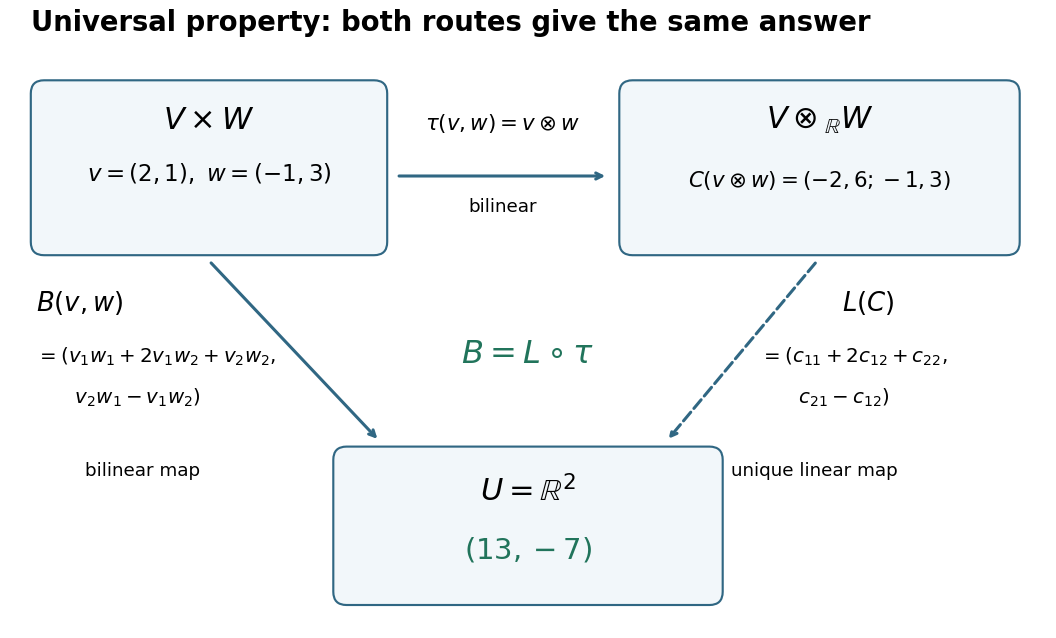

A short proof uses a tensor-product basis: assign and extend by linearity. Expanding both inputs verifies by bilinearity; the assigned values on a basis force uniqueness. More generally, every multilinear map factors uniquely through a linear map from . This lets formulas involving several inputs define linear maps without choosing coordinates; tensor contraction uses the evaluation pairing between a vector and a covector.
Articles by others on the same topic
There are currently no matching articles.