If and are bases of finite-dimensional vector spaces over , then the products form a basis of . There is one independent coordinate for every pair of indices.[ref]
Linear Algebra Done Right by Sheldon Axler (4th edition). §9D, Theorems 9.72 and 9.74, printed pp. 372–373: dimension and tensor-product basis
For a proof outline, bilinearity expands each pure tensor asso these products form a spanning set. For linear independence, take the coordinate functionals from the two dual bases. The bilinear map induces a linear functional on the tensor product, satisfying . Applying it to a proposed zero linear combination selects just , forcing every coefficient to vanish. Thus dimensions multiply, rather than add. This finite-dimensional count includes a zero factor, whose tensor product has dimension zero.
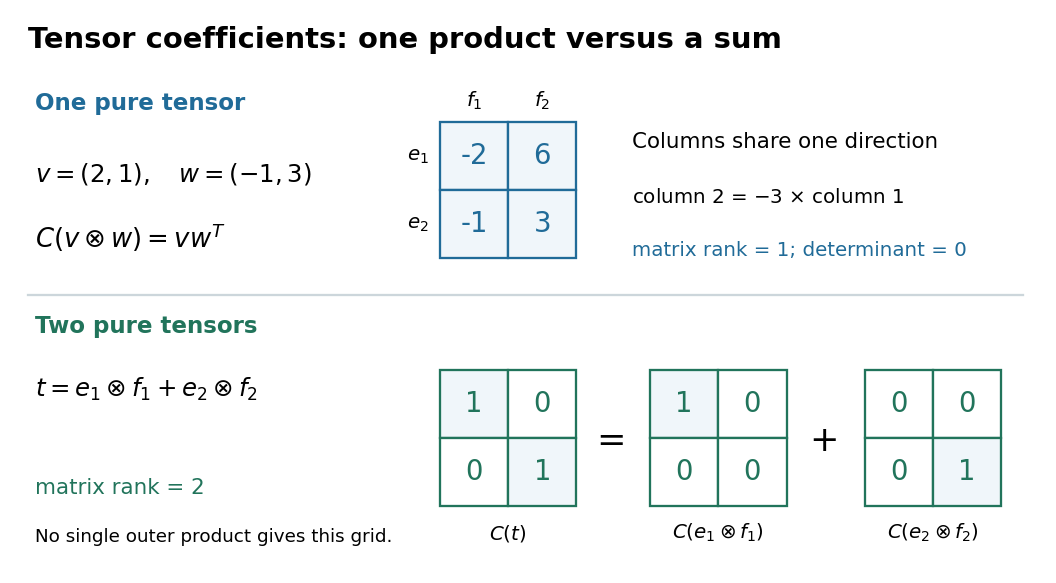
After choosing ordered bases, identify a tensor with its matrix . This is a linear isomorphism between and the vector space of -by- matrices: each tensor-product basis element becomes the matrix with one entry equal to one and all others zero. In particular, a pure tensor has the outer product coefficient formulaHere on the right denote column coordinate vectors. The identification depends on the chosen bases, while the tensor itself does not. Over the complex numbers, the same formula uses the ordinary transpose , with no complex conjugation; replacing it by the conjugate transpose would conjugate the scalar in the second input, violating bilinearity.

Articles by others on the same topic
There are currently no matching articles.