The University of New South Wales documents an undriven, visitor-started Foucault pendulum. A fixed vertical wire and wall line define its initial north–south swing plane. The documented comparison one hour later shows reduced amplitude and about nine degrees of anticlockwise precession. The apparatus swings for several hours without an electromagnetic drive.[ref]
The Foucault pendulum by Joe Wolfe. The Foucault pendulum, opening observation sequence and Our Foucault Pendulum: wire/wall reference, one-hour comparison, no electromagnetic drive
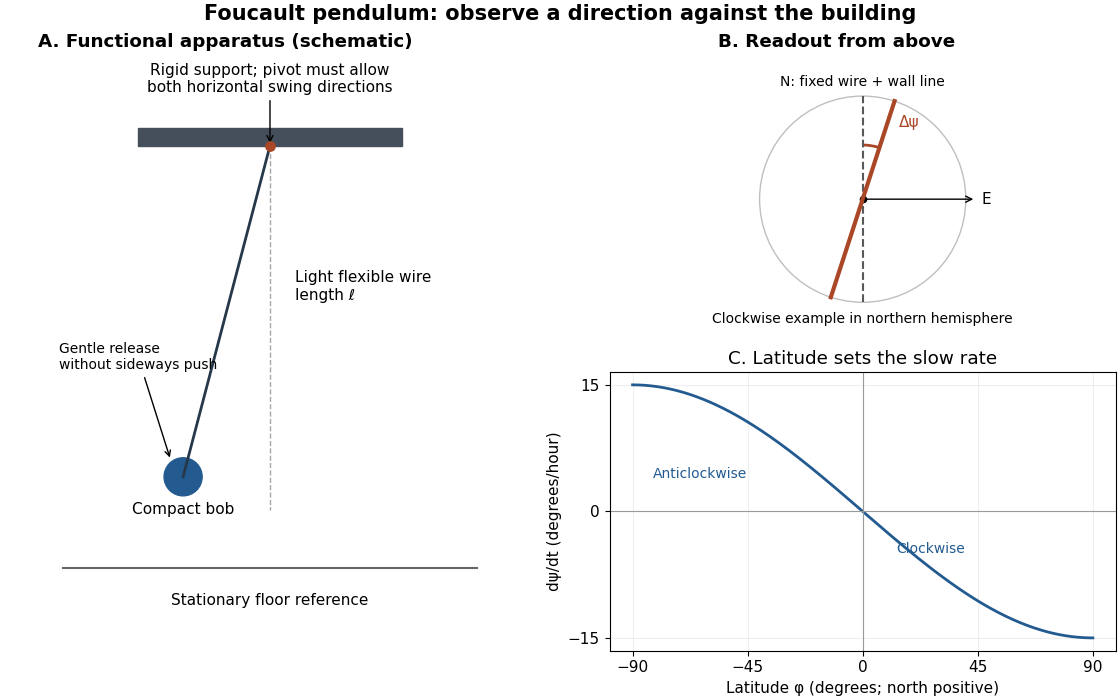
Functional Foucault pendulum apparatus, fixed sighting reference, and predicted latitude dependence; schematic with no historical dimensions
. Details. 
To turn that demonstration into a quantitative experiment, the following is a proposed measurement protocol. Establish a rigid support with no preferred horizontal swing direction, measure the wire length to the bob's centre, and mark two perpendicular horizontal axes fixed to the building. Start with a small displacement along the sighting plane, then release with as little transverse velocity as possible. Record the actual launch method; burning a fine restraining thread is one possible proposed release, not a claim about the documented UNSW launch. Keep people clear of the bob and avoid touching the suspension during the observation.
Record the horizontal position from above with a stationary, calibrated camera, or sight the bob against the wire and wall line at recorded times. Fit the long axis of each short group of swings to estimate its orientation ; use the extrema on both sides rather than following the bob's rapidly reversing velocity. A swing line has orientation modulo , so unwrap successive small direction changes continuously. Rotate no camera or reference between measurements. Record the fast oscillation period separately, and compare the slope of with the Latitude law of Foucault precession. Repeat launches along different directions and monitor ellipses, pivot motion, and air currents before attributing the slow change to Earth's rotation.
Articles by others on the same topic
There are currently no matching articles.