The viscous stress tensor is the part of the Cauchy stress tensor associated with deformation rates. For an isotropic Newtonian fluid in incompressible flow,Here is pressure, is the identity matrix, is dynamic viscosity, and is the strain-rate tensor. The convention is ; denotes transpose and denotes trace. Across a plane with unit normal vector , the viscous traction is . The tensor makes this rule work for any plane orientation. [ref]
https://www.damtp.cam.ac.uk/user/tong/fluids/fluids.pdf. David Tong, Fluid Mechanics, section 3.1.1, equations (3.5)–(3.6)
In the worked Couette flow, , soIn particular, while the shear rate is ; the factor in recovers . On the upper face of a fluid slice, gives viscous traction ; on the lower face it is . Constant stress can therefore transmit a force between the plates even though its divergence, and the net viscous force on each slice, vanish.
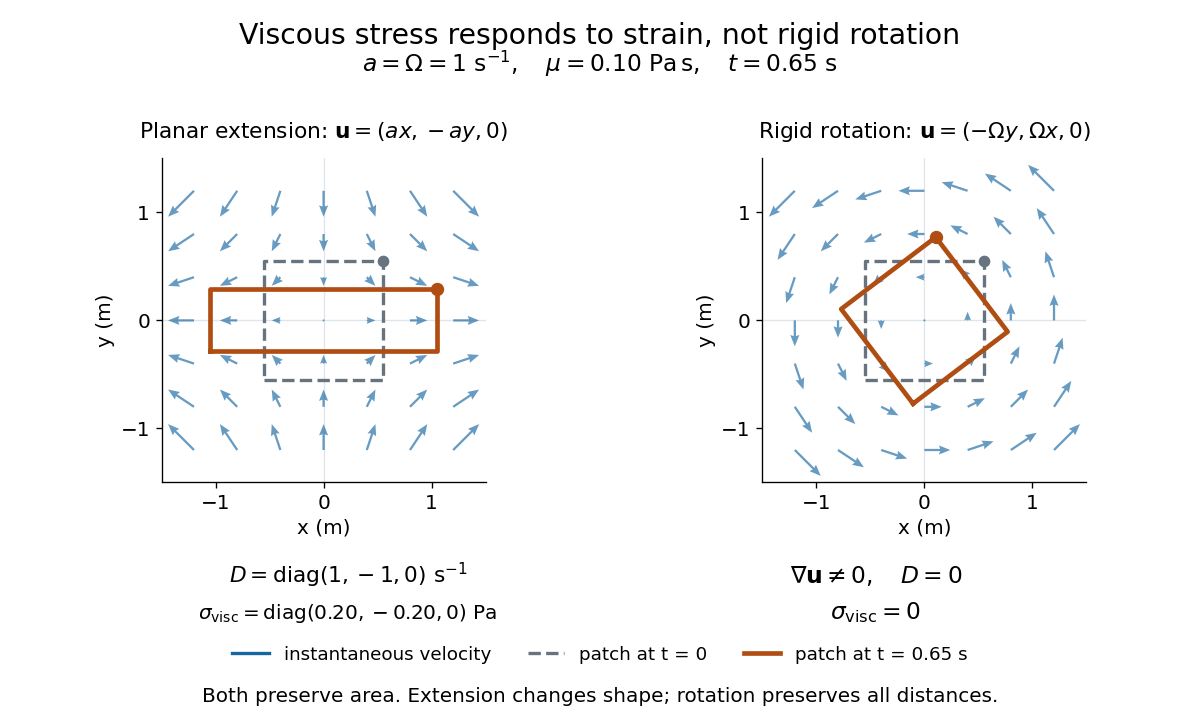
Compare planar extension with solid-body rotation :Extension changes lengths and produces viscous normal stresses . Rotation preserves distances and gives zero viscous stress, despite its nonzero velocity gradient and vorticity . For and , extension gives and ; rotation gives zero. A rotating fluid may still have a pressure gradient supplying its centripetal acceleration.
For an isotropic Newtonian fluid in three-dimensional compressible flow, separate shape change from volume change:The first term is deviatoric stress, with zero trace; is volume viscosity, also called bulk viscosity. For uniform expansion , and , so the shear contribution vanishes and the viscous stress is . Thus dynamic viscosity and volume viscosity describe distinct responses, and incompressible flow removes only the volume-change term. [ref]
https://notes.shreyasmandre.com/fluid-dynamics-notes/Ch2.html. Shreyas Mandre, Fluid Dynamics Lecture Notes, section 2.11.3, equation (2.49)
The viscous force on a fluid region is the resultant of the traction supplied by the viscous stress tensor . With the outward unit normal of the region, its surface contribution is the displayed surface integral. For an incompressible Newtonian fluid, , where is dynamic viscosity and is velocity. A force scale is for a body of size moving at speed , while the inertial force scale is ; their ratio is the Reynolds number. Total hydrodynamic drag on a body includes both viscous traction and the pressure traction induced by the flow. For example, the full Stokes drag law gives for a no-slip sphere, rather than just the viscous-traction part alone.
Articles by others on the same topic


The viscous stress tensor is a mathematical representation that describes the internal frictional forces in a fluid (or a deformable solid) due to its viscosity when it is subjected to deformation. It plays a critical role in fluid dynamics, especially in the study of Newtonian fluids, where the stress is linearly related to the strain rate.