For every positive integer , the divisor sum of its Von Mangoldt function weights recovers its natural logarithm:The sum runs over the positive integer divisors of . For , its only term is . Equivalently, if and is the constant-one arithmetic function, then , where is Dirichlet convolution. [ref]
For , the positive integer divisors are . Only contribute:Thus the vanishing of loses no information here: the divisor sum retrieves both copies of the prime factor from the integer divisors and .
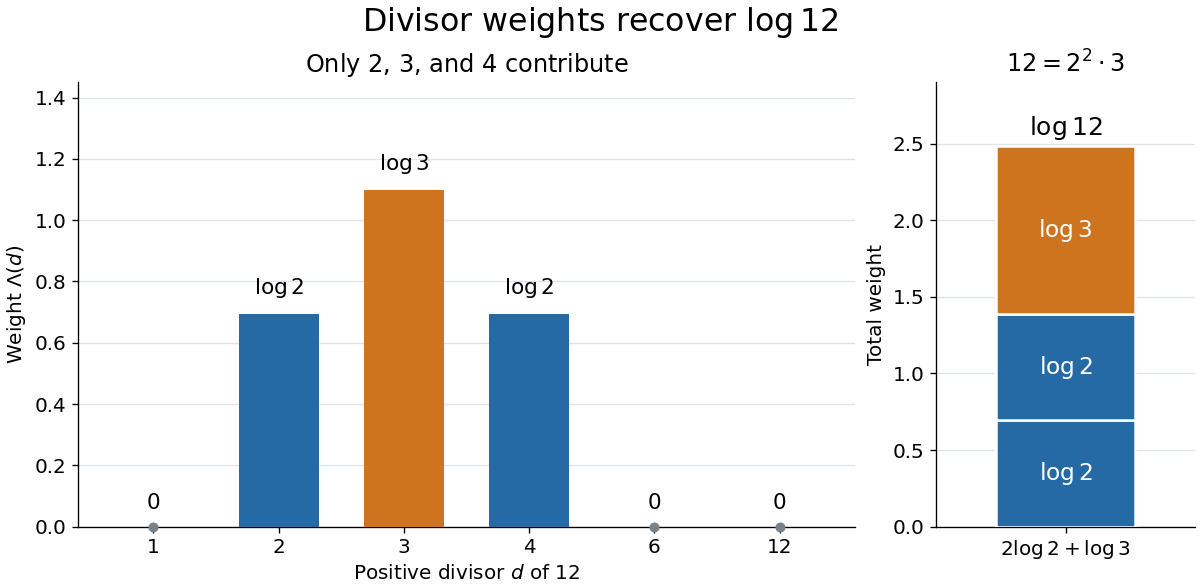

Proof outline: by the fundamental theorem of arithmetic, write with distinct prime numbers and positive exponents . Among the positive integer divisors, the ones with nonzero Von Mangoldt function weights are exactly . ConsequentlyThe natural logarithm turns the prime factorization product into a sum, and the prime powers greater than one supply exactly the required multiplicities.
Articles by others on the same topic
There are currently no matching articles.