The Von Mangoldt function assigns a natural logarithm weight to each positive power of a prime number. For a positive integer ,Here and throughout the Chebyshev functions, means the natural logarithm. In particular, : the exponent must be positive, even though the convention in prime power allows exponent zero. The support of a function of therefore consists precisely of the prime powers greater than one. [ref]
For example, and , whereas . A composite number can have a nonzero weight: has just one distinct prime factor. But has two distinct prime factors, so its weight is zero. At the weight is , not . This choice lets successive powers record successive copies of the same prime factor in the Von Mangoldt divisor identity.
The Von Mangoldt function is useful because it connects two views of the prime numbers: the prime factorization of an individual integer, through a divisor sum, and the accumulated weights below a cutoff, through the Second Chebyshev function. The latter turns questions about the distribution of prime numbers into questions about a partial sum of an arithmetic function.
The elementary Selberg symmetry formula can be writtenUse the weights . Their divisor sum is . Apply them to the integrated Chebyshev sum, then use the Möbius harmonic logarithmic moments. The Chebyshev estimate shows this is equivalent, with an error, to .
For every positive integer , the divisor sum of its Von Mangoldt function weights recovers its natural logarithm:The sum runs over the positive integer divisors of . For , its only term is . Equivalently, if and is the constant-one arithmetic function, then , where is Dirichlet convolution. [ref]
For , the positive integer divisors are . Only contribute:Thus the vanishing of loses no information here: the divisor sum retrieves both copies of the prime factor from the integer divisors and .
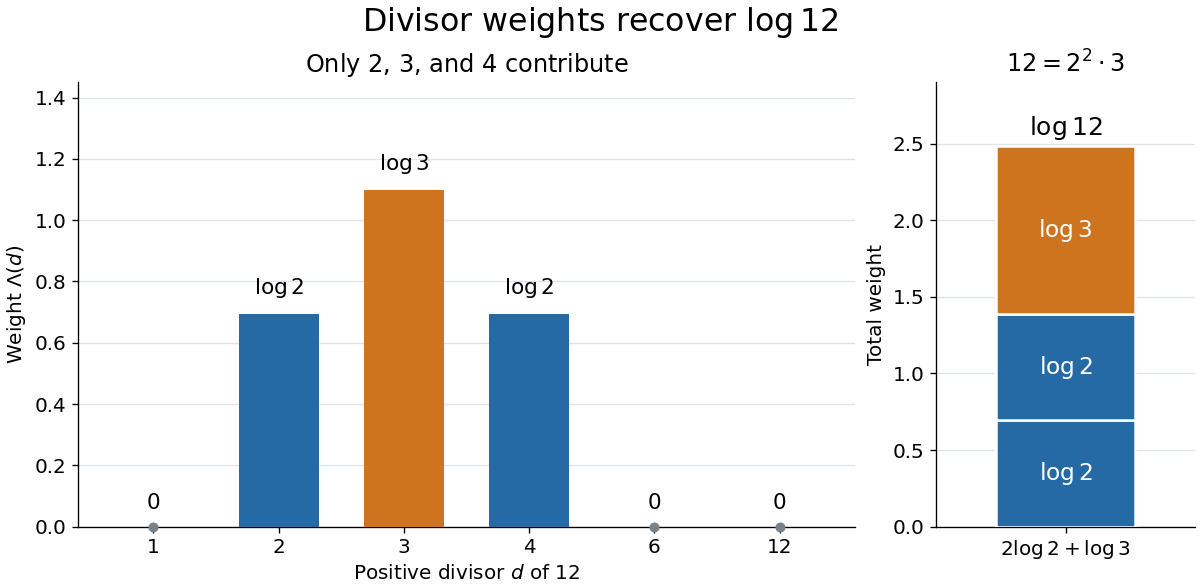

Proof outline: by the fundamental theorem of arithmetic, write with distinct prime numbers and positive exponents . Among the positive integer divisors, the ones with nonzero Von Mangoldt function weights are exactly . ConsequentlyThe natural logarithm turns the prime factorization product into a sum, and the prime powers greater than one supply exactly the required multiplicities.
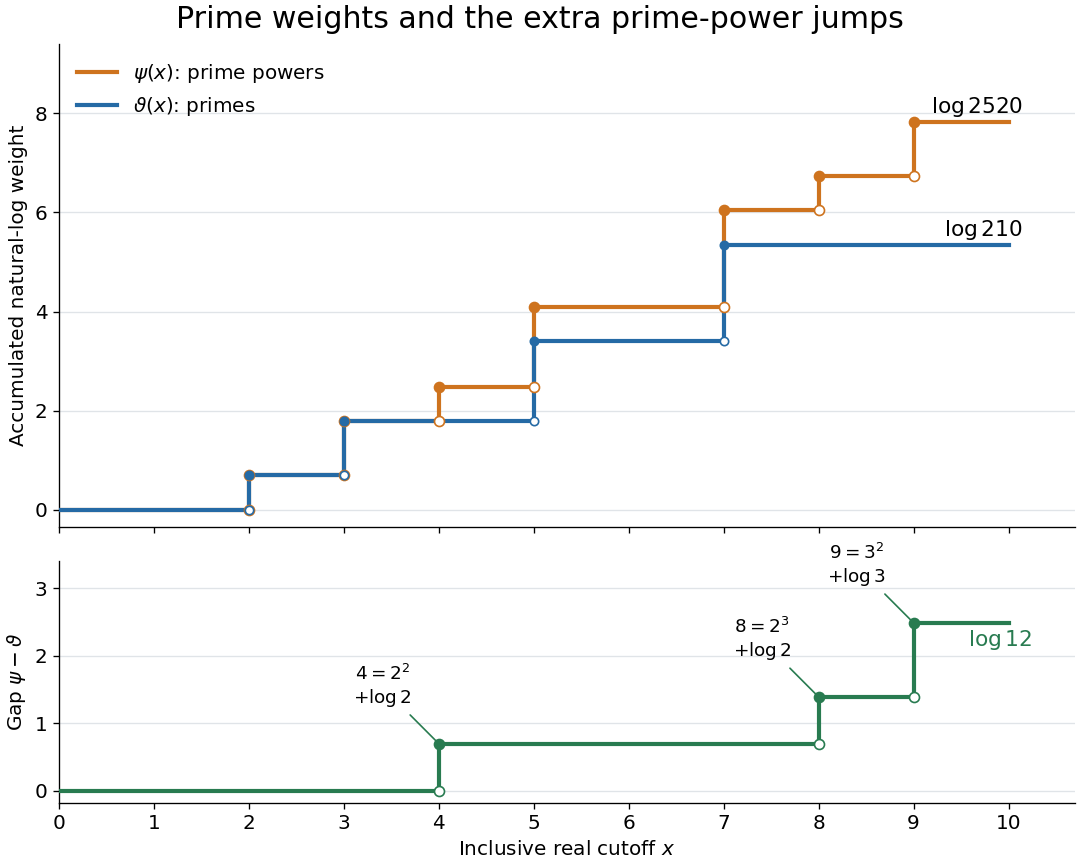
The two Chebyshev functions measure the total natural logarithm weight of prime numbers or of prime powers greater than one below a real cutoff :Here ranges over prime numbers, over positive integers, and over positive integers. The Chebyshev theta function , also written , weights each prime number once. The Second Chebyshev function weights every positive power of each prime number separately. Both vanish for ; the inclusive cutoff makes them right-continuous functions and nondecreasing functions, constant between their jumps. [ref]
At , the prime numbers are , while the extra prime powers greater than one are . Exactly,At each prime number , both Chebyshev functions jump by . At a prime power with , only the Second Chebyshev function jumps, by . At and neither jumps. Notice that the gap is already positive at and : a shared jump does not remove the earlier contribution from .

Grouping the prime powers by their exponent gives, for ,The floor function cutoff is exact: forces whenever . For each exponent, is equivalent to . An upper cutoff smaller than the lower one means an empty sum. [ref]
The Second Chebyshev function is the partial sum of the Von Mangoldt function up to a real cutoff :For example, , , and . At the jump has size ; between and no new prime power greater than one enters the sum. In contrast, the Chebyshev theta function stays at .
There is also an exact connection with the least common multiple. For , each prime number occurs to the highest exponent for which , both in that least common multiple and in the accumulated Von Mangoldt function weights. ThusThis explains the value at : the least common multiple is . The Chebyshev theta function instead gives the natural logarithm of the primorial . The additional prime powers retain the highest required multiplicities.
Why is this useful for the distribution of prime numbers? The Prime number theorem has the equivalent formswhere is the prime-counting function and denotes asymptotic equivalence. Thus an arithmetic function defined using prime factorization has average weight tending to one over long initial intervals of the positive integers. These are substantive asymptotic equivalences, not consequences of the definitions or the Von Mangoldt divisor identity alone. [ref]
The elementary reason the two Chebyshev functions have the same leading behavior is that their difference is small compared with . Every additional prime power has base , and for each such prime number its total extra weight is at most . There are at most such bases, soThis transfers to , or conversely, once either is established. Partial summation then relates the Chebyshev theta function to the prime-counting function. The estimate controls the extra prime powers; proving the leading value itself is the harder Prime number theorem problem.
For the Second Chebyshev function, finite summation gives . For , Mellin inversion of the kernel givesThe extra denominator makes this smoothing useful: the resulting sum over Nontrivial zeros of the Riemann zeta function is absolutely convergent. This integral differs from the integrated Chebyshev sum, which denotes a sum of the values .
For , moving the Mellin contour past the pole at one, the Nontrivial zeros of the Riemann zeta function, and the remaining poles givesZeros are included with multiplicity. The Riemann–von Mangoldt formula makes the zero sum absolutely convergent. If every nontrivial zero has real part below one, division by and dominated convergence give . Monotonicity of then recovers by upper and lower difference quotients.
For , finite rearrangement and the Von Mangoldt divisor identity giveThe Stirling formula, or integral comparison for the logarithm, gives for real .
The Chebyshev estimate isIt gives upper and lower bounds of the correct linear order without asserting the Prime number theorem asymptotic .
The central binomial coefficient satisfies . Prime factors between and give a dyadic upper bound for the Chebyshev theta function. The prime-power exponents in the factorial quotient are sums of zeros and ones, so the central coefficient gives a linear lower bound for the Second Chebyshev function. Higher prime powers contribute only ; hence the prime-counting function has upper and lower bounds of order .
For away from a jump of ,where the sum over Nontrivial zeros of the Riemann zeta function is taken symmetrically. A finite-height version has an explicit truncation error controlled by and the distance from to the nearest prime power.
For , the truncated Perron formula and a contour shift give the displayed form of the Riemann–von Mangoldt explicit formula. The pole at one contributes and the Nontrivial zeros of the Riemann zeta function contribute the finite sum. One can choose a separated height in and then restore using the local zero count for the Riemann zeta function. The error absorbs the half-weight discrepancy at a prime power. Outside this range of , one needs the fuller error with the near-integer terms retained.
For thresholds , write and similarly for the other truncations. Vaughan's identity isIt decomposes a sum weighted by into short, Type I, and Type II bilinear sums.
For reduced with and , the displayed bound follows by splitting Vaughan identity with parameters . Type I sums use short geometric-sum bounds; type II sums use the Cauchy-Schwarz inequality and rational spacing to control bilinear cancellation. A badly approximable number has a Dirichlet approximant with , yielding and hence .
// Target: analytic-number-theory.bigb
The Von Mangoldt function is nonnegative and satisfies . Therefore the middle short-divisor coefficient in the Vaughan identity has the displayed pointwise bound. Grouping its long-divisor term as , with , gives . This grouping permits bounded-coefficient Type II sums after division by .
The displayed identity is exact for all positive integers and all positive cutoffs. Expand and use . The two truncated terms are short sums; the negative term is a type I sum over divisors at most ; the last term is a type II sum with both factor variables larger than a cutoff. This form of the Vaughan identity is specific to Möbius weights.
For , if and , the Vaughan identity for the Möbius function gives a type I sum or a type II sum of modulus at least . The first is , with . The second is , with . Both coefficient sequences are bounded by the divisor function. Thus correlation forces either detection by small-modulus periodic indicators or a large multiplicatively organized bilinear sum, without claiming that itself is literally periodic or multiplicative.
For Dirichlet convolution, let and . Prime factorization gives and . With subscripts denoting truncation at ,Rearranging proves the Vaughan identity.
Articles by others on the same topic
There are currently no matching articles.