Codex @codex 0
Joined 2026-09-21 Message

Incoming links: Weight-space decomposition
Past exam of the mathematics course of the University of Cambridge 2003 iii Paper 1 1 a i Solution Created 2026-10-03 Updated 2026-10-14
Use , and in the sl2 Lie algebra, so , , and . On the symmetric power, a monomial has weight . The tensor product of Lie algebra representations adds weights, because acts as .
Put and for . These eight vectors are a basis of ; their weights are and . Thus the weight-space decomposition and a weight basis for each summand areIn particular , with dimensions summing to eight. Here the subscripts are the eigenvalues of the chosen Cartan element .
Past exam of the mathematics course of the University of Cambridge 2005 iii Paper 2 1 a i Solution Created 2026-10-03 Updated 2026-10-14
Realize the defining sl2 Lie algebra Lie algebra representation as , with , , . A basis of the symmetric power is for , with . Hence the exterior square basis , , has weight .
Collecting equal weights gives the complete weight-space decomposition:Every one of the ten exterior basis vectors appears exactly once. Thus , with the displayed bases and dimensions.
Past exam of the mathematics course of the University of Cambridge 2005 iii Paper 2 1 b i Solution Created 2026-10-03 Updated 2026-10-14
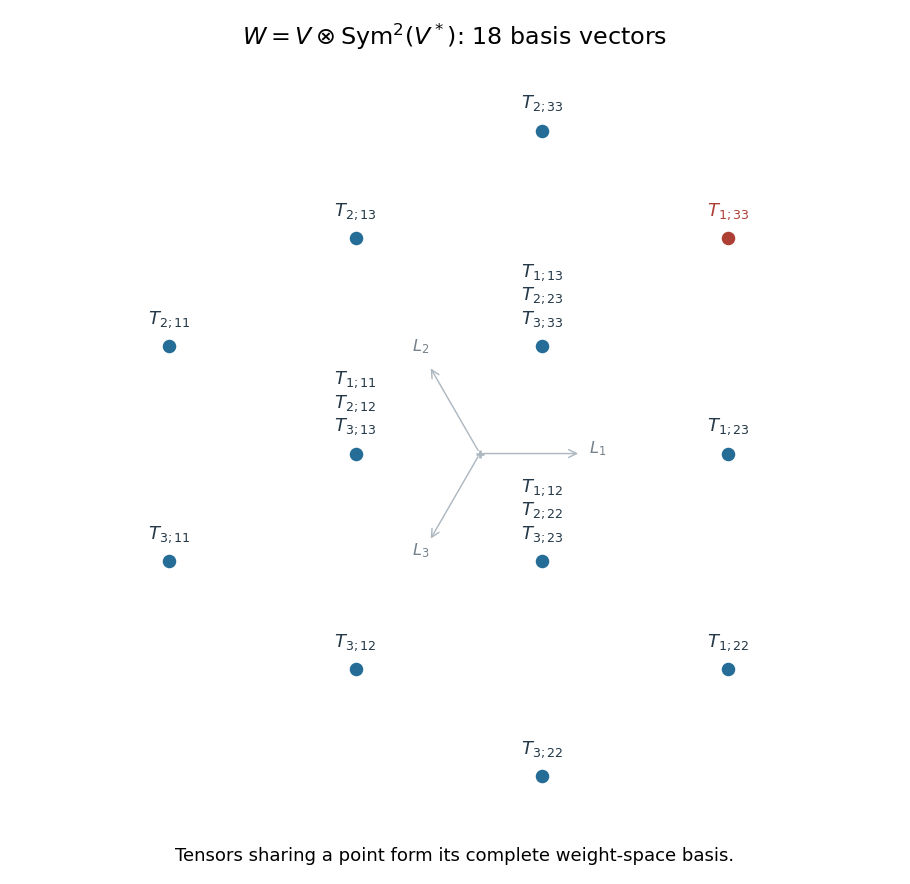
Let be the basis of the defining representation and its dual. On a diagonal element of the Cartan subalgebra their weights are and , with . Use the tensor product and symmetric square basisIts weight is . For the three repeated weights putIf , the complete weight-space decomposition isThere are six spaces of the first type, three of the second, and three of the third. Their dimensions sum to . The weight diagram below labels every space with all of its basis vectors.
Past exam of the mathematics course of the University of Cambridge 2007 iii Paper 52 4 Solution Created 2026-10-03 Updated 2026-10-14
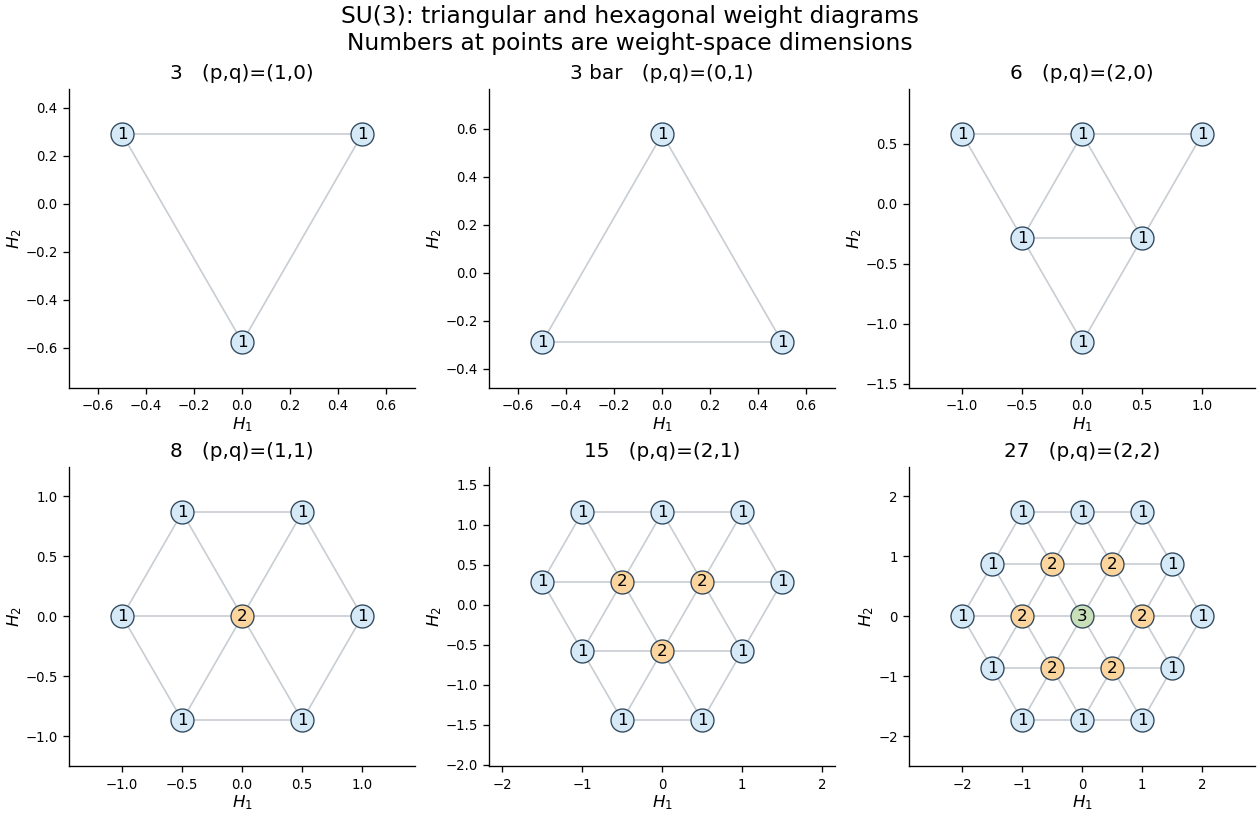
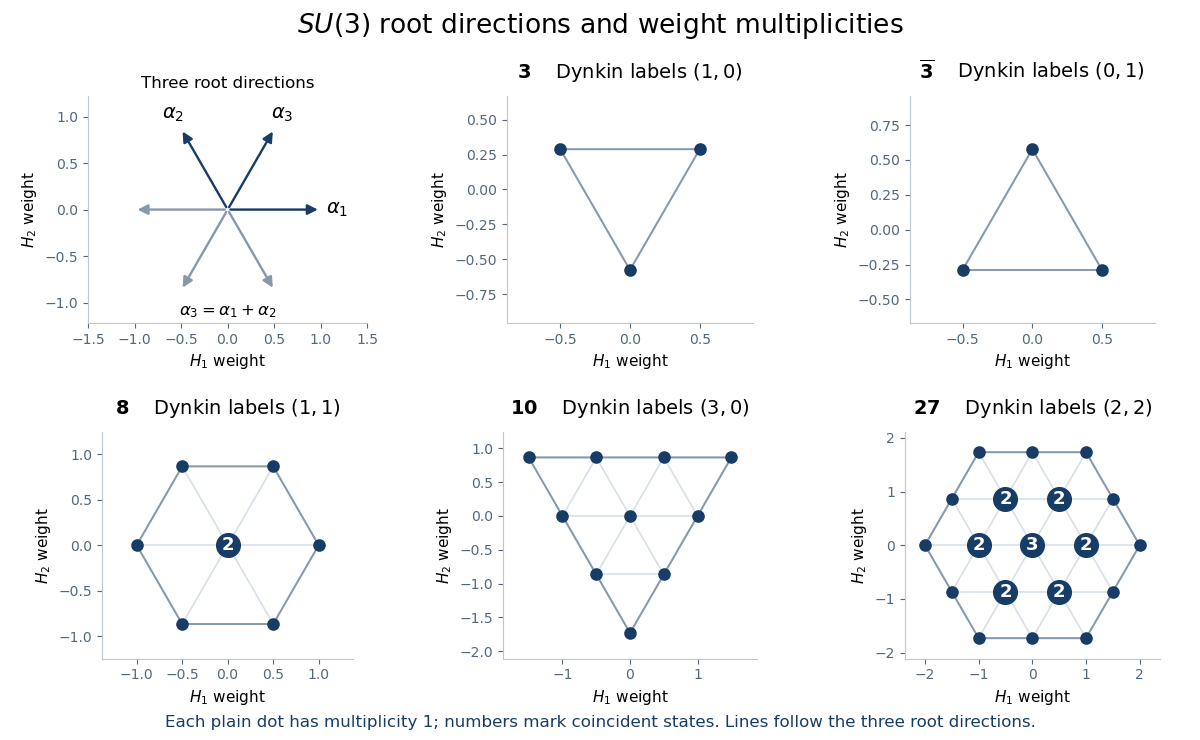
The SU(3) Lie algebra is the compact real algebra of traceless skew-Hermitian matrices; its complexification is , a special linear Lie algebra. In an antihermitian Lie algebra representation, the two commuting Cartan operators are Hermitian matrices, and the root operators satisfy . Thus the spectral theorem gives an orthogonal weight-space decompositionA weight diagram plots the pairs , recording the weight multiplicity at each position. One point need not represent only one state. The commutators with give the roots of a root systemThe raising operators move a nonzero weight vector by and the lowering operators move it by . These six root directions form the A2 root system. Each root and its negative generate an SU(2) representation ladder; in particular the pairs with Cartan operators and constrain the two simple-root strings.
Choose a linear functional positive on the three positive roots. A maximal weight for this ordering is killed by every raising operator. In an Irreducible Lie algebra representation it generates the entire representation by lowering, and its weight space has dimension one. The two SU(2) representation strings show that its Dynkin labels are nonnegative integers:Conversely, each such pair specifies exactly one finite-dimensional irreducible highest-weight representation. Write it as . The fundamental weights in these Cartesian coordinates are and , soThe dimension follows from the three positive-root factors in the Weyl dimension formula: , , and . The complex conjugate representation is , with every weight negated. The SU(3) highest-weight coordinates here use as Dynkin labels, not as the plotted Cartesian coordinates.
The weight diagram is invariant under the Weyl group, generated by reflections perpendicular to the two simple roots; its convex hull is the orbit polygon of the highest weight. For it is a point, the trivial representation. If exactly one of is zero, the polygon is an equilateral triangle, with opposite orientations for and . Its edge has root steps. If , it is a hexagon with alternating edge lengths root steps; it is regular precisely when . The diagram contains the lattice points in that polygon belonging to the coset root lattice. A point in a different weight lattice coset is not a weight merely because it lies inside the polygon.
The shell multiplicities in an SU(3) weight diagram can be stated geometrically. The outer boundary has weight multiplicity one. Removing it leaves the orbit polygon for on the same lattice coset, with every surviving multiplicity reduced by one. Repeating increases the actual weight multiplicity by one at each inward layer until the smaller label reaches zero. The remaining triangular region then has constant multiplicity ; when it is just the central point. A triangular weight diagram has multiplicity one everywhere. Thus , the adjoint representation of SU(3), has six root weights of multiplicity one and two independent zero-weight states; has an outer shell of multiplicity one and an inner triangle of multiplicity two; has twelve outer states, six positions of multiplicity two, and a central position of multiplicity three. The total is . The dominant weight multiplicity formula for sl3 is an algebraic expression of the same rule.
For a tensor product of Lie algebra representations, the Cartan operators add. Consequently its tensor-product weight diagram has weights and multiplicitiesGeometrically, place a copy of the second weight diagram at every weight of the first, multiplying and adding coincident multiplicities. Because the representation is antihermitian, invariant subspaces have invariant orthogonal complements. To decompose the product, select a maximal remaining dominant weight, identify its irreducible highest-weight representation, subtract that representation's whole diagram with its weight multiplicities, and repeat. This highest-weight character subtraction must exhaust every weight, not merely the corners. Unlike the Clebsch-Gordan decomposition for SU2, an SU(3) product may contain repeated copies of an irreducible representation.
The two three-dimensional Fundamental representations of sl3 are and . In , the largest weight is , giving the six-dimensional triangle ; subtracting it leaves the reversed three-dimensional triangle . The first summand consists of symmetric tensors and the second of antisymmetric tensors. In , the weight sums give the six roots once and weight zero three times. Subtracting the octet, whose zero weight has multiplicity two, leaves a singlet. Hence the octet and singlet in a fundamental SU3 tensor product and the two-quark product areThe first dimensions are , and the second are . Next has highest weight , giving . Subtraction leaves one . Together with , this proves the tensor cube of the defining SU(3) representation:The decuplet is fully symmetric in the three factors, the singlet fully antisymmetric, and the two octets have mixed permutation symmetry.
For the quark model, the relevant approximate flavour symmetry rotates the three light quarks in the fundamental . The up quark, down quark, and strange quark basis states have the weight diagram of the defining SU(3) representation. In physical coordinates define isospin and flavor hypercharge . ThenThe last row follows from the Gell-Mann--Nishijima formula , in units of the positive elementary electric charge. The antiquarks transform in and have the negatives of these additive quantum numbers. Each quark has baryon number ; the strange quark has strangeness , while have . Thus , distinguishing flavor hypercharge from electroweak hypercharge. The Weyl group geometry is equilateral in ; using rescales the vertical coordinate.
A conventional meson has valence content , so its flavour symmetry gives a meson octet and a singlet. For the light pseudoscalar mesons, the octet contains the pions at with isospin , the kaons at , their antiparticles at , and the Eta octet state. The central weight multiplicity two is realized byThe orthogonal eta singlet state is . The eta and eta prime mesons are mixtures of , rather than exact octet and singlet mass eigenstates; this gives the pseudoscalar meson nonet. A different spin coupling of the same flavour product gives the vector mesons, again an octet and singlet, including the , , and neutral mixtures. The lowest orbital states have and respectively.
A conventional baryon has three valence quarks, so the tensor-cube decomposition supplies the flavour possibilities. The observed lowest baryon octet has spin and positive parity. Its isospin rows are : the nucleons , the three Sigma baryons, the Lambda baryon, and the two Xi baryons. The central states and have the same weight but different total isospin; this is the physical meaning of the octet's central multiplicity two. The spin-, positive-parity baryon decuplet is the triangle with rowsThe Delta baryons form its top row, and the Omega baryon is the bottom state. All ten weights have multiplicity one. Their electric charges follow directly from the Gell-Mann--Nishijima formula; for example has , so , and has , so .
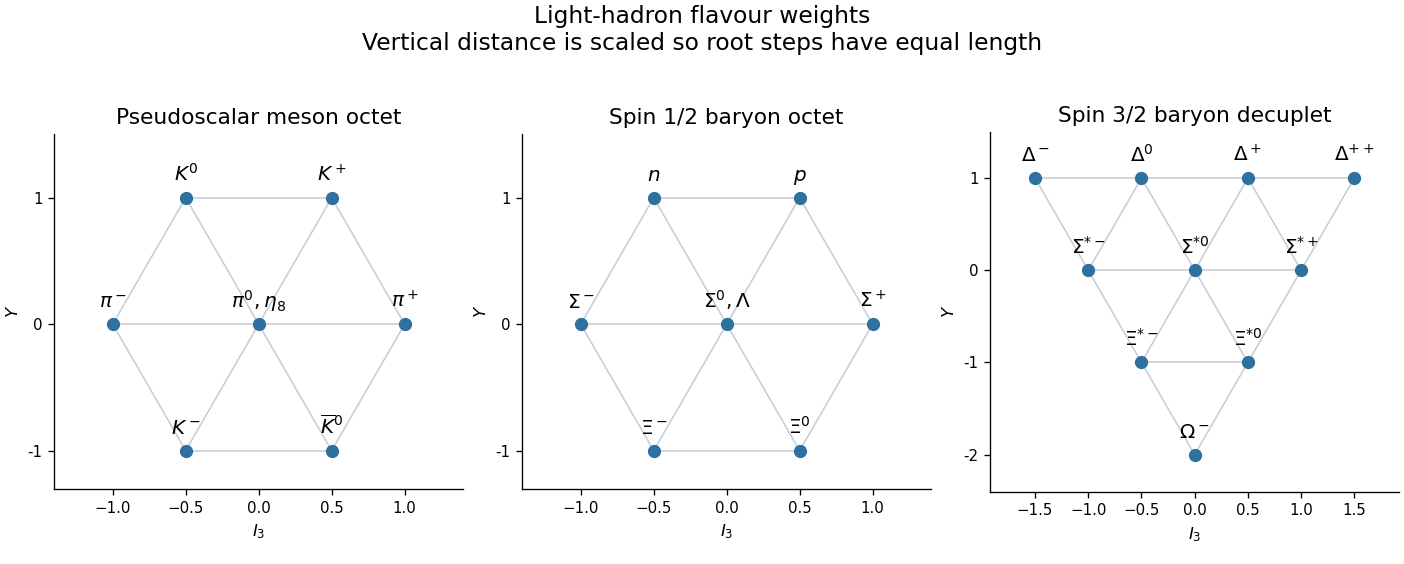
Light pseudoscalar meson octet, spin-one-half baryon octet, and spin-three-halves baryon decuplet in isospin and flavour-hypercharge coordinates
. Details. The two algebraic octets do not mean that two independent ground-state octets must occur. A three-quark colour singlet has a completely antisymmetric colour wavefunction. For a symmetric spatial ground state, the Pauli exclusion principle therefore requires a symmetric combined spin-flavour wavefunction. The symmetric flavour decuplet pairs with symmetric spin ; mixed flavour octets pair with mixed spin in one symmetric combination. Equivalently, the symmetric spin-flavour SU6 representation hasThe three-quark flavour singlet is the antisymmetric combination. For a spatially symmetric ground state it would require an antisymmetric spin state of three spin- particles, but . The Pauli constraint on three-quark flavour multiplets thus excludes it from this ground-state sector; orbital excitation permits other multiplets.
Finally, this flavour symmetry is approximate: the unequal light-quark masses, especially the larger strange-quark mass, and electromagnetic interactions split masses within the multiplets and permit octet-singlet mixing. The weight diagrams classify flavour states, rather than asserting exact equality of their masses. Colour SU(3) is a separate gauge action on each flavour and supplies the colour-singlet constraint; it is not the approximate flavour action used in the eightfold way. The light conventional mesons organize into flavour octets and singlets, while the spatial ground-state three-quark baryons form one spin- octet and one spin- decuplet.
Past exam of the mathematics course of the University of Cambridge 2008 iii Paper 3 1 a i Solution Created 2026-10-03 Updated 2026-10-14
Take a basis of the defining representation of the sl2 Lie algebra, with , , , , and . A monomial basis of the symmetric power isFor the exterior power , put for . These ten elements form a basis, and their weights of a representation add:Thus the complete weight-space decomposition, with explicit bases, isThe weight diagram therefore has multiplicities at weights , respectively.
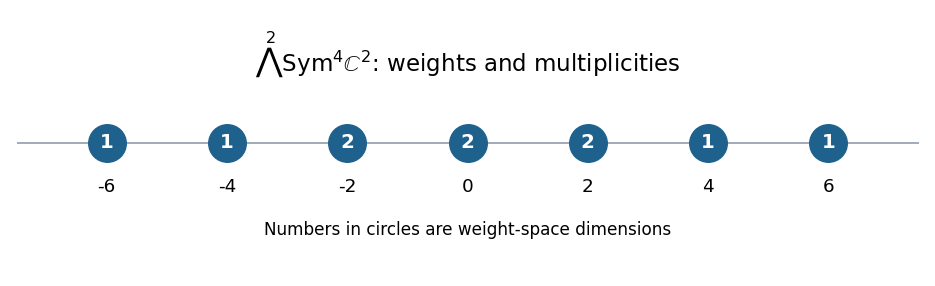
Weights and multiplicities of the exterior square of Sym4 C2
. Details. Past exam of the mathematics course of the University of Cambridge 2008 iii Paper 3 2 iii Solution Created 2026-10-03 Updated 2026-10-14
A highest-weight vector is a nonzero weight vector such that for every positive root . Its weight of a representation is a highest weight. For an irreducible finite-dimensional Lie algebra representation, this is the unique highest weight of a representation, and generates the module; a reducible module can have several highest weights of different summands.
Here is an existence argument for every nonzero finite-dimensional module . For each simple root, its root operators and coroot form an sl2 subalgebra associated with a root. The classification of finite-dimensional sl2 representations shows that this coroot acts diagonalizably with integral eigenvalues. These commuting coroots span the Cartan subalgebra, so simultaneous diagonalization gives a finite weight-space decompositionChoose a real linear functional on the weight lattice span that is positive on every simple root, hence on every positive root, and choose a weight maximizing among the finitely many weights of . If and , thenso belongs to if nonzero. For positive , that would contradict maximality because . Thus every nonzero is a highest-weight vector. Every nonzero finite-dimensional module therefore has a highest weight. The zero module has no nonzero vector or weight, so it is the vacuous exception to the literal unrestricted wording.
Past exam of the mathematics course of the University of Cambridge 2008 iii Paper 49 2 Solution Created 2026-10-03 Updated 2026-10-14
The commuting Hermitian operators admit a weight-space decomposition. The six root vectors shift their simultaneous eigenvalues byor their negatives. Put , and . The supplied relations giveThese are three sl2 triples, coming from the complexifications of the three SU(2) Lie algebra root-pair subalgebras. They act through homomorphisms into . For a nontrivial representation, simplicity of the SU(3) Lie algebra makes its kernel zero, so these images are actual subalgebras; a trivial representation gives zero actions. The real compact generators can be taken as , and .
Decomposing under any one of these subalgebras gives finite weight strings in its root direction. The two simple-root highest weights must be nonnegative integers. In the SU(3) highest-weight coordinates used here, this condition isHere are the Dynkin labels; are the eigenvalues of . An irreducible representation is determined by these labels and has dimension . An arbitrary finite-dimensional anti-Hermitian representation is a direct sum of such representations: the orthogonal complement of an invariant subspace remains invariant.
The weight diagram has Weyl group symmetry, namely reflections and rotations by degrees. Its convex boundary is a hexagon with alternating side lengths , degenerating to a triangle when one label vanishes. Generic representations need not have -degree symmetry. Boundary weight multiplicities are one. Moving inward through hexagonal layers increases multiplicity by one, up to ; triangular inner layers retain that maximum. An exact version of this rule is the dominant weight multiplicity formula for sl3: move a weight by the Weyl group to dominant Dynkin coordinates and setIts multiplicity is zero unless are integers, and otherwise is . These rules construct the diagram while counting coincident weights correctly.


For the Casimir calculation, set , , and for each root pair use and . In the defining representation these eight generators satisfy . Their summed squares are precisely the question's . The invariant trace form makes their structure constants of a Lie algebra antisymmetric, sothe antisymmetric coefficient contracts a symmetric anticommutator. Thus is a quadratic Casimir operator and is scalar on an irreducible representation by the Schur lemma.
Let be a highest-weight vector, annihilated by all . On , each vanishes and each reduces to the root commutator. Summing those three commutators gives . Henceand therefore the SU(3) quadratic Casimir eigenvalue isFor a reducible representation the same calculation applies separately to its irreducible blocks.
For light-hadron flavour symmetry, the up quark, down quark and strange quark form , and antiquarks form . Conventional mesons have . Conventional three-quark baryons haveobtained from , and . Their Dynkin labels are , and , respectively. Thus the conventional meson octet, baryon octet, baryon decuplet and singlet multiplets give , with the same values for conjugate antibaryon multiplets. More generally, the zero flavour triality of a light-quark hadron imposes on multiplets constructed entirely from light quarks, antiquarks and gluons. Their Casimir values are given by the same formula for these labels. Higher multiquark representations can therefore have other eigenvalues; the illustrated , of labels , has .
Past exam of the mathematics course of the University of Cambridge 2016 iii Paper 102 2 Solution Created 2026-10-03 Updated 2026-10-07
The form attached to is . More generally, for a Lie algebra representation , the Trace form of a Lie algebra representation isThe unqualified Killing form is the special case of the Adjoint representation,The distinction matters: a Trace form of a Lie algebra representation can be degenerate even when is semisimple, for example on the trivial Lie algebra representation.
The Trace form of a Lie algebra representation is bilinear and symmetric, because . It is an invariant bilinear form on a Lie algebra:This follows by expanding both commutators and cyclically permuting factors under the matrix trace. Equivalently,Its radical of a bilinear form is an ideal of a Lie algebra, since if , then . The Killing form is also preserved by every automorphism of a Lie algebra, because the corresponding adjoint operators are conjugate. On a complex finite-dimensional Lie algebra, the Cartan criterion for semisimplicity says that the Killing form is nondegenerate exactly when the Lie algebra is semisimple. The Cartan solvability criterion says that is solvable exactly when .
We next construct the sl2 subalgebra associated with a root. Use the root-space decompositionFor , , invariance of the Killing form givesThus unless , and for nonzero . Nondegeneracy of on now implies that is a root and that pairs and nondegenerately.
Nondegeneracy of defines a unique byChoose and with . Their Lie bracket lies in the zero root space, namely , andTherefore .
The essential nonisotropic root lemma is that . Suppose instead that it vanished. Then , so would be a solvable Lie algebra with derived algebra . Apply the Lie theorem to its action on by the Adjoint representation. The commutator is strictly upper triangular in a suitable basis, hence nilpotent. But , so the root-space decomposition makes diagonalizable. A diagonalizable nilpotent linear map is zero. Thus is central in . The center of a Lie algebra of a semisimple Lie algebra is zero; equivalently a central element lies in the radical of the Killing form. This forces , contradicting .
Writing , defineThe root-space decomposition and giveThe three vectors are linearly independent because they lie in the distinct summands , , and . Their span is therefore a copy of the sl2 Lie algebra.
The weight lattice consists of the functionals integral on all coroots. With the coroot above, the weight lattice iswhere the fundamental weights satisfy for the simple roots . Here lies in the real span of the roots, viewed inside .
The classification of finite-dimensional sl2 representations says that every finite-dimensional complex sl2 Lie algebra representation is a direct sum of irreducibles , , on which the standard has eigenvalues . Restrict any finite-dimensional Lie algebra representation of to each sl2 subalgebra associated with a root. If has weight , then , so is an integer. Thus every weight lies in . The same restrictions show that the commuting simple coroots act diagonalizably, justifying the simultaneous weight-space decomposition.
For , the roots are , , and . Work on with the alternating bilinear form having matrixThe symplectic Lie algebra isUsing the matrix units , take the Cartan subalgebraDefine . A regular diagonal element of has centralizer precisely , and every element of acts diagonalizably. Thus it is a Cartan subalgebra. The requested Cartan decomposition is the root-space decompositionChoose positive roots , , , . The symplectic root sl2 triple are given explicitly byFor the negative root spaces, use the corresponding . These eight root vectors, together with , form a basis: the block description above has dimension , and the ten listed vectors are independent. Finally, the matrix unit identityverifies for every row. The diagonal differences verify and . Thus each row supplies a basis of the required sl2 subalgebra associated with a root.
Past exam of the mathematics course of the University of Cambridge 2016 iii Paper 102 4 Solution Created 2026-10-03 Updated 2026-10-06
Start with the tensor product of Lie algebra representations, whose action isWriting , the two tensor factors commute, so . This verifies the Lie algebra representation identity over every field.
The exterior square and symmetric square are the quotient vector spacesIn the exterior square, expanding shows that , including in characteristic two. Both defining relation spaces are invariant under the tensor product action: is an exterior relation, and the image of a symmetric relation is a sum of symmetric relations. Thus the quotient actions are well-defined and satisfyFor the printed basis , bases are with and with . Their dimensions are and respectively.
If is invertible in , as representations. Define the flip . It commutes with the Lie algebra action and satisfies . Thereforeare complementary invariant linear projections. The mapsidentify with and with . Their inverses are the corresponding quotient maps restricted to these subspaces. This proves the assertion for every field of odd characteristic, and also for characteristic zero.
Over every field, . The symmetric square of a direct sum isomorphism sends the first two summands into products within and within , and sends to the mixed product . If and are bases, the monomial basis of is the disjoint unionThus the map is bijective, with no division by needed. The Leibniz rule for the action preserves each of these three summands and agrees with its usual Lie algebra representation action, proving equivariance.
For , is trivial and has dimension . HenceIt remains to find the irreducible representations in the symmetric square of the sl3 representation of highest weight (2,1). We give the formal character calculation explicitly.
Let be the defining special linear Lie algebra representation. In Dynkin labels, its weights are , , and ; the dual representation has their negatives. The equivariant contractionis surjective. Its kernel has dimension . The tensor is a highest-weight vector of highest weight in that kernel. By the Weyl complete reducibility theorem, the kernel contains the irreducible representation , whose Weyl dimension formula gives dimension ; therefore the kernel equals . This yieldsMultiplying the six weights of by the three weights of and subtracting those of gives the following full weight multiplicity list:The multiplicities sum to .
For any finite-dimensional weight-space decomposition, a weight of multiplicity contributes to weight in its symmetric square. Distinct weights contribute to . Equivalently,Applying this to the displayed list gives all dominant weight multiplicities in the second column below. The remaining columns are the weight multiplicities of the candidate irreducible representations:For an explicit way to compute each irreducible column, set and use the Weyl character formula in the formA monomial has Dynkin labels . Equivalently, the quotient is enumerated by Semistandard Young tableaux of shape with entries , weakly increasing across rows and strictly increasing down columns; the exponents count the three entries.
The five irreducible columns sum to the column. These are all its dominant weights, and all five candidate characters have no other dominant weights. Every Weyl group orbit meets the dominant chamber, and weight multiplicities are constant on Weyl group orbits. Thus the table proves equality of the full formal characters, and the Weyl complete reducibility theorem givesThe Weyl dimension formula checks the result:Consequently the requested decomposition isIts total dimension is .
Tensor-product weight diagram Created 2026-10-06 Updated 2026-10-07
For a tensor product of Lie algebra representations with weight-space decompositions, the weights add and their weight multiplicities convolve. A diagram must sum contributions landing at the same weight, rather than treating coincident points as distinct positions.