One of the sequencers made by Oxford Nanopore Technologies.
The device has had several updates since however, notably of the pore proteins which are present in the critical flow cell consumable.
Official documentation: nanoporetech.com/products/minion (archive)
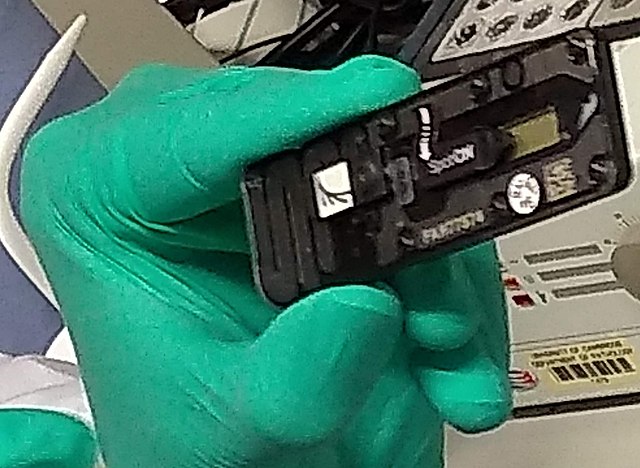
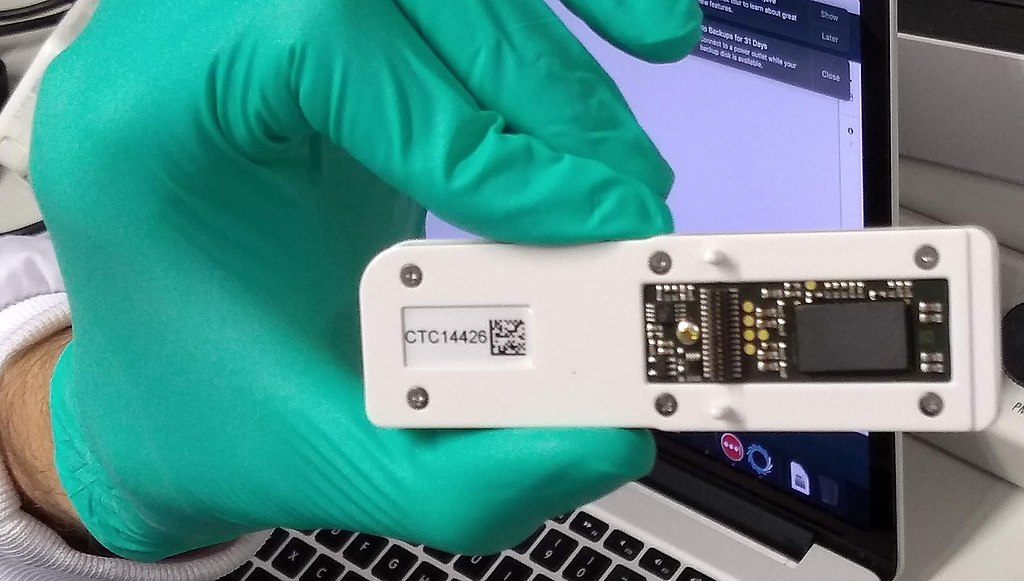
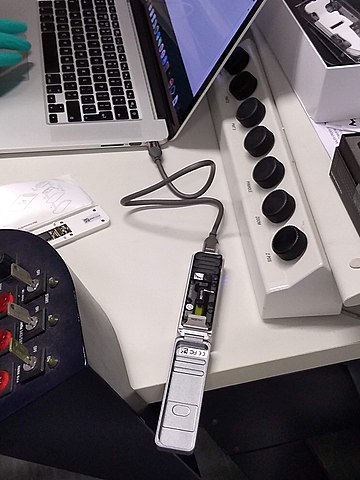
The following images of the device and its peripherals were taken during the experiment: Section "How to use an Oxford Nanopore MinION to extract DNA from river water and determine which bacteria live in it".
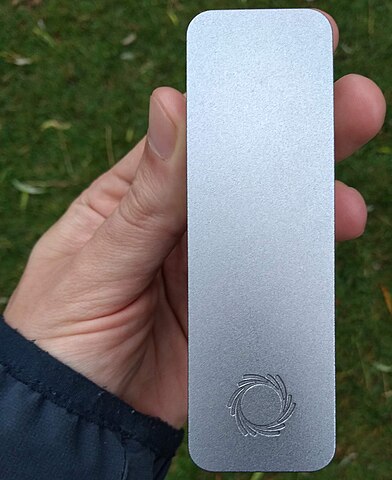
Top view of a closed Oxford Nanopore MinION
. Source. 
Side view of an Oxford Nanopore MinION
. Source. 
Top view of an open Oxford Nanopore MinION
. Source. 


How to use an Oxford Nanopore MinION to extract DNA from river water and determine which bacteria live in it Why Oxford Nanopore was used instead of Illumina for the sequencing by  Ciro Santilli 37 Updated 2025-07-16
Ciro Santilli 37 Updated 2025-07-16At the time of the experiment, Illumina equipment was cheaper per base pair and dominates the human genome sequencing market, but it required a much higher initial investment for the equipment (TODO how much).
The reusable Nanopore device costs just about 500 dollars, and about 500 dollars (50 unit volume) for the single usage flow cell which can decode up to 30 billion base pairs, which is about 10 human genomes 1x! Note that 1x is basically useless for one of the most important of all applications of sequencing: detection of single-nucleotide polymorphisms, since the error rate would be too high to base clinical decisions on.
Compare that to Illumina which is currently doing about an 1000 dollar human genome at 30x, and a bit less errors per base pair (TODO how much).
Other advantages of the MinION over Illumina which didn't really matter to this particular experiment are:
- portability for e.g. to do analysis on the field near infections outbreaks. Compare that to the smallest Illumina sequencer currently available in 2019, the iSeq 100: Figure 1. "Illumina iSeq 100 DNA sequencer".
- long reads which can be necessary for long repetitive regions, see also: Section "Sequence alignment"

In your normal 2020 broken educational system, it is the first time at which students get an official chance to learn something advanced, and possibly prepare to go venture into the PhD desert.
They mean that until you are 18, you have to study a bunch of generic crap you hate just to get into university. Rather than studying whatever it is that you truly love to become a God at it as fast as possible and have any chance of advancing the field.
And then, if you decide that you want to change, which is not unlikely since you haven't really try to study what you signed up for before then, it can be very hard and time consuming, leading to a bunch of adults with useless degress they will never use at work.
Pinned article: Introduction to the OurBigBook Project
Welcome to the OurBigBook Project! Our goal is to create the perfect publishing platform for STEM subjects, and get university-level students to write the best free STEM tutorials ever.
Everyone is welcome to create an account and play with the site: ourbigbook.com/go/register. We belive that students themselves can write amazing tutorials, but teachers are welcome too. You can write about anything you want, it doesn't have to be STEM or even educational. Silly test content is very welcome and you won't be penalized in any way. Just keep it legal!
Intro to OurBigBook
. Source. We have two killer features:
- topics: topics group articles by different users with the same title, e.g. here is the topic for the "Fundamental Theorem of Calculus" ourbigbook.com/go/topic/fundamental-theorem-of-calculusArticles of different users are sorted by upvote within each article page. This feature is a bit like:
- a Wikipedia where each user can have their own version of each article
- a Q&A website like Stack Overflow, where multiple people can give their views on a given topic, and the best ones are sorted by upvote. Except you don't need to wait for someone to ask first, and any topic goes, no matter how narrow or broad
This feature makes it possible for readers to find better explanations of any topic created by other writers. And it allows writers to create an explanation in a place that readers might actually find it.
Figure 1. Screenshot of the "Derivative" topic page. View it live at: ourbigbook.com/go/topic/derivativeVideo 2. OurBigBook Web topics demo. Source. - local editing: you can store all your personal knowledge base content locally in a plaintext markup format that can be edited locally and published either:This way you can be sure that even if OurBigBook.com were to go down one day (which we have no plans to do as it is quite cheap to host!), your content will still be perfectly readable as a static site.
- to OurBigBook.com to get awesome multi-user features like topics and likes
- as HTML files to a static website, which you can host yourself for free on many external providers like GitHub Pages, and remain in full control

Figure 3. Visual Studio Code extension installation.
Figure 4. Visual Studio Code extension tree navigation.
Figure 5. Web editor. You can also edit articles on the Web editor without installing anything locally.Video 3. Edit locally and publish demo. Source. This shows editing OurBigBook Markup and publishing it using the Visual Studio Code extension.Video 4. OurBigBook Visual Studio Code extension editing and navigation demo. Source. 
- Infinitely deep tables of contents:




All our software is open source and hosted at: github.com/ourbigbook/ourbigbook
Further documentation can be found at: docs.ourbigbook.com
Feel free to reach our to us for any help or suggestions: docs.ourbigbook.com/#contact