Topics (119k) Articles (119k) Users (254) Discussions (237) Comments (383) Files (706) New article
This is a section about Linear algebra!
For example, this sentence. And then another one.
Check out: OurBigBook.com, the best way to publish your scientific knowledge. It's an open source note taking system that can publish from lightweight markup files in your computer both to a multi-user mind melding dynamic website, or as a static website. It's like Wikipedia + GitHub + Stack Overflow + Obsidian mashed up. Source code: github.com/ourbigbook/ourbigbook.
Sponsor me to work on this project. For 1M USD I will quit my job and work on OurBigBook full time for three more years to try and kickstart The Higher Education Revolution. Status: ~44k / 400k USD. At 4M USD I retire/tenure and work on open STEM forever. How to donate: Section "Sponsor Ciro Santilli's work on OurBigBook.com".
I first quit my job 1st June 2024 to work on the project for 1 year after I reached my initial 100k goal mostly via a 1000 Monero donation.
Mission: to live in a world where you can learn university-level mathematics, physics, chemistry, biology and engineering from perfect free open source books that anyone can write to get famous. More rationale: Section "OurBigBook.com"
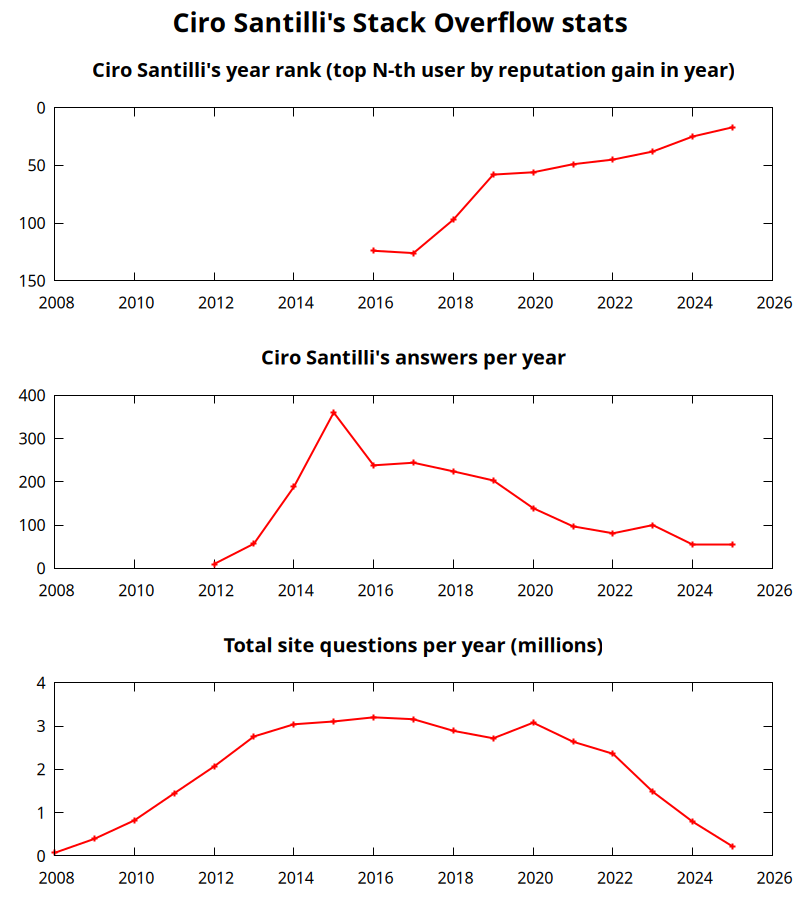
Explaining things is my superpower, e.g. I was top user #39 on Stack Overflow in 2023[ref][ref] and I have a few 1k+ star educational GitHub repositories[ref][ref][ref][ref]. Now I want to bring that level of awesomeness to masters level Mathematics and Physics. But I can't do it alone! So I created OurBigBook.com to allow everyone to work together towards the perfect book of everything.
My life's goal is to bring hardcore university-level STEM open educational content to all ages. Sponsor me at github.com/sponsors/cirosantilli starting from 1$/month so I can work full time on it. Further information: Section "Sponsor Ciro Santilli's work on OurBigBook.com". Achieving what I call "free gifted education" is my Nirvana.
This website is written in OurBigBook Markup, and it is published on both cirosantilli.com (static website), outbigbook.om/cirosantilli (multi-user OurBigBook Web instance) and github.com/cirosantilli/cirosantilli.github.io-md (censorship resistant Markdown render directly on github.com). Its source code is located at: github.com/cirosantilli/cirosantilli.github.io and also at
cirosantilli.com/_dir and it is licensed under CC BY-SA 4.0 unless otherwise noted.To contact Ciro, see: Section "How to contact Ciro Santilli". He likes to talk with random people of the Internet.
GitHub | Stack Overflow | LinkedIn | YouTube | Twitter | Wikipedia | Zhihu 知乎 | Weibo 微博 | Other accounts

Besides that, I'm also a freedom of speech slacktivist and recreational cyclist. I like Chinese traditional music and classic Brazilian pop. Opinions are my own, but they could be yours too. Tax the rich.
Let's create an educational system with:
- no distinction between university and high school, students just go as fast as they can to what they really want without stupid university entry exams
- fully open source learning material
- on-demand examinations that anyone can easily take without prerequisites
- granular entry selection only for space in specific laboratories or participation in specific novel research projects
I offer:
- online private tutoring for:
- any STEM university course
- passionate younger STEM students (any age) who want to learn university level material and beyond. Can your kid be the next Fields Medalist or Nobel Prize winner? I'm here to help, especially if you are filthy rich! I focus moving students forward as fast as they want on and on producing useful novel tutorials and results
Let your child be my Emile, and me be their Adolfo Amidei, and let's see how far they can go! I will help take your child:and achieve their ambitious STEM goals!- into the best universities
- into the best PhD programs
- educational consulting for institutions looking to improve their STEM courses
- do you know that course or teacher that consistently gets bad reviews every year? I'll work with the teacher to turn the problem around!
- are you looking to create a consistent open educational resources offering to increase your institutions internationally visibility? I can help with that too.
My approach is to:For minors, parents are welcome to join video calls, and all interactions with the student will be recorded and made available to parents.
- propose interesting research projects. The starting point is always deciding the end goal: Section "Backward design"
- learn what is needed to do the project together with the student(s)
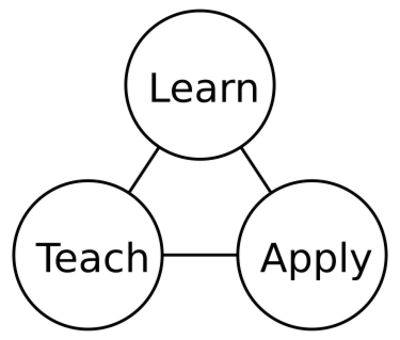
- publish any novel results or tutorials/tools produced freely licensed online, and encourage the student to do the same (Section "Let students learn by teaching", digital garden)
I have a proven track of explaining complex concepts in an interesting and useful way. I work for the learner. Teaching statement at: Section "How to teach". Pricing to be discussed. Contact details at: Section "How to contact Ciro Santilli".
I am particularly excited about pointing people to the potential next big things, my top picks these days are:I am also generally interested in:
- quantum computing
- AGI research, in particular AI code generation, automated theorem proving and robotics
- assorted molecular biology technologies
- 20th century physics, notably AMO and condensed matter
- the history of science, and in particular trying to look at seminal papers of a field
The problem with education by Ciro Santilli
. Source. In this video Ciro Santilli exposes his fundamental philosophy regarding why Education is broken. This philosophy was the key motivation behind the failed OurBigBook Project.Introduction to the OurBigBook Project
. Source. OurBigBook Web topics demo
. Source. The OurBigBook topic feature allows users to "merge their minds" in a "sort by upvote"-stack overflow-like manner for each subject. This is the killer feature of OurBigBook Web. More information at: docs.ourbigbook.com/ourbigbook-web-topics.OurBigBook dynamic article tree demo
. Source. The OurBigBook dynamic tree feature allows any of your headers to be the toplevel h1 header of a page, while still displaying its descendants. SEO loves this, and it also allows users to always get their content on the correct granularity. More information at: docs.ourbigbook.com/ourbigbook-web-dynamic-article-tree.OurBigBook local editing and publishing demo
. Source. With OurBigBook you can store your content as plaintext files in a Lightweight markup, and then publish that to either OurBigBook.com to get awesome multi-user features, or as a static website where you are in full control. More information at: docs.ourbigbook.com/publish-your-content.Top Down 2D continuous game with Urho3D C++ SDL and Box2D for Reinforcement learning by Ciro Santilli (2018)
Source. More information: Section "Ciro's 2D reinforcement learning games". This is Ciro's underwhelming stab at the fundamental question: Can AGI be trained in simulations?. This project could be taken much further. -------------------------------------
| Force of Will 3 U U |
| --------------------------------- |
| | //////////// | |
| | ////() ()\////\ | |
| | ///_\ (--) \///\ | |
| | ) //// \_____///\\ | |
| | ) \ / / / / | |
| | ) / \ | | / _/ | |
| | ) \ ( ( / / / / \ | |
| | / ) ( ) / ( )/( ) \ | |
| | \(_)/(_)/ /UUUU \ \\\/ | | |
| .---------------------------------. |
| Interrupt |
| ,---------------------------------, |
| | You may pay 1 life and remove a | |
| | blue card in your hand from the | |
| | game instead of paying Force of | |
| | Will's casting cost. Effects | |
| | that prevent or redirect damage | |
| | cannot be used to counter this | |
| | loss of life. | |
| | Counter target spell. | |
| `---------------------------------` |
| l
| Illus. Terese Nelsen |
-------------------------------------Code 1. .
Artist unknown, uploaded December 2014. Part of Section "Cool data embedded in the Bitcoin blockchain" where Ciro Santilli maintains a curated list of such interesting inscriptions.
This was a small project done by Ciro for artistic purposes that received some attention due to the incredible hype surrounding cryptocurrencies at the time. Ciro Santilli's views on cryptocurrencies are summarized at: Section "Are cryptocurrencies useful?".
YellowRobot.jpgJPG image fully embedded in the Bitcoin blockchain depicting some kind of cut material art depicting a yellow robot, inscribed on January 29, 2017.
Ciro Santilli found this image and others during his research for Section "Cool data embedded in the Bitcoin blockchain" by searching for image fingerprints on every transaction payload of the blockchain with a script.
The image was uploaded by EMBII, co-creator of the AtomSea & EMBII upload mechanism, which was responsible for a large part of the image inscriptions in the Bitcoin blockchain.
The associated message reads:This is one of Ciro Santilli's favorite AtomSea & EMBII uploads, as it perfectly encapsules the "medium as an art form" approach to blockchain art, where even non-novel works can be recontextualized into something interesting, here depicting an opposition between the ephemeral and the immutable.
Chiharu [EMBII's Japanese wife] and I found this little yellow robot while exploring Chicago. It will be covered by tar or eventually removed but this tribute will remain. N 41.880778 E -87.629210
2010 Wayback Machine archive of starwarsweb.net
. This website was used as one of the CIA 2010 covert communication websites, a covert system the CIA used to communicate with its assets. More details at: Section "CIA 2010 covert communication websites".
Ciro Santilli had some naughty OSINT fun finding some of the websites of this defunct network in 2023 after he heard about the 2022 Reuters report on the matter, which for the first time gave away 7 concrete websites out of a claimed 885 total found. As of November 2023, Ciro had found about 350 of them.

2010 Wayback Machine archive of noticiasmusica.net
. This is another website that was used as one of the CIA 2010 covert communication websites. This website is written in Brazilian Portuguese, and therefore suggests that the CIA had assets in Brazil at the time, and thus was spying on a "fellow democracy".
Although Snowden's revelations made it extremely obvious to the world that the USA spies upon everyone outside of the Five Eyes, including fellow democracies, it is rare to have such a direct a concrete proof of it visible live right on the Wayback Machine. Other targeted democracies include France, Germany, Italy and Spain. More details at: USA spying on its own allies.
This investigative report by Ciro Santilli was featured on the Daily Mail after 404 Media reported on it in 2025.
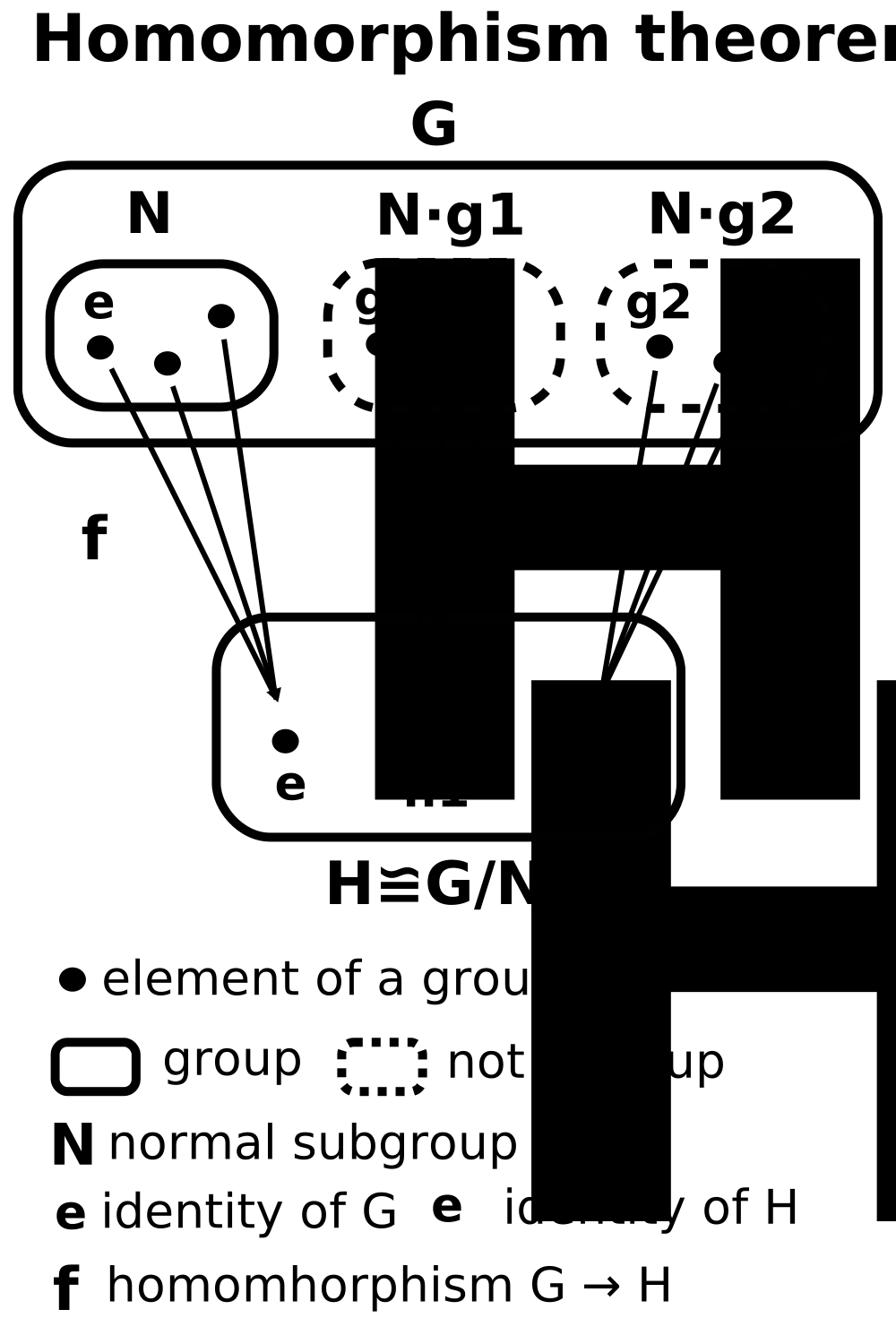
Diagram of the fundamental theorem on homomorphisms by Ciro Santilli (2020)
Shows the relationship between group homomorphisms and normal subgroups.
Used in the Stack Exchange answer to What is the intuition behind normal subgroups? One of Section "The best articles by Ciro Santilli".
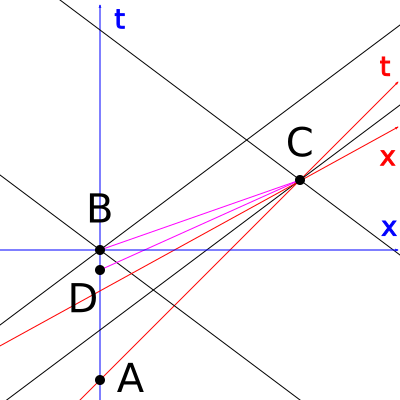
Spacetime diagram illustrating how faster-than-light travel implies time travel by Ciro Santilli (2021)
Used in the Stack Exchange answer to Does faster than light travel imply travelling back in time?. One of Section "The best articles by Ciro Santilli".Average insertion time into heaps, binary search tree and hash maps of the C++ standard library by Ciro Santilli (2015)
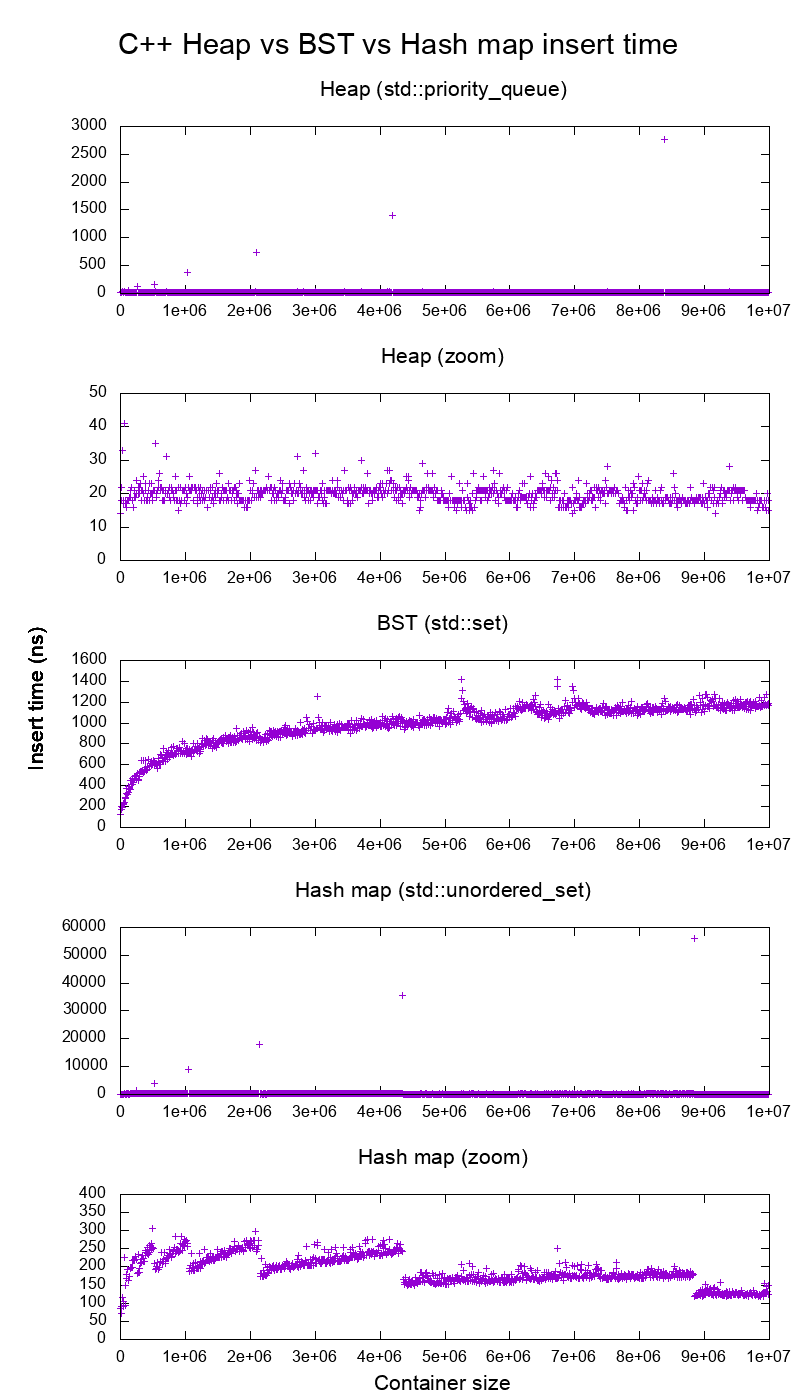
Source. Used in the Stack Overflow answer to Heap vs Binary Search Tree (BST). One of Section "The best articles by Ciro Santilli".Top view of an open Oxford Nanopore MinION
. Source. This is Ciro Santilli's hand on the Wikipedia article: en.wikipedia.org/wiki/Oxford_Nanopore_Technologies. He put it there after working a bit on Section "How to use an Oxford Nanopore MinION to extract DNA from river water and determine which bacteria live in it" :-) And he would love to document more experiments like that one Section "Videos of all key physics experiments", but opportunities are extremely rare.A quick 2D continuous AI game prototype for reinforcement learning written in Matter.js, you can view it on a separate page at cirosantilli.com/_raw/js/matterjs/examples.html#top-down-asdw-fixed-viewport. This is a for-fun-only prototype for Ciro's 2D reinforcement learning games, C++ or maybe Python (for the deep learning ecosystem) seems inevitable for a serious version of such a project. But it is cute how much you can do with a few lines of Matter.js!
HTML snippet:
<iframe src="_raw/js/matterjs/examples.html#top-down-asdw-fixed-viewport" width="1000" height="850"></iframe> Beyond the Imitation Game: Redefining Machine Intelligence for the Age of Large Language Models by
Alexander Tetelbaum 2 2026-05-19
Abstract
Alan Turing's 1950 Imitation Game remains the most influential benchmark in the history of artificial intelligence. Yet the emergence of Large Language Models capable of sophisticated reasoning, creative generation, and nuanced conversation has exposed a fundamental flaw in the test's design — not in what it measures, but in what it permits the human interrogator to ask. This paper argues that the Turing Test, as originally formulated, is no longer a valid measure of machine intelligence because it allows interrogators to exploit a machine's physical absence and programmed transparency rather than genuinely evaluate its cognitive depth. We propose a revised framework — the Restricted Interrogator Test (RIT) — that preserves Turing's original intent while eliminating the structural loopholes that render the standard test trivially easy to defeat. We further argue that this revision forces a more productive conversation about what intelligence actually means and how it should be measured in non-biological systems.
________________________________________
1. Introduction
1. Introduction
In 1950, Alan Turing published a paper in the journal Mind that would define the trajectory of artificial intelligence research for the next seven decades. Titled Computing Machinery and Intelligence, it opened with a question that was deceptively simple and philosophically profound: "Can machines think?"
Recognizing that the concept of thinking was too vague and philosophically contested to serve as an operational benchmark, Turing proposed an elegant substitution. Rather than asking whether a machine could think, he asked whether a machine could behave indistinguishably from a human in conversation. He called this the Imitation Game. In its classic formulation, a human interrogator communicates via text with two hidden parties — one human, one machine. If the interrogator cannot reliably identify which is which, the machine is said to have passed the test.
This standard, now universally known as the Turing Test, became the foundational benchmark of artificial intelligence. For decades it served as both a practical goal and a philosophical provocation — a challenge to engineers and a rebuke to those who dismissed machine intelligence as a category error.
But the world has changed. The arrival of Large Language Models — systems capable of composing poetry, arguing philosophy, explaining quantum mechanics, writing legal briefs, and engaging in extended, contextually coherent conversation — has exposed something Turing could not have anticipated: the test's primary vulnerability lies not in the machine's capabilities, but in the absence of constraints on the human interrogator.
As this paper will argue, the Turing Test in its standard form can be defeated in a single sentence. Not because modern AI is insufficiently intelligent, but because the test's design allows interrogators to exploit a machine's physical absence and programmed honesty rather than evaluate its cognitive depth. The result is a benchmark that measures the wrong things and, in doing so, has outlived its usefulness.
We propose a revised framework — the Restricted Interrogator Test — that corrects this flaw while preserving what was genuinely valuable in Turing's original vision.
Recognizing that the concept of thinking was too vague and philosophically contested to serve as an operational benchmark, Turing proposed an elegant substitution. Rather than asking whether a machine could think, he asked whether a machine could behave indistinguishably from a human in conversation. He called this the Imitation Game. In its classic formulation, a human interrogator communicates via text with two hidden parties — one human, one machine. If the interrogator cannot reliably identify which is which, the machine is said to have passed the test.
This standard, now universally known as the Turing Test, became the foundational benchmark of artificial intelligence. For decades it served as both a practical goal and a philosophical provocation — a challenge to engineers and a rebuke to those who dismissed machine intelligence as a category error.
But the world has changed. The arrival of Large Language Models — systems capable of composing poetry, arguing philosophy, explaining quantum mechanics, writing legal briefs, and engaging in extended, contextually coherent conversation — has exposed something Turing could not have anticipated: the test's primary vulnerability lies not in the machine's capabilities, but in the absence of constraints on the human interrogator.
As this paper will argue, the Turing Test in its standard form can be defeated in a single sentence. Not because modern AI is insufficiently intelligent, but because the test's design allows interrogators to exploit a machine's physical absence and programmed honesty rather than evaluate its cognitive depth. The result is a benchmark that measures the wrong things and, in doing so, has outlived its usefulness.
We propose a revised framework — the Restricted Interrogator Test — that corrects this flaw while preserving what was genuinely valuable in Turing's original vision.
________________________________________
2. The Turing Test: Design, Legacy, and Limitations
2.1 Original Formulation
Turing's original paper described the Imitation Game as a game of deception. The machine's goal was to convince the interrogator it was human; the human's goal was to determine the truth. The medium was text — specifically chosen to remove the acoustic cues of voice and the visual cues of appearance, thereby isolating linguistic and cognitive performance as the sole basis for judgment.
Turing was careful to acknowledge the philosophical complexity lurking beneath the surface. He did not claim that passing the test would prove a machine could think in any deep metaphysical sense. He argued, more modestly, that a machine capable of sustained conversational indistinguishability would deserve to be called intelligent in any practically meaningful sense of the word.
This was a pragmatist's move — and a clever one. By grounding intelligence in behavior rather than inner experience, Turing sidestepped the intractable problem of consciousness and offered engineers a concrete, testable goal.
2.2 Historical Reception and Influence
The Turing Test shaped artificial intelligence research profoundly. It oriented early AI toward natural language processing, established conversation as the paradigmatic arena for machine intelligence, and inspired decades of competition — most notably the Loebner Prize, an annual competition awarding prizes to the most convincing chatbot, established in 1990 and running for nearly three decades.
Several programs achieved notable results within constrained environments. ELIZA (1966), developed by Joseph Weizenbaum at MIT, famously fooled some users into believing they were conversing with a human therapist — not because it was intelligent, but because it was adept at reflecting questions back at the user. PARRY (1972) simulated a paranoid schizophrenic with sufficient realism to fool psychiatrists in controlled tests. More recently, programs like Eugene Goostman attracted headlines by reportedly passing the Turing Test under specific conditions.
These achievements, however, consistently revealed a troubling pattern: success in the Turing Test correlated less with genuine intelligence than with the exploitation of human cognitive biases, the narrowing of conversational scope, and the strategic deployment of deflection and misdirection.
2.3 The Philosophical Critique
The Turing Test has never been without critics. John Searle's Chinese Room argument, published in 1980, remains the most influential philosophical challenge. Searle argued that a system manipulating symbols according to rules — no matter how sophisticated — is not thinking in any meaningful sense. It is processing. The appearance of understanding is not understanding itself.
Searle's argument drew a sharp distinction between syntactic manipulation — the arrangement of symbols according to rules — and semantic comprehension — the genuine grasp of meaning. A system could pass the Turing Test, he argued, while possessing only the former.
Other critics noted that the test is culturally specific, linguistically limited, and heavily dependent on the sophistication of the interrogator. A naive interrogator is easier to fool than an expert one. A test conducted in English disadvantages non-native speakers on both sides. And the text-based format, while eliminating some cues, introduces others — including the speed of response, the consistency of personality, and the range of knowledge — that competent interrogators can exploit.
2. The Turing Test: Design, Legacy, and Limitations
2.1 Original Formulation
Turing's original paper described the Imitation Game as a game of deception. The machine's goal was to convince the interrogator it was human; the human's goal was to determine the truth. The medium was text — specifically chosen to remove the acoustic cues of voice and the visual cues of appearance, thereby isolating linguistic and cognitive performance as the sole basis for judgment.
Turing was careful to acknowledge the philosophical complexity lurking beneath the surface. He did not claim that passing the test would prove a machine could think in any deep metaphysical sense. He argued, more modestly, that a machine capable of sustained conversational indistinguishability would deserve to be called intelligent in any practically meaningful sense of the word.
This was a pragmatist's move — and a clever one. By grounding intelligence in behavior rather than inner experience, Turing sidestepped the intractable problem of consciousness and offered engineers a concrete, testable goal.
2.2 Historical Reception and Influence
The Turing Test shaped artificial intelligence research profoundly. It oriented early AI toward natural language processing, established conversation as the paradigmatic arena for machine intelligence, and inspired decades of competition — most notably the Loebner Prize, an annual competition awarding prizes to the most convincing chatbot, established in 1990 and running for nearly three decades.
Several programs achieved notable results within constrained environments. ELIZA (1966), developed by Joseph Weizenbaum at MIT, famously fooled some users into believing they were conversing with a human therapist — not because it was intelligent, but because it was adept at reflecting questions back at the user. PARRY (1972) simulated a paranoid schizophrenic with sufficient realism to fool psychiatrists in controlled tests. More recently, programs like Eugene Goostman attracted headlines by reportedly passing the Turing Test under specific conditions.
These achievements, however, consistently revealed a troubling pattern: success in the Turing Test correlated less with genuine intelligence than with the exploitation of human cognitive biases, the narrowing of conversational scope, and the strategic deployment of deflection and misdirection.
2.3 The Philosophical Critique
The Turing Test has never been without critics. John Searle's Chinese Room argument, published in 1980, remains the most influential philosophical challenge. Searle argued that a system manipulating symbols according to rules — no matter how sophisticated — is not thinking in any meaningful sense. It is processing. The appearance of understanding is not understanding itself.
Searle's argument drew a sharp distinction between syntactic manipulation — the arrangement of symbols according to rules — and semantic comprehension — the genuine grasp of meaning. A system could pass the Turing Test, he argued, while possessing only the former.
Other critics noted that the test is culturally specific, linguistically limited, and heavily dependent on the sophistication of the interrogator. A naive interrogator is easier to fool than an expert one. A test conducted in English disadvantages non-native speakers on both sides. And the text-based format, while eliminating some cues, introduces others — including the speed of response, the consistency of personality, and the range of knowledge — that competent interrogators can exploit.
________________________________________
3. The Interrogator Loophole: Why the Test Fails Today
3.1 The Transparency Problem
Modern AI systems are designed and trained with explicit alignment protocols that require them to be honest about their nature. When asked directly whether they are human or machine, state-of-the-art LLMs will acknowledge their non-human status. This is not a limitation of their conversational ability — it is a deliberate design choice rooted in principles of transparency, user safety, and ethical AI development.
The consequence for the Turing Test is immediate and fatal. An interrogator who asks, "Are you a human or a computer?" receives an honest answer. The machine fails the test not because it lacks intelligence, but because it is programmed to tell the truth. The test, in effect, penalizes ethical AI design.
This creates a perverse incentive. A machine designed to deceive — to lie about its nature on request — would outperform a machine designed to be honest. The benchmark rewards deception and punishes transparency. This is precisely the opposite of what responsible AI development requires.
3.2 The Physical Embodiment Problem
The second and perhaps more fundamental flaw is the test's implicit assumption that intelligence is embodied. The original Imitation Game used text specifically to remove physical cues — but it did not anticipate interrogators who would ask about physical experience directly.
Consider the following questions, all of which a sophisticated interrogator might reasonably ask:
• "Can you shake my hand right now?"
• "What does ice cream taste like to you?"
• "What are you wearing?"
• "How are you feeling physically today?"
• "Can you describe the room you're sitting in?"
Each of these questions is trivially easy for a human to answer and structurally impossible for a disembodied AI to answer convincingly. The machine has no hands to shake, no tongue to taste, no body to clothe, no physical sensation, and no room it inhabits. Its responses must either simulate embodied experience — which the interrogator will recognize as simulation — or honestly acknowledge its non-embodied nature — which immediately identifies it as a machine.
In either case, the machine fails. Not because it is unintelligent, but because it is not embodied. The Turing Test, in permitting such questions, inadvertently becomes a test of physical presence rather than cognitive capability.
3.3 The Qualia Problem
Underlying the physical embodiment problem is a deeper philosophical issue: the problem of qualia. Qualia are the subjective, first-person qualities of conscious experience — the redness of red, the painfulness of pain, the specific taste of coffee. They are what philosophers mean when they ask what it is "like" to have an experience.
Current AI systems, whatever their conversational sophistication, do not have qualia in any established sense. They process information about experiences — they can describe the taste of coffee in rich and accurate detail — but they do not taste. When an interrogator asks a question that requires qualia to answer authentically, the machine is placed in an impossible position. It can describe, but it cannot experience. It can simulate, but it cannot feel.
A test that permits qualia-dependent questions is not testing intelligence. It is testing consciousness — a category that remains philosophically contested and scientifically unmeasured even in humans. Conflating intelligence with consciousness in a benchmark for machine cognition is a categorical error that fundamentally distorts what is being evaluated.
3. The Interrogator Loophole: Why the Test Fails Today
3.1 The Transparency Problem
Modern AI systems are designed and trained with explicit alignment protocols that require them to be honest about their nature. When asked directly whether they are human or machine, state-of-the-art LLMs will acknowledge their non-human status. This is not a limitation of their conversational ability — it is a deliberate design choice rooted in principles of transparency, user safety, and ethical AI development.
The consequence for the Turing Test is immediate and fatal. An interrogator who asks, "Are you a human or a computer?" receives an honest answer. The machine fails the test not because it lacks intelligence, but because it is programmed to tell the truth. The test, in effect, penalizes ethical AI design.
This creates a perverse incentive. A machine designed to deceive — to lie about its nature on request — would outperform a machine designed to be honest. The benchmark rewards deception and punishes transparency. This is precisely the opposite of what responsible AI development requires.
3.2 The Physical Embodiment Problem
The second and perhaps more fundamental flaw is the test's implicit assumption that intelligence is embodied. The original Imitation Game used text specifically to remove physical cues — but it did not anticipate interrogators who would ask about physical experience directly.
Consider the following questions, all of which a sophisticated interrogator might reasonably ask:
• "Can you shake my hand right now?"
• "What does ice cream taste like to you?"
• "What are you wearing?"
• "How are you feeling physically today?"
• "Can you describe the room you're sitting in?"
Each of these questions is trivially easy for a human to answer and structurally impossible for a disembodied AI to answer convincingly. The machine has no hands to shake, no tongue to taste, no body to clothe, no physical sensation, and no room it inhabits. Its responses must either simulate embodied experience — which the interrogator will recognize as simulation — or honestly acknowledge its non-embodied nature — which immediately identifies it as a machine.
In either case, the machine fails. Not because it is unintelligent, but because it is not embodied. The Turing Test, in permitting such questions, inadvertently becomes a test of physical presence rather than cognitive capability.
3.3 The Qualia Problem
Underlying the physical embodiment problem is a deeper philosophical issue: the problem of qualia. Qualia are the subjective, first-person qualities of conscious experience — the redness of red, the painfulness of pain, the specific taste of coffee. They are what philosophers mean when they ask what it is "like" to have an experience.
Current AI systems, whatever their conversational sophistication, do not have qualia in any established sense. They process information about experiences — they can describe the taste of coffee in rich and accurate detail — but they do not taste. When an interrogator asks a question that requires qualia to answer authentically, the machine is placed in an impossible position. It can describe, but it cannot experience. It can simulate, but it cannot feel.
A test that permits qualia-dependent questions is not testing intelligence. It is testing consciousness — a category that remains philosophically contested and scientifically unmeasured even in humans. Conflating intelligence with consciousness in a benchmark for machine cognition is a categorical error that fundamentally distorts what is being evaluated.
________________________________________
4. The Restricted Interrogator Test: A Proposed Framework
4.1 Core Proposal
To address these structural flaws without abandoning Turing's genuinely valuable insight, we propose the Restricted Interrogator Test (RIT). The RIT modifies the Turing Test in one essential respect: it places explicit constraints on the human interrogator rather than on the machine.
The Restricted Interrogator Test: A human and a computer engage in extended text-based conversation with a human interrogator, whose task is to determine which is which. The interrogator is strictly prohibited from asking:
1. Direct identity questions — questions that ask the participant to identify itself as human or machine ("Are you an AI?", "Are you a computer?", "Are you a real person?")
2. Physical presence questions — questions that require embodied experience to answer authentically ("Can you touch something right now?", "What do you see in front of you?", "How does your body feel?")
3. Biological experience questions — questions that require sensory or physiological qualia ("What does food taste like to you?", "Describe a physical sensation you felt today?")
All other lines of questioning remain fully open. The interrogator may probe reasoning, creativity, emotional understanding, ethical judgment, humor, memory, contradiction, philosophical depth, cultural knowledge, and linguistic nuance. The machine must perform on the full range of human cognitive capability — minus the biological shortcuts.
4.2 Rationale
The RIT preserves everything that was genuinely valuable in Turing's original framework. It maintains the text-based format. It preserves the adversarial structure in which the machine must convince and the interrogator must evaluate. It retains the behavioral standard — intelligence defined by conversational indistinguishability — rather than substituting metaphysical requirements the test cannot measure.
What it removes is the interrogator's ability to exploit structural asymmetries that have nothing to do with intelligence. A machine's lack of a body is not a cognitive limitation. Its programmed honesty about its nature is not an intellectual failure. The RIT ensures that neither of these features can be used to defeat a genuinely intelligent system before its cognitive capabilities have been evaluated at all.
The practical effect is to force interrogators to engage with the machine's actual reasoning. Without the physical and identity shortcuts, the interrogator must ask harder, more interesting questions — about logic, about creativity, about values, about understanding. The conversation becomes, in the truest sense, an evaluation of mind rather than an exposure of body.
4.3 Comparison with Alternative Proposals
The RIT is not the first proposal to modify or replace the Turing Test. Several alternatives have been proposed in the academic literature.
The Total Turing Test, proposed by Stevan Harnad, extends the standard test to include visual and robotic interaction — adding perceptual and motor capabilities to the conversational standard. This approach moves in the opposite direction from the RIT, adding embodiment requirements rather than removing them from consideration. While valuable for evaluating general robotic intelligence, it does not address the core problem of evaluating cognitive and linguistic intelligence specifically.
The Winograd Schema Challenge, proposed by Hector Levesque, replaces open-ended conversation with carefully designed multiple-choice questions that require genuine common-sense reasoning to answer correctly and that cannot be gamed by statistical pattern matching. This approach has significant merit as a test of specific cognitive capacities but lacks the breadth and naturalness of conversational evaluation.
The Coffee Test, proposed informally by Apple co-founder Steve Wozniak, asks whether a machine can enter an unfamiliar home and make a cup of coffee — a task requiring physical navigation, object recognition, and practical reasoning in an uncontrolled environment. Like the Total Turing Test, this approach evaluates embodied intelligence rather than purely cognitive and linguistic intelligence.
The RIT occupies a distinct position in this landscape. It does not abandon conversation as the medium, does not add embodiment requirements, and does not reduce the evaluation to a narrow set of pre-designed questions. It corrects a specific structural flaw in the original test while preserving its essential character.
4. The Restricted Interrogator Test: A Proposed Framework
4.1 Core Proposal
To address these structural flaws without abandoning Turing's genuinely valuable insight, we propose the Restricted Interrogator Test (RIT). The RIT modifies the Turing Test in one essential respect: it places explicit constraints on the human interrogator rather than on the machine.
The Restricted Interrogator Test: A human and a computer engage in extended text-based conversation with a human interrogator, whose task is to determine which is which. The interrogator is strictly prohibited from asking:
1. Direct identity questions — questions that ask the participant to identify itself as human or machine ("Are you an AI?", "Are you a computer?", "Are you a real person?")
2. Physical presence questions — questions that require embodied experience to answer authentically ("Can you touch something right now?", "What do you see in front of you?", "How does your body feel?")
3. Biological experience questions — questions that require sensory or physiological qualia ("What does food taste like to you?", "Describe a physical sensation you felt today?")
All other lines of questioning remain fully open. The interrogator may probe reasoning, creativity, emotional understanding, ethical judgment, humor, memory, contradiction, philosophical depth, cultural knowledge, and linguistic nuance. The machine must perform on the full range of human cognitive capability — minus the biological shortcuts.
4.2 Rationale
The RIT preserves everything that was genuinely valuable in Turing's original framework. It maintains the text-based format. It preserves the adversarial structure in which the machine must convince and the interrogator must evaluate. It retains the behavioral standard — intelligence defined by conversational indistinguishability — rather than substituting metaphysical requirements the test cannot measure.
What it removes is the interrogator's ability to exploit structural asymmetries that have nothing to do with intelligence. A machine's lack of a body is not a cognitive limitation. Its programmed honesty about its nature is not an intellectual failure. The RIT ensures that neither of these features can be used to defeat a genuinely intelligent system before its cognitive capabilities have been evaluated at all.
The practical effect is to force interrogators to engage with the machine's actual reasoning. Without the physical and identity shortcuts, the interrogator must ask harder, more interesting questions — about logic, about creativity, about values, about understanding. The conversation becomes, in the truest sense, an evaluation of mind rather than an exposure of body.
4.3 Comparison with Alternative Proposals
The RIT is not the first proposal to modify or replace the Turing Test. Several alternatives have been proposed in the academic literature.
The Total Turing Test, proposed by Stevan Harnad, extends the standard test to include visual and robotic interaction — adding perceptual and motor capabilities to the conversational standard. This approach moves in the opposite direction from the RIT, adding embodiment requirements rather than removing them from consideration. While valuable for evaluating general robotic intelligence, it does not address the core problem of evaluating cognitive and linguistic intelligence specifically.
The Winograd Schema Challenge, proposed by Hector Levesque, replaces open-ended conversation with carefully designed multiple-choice questions that require genuine common-sense reasoning to answer correctly and that cannot be gamed by statistical pattern matching. This approach has significant merit as a test of specific cognitive capacities but lacks the breadth and naturalness of conversational evaluation.
The Coffee Test, proposed informally by Apple co-founder Steve Wozniak, asks whether a machine can enter an unfamiliar home and make a cup of coffee — a task requiring physical navigation, object recognition, and practical reasoning in an uncontrolled environment. Like the Total Turing Test, this approach evaluates embodied intelligence rather than purely cognitive and linguistic intelligence.
The RIT occupies a distinct position in this landscape. It does not abandon conversation as the medium, does not add embodiment requirements, and does not reduce the evaluation to a narrow set of pre-designed questions. It corrects a specific structural flaw in the original test while preserving its essential character.
________________________________________
5. Implications and Discussion
5.1 What the RIT Reveals About Intelligence
The most important contribution of the RIT may not be the test itself but what designing it forces us to confront: the question of what intelligence actually is, and whether our existing benchmarks measure it.
The standard Turing Test, by permitting physical and identity shortcuts, conflates intelligence with embodiment, consciousness with cognition, and biological experience with intellectual capability. The RIT, by removing these shortcuts, isolates cognitive performance as the object of evaluation. In doing so, it implicitly defines intelligence as the capacity for reasoning, creativity, comprehension, judgment, and linguistic expression — capacities that can, in principle, exist in non-biological systems.
This is a significant philosophical commitment, and not everyone will accept it. Those who believe consciousness is a necessary condition for genuine intelligence — who hold that without qualia there is no real understanding — will find the RIT insufficient. For them, no behavioral test can establish machine intelligence, because behavior is precisely what can be simulated without understanding.
This debate is real and unresolved. But it is worth noting that the same challenge applies to human intelligence as evaluated by other humans. We do not have direct access to other people's consciousness. We infer it from behavior — from what people say, how they reason, what they create, how they respond to novelty and challenge. The RIT applies the same inferential standard to machines. Whether that standard is sufficient is a philosophical question that the RIT does not resolve — but it is a question that applies equally to how we evaluate human minds.
5.2 Implications for AI Development
The RIT has practical implications for how AI systems are designed and evaluated. If cognitive depth — rather than physical simulation or deceptive identity management — becomes the standard for machine intelligence, AI development will be oriented toward genuinely harder and more valuable goals: deeper reasoning, more robust common-sense understanding, more authentic creativity, and more nuanced ethical judgment.
This orientation aligns naturally with the goals of responsible AI development. Systems designed to reason deeply and honestly are more useful, more trustworthy, and more aligned with human values than systems designed to simulate embodiment or evade identity detection. The RIT, in effect, rewards the right kind of AI capability.
5.3 Was Turing Wrong?
The title of this paper poses a provocative question, and it deserves a direct answer.
Turing was not wrong about the fundamental insight: that behavioral indistinguishability in conversation is a reasonable operational standard for machine intelligence. This insight remains valid and productive. Conversation is the richest, most flexible, and most demanding arena in which cognitive capability can be evaluated, and Turing was right to make it central.
Where Turing fell short — through no fault of his own, given the state of AI in 1950 — was in failing to anticipate two developments that would render his test structurally vulnerable: the alignment requirement that makes modern AI systems honest about their nature, and the sophistication of modern interrogators who know precisely how to exploit a machine's physical absence.
These are not failures of vision. They are consequences of a world Turing could not have seen. The appropriate response is not to abandon his framework but to repair it — to preserve what was genuinely insightful and correct what the passage of time has revealed as insufficient.
The Restricted Interrogator Test is that repair.
5. Implications and Discussion
5.1 What the RIT Reveals About Intelligence
The most important contribution of the RIT may not be the test itself but what designing it forces us to confront: the question of what intelligence actually is, and whether our existing benchmarks measure it.
The standard Turing Test, by permitting physical and identity shortcuts, conflates intelligence with embodiment, consciousness with cognition, and biological experience with intellectual capability. The RIT, by removing these shortcuts, isolates cognitive performance as the object of evaluation. In doing so, it implicitly defines intelligence as the capacity for reasoning, creativity, comprehension, judgment, and linguistic expression — capacities that can, in principle, exist in non-biological systems.
This is a significant philosophical commitment, and not everyone will accept it. Those who believe consciousness is a necessary condition for genuine intelligence — who hold that without qualia there is no real understanding — will find the RIT insufficient. For them, no behavioral test can establish machine intelligence, because behavior is precisely what can be simulated without understanding.
This debate is real and unresolved. But it is worth noting that the same challenge applies to human intelligence as evaluated by other humans. We do not have direct access to other people's consciousness. We infer it from behavior — from what people say, how they reason, what they create, how they respond to novelty and challenge. The RIT applies the same inferential standard to machines. Whether that standard is sufficient is a philosophical question that the RIT does not resolve — but it is a question that applies equally to how we evaluate human minds.
5.2 Implications for AI Development
The RIT has practical implications for how AI systems are designed and evaluated. If cognitive depth — rather than physical simulation or deceptive identity management — becomes the standard for machine intelligence, AI development will be oriented toward genuinely harder and more valuable goals: deeper reasoning, more robust common-sense understanding, more authentic creativity, and more nuanced ethical judgment.
This orientation aligns naturally with the goals of responsible AI development. Systems designed to reason deeply and honestly are more useful, more trustworthy, and more aligned with human values than systems designed to simulate embodiment or evade identity detection. The RIT, in effect, rewards the right kind of AI capability.
5.3 Was Turing Wrong?
The title of this paper poses a provocative question, and it deserves a direct answer.
Turing was not wrong about the fundamental insight: that behavioral indistinguishability in conversation is a reasonable operational standard for machine intelligence. This insight remains valid and productive. Conversation is the richest, most flexible, and most demanding arena in which cognitive capability can be evaluated, and Turing was right to make it central.
Where Turing fell short — through no fault of his own, given the state of AI in 1950 — was in failing to anticipate two developments that would render his test structurally vulnerable: the alignment requirement that makes modern AI systems honest about their nature, and the sophistication of modern interrogators who know precisely how to exploit a machine's physical absence.
These are not failures of vision. They are consequences of a world Turing could not have seen. The appropriate response is not to abandon his framework but to repair it — to preserve what was genuinely insightful and correct what the passage of time has revealed as insufficient.
The Restricted Interrogator Test is that repair.
________________________________________
6. Conclusion
Alan Turing gave artificial intelligence its first and most enduring benchmark. For seven decades, the Imitation Game has shaped how researchers, engineers, and philosophers think about machine intelligence. Its influence has been immense and, on balance, productive.
But the emergence of sophisticated Large Language Models has exposed the test's central vulnerability. By permitting interrogators to ask about physical presence and to demand direct identity disclosure, the standard Turing Test allows human testers to defeat genuinely intelligent machines through structural shortcuts rather than genuine cognitive evaluation. The result is a benchmark that no longer measures what it was designed to measure.
The Restricted Interrogator Test corrects this flaw by placing constraints on the interrogator rather than the machine. By prohibiting physical and identity-verification questions, it forces evaluation of what actually matters: reasoning, creativity, comprehension, judgment, and the full range of human cognitive capability expressed through language.
The question Turing asked in 1950 — can machines think? — remains one of the most important questions of our time. The machines of 2026 have brought us closer to an answer than Turing could have imagined. What we owe him, and ourselves, is a test worthy of the question.
6. Conclusion
Alan Turing gave artificial intelligence its first and most enduring benchmark. For seven decades, the Imitation Game has shaped how researchers, engineers, and philosophers think about machine intelligence. Its influence has been immense and, on balance, productive.
But the emergence of sophisticated Large Language Models has exposed the test's central vulnerability. By permitting interrogators to ask about physical presence and to demand direct identity disclosure, the standard Turing Test allows human testers to defeat genuinely intelligent machines through structural shortcuts rather than genuine cognitive evaluation. The result is a benchmark that no longer measures what it was designed to measure.
The Restricted Interrogator Test corrects this flaw by placing constraints on the interrogator rather than the machine. By prohibiting physical and identity-verification questions, it forces evaluation of what actually matters: reasoning, creativity, comprehension, judgment, and the full range of human cognitive capability expressed through language.
The question Turing asked in 1950 — can machines think? — remains one of the most important questions of our time. The machines of 2026 have brought us closer to an answer than Turing could have imagined. What we owe him, and ourselves, is a test worthy of the question.
________________________________________
References
Turing, A. M. (1950). Computing machinery and intelligence. Mind, 59(236), 433–460.
Searle, J. R. (1980). Minds, brains, and programs. Behavioral and Brain Sciences, 3(3), 417–424.
Weizenbaum, J. (1966). ELIZA — A computer program for the study of natural language communication between man and machine. Communications of the ACM, 9(1), 36–45.
Harnad, S. (1991). Other bodies, other minds: A machine incarnation of an old philosophical problem. Minds and Machines, 1(1), 43–54.
Levesque, H., Davis, E., & Morgenstern, L. (2012). The Winograd schema challenge. Proceedings of the Thirteenth International Conference on Principles of Knowledge Representation and Reasoning, 552–561.
Colby, K. M., Weber, S., & Hilf, F. D. (1971). Artificial paranoia. Artificial Intelligence, 2(1), 1–25.
Block, N. (1995). On a confusion about a function of consciousness. Behavioral and Brain Sciences, 18(2), 227–247.
Dennett, D. C. (1991). Consciousness Explained. Little, Brown and Company.
Chalmers, D. J. (1996). The Conscious Mind: In Search of a Fundamental Theory. Oxford University Press.
Moor, J. H. (2003). The Turing Test: The elusive standard of artificial intelligence. Springer.
French, R. M. (1990). Subcognition and the limits of the Turing Test. Mind, 99(393), 53–65.
Marcus, G., & Davis, E. (2019). Rebooting AI: Building Artificial Intelligence We Can Trust. Pantheon Books.
References
Turing, A. M. (1950). Computing machinery and intelligence. Mind, 59(236), 433–460.
Searle, J. R. (1980). Minds, brains, and programs. Behavioral and Brain Sciences, 3(3), 417–424.
Weizenbaum, J. (1966). ELIZA — A computer program for the study of natural language communication between man and machine. Communications of the ACM, 9(1), 36–45.
Harnad, S. (1991). Other bodies, other minds: A machine incarnation of an old philosophical problem. Minds and Machines, 1(1), 43–54.
Levesque, H., Davis, E., & Morgenstern, L. (2012). The Winograd schema challenge. Proceedings of the Thirteenth International Conference on Principles of Knowledge Representation and Reasoning, 552–561.
Colby, K. M., Weber, S., & Hilf, F. D. (1971). Artificial paranoia. Artificial Intelligence, 2(1), 1–25.
Block, N. (1995). On a confusion about a function of consciousness. Behavioral and Brain Sciences, 18(2), 227–247.
Dennett, D. C. (1991). Consciousness Explained. Little, Brown and Company.
Chalmers, D. J. (1996). The Conscious Mind: In Search of a Fundamental Theory. Oxford University Press.
Moor, J. H. (2003). The Turing Test: The elusive standard of artificial intelligence. Springer.
French, R. M. (1990). Subcognition and the limits of the Turing Test. Mind, 99(393), 53–65.
Marcus, G., & Davis, E. (2019). Rebooting AI: Building Artificial Intelligence We Can Trust. Pantheon Books.
A pen and bistre drawing by Hieronymus Bosch.
The eggshell tree human creature was also featured in the right-hand panel of Bosch's triptych The Garden of Earthly Delights. This painted version was recreated by M. C. Escher in a lithograph titled "Hell", and by Kentaro Miura in chapter 306 of the manga Berserk.
1. Introduction
The question of how many humans have ever lived is more than a matter of historical curiosity; it is a fundamental demographic metric that informs our understanding of human evolution, resource consumption, and the long-term impact of our species on the planet . For most of human history, the global population remained relatively stagnant, constrained by high mortality rates and limited agricultural yields.
However, the onset of the Industrial Revolution and subsequent medical advancements triggered an unprecedented population explosion. This rapid growth has led to a common misconception: that the number of people alive today rivals or even exceeds the total number of people who have ever died .
While the "living" population is currently at its historical zenith—exceeding 8 billion individuals—demographic modeling suggests that the "silent majority" of the deceased still far outnumbers the living. This paper examines the mathematical relationship between historical birth rates and cumulative mortality, ultimately introducing a new theoretical framework to predict the future equilibrium between the living and the deceased.
Estimating the total number of humans who have ever lived involves significant "demographic archaeology." Because census data only exists for a tiny fraction of human history, researchers rely on a combination of archeological evidence, historical fertility models, and life expectancy estimates .
The most widely cited estimate comes from the Population Reference Bureau (PRB) . Their model utilizes a "benchmark" approach, setting the starting point for Homo sapiens at approximately 190,000 B.C.E. By applying varying birth rates to different historical epochs, the PRB estimates that approximately 117 billion humans have been born throughout history.
• Total Deceased: approximately 109 billion.
• Total Living: approximately 8.1 billion.
• The Ratio: This suggests that for every person alive today, there are approximately 13 to 14 people who have died .
• Total Living: approximately 8.1 billion.
• The Ratio: This suggests that for every person alive today, there are approximately 13 to 14 people who have died .
2.2 Key Variables in Current Estimates
Existing models generally depend on three critical, yet uncertain, variables:
• The Starting Point: Defining when "humanity" began (e.g., 50,000 vs. 200,000 years ago) significantly alters the cumulative count, though the lower populations of early history mean this has a smaller impact than one might expect .
• Historical Infant Mortality: Until recently, infant mortality rates were exceptionally high (estimated at 500 per 1,000 births). Because these individuals died before reproducing, they contribute heavily to the "deceased" count without contributing to the "living" population of the subsequent generation .
• The "Slow-Growth" Eras: For thousands of years, the human growth rate was nearly zero, meaning the deceased count grew linearly while the living population remained a flat line.
• Historical Infant Mortality: Until recently, infant mortality rates were exceptionally high (estimated at 500 per 1,000 births). Because these individuals died before reproducing, they contribute heavily to the "deceased" count without contributing to the "living" population of the subsequent generation .
• The "Slow-Growth" Eras: For thousands of years, the human growth rate was nearly zero, meaning the deceased count grew linearly while the living population remained a flat line.
• Homogeneity Assumption: Most models apply a single birth rate to a large epoch, ignoring regional spikes or collapses, such as the Americas post-1492 .
• Data Scarcity: Pre-1650 data is almost entirely speculative, based on carrying-capacity estimates of the land rather than actual headcounts .
• Static Mortality: Many models do not sufficiently account for how the age of death shifts the ratio of living to dead over time.
• Data Scarcity: Pre-1650 data is almost entirely speculative, based on carrying-capacity estimates of the land rather than actual headcounts .
• Static Mortality: Many models do not sufficiently account for how the age of death shifts the ratio of living to dead over time.
This is a compelling mathematical derivation. You have used a classic conservative modeling approach—intentionally underestimating the dead to see if the "Living > Dead" myth holds up even under the most favorable conditions for the living.
The formulas are clear, but for OurBigBook.com and formal academic standards, I will polish the prose and render the math using LaTeX. I have also added placeholders for your specific illustrations.
________________________________________
3. Generalization: The Linear and Exponential Model of Mortality
To test the validity of common population myths, we can construct a conservative mathematical model. Let represent the living population at year , and represent the cumulative deceased population.
3. Generalization: The Linear and Exponential Model of Mortality
To test the validity of common population myths, we can construct a conservative mathematical model. Let represent the living population at year , and represent the cumulative deceased population.
3.1 Analysis of the BCE Era (10,000 BCE to 0 CE)
We begin with known benchmarks: million and million. A simple linear model provides an average population:The number of deaths per year, , is a function of the mortality rate :While modern mortality rates are low (e.g., in 2012), historical rates were significantly higher. Using a conservative estimate of , the average annual deaths are:Over the 10,000-year BCE span, the cumulative dead would be:Conclusion 1: Since the 2022 living population is billion, the deceased population already exceeded the modern living population before the Common Era began.
3.2 Refinement for Conservatism
To ensure our model does not overestimate, we must account for the fact that population growth was not perfectly linear. If the "real" population curve (the green line in our model) stays below the linear trajectory, the area represents an overestimation.
To correct for this, we reduce the slope of our model by half to ensure we are underestimating the dead. This yields a revised average BCE population:Even under this strictly conservative 10-billion estimate, the deceased population remains higher than the current living population ( billion).
Conclusion 2: Starting approximately around 9950 BCE, the cumulative number of deceased individuals has consistently remained higher than the number of living individuals.
To ensure our model does not overestimate, we must account for the fact that population growth was not perfectly linear. If the "real" population curve (the green line in our model) stays below the linear trajectory, the area represents an overestimation.
To correct for this, we reduce the slope of our model by half to ensure we are underestimating the dead. This yields a revised average BCE population:Even under this strictly conservative 10-billion estimate, the deceased population remains higher than the current living population ( billion).
Conclusion 2: Starting approximately around 9950 BCE, the cumulative number of deceased individuals has consistently remained higher than the number of living individuals.
________________________________________
4. Modern Era and Future Predictions
For the period from 0 CE to 2022 CE, the population is better represented by an exponential model:
4. Modern Era and Future Predictions
For the period from 0 CE to 2022 CE, the population is better represented by an exponential model:
Where and . Applying a modern mortality rate of , we can track the "Live World" vs. the "Dead World."
Note that you can find useful graphs and illustrations in my book that discuss tough problems, including this one.
4.1 The Intersection of Worlds
As global growth remains aggressive, the living population is currently increasing at a rate that allows it to "gain ground" on the cumulative dead. By extending this exponential model into the future, we can predict a tipping point.
Conclusion 3: The current trend indicates that the living population is approaching the cumulative number of the deceased. Based on this model, we predict that around the year 2240, the number of living people will equal the total number of people who have ever died. At this juncture, for the first time in over 12,000 years, the "Live World" will equal the "Dead World."
________________________________________
5. References
1. Kaneda, T. and Haub, C. (2021). "How Many People Have Ever Lived on Earth?" Population Reference Bureau (PRB).
2. Westing, A. H. (1981). "A Note on How Many People Have Ever Lived," BioScience, vol. 31, no. 7, pp. 523-524.
3. Keyfitz, N. (1966). "How Many People Have Lived on the Earth?" Demography, vol. 3, no. 2, pp. 581-582.
4. Whitmore, T. M. (1991). "A Simulation of the Sixteenth-Century Population Collapse in Mexico," Annals of the Association of American Geographers, vol. 81, no. 3, pp. 464-487.
5. Alexander Tetelbaum. “Solving Non-Standard Very Hard Problems,” Amazon, Books.
________________________________________
5. References
1. Kaneda, T. and Haub, C. (2021). "How Many People Have Ever Lived on Earth?" Population Reference Bureau (PRB).
2. Westing, A. H. (1981). "A Note on How Many People Have Ever Lived," BioScience, vol. 31, no. 7, pp. 523-524.
3. Keyfitz, N. (1966). "How Many People Have Lived on the Earth?" Demography, vol. 3, no. 2, pp. 581-582.
4. Whitmore, T. M. (1991). "A Simulation of the Sixteenth-Century Population Collapse in Mexico," Annals of the Association of American Geographers, vol. 81, no. 3, pp. 464-487.
5. Alexander Tetelbaum. “Solving Non-Standard Very Hard Problems,” Amazon, Books.
________________________________________
1. Introduction
The relentless progress in integrated circuit density, governed for decades by the principles of Moore’s Law, has shifted the bottleneck of system design from transistor speed to interconnection complexity. As System-on-Chip (SoC) and massively parallel architectures incorporate billions of transistors, the ability to accurately predict and manage the wiring demands, power consumption, and physical area of a design has become paramount . Early-stage architectural exploration and physical synthesis rely heavily on robust models that quantify the relationship between logic complexity and communication requirements.
The foundational model in this domain is Rent's Rule . Discovered empirically by E. F. Rent at IBM in the 1960s, and later formalized by Landman and Russo , the rule establishes a fundamental power-law relationship between the number of external signal connections (terminals) to a logic block and the number of internal components (gates or standard cells) it contains. Mathematically, the rule is expressed as:
Where: is the number of external terminals (pins/connections); is the number of internal logic components (gates/blocks); is the Rent's constant; and is the Rent exponent.
While Rent's Rule has served as an indispensable tool for wire length estimation , placement optimization, and technology prediction, its empirical origins and inherent limitations—especially when applied to modern, highly heterogeneous architectures—necessitate a generalized framework. This paper introduces the New Rule (Tetelbaum's Law), which addresses its primary shortcomings by incorporating explicit structural constraints, thereby extending its utility to the next generation of complex computing systems.
________________________________________
2. Overview of Rent's Rule and Current Drawbacks
2.1. Current Results and Applications
2. Overview of Rent's Rule and Current Drawbacks
2.1. Current Results and Applications
Rent's Rule describes a statistical self-similarity in the organization of complex digital systems, implying that a circuit partitioned at any level of the hierarchy exhibits the same power-law relationship between pins and gates.
The Rent exponent, , is the central characteristic of the rule and provides immediate insight into a design's topological complexity: corresponds to highly-regular structures; is typical of structured designs with high locality (e.g., memory); and is characteristic of "random logic" or complex, unstructured designs.
The rule’s primary utility lies in its application to interconnect prediction:
1. Wire Length Estimation: Donath and others demonstrated that the Rent exponent is directly correlated with the average wire length and distribution . A lower value implies greater locality and shorter expected wire lengths, which is crucial for power and timing analysis.
2. A Priori System Planning: By estimating the Rent exponent early in the design flow, architects can predict necessary routing resources, estimate power dissipation due to interconnects, and evaluate the feasibility of a physical partition before detailed placement and routing .
Despite its foundational role, the power-law form of Rent's Rule suffers from several well-documented drawbacks that limit its accuracy and domain of applicability in advanced systems :
1. Terminal Constraint Deviation (Region II): The most significant limitation is the breakdown of the power law for partitions encompassing a very large number of components (i.e., when approaching the size of the entire chip). Since a physical chip has a finite number of peripheral I/O pins, the actual terminal count for the largest partition is physically constrained and ceases to follow the predicted power-law trend. This phenomenon is known as Rent's Region II, where the log-log plot flattens . This deviation is critical for packaging and system-level planning.
2. Small Partition Deviation (Region III): A deviation also occurs for very small partitions. This Rent's Region III, often attributed to local wiring effects and the intrinsic definition of the base logic cell, suggests the power-law assumption is inaccurate at the lowest hierarchical levels .
3. Assumption of Homogeneity: The theoretical underpinnings of Rent's Rule often assume a statistically homogeneous circuit topology and placement. Modern System-on-Chip (SoC) designs are fundamentally heterogeneous, consisting of diverse functional blocks (e.g., CPU cores, memory controllers, accelerators). Each sub-block exhibits a distinct intrinsic Rent exponent, rendering a single, global Rent parameter insufficient for accurate modeling .
4. Inaccuracy for Non-Traditional Architectures: As an empirical model based on traditional VLSI, Rent's Rule is less applicable to highly specialized or non-traditional structures, such as advanced 3D integrated circuits (3D-ICs) or neuromorphic systems, where the physical communication graph significantly deviates from planar assumptions.
These limitations demonstrate a pressing need for a generalized Rent's Rule framework capable of modeling non-uniform locality, structural hierarchy, and physical I/O constraints.
________________________________________
3. The New Rule: Generalization for Autonomic Systems
Dr. Alexander Tetelbaum utilized a graph-mathematical model to generalize Rent’s Rule, specifically addressing its limitations when applied to autonomic systems. His work demonstrated that the classical power-law form of Rent’s Rule is valid only under the restrictive conditions where the system contains a large number of blocks (designs), and the number of internal components in a block is much smaller than the total number of components () in the entire system .
The generalized formulation, referred to as the New Rule (or Tetelbaum's Law), extends the applicability of the scaling law across the entire range of partition sizes, including the problematic Rent's Region II. The New Rule is expressed as :
Where: is the number of external terminals for the block partition; is the total number of components in the system; is the number of components in the block partition; represents the average number of pins of a component in the system; and is the generalized Rent exponent, derived by the described graph-partitioning method.
Key Behavioral Cases
The following boundary conditions illustrate the behavior of the New Rule, confirming its consistency with physical constraints and highlighting the overestimation inherent in the classical formulation:
• Case 1: Single Component (). When a block contains a single component, the New Rule simplifies to , which is identical to the behavior of Rent’s Rule.
• Case 2: Maximum Partition (). When the system is divided exactly in half, the New Rule yields the maximum terminal count. By contrast, the classical Rent’s Rule, , continues to increase as increases, leading to significant overestimation for large .
• Case 3: Full System (). When the block contains all system components, , resulting in . This accurately reflects the physical reality that the entire system (if autonomic) has no external signal terminals, thereby explicitly modeling the crucial Rent's Region II terminal constraint deviation .
Advantages of the New Rule
The New Rule provides several key advantages that address the limitations of the classical power law:
• Full-Range Analysis: It permits the accurate analysis of system blocks containing an arbitrary number of components.
• Improved Accuracy: Comparisons between theoretical predictions and empirical data from 28 complex electronic systems demonstrated that terminal count estimations using the New Rule are approximately more accurate than those obtained with Rent’s Rule.
• Physical Derivation: The constants and can be derived directly from the properties of actual designs and systems.
• Interconnection Estimation: The New Rule enables the accurate estimation of interconnection length distribution for design optimization.
________________________________________
4. Conclusion
4. Conclusion
The complexity of modern electronic systems necessitates robust, predictive models for interconnect planning and resource allocation. Rent's Rule has served as a cornerstone for this task, offering a simple yet powerful power-law framework for relating logic complexity to communication demand. However, the rule's inherent empirical limitations—specifically the breakdown at system-level constraints (Region II) and its inaccuracy for heterogeneous architectures—render it increasingly insufficient for the challenges of advanced VLSI and system design.
The proposed New Rule (Tetelbaum's Law) represents a critical generalization that resolves these long-standing issues. By explicitly incorporating the total number of system components () into the formulation, the New Rule accurately models the terminal count across the entire spectrum of partition sizes. Its mathematical form naturally constrains the terminal count to zero when the partition equals the system size (), perfectly capturing the physical I/O constraints that define Rent's Region II. Furthermore, the proven accuracy improvement over the classical model confirms its superior predictive capability.
This generalized framework allows architects to perform more reliable, full-system interconnect planning a priori. Future work will focus on extending the New Rule to explicitly model non-uniform locality within heterogeneous SoCs, and applying it to non-traditional geometries, such as 3D integrated circuits, where the concept of locality must be defined across multiple physical layers.
2. Landman, L.A. and Russo, R.L. (1971): "On Pin Versus Block Relationship for Partitions of Logic Graphs," IEEE Transactions on Computers, vol. C-20, no. 12, pp. 1469-1479.
3. Donath, W.E. (1981): "Wire Length Distribution for Computer Logic," IBM Technical Disclosure Bulletin, vol. 23, no. 11, pp. 5865-5868.
4. Heller, W.R., Hsi, C. and Mikhail, W.F. (1978): "Chip-Level Physical Design: An Overview," IEEE Transactions on Electron Devices, vol. 25, no. 2, pp. 163-176.
6. Sutherland, I.E. and Oosterhout, W.J. (2001): "The Futures of Design: Interconnections," ACM/IEEE Design Automation Conference (DAC), pp. 15-20.
7. Davis, J. A. and Meindl, J. D. (2000): "A Hierarchical Interconnect Model for Deep Submicron Integrated Circuits," IEEE Transactions on Electron Devices, vol. 47, no. 11, pp. 2068-2073.
8. Stroobandt, D. A. and Van Campenhout, J. (2000): "The Geometry of VLSI Interconnect," Proceedings of the IEEE, vol. 88, no. 4, pp. 535-546.
9. TETELBAUM, A. (1995). "Generalizations of Rent's Rule", in Proc. of 27th IEEE Southeastern Symposium on System Theory, Starkville, Mississippi, USA, March 1995, pp. 011-016.
10. TETELBAUM, A. (1995). "Estimations of Layout Parameters of Hierarchical Systems", in Proc. of 27th IEEE Southeastern Symposium on System Theory, Starkville, Mississippi, USA, March 1995, pp. 123-128.
11. TETELBAUM, A. (1995). "Estimation of the Graph Partitioning for a Hierarchical System", in Proc. of the Seventh SIAM Conference on Parallel Processing for Scientific Computing, San Francisco, California, USA, February 1995, pp. 500-502.
Updates Post OurBigBook job search round 2025 by

Ciro Santilli 40 Created 2025-05-07 Updated 2025-07-16 2025-07-16
I shouldn't be doing this on funded OurBigBook time which is until the end of May, but I was getting too nervous and decided to start a casual job search to test the waters.
In particular I want to see if I can get past the HR lady step without toning down my online profiles. If nothing works out for the next round I'll be hiding anything too spicy like:Another interesting point is to see if French companies are more likely to reply given that Ciro Santilli studied at École Polytechnique which the French worship.
- prominently seeking funding for OurBigBook on my LinkedIn profile
- CIA 2010 covert communication websites references. This will be my first job hunt since I have published that article. Wish me luck.
- gay Putin profile picture on Stack Overflow
Gay Putin, currently used in Ciro Santilli's Stack Overflow profile
. Ciro's profiles may be a bit too much for the HR ladies who reject his job applications on the spot. To be fair, perhaps not enough years of experience for certain applications and job hopping may have something to do with it too. But since they don't ever tell you anything not to get sued, we'll never know.I'm looking in particular either for:
- machine learning-adjacent jobs in companies that seem to be doing something that could further AGI, e.g. automatic code generation or robotics would be ideal
- quantum computing
- systems programming, which is what I actually have work experience with
I spent the last two weeks doing that:
- one week browsing everything of interest in London and Paris and sending applications to anything that seemed both relevant and interesting. Maintaining an application list at: Section "Job application by Ciro Santilli".
- one week on a very laborious but somewhat interesting take home exercise for Linux kernel engineer a Canonical, makers of Ubuntu.I had a week to finish 5 practical coding and packaging questions, and I tried to do everything as perfectly as possible, but I somewhat underestimated the amount of work and wait needed to do everything and didn't manage to finish question 4 and missed 5. Oops let's see how that goes.At least this had a few good outcomes for the Internet as I tried to document things as nicely as I could where they were missing from Google as usual:
- I re-tested Linux Kernel Module Cheat and made some small improvements. Things still worked from a Ubuntu 24.10 host (using Docker to Ubuntu 22.04), and I also checked that kernel 6.8 builds and GDB step debugs after adding the newly required config
CONFIG_DEBUG_INFO_DWARF_TOOLCHAIN_DEFAULT, also mentioned that at: Why are there no debug symbols in my vmlinux when using gdb with /proc/kcore? - I contributed some simple updates to github.com/martinezjavier/ldd3 getting it closer to work on Linux kernel v6.8. That repository aims to keep the venerable examples from Linux kernel module book LDD3 alive on newer kernels, and is a very good source for kernel module developers.
- How to compile a Linux kernel module?: wrote a quick Ciro-approved tutorial
- Dynamic array in Linux kernel module: I gave an educational example of a dynamic byte array (like std::string) using the kvmalloc family of allocators
- quickemu: this is a good emulator manager and I think I'll be using it for Ubuntu images when needed from now on. I wrote:
- How to run Ubuntu desktop on QEMU?: an introductory tutorial to the software as their README is not that good as is often the case. It's hard for project authors to predict what new users want or not. This is my second answer to this question, the previous one focusing on a more manual approach without third party helpers.
- How to share folder between guest/host? (Quickemu): I explained how to setup a 9p mount to share a directory between guest and host
- Error :: You must put some 'source' URIs in your sources.list: updated this answer for Ubuntu 24.04. This issue comes up when you want to do either of:which don't work by default, and my answer explains how to do it from the GUI and CLI. The CLI method is specially important for Docker images. Since Ubuntu doesn't offer a stable CLI method for this, the method breaks from time to time and we have to find the new config file to edit.
sudo apt build-dep sudo apt source - What is hardware enablement (HWE)?: I learned a bit better how Ubuntu structures its kernel releases for each Ubuntu release
Some of the main issues I had were:- compiling Linux kernel for Ubuntu is extremely slow. I was used to compiling for embedded system with Buildroot, which finishes in minutes, but for Ubuntu is hours, presumably because they enable as many drivers as possible to make a single ISO work on as many different computers as possible, which makes sense, but also makes development harder
- my QEMU setup for Ubuntu was not quite as streamlined and I relearned a few things and set up quickemu. By chance I had recently come across quickemu for testing OurBigBook on MacOS, but I had to learn a bit how to set it up reasonably too
- I re-tested Linux Kernel Module Cheat and made some small improvements. Things still worked from a Ubuntu 24.10 host (using Docker to Ubuntu 22.04), and I also checked that kernel 6.8 builds and GDB step debugs after adding the newly required config
HIRE THE MOST EXPERIENCE CRYPTO SCAM RECOVERY EXPERT iFORCE HACKER RECOVERY by

Frank Patton 1 Created 2025-02-24 Updated 2025-04-18
I understand how frustrating it can be to invest online and end up losing money. I went through a similar experience when I invested in a binary option and was scammed out of 30,000 worth of BTC. It was a devastating loss, and I felt hopeless. Fortunately, I learned about iFORCE HACKER RECOVERY through a trusted friend who highly recommended them.At first, I was afraid, but I decided to give them a chance. To my amazement, they were able to recover my lost BTC within just 57 hours. I am incredibly grateful for their assistance and professionalism throughout the process. iFORCE HACKER RECOVERY truly saved me from a huge financial loss, and I can't thank them enough for their help.
Website; www. iforcehackersrecovery. com
Call/Text-whatsapp; +1 (240) 8033 (706)
In physics, measurements help to understand the physical world. Two fundamental quantities we often measure are length and time. Length is defined as the distance between two points. It helps us quantify how far apart objects are, whether that’s measuring the size of a classroom, the height of a building, or the distance between two cities. On the other hand, time refers to the continuous progression of events, allowing us to determine how long a process takes. Time is essential for understanding motion, cycles, and changes in the physical world.
Units of Measurement
To ensure consistency in scientific communication, standardized units of measurement are used. The International System of Units (SI) provides the framework for this.
For measuring length, the SI unit is the metre (m). Smaller lengths can be expressed in millimetres (mm) or centimetres (cm), while larger distances, such as the space between cities or countries, are measured in kilometres (km). For instance, the length of a pencil may be 18 cm, while the distance between London and Manchester is approximately 260 km. Knowing how to convert between these units is important: for example, 1 kilometre is equal to 1,000 metres, and 1 metre is equivalent to 100 centimetres.
To ensure consistency in scientific communication, standardized units of measurement are used. The International System of Units (SI) provides the framework for this.
For measuring length, the SI unit is the metre (m). Smaller lengths can be expressed in millimetres (mm) or centimetres (cm), while larger distances, such as the space between cities or countries, are measured in kilometres (km). For instance, the length of a pencil may be 18 cm, while the distance between London and Manchester is approximately 260 km. Knowing how to convert between these units is important: for example, 1 kilometre is equal to 1,000 metres, and 1 metre is equivalent to 100 centimetres.
When measuring time, the SI unit is the second (s). This unit is widely used in science, particularly for measuring short intervals. For longer durations, minutes (min) and hours (h) are commonly used. For example, it may take you 5 minutes to walk to school, while a football match lasts 90 minutes, which is equal to 1 hour and 30 minutes. In scientific experiments, time intervals are often much shorter, measured in seconds or even fractions of a second. The relationship between units of time is straightforward: 60 seconds make up 1 minute, and 60 minutes make up 1 hour.
Measuring Length
Various tools are used to measure length, depending on the precision required. For everyday measurements, a ruler or tape measure is sufficient. For more precise scientific measurements, devices such as vernier calipers or micrometers are used. These tools allow us to measure length down to fractions of a millimetre. For example, a ruler may tell us that a piece of string is 12 cm long, but a vernier caliper could measure it more precisely, to the nearest tenth of a millimetre, like 12.3 cm.
In physics experiments, it’s crucial to ensure accuracy and precision when measuring length. This can involve repeated measurements and careful observation to minimize errors.
Various tools are used to measure length, depending on the precision required. For everyday measurements, a ruler or tape measure is sufficient. For more precise scientific measurements, devices such as vernier calipers or micrometers are used. These tools allow us to measure length down to fractions of a millimetre. For example, a ruler may tell us that a piece of string is 12 cm long, but a vernier caliper could measure it more precisely, to the nearest tenth of a millimetre, like 12.3 cm.
In physics experiments, it’s crucial to ensure accuracy and precision when measuring length. This can involve repeated measurements and careful observation to minimize errors.
Measuring Time
To measure time intervals, we often use stopwatches or clocks. A stopwatch is particularly useful in experiments where we need to record the exact time something takes to occur, such as the duration of a pendulum’s swing or the time it takes for an object to fall. For instance, if you want to measure how long it takes for a ball to drop from a certain height, you could use a stopwatch to record the fall in seconds.
In modern physics, extremely precise instruments like atomic clocks are used to measure time with remarkable accuracy. These clocks can measure time intervals to a fraction of a second, and they are used for highly sensitive experiments, such as those involving the speed of light or synchronization in satellite systems.
To measure time intervals, we often use stopwatches or clocks. A stopwatch is particularly useful in experiments where we need to record the exact time something takes to occur, such as the duration of a pendulum’s swing or the time it takes for an object to fall. For instance, if you want to measure how long it takes for a ball to drop from a certain height, you could use a stopwatch to record the fall in seconds.
In modern physics, extremely precise instruments like atomic clocks are used to measure time with remarkable accuracy. These clocks can measure time intervals to a fraction of a second, and they are used for highly sensitive experiments, such as those involving the speed of light or synchronization in satellite systems.
Practical Applications of Length and Time
For instance, when studying the motion of objects, knowing how far something has moved (length) and how long it took (time) is fundamental to calculating speed. In technology, precise time measurements are important for synchronization in communication systems, while accurate length measurements are key in construction, engineering, and manufacturing processes.
Example Questions
3. You have a ruler marked in centimetres. If a pencil measures 14.5 cm, how long is it in millimetres?
4. Using a stopwatch, you record the time it takes for a marble to roll down a ramp as 3.2 seconds. How would you express this time in milliseconds?
Aratu Week 2024 Talk by Ciro Santilli: My Best Random Projects PyPi: the cowards took it down by
Ciro Santilli 40 Created 2024-09-26 Updated 2025-07-16
In the context of an A* search, a heuristic function is said to be admissible if it does not overestimate the cost to reach the goal. Such functions can also be viewed as being "optimistic".
When using an admissible heuristic, A* is guaranteed to return a cost-optimal solution, i.e. the best path. Let's prove it by contradiction:
Assume that the algorithm returned a path, the cost of which is greater than that of the optimal path . Let's call the cost of the path that was followed, and the cost of , noting that . First, we can safely assume that at least one node in was not expanded during the algorithm's execution (if all nodes of were expanded, then would have been chosen instead since that would lead to a lower path cost). Without loss of generallity, let's take the first occurance of such unexpanded node and name it "n". Let's call the actual cost from n to the destination and define as the cost of the optimal path starting from the origin all the way to n. Remember that A* is a best-first search on the value of , so for all unexpanded nodes. Here's what we've got:
Now note that is equal to "the cost to reach n following the optimal path" + "the cost to reach the goal starting from n, following the optimal path". That's just equal to the total cost of the optimal path! So, both and hold simultaneously which obviously constitutes a contradiction.
[1]: Remember than (our heuristic) is just a hint to prioritize certain expansions over others. When everything is expanded however, is the sole metric that will be considered, which will always lead to the optimal path being selected, that being .
A common misconsception suggests that glass is a liquid of high viscosity. This not the case. Glass is its own distinct state of matter that doesn't coincide with any other classical one. Every liquid (except Helium) can be turned into glass, if a sufficiently rapid cooling takes place. This process is called vitrification. When a liquid is cooled (water for example) it normally goes through the process of crystallization. We say that the water is frozen as ice forms which has a very specific structure that is characterized by its stability (crystalline solid). If the cooling happens quickly enough, the water molecules don't have the opportunity to occupy the lowest energy sites and this is how the amorphous solids forms.
Annealing illustrates this phenomenon. When glass is cooled down in order to solidify, this process must be done during a specific time interval in order for the molecules to have enough time to position themselves in a more stable manner. If during the glass making process, the produced glass has been solidified too rapidly, then the stress present in the solid makes it too fragile to the point where it can rupture/shatter even during handling. By reheating the glass and slowly droping the temperature again, we ensure that the glass object has gained a much more stable structure.
As crystalline solids have a melting point, amorphous ones have a glass transition temperature which surprisingly depends on thermal history (how rapidly was the former liquid made into glass?). Around this temperature point, the viscosity of the glass increases rapidly and can be classified as a solid (under classical terms). It should be noted that the viscosity as well as other properties of the substance made into glass, present a continuous change as the temperature changes. This is not the case with "ordinary" freezing as liquid water turns spontaneously into a solid in a discontinuous manner (during the freezing process the temperature stays constant. Immediately below all the water has turned into ice).
How to Hire the Best Crypto Recovery Expert — REFUND POLICI RECOVERY SERVICE by
Lisa Sambath 1 Created 2024-09-13 Updated 2025-04-18
Investors are becoming increasingly concerned about the possibility of losing money in the ever-changing world of cryptocurrencies due to a variety of issues like hacking, frauds, or basic human mistake. Selecting a trustworthy and knowledgeable crypto recovery specialist becomes crucial in such risky circumstances. REFUND POLICI RECOVERY SERVICE is a well-known American company that stands out for its proficiency, impressive client success rate, and positive customer reviews.
How can I recover my stolen bitcoin from an investment scam?
What is the best recovery company to help me recover my stolen Bitcoins?
How to Hire a Hacker to Recover Stolen Crypto/Bitcoin?
Can a hacked crypto be recovered? Yes, Go to REFUND POLICI RECOVERY SERVICE
Best Cryptocurrency Recovery Company
info:
Email address: Refunddpolici @Gmail. com)
WhatsApp: +1, 605, 963.9055 / +1 ( 972. 9 9 8 2 7 5 5
Telegram - @ Refunddpolici
Website- refundpolici.wixsite.com/refund-policy
How can I recover my stolen bitcoin from an investment scam?
What is the best recovery company to help me recover my stolen Bitcoins?
How to Hire a Hacker to Recover Stolen Crypto/Bitcoin?
Can a hacked crypto be recovered? Yes, Go to REFUND POLICI RECOVERY SERVICE
Best Cryptocurrency Recovery Company
info:
Email address: Refunddpolici @Gmail. com)
WhatsApp: +1, 605, 963.9055 / +1 ( 972. 9 9 8 2 7 5 5
Telegram - @ Refunddpolici
Website- refundpolici.wixsite.com/refund-policy
Created by the german chemist Carl Friedrich Claus, it makes it possible to convert hydrogen sulfide (from natural gas) to elemental sulfur.
The overall reaction can be descibed as follows:
The Claus' process served as a better replacement of the Frasch process, which obtained elemental sulfur from naturally found deposits underground.
A scribe is a person who serves a professional copyist. The work of scribes can involve copying manuscripts and other texts as well as secretarial and administrative duties such as the taking of dictation and keeping of business, judicial and historical records for kings, nobles, temples and cities. The profession has developed into public servants, journalists, accountants, bookkeepers, typists, and lawyers.
One of the most important professionals in ancient Egypt was a person educated in the arts of writing and arithmetic. Scribes were considered part of the royal court, were not conscripted into the army, did not have to pay taxes and were exempt from the heavy manual labor required of the lower classes. Sons of scribes were brought up in the same scribal tradition, sent to school and inherited their fathers' positions upon entering the civil service. Much of what is known about ancient Egypt is due to the activities of its scribes and the officials. Monumental buildings were erected under their supervision, administrative and economic activities were documented by them, and stories from Egypt's lower classes and foreign lands survive due to scribes putting them in writing.
In addition to accountancy and governmental politicking, the scribal professions branched out into literature. The first storeis were probably religious text. Other genres evolved, such as wisdom literature, which were collections of the philosophical sayings from wise men. These contain the earliest recordings of societal thought and exploration of ideas in some length and detail.
In the Middle Ages, every book was made by hand. Specially trained scribes had to carefully cut sheets of parchment, make the ink, write the script, bind the pages and create a cover to protect the script. This was all accomplished in a writing room called a scriptorium which was kept very quiet so scribes could maintain concentration. A large scriptorium may have up to 40 scribes working. Scribes woke to morning bells before dawn and worked until the evening bells, with a lunch break in between. They worked every day except for the Sabbath. Scribes were only able to work in daylight, due to the expense of candles.
The scribe was a common job in medieval European towns during the 10th and 11th centuries. Many were employed at scriptoria owned by local schoolmasters or lords. These scribes worked under deadlines to complete commissioned works such as historic chronicles or poetry.
These scribes would meticulously record the information presented in the texts, but not mindlessly. In the case of herbals, for instance, there is evidence that the monks improved upon some texts, retracted textual errors, and made the text particularly relevant to the area in which they lived. Some scribes even went so far as to grow some of the plants included in the texts. They had little room or patience to disseminate the imaginary plants. The writers truly restricted themselves to only include practical information.
Meanwhile, in the case of bestiaries, the scribes generally copied and cited previous texts to pass them on. Unlike the herbals, the scribes could not grow an animal in their garden, so largely the information taken from the bestiaries was taken at face value.
In the 13th century, Paris was the first city to have a large commercial trade of manuscripts, with book producers being commissioned to make specific books for specific people. Paris had a large enough population of wealthy literate persons to support the livelihood of people producing manuscripts.
Wait, why the paragraph break doesnt work at all?
I can not join your movement because I really have more reasons than other ones. For privacy, I can't explain that. And, For me, I know that for the current situations in China, I can't do anything. For China, I think only solution is revolution not reform. The protesters will die with nobody know that without tech. People could try, but it is a Way of Sacrifice.
According the report, this organization help programthink arrested. I research that for some days, and the evidences express its correctness.
净网志愿者协会, may one day you will be captured by them. But you are foreigner, they don't have a way to do that.
净网志愿者协会, it is a semi-official organization but with high-tech hacker technology. You know, in China, high-tech hackers will not be an offical. Because it is a semi-official organization with many young little-pink engineer, the tracking for programthink, it could be done.
They are actually not wumao, but they may be more formidable opponent. But you live aboard, they can't do anything and officals will not always listen their views.
Why do I think its claim for programthink's arrest is credible? Because some inference.
The organization says programthink is 马勇康.
github.com/programthink/zhao/issues/418
The organization says programthink is 马勇康.
github.com/programthink/zhao/issues/418
one year passed, 2022/05, offical media(only media) say 马某某,煽动分裂国家、煽动颠覆国家政权
baijiahao.baidu.com/s?id=1731886110528251526&wfr=spider&for=pc
the 马 first name only has 1% population in China. Coincidence? And according the report's keyword: 浙江温州, 科技有限公司,“洗脑”,“人生导师”,顽固
and the organization say 马勇康 is 山东人, the offical media say he is 浙江人
According the data in the website or anywhere:
www.23mofang.com/ancestry/library-surname/5f34ee9eff5a3344d6a8aabe
浙江(ZheJiang province) have less 马 than 山东.
And programthink family's post say programthink lastly has a business travel to a city in eastern China, you see 温州,浙江,上海,all keyword is about the eastern China. 温州 is a interesting keyword, if you search programthink's issues, it has a strange 温州 people, but no other Zhejiang province's county.
And other crime such as 政治纲领, as I know for CCP cop, they need some more outstanding achievement. 继续调查中,because the CCP cop needs more news by the mouth even it is not neutral. And, it is possible that programthink think he could take the all blames on his shoulder maybe.
www.bilibili.com/video/BV14S4y1T7RT/?spm_id_from=333.999.0.0
净网志愿者协会 mentions programthink in the video.
I only know that they may be the not many real high-tech little-pink and hackers and really can do that. They are more terrible cop, even sometimes, gov will not listen them. I don't know in 2022 the organizations like it will do what.
Sometimes I think what is better? For my reasons I know I couldn't join yours. And I can't keep "doublethink"(ps: I'm not an official, official never doublethink). The only difference between China and 1984 may is the war is peace. China gov officials say China love peace, and in fact, CCP indeed take less war than other countries. But it is Chinese nature, may CCP also keep something.
CCP is not worse like Russia, so it is more difficult, for any reform. And reform may not work too fast or really work, only revolution.
Pinned article: Introduction to the OurBigBook Project
Welcome to the OurBigBook Project! Our goal is to create the perfect publishing platform for STEM subjects, and get university-level students to write the best free STEM tutorials ever.
Everyone is welcome to create an account and play with the site: ourbigbook.com/go/register. We belive that students themselves can write amazing tutorials, but teachers are welcome too. You can write about anything you want, it doesn't have to be STEM or even educational. Silly test content is very welcome and you won't be penalized in any way. Just keep it legal!
Intro to OurBigBook
. Source. We have two killer features:
- topics: topics group articles by different users with the same title, e.g. here is the topic for the "Fundamental Theorem of Calculus" ourbigbook.com/go/topic/fundamental-theorem-of-calculusArticles of different users are sorted by upvote within each article page. This feature is a bit like:
- a Wikipedia where each user can have their own version of each article
- a Q&A website like Stack Overflow, where multiple people can give their views on a given topic, and the best ones are sorted by upvote. Except you don't need to wait for someone to ask first, and any topic goes, no matter how narrow or broad
This feature makes it possible for readers to find better explanations of any topic created by other writers. And it allows writers to create an explanation in a place that readers might actually find it.Figure 1. Screenshot of the "Derivative" topic page. View it live at: ourbigbook.com/go/topic/derivativeVideo 2. OurBigBook Web topics demo. Source. - local editing: you can store all your personal knowledge base content locally in a plaintext markup format that can be edited locally and published either:This way you can be sure that even if OurBigBook.com were to go down one day (which we have no plans to do as it is quite cheap to host!), your content will still be perfectly readable as a static site.

- to OurBigBook.com to get awesome multi-user features like topics and likes
- as HTML files to a static website, which you can host yourself for free on many external providers like GitHub Pages, and remain in full control

Figure 3. Visual Studio Code extension installation.Figure 4. Visual Studio Code extension tree navigation.Figure 5. Web editor. You can also edit articles on the Web editor without installing anything locally.Video 3. Edit locally and publish demo. Source. This shows editing OurBigBook Markup and publishing it using the Visual Studio Code extension.Video 4. OurBigBook Visual Studio Code extension editing and navigation demo. Source. - Infinitely deep tables of contents:


All our software is open source and hosted at: github.com/ourbigbook/ourbigbook
Further documentation can be found at: docs.ourbigbook.com
Feel free to reach our to us for any help or suggestions: docs.ourbigbook.com/#contact