Topics (119k) Articles (119k) Users (319) Discussions (245) Comments (383) Files (707) New article

Ciro Santilli has sometimes wasted time with low impact projects such as those listed at Ciro Santilli's minor projects instead of doing higher impact projects such as those mentioned at: Section "The most important projects Ciro Santilli wants to do".
But maybe "Everything you did brought you where you are now." applies, maybe it is during the "low impact activities" that one gets the inspiration and experience required for the "high impact ones".
Top one: OurBigBook.com.
If you are going to live, you might as well chase one of them.
You might not achieve them in your lifetime, but you never know. At some point, the pieces just "fall into place", and they happen.
And they will all come from deep tech.
Ciro Santilli would like to contribute to them. but this is a bit less realistic than software projects.
And one can at least have some fun by learning deeply about those subjects.
These are the best articles ever authored by Ciro Santilli, most of them in the format of Stack Overflow answers.
Ciro posts update about new articles on his Twitter accounts.
Some random generally less technical in-tree essays will be present at: Section "Essays by Ciro Santilli".
- Trended on Hacker News:
- CIA 2010 covert communication websites on 2023-06-11. 190 points, a mild success.
- x86 Bare Metal Examples on 2019-03-19. 513 points. The third time something related to that repo trends. Hacker news people really like that repo!
- again 2020-06-27 (archive). 200 points, repository traffic jumped from 25 daily unique visitors to 4.6k unique visitors on the day
- How to run a program without an operating system? on 2018-11-26 (archive). 394 points. Covers x86 and ARM
- ELF Hello World Tutorial on 2017-05-17 (archive). 334 points.
- x86 Paging Tutorial on 2017-03-02. Number 1 Google search result for "x86 Paging" in 2017-08. 142 points.
- x86 assembly
- What does "multicore" assembly language look like?
- What is the function of the push / pop instructions used on registers in x86 assembly? Going down to memory spills, register allocation and graph coloring.
- Linux kernel
- What do the flags in /proc/cpuinfo mean?
- How does kernel get an executable binary file running under linux?
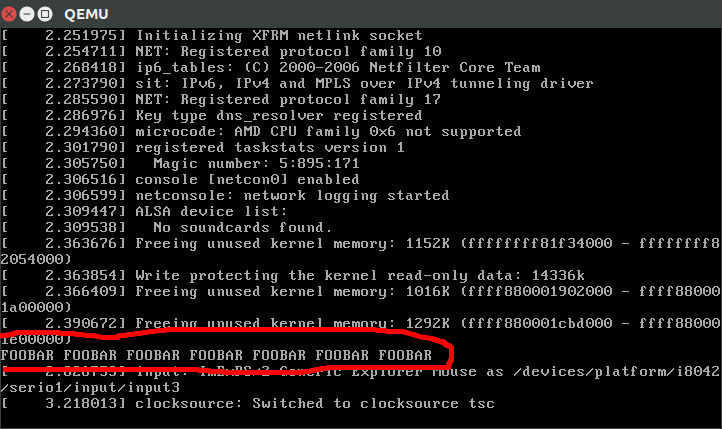
- How to debug the Linux kernel with GDB and QEMU?
- Can the sys_execve() system call in the Linux kernel receive both absolute or relative paths?
- What is the difference between the kernel space and the user space?
- Is there any API for determining the physical address from virtual address in Linux?
- Why do people write the
#!/usr/bin/envpython shebang on the first line of a Python script? - How to solve "Kernel Panic - not syncing: VFS: Unable to mount root fs on unknown-block(0,0)"?
- Single program Linux distro
- QEMU
- gcc and Binutils:
- How do linkers and address relocation works?
- What is incremental linking or partial linking?
- GOLD (
-fuse-ld=gold) linker vs the traditional GNU ld and LLVM ldd - What is the -fPIE option for position-independent executables in GCC and ld? Concrete examples by running program through GDB twice, and an assembly hello world with absolute vs PC relative load.
- How many GCC optimization levels are there?
- Why does GCC create a shared object instead of an executable binary according to file?
- C/C++: almost all of those fall into "disassemble all the things" category. Ciro also does "standards dissection" and "a new version of the standard is out" answers, but those are boring:
- What does "static" mean in a C program?
- In C++ source, what is the effect of
extern "C"? - Char array vs Char Pointer in C
- How to compile glibc from source and use it?
- When should
static_cast,dynamic_cast,const_castandreinterpret_castbe used? - What exactly is
std::atomicin C++?. This answer was originally more appropriately entitled "Let's disassemble some stuff", and got three downvotes, so Ciro changed it to a more professional title, and it started getting upvotes. People judge books by their covers. notmain.o 0000000000000000 0000000000000017 W MyTemplate<int>::f(int) main.o 0000000000000000 0000000000000017 W MyTemplate<int>::f(int)Code 1.. From: What is explicit template instantiation in C++ and when to use it?nmoutputs showing that objects are redefined multiple times across files if you don't use template instantiation properly
- IEEE 754
- What is difference between quiet NaN and signaling NaN?
- In Java, what does NaN mean?
Without subnormals:

          +---+---+-------+---------------+-------------------------------+
exponent  | ? | 0 |   1   |       2       |               3               |
          +---+---+-------+---------------+-------------------------------+
          |   |   |       |               |                               |
          v   v   v       v               v                               v
          -----------------------------------------------------------------
floats    *    **** * * * *   *   *   *   *       *       *       *       *
          -----------------------------------------------------------------
          ^   ^   ^       ^               ^                               ^
          |   |   |       |               |                               |
          0   |   2^-126  2^-125          2^-124                          2^-123
              |
              2^-127

With subnormals:

          +-------+-------+---------------+-------------------------------+
exponent  |   0   |   1   |       2       |               3               |
          +-------+-------+---------------+-------------------------------+
          |       |       |               |                               |
          v       v       v               v                               v
          -----------------------------------------------------------------
floats    * * * * * * * * *   *   *   *   *       *       *       *       *
          -----------------------------------------------------------------
          ^   ^   ^       ^               ^                               ^
          |   |   |       |               |                               |
          0   |   2^-126  2^-125          2^-124                          2^-123
              |
              2^-127
- Computer science
- Algorithms
- Is it necessary for NP problems to be decision problems?
- Polynomial time and exponential time. Answered focusing on the definition of "exponential time".
- What is the smallest Turing machine where it is unknown if it halts or not?. Answer focusing on "blank tape" initial condition only. Large parts of it are summarizing the Busy Beaver Challenge, but some additions were made.
- Algorithms
- Git
| 0 | 4 | 8 | C | |-------------|--------------|-------------|----------------| 0 | DIRC | Version | File count | ctime ...| 0 | ... | mtime | device | 2 | inode | mode | UID | GID | 2 | File size | Entry SHA-1 ...| 4 | ... | Flags | Index SHA-1 ...| 4 | ... |tree {tree_sha} {parents} author {author_name} <{author_email}> {author_date_seconds} {author_date_timezone} committer {committer_name} <{committer_email}> {committer_date_seconds} {committer_date_timezone} {commit message}- How do I clone a subdirectory only of a Git repository?
- Python
- Web technology
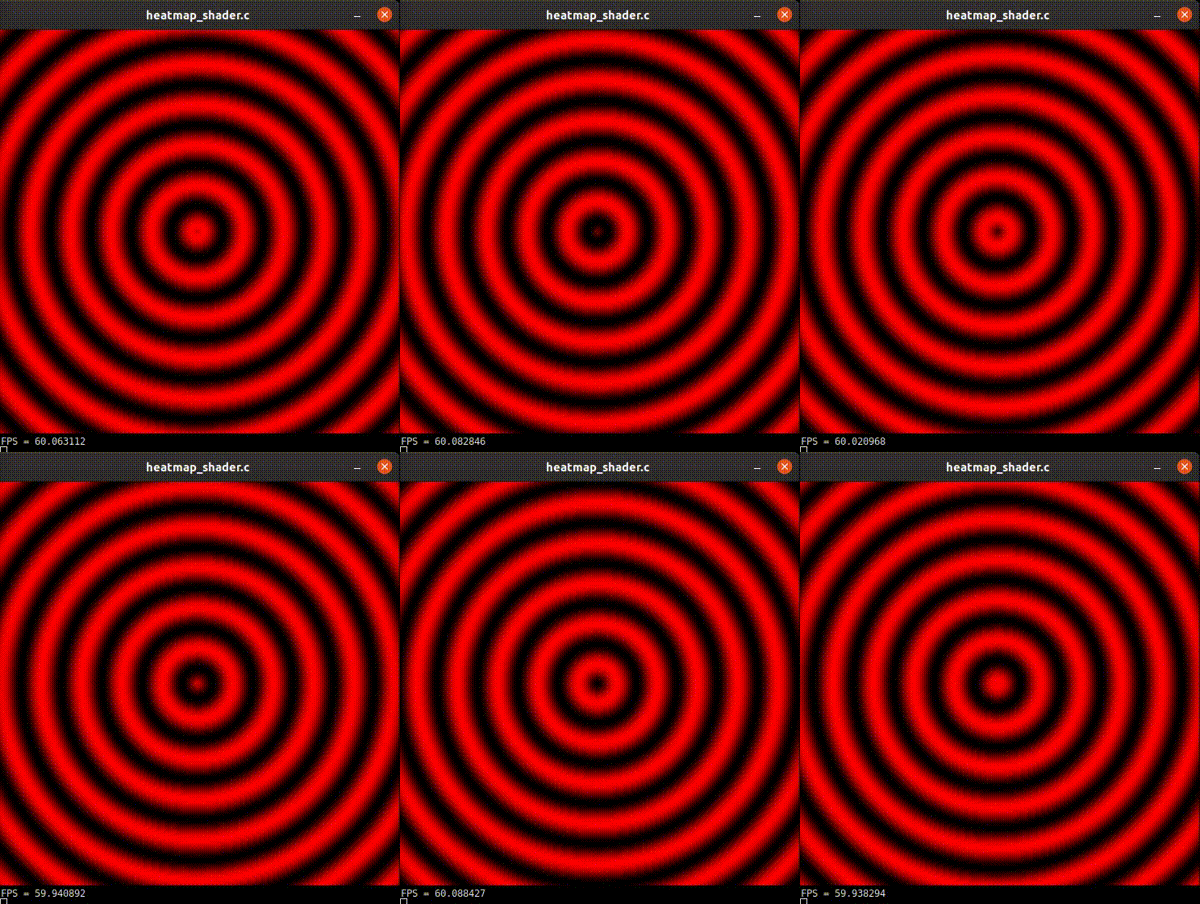
- OpenGL
- Node.js
- Ruby on Rails
- POSIX
- What is POSIX? Huge classified overview of the most important things that POSIX specifies.
- Systems programming
- What do the terms "CPU bound" and "I/O bound" mean?
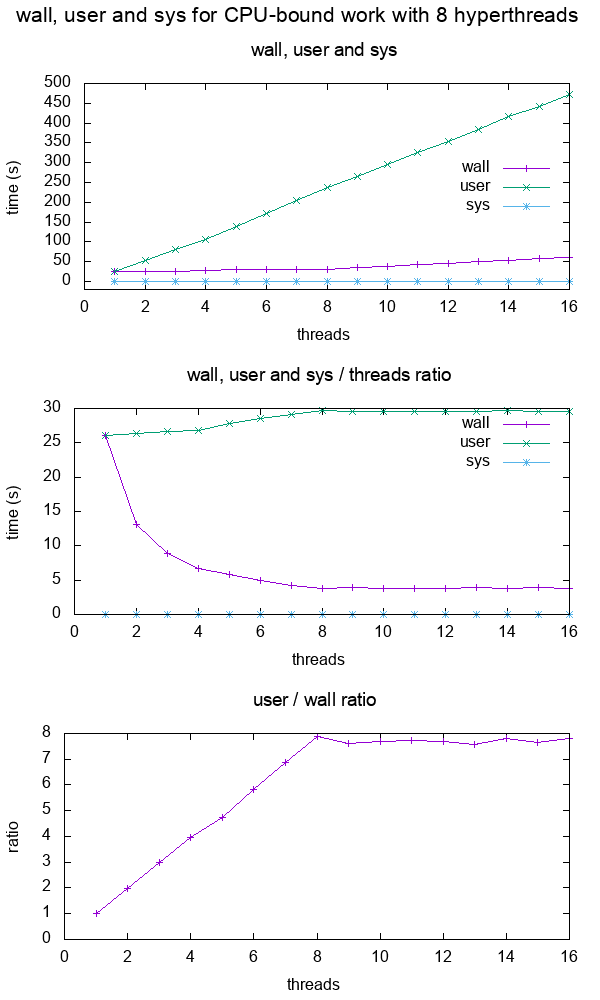
Figure 12. Plot of "real", "user" and "sys" mean times of the output of time for CPU-bound workload with 8 threads. Source. From: What do 'real', 'user' and 'sys' mean in the output of time?+--------+ +------------+ +------+ | device |>---------------->| function 0 |>----->| BAR0 | | | | | +------+ | |>------------+ | | | | | | | +------+ ... ... | | |>----->| BAR1 | | | | | | +------+ | |>--------+ | | | +--------+ | | ... ... ... | | | | | | | | +------+ | | | |>----->| BAR5 | | | +------------+ +------+ | | | | | | +------------+ +------+ | +--->| function 1 |>----->| BAR0 | | | | +------+ | | | | | | +------+ | | |>----->| BAR1 | | | | +------+ | | | | ... ... ... | | | | | | +------+ | | |>----->| BAR5 | | +------------+ +------+ | | | ... | | | +------------+ +------+ +------->| function 7 |>----->| BAR0 | | | +------+ | | | | +------+ | |>----->| BAR1 | | | +------+ | | ... ... ... | | | | +------+ | |>----->| BAR5 | +------------+ +------+Code 5.Logical struture PCIe device, functions and BARs. From: What is the Base Address Register (BAR) in PCIe?
- Electronics
- Raspberry Pi

Figure 13. . Image from answer to: How to hook up a Raspberry Pi via Ethernet to a laptop without a router? 
Figure 14. . Image from answer to: How to hook up a Raspberry Pi via Ethernet to a laptop without a router? 
Figure 15. . Image from answer to: How to emulate the Raspberry Pi 2 on QEMU? 
Figure 16. . Image from answer to: How to run a C program with no OS on the Raspberry Pi?
- Raspberry Pi
- Computer security
- Media
Video 2. . Source. The original question was deleted, lol...: How to programmatically synthesize music?- How to resize a picture using ffmpeg's sws_scale()?
- Is there any decent speech recognition software for Linux? ran a few examples manually on
vosk-apiand compared to ground truth.
- Eclipse
- Computer hardware
- Scientific visualization software
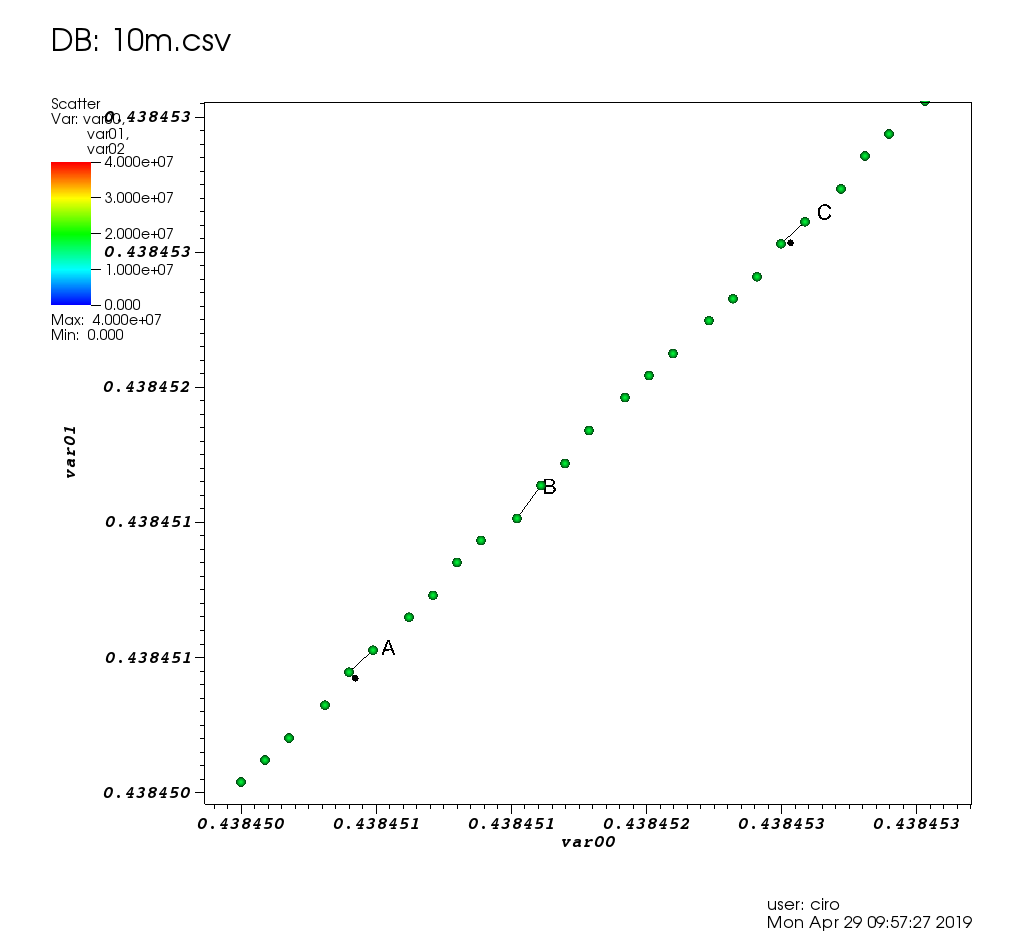
Figure 17. VisIt zoom in 10 million straight line plot with some manually marked points. Source. From: Section "Survey of open source interactive plotting software with a 10 million point scatter plot benchmark by Ciro Santilli"
- Numerical analysis
Video 3. Real-time heat equation OpenGL visualization with interactive mouse cursor using relaxation method by Ciro Santilli (2016)Source.
- Computational physics
- Register transfer level languages like Verilog and VHDL
- Verilog:
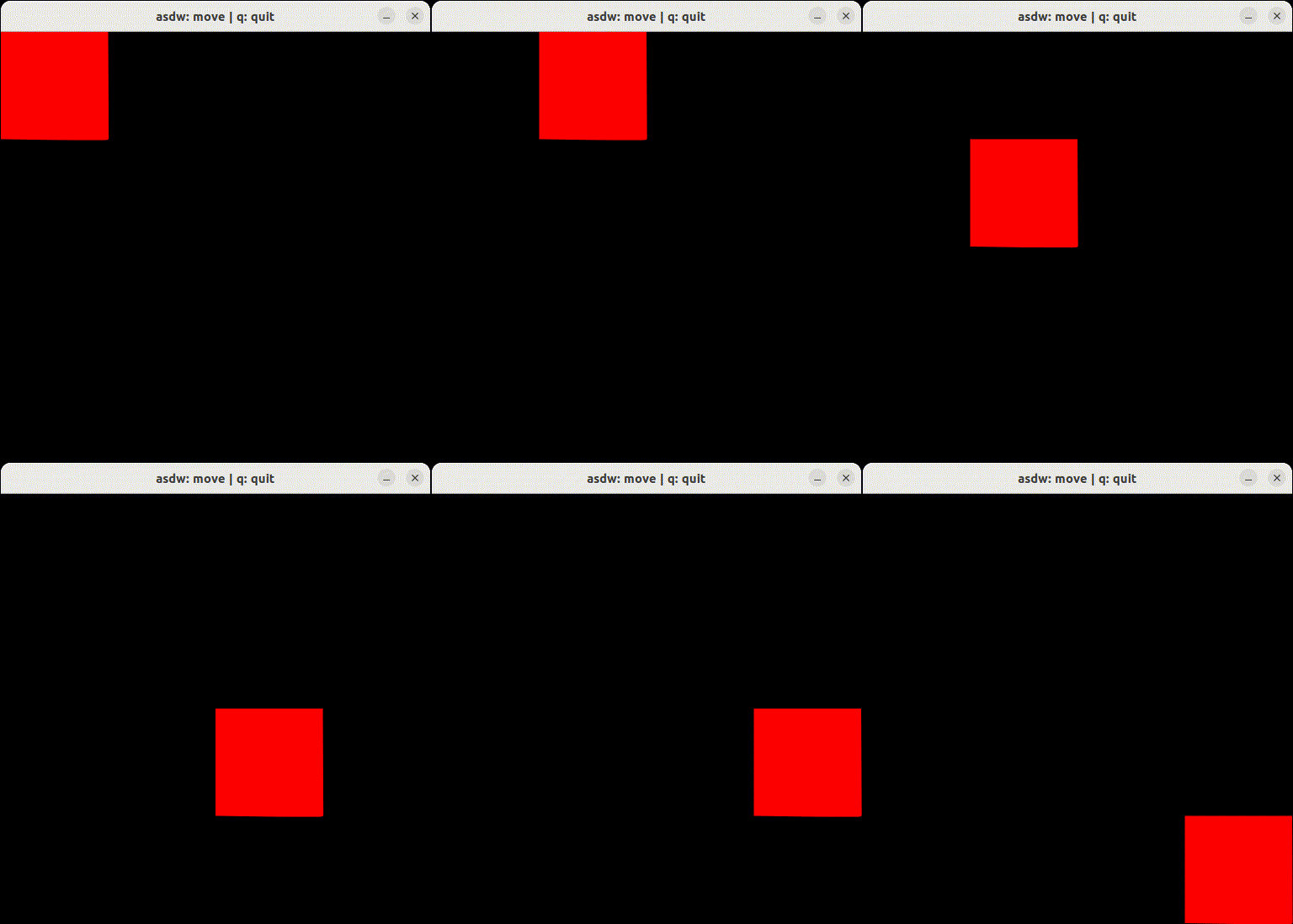
Figure 19. . See also: Section "Verilator interactive example"
- Verilog:
- Android
- Debugging
- Program optimization
- What is tail call optimization?

Figure 21. . Source. The answer compares gprof, valgrind callgrind, perf and gperftools on a single simple executable.
- Data
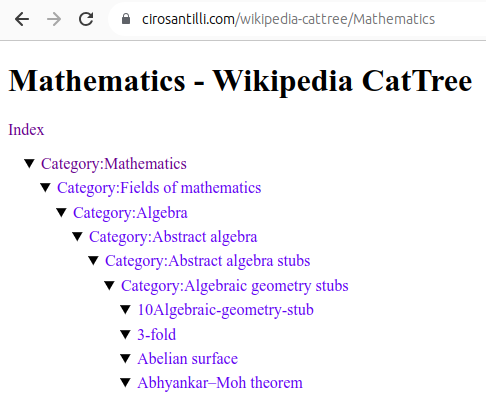
Figure 22. Mathematics dump of Wikipedia CatTree. Source. In this project, Ciro Santilli explored extracting the category and article tree out of the Wikipedia dumps.
- Mathematics
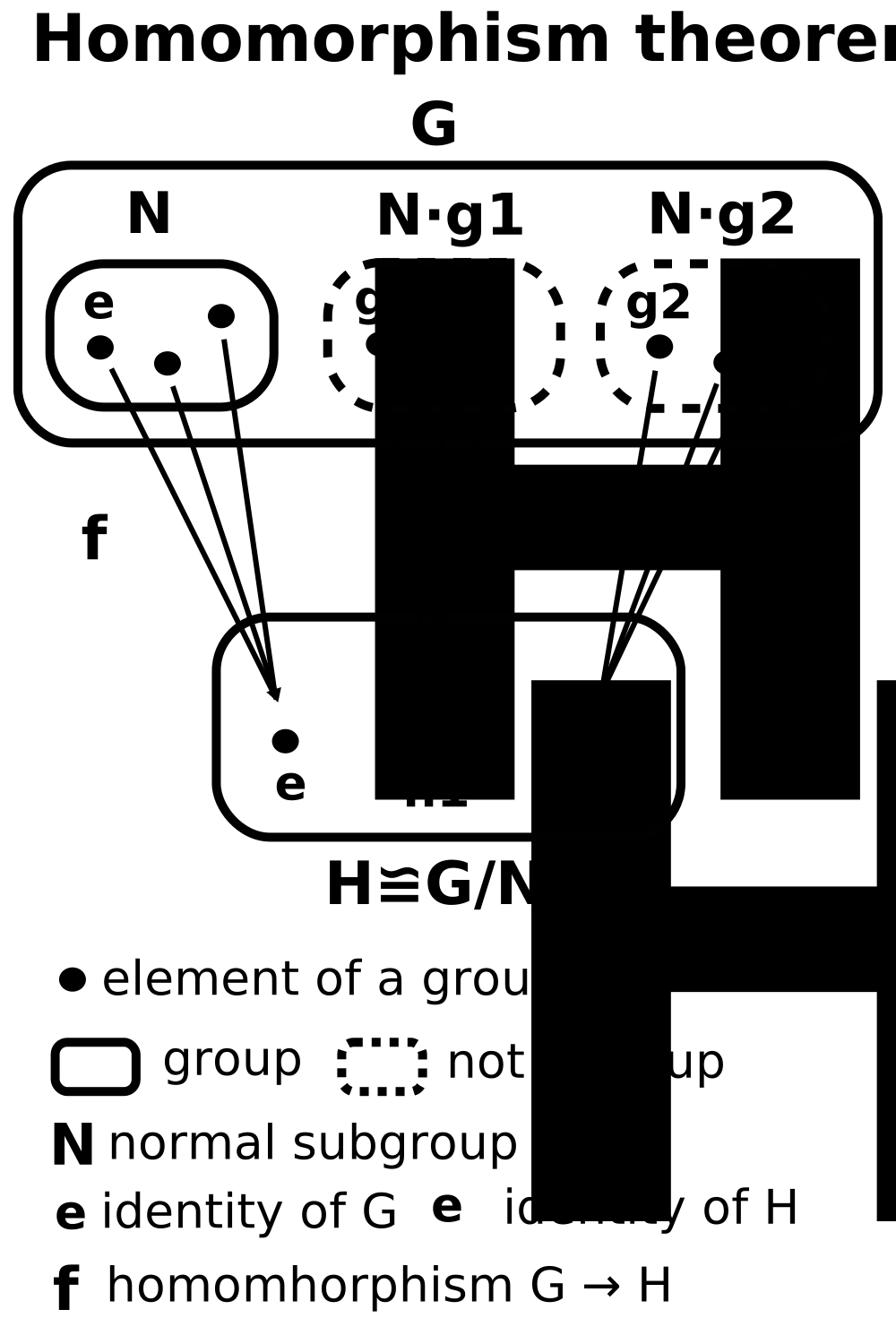
Figure 23. Diagram of the fundamental theorem on homomorphisms by Ciro Santilli (2020)Shows the relationship between group homomorphisms and normal subgroups.- Section "Formalization of mathematics": some early thoughts that could be expanded. Ciro almost had a stroke when he understood this stuff in his teens.

Figure 24. Simple example of the Discrete Fourier transform. Source. That was missing from Wikipedia page: en.wikipedia.org/wiki/Discrete_Fourier_transform!
- Network programming
- Physics
- Biology
- Quantum computing
- Section "Quantum computing is just matrix multiplication"
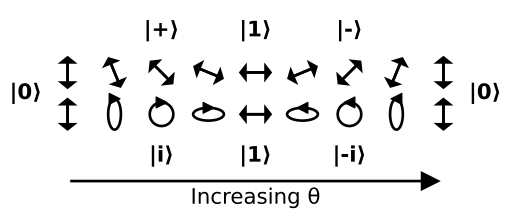
Figure 28. Visualization of the continuous deformation of states as we walk around the Bloch sphere represented as photon polarization arrows. From: Understanding the Bloch sphere.
- Bitcoin
- GIMP

Figure 29. GIMP screenshot part of how to combine two images side-by-side in GIMP?.
- Home DIY

Figure 30. Total_Blackout_Cassette_Roller_Blind_With_Curtains.Source. From: Section "How to blackout your window without drilling"
- China







Ciro Santilli is very happy to meet people with related interests, he really loves his like-minded online friends. Even if you don't have something a specific goal in mind for the contact, please just say hi.
To contact Ciro publicly about any general subject that is not covered in a more specific GitHub repository, including saying hi or suggestions about his website either:
- create a GitHub issue at: github.com/cirosantilli/cirosantilli.github.io/issues/new or Giscus thread
- at mention Ciro's main Twitter account
For comments about China, first read:
and then create a GitHub issue at: github.com/cirosantilli/china-dictatorship/issues/new
Publicly viewable contact is preferred if possible to more effectively share Ciro's wisdom with the world.
But if you feel more comfortable with private contact, no problem, either:
- email: username
cirosantilliwith provider ProtonMail which has domain nameproton.me. Note that Ciro also controls the Gmail address with that same username, and keep in mind that dots are ignored in Gmail addresses. But ProtonMail preferred because why should we give our private minds to the CIA by default? Push notifications disabled. - Signal: username
cirosantilli.89signal.me/#eu/BuJjV0enXYTOnFFc1FZV5LFcWodL1a2Oy9VZ5uyQU7xrYxqw+npIcaHBqghWudrI. 89 is a reference to Ciro Santilli's birth year 1989. Push notifications enabled, but treat like email unless we are actively chatting back and forth.
For other less good methods that will also likely work, use direct messages of the following profiles from under Section "Accounts controlled by Ciro Santilli":Ciro's Twitter DMs are also open, but note that Ciro receives endless Chinese language SPAM there which Twitter is doing nothing to combat, so it's not as reliable.
- LinkedIn: www.linkedin.com/in/cirosantilli
- Reddit: www.reddit.com/user/cirosantilli
- Facebook: www.facebook.com/cirosantilli
- Telegram: telegram.me/cirosantilli. Note that end-to-end encryption is present on secret chats only, which don't have device sync. Ridiculous.
If you are a privacy freak or are going to tell Ciro state secrets Ciro has this GNU Privacy Guard public key: pubkey.gpg, but it's not something that he has ever really used.
Disqus comments were removed from his website in 2019-05-04, a manual dump is available here, removal rationale at: why Ciro Santilli removed Disqus comments from his website in 2019-05-04.
Ciro Santilli controls the following accounts.
With non-trivial activity:
- github.com/cirosantilli on GitHub
- stackoverflow.com/users/895245 on Stack Overflow
- www.linkedin.com/in/cirosantilli on LinkedIn
- www.youtube.com/c/CiroSantilli on YouTube
- Twitter: see Section "Ciro Santilli's Twitter accounts"
- archive.org/details/@cirosantilli2 on the Internet Archive. Was archive.org/details/@cirosantilli but got deleted due to an "admin error" and the old username cannot be restored![ref]
- en.wikipedia.org/wiki/User:Cirosantilli2 and commons.wikimedia.org/wiki/User:Cirosantilli2: Ciro tries to upload all educational CC content he creates to Wikimedia Commons as an extra backup and sometimes to use in Wikipedia pages
- www.facebook.com/cirosantilli/ Ciro accepts all friend requests there, but expect a few non-technical posts. Unless you look like a massive honeypot account, please send context in advance in that case.
- www.quora.com/profile/Ciro-Santilli
- www.reddit.com/user/cirosantilli/ is Ciro's Reddit account, mostly computer and China topics
- maps.app.goo.gl/npV35XTppSBTmNqC8: Google Maps. Ciro Santilli likes to make additions to certain niche topics that are missing, having reached Local Guide Level 6 as of 2024. He can't do as much as he'd like so as to not reveal his current city however.
Trivial or no activity:
- seqanswers.com/forums/member.php?u=90053
- answers.gazebosim.org/users/2289/cirosantilli/
- 4programmers.net/Profile/86786
- 500px.com/p/cirosantilli
- 9gag.com/u/cirosantilli
- addons.mozilla.org/en-US/firefox/user/cirosantilli/
- agoradesk.com/user/cirosantilli
- anaconda.org/cirosantilli
- androidforums.com/members/ciro-santilli.1918307
- app.element.io/#/user/@cirosantilli:matrix.org. Proof: matrix.to/#/!OisxJPszSYdWdwXrrL:matrix.org/$YbrChbGFvlgYiDM5E2OgWXSp0vy7ayLfGkCXftAUyTI?via=matrix.org
- archive.org/details/@ciro_santilli_ourbigbook created during the account deletion mess.
- ask.libreoffice.org/en/users/2352/cirosantilli/
- bbs.archlinux.org/profile.php?id=116270
- bitcointalk.org/index.php?action=profile
- brilliant.org/profile/ciro-il1uxz/
- bsky.app/profile/cirosantilli.bsky.social
- bugzilla.gnome.org/page.cgi?id=describeuser.html&login=ciro.santilli@gmail.com
- cirosantilli.blogspot.com/
- cirosantilli.itch.io
- cirosantilli.livejournal.com/profile
- cirosantilli.medium.com/ on Medium
- cirosantilli.substack.com/ and substack.com/@cirosantilli
- cirosantilli.wordpress.com/ on WordPress
- codeberg.org/cirosantilli
- codeforces.com/profile/cirosantilli reverse proof codeforces.com/blog/entry/98393
- coderwall.com/Ciro%20Santilli Note that space on the username. Beauty.
- community.arm.com/people/cirosantilli
- community.atlassian.com/t5/user/viewprofilepage/user-id/680821
- community.fandom.com/wiki/User:Cirosantilli
- community.openai.com/u/cirosantilli
- community.plos.org/people/cirosantilli
- community.skype.com/t5/user/viewprofilepage/user-id/2646858
- community.zimbra.com/members/cirosantilli
- connect.mozilla.org/t5/user/viewprofilepage/user-id/46889
- del.icio.us/cirosantilli
- dev.to/cirosantilli
- developer.mbed.org/users/cirosantilli/
- devtalk.nvidia.com/member/2118846/
- droit-finances.commentcamarche.net/profile/user/cirosantilli
- en.gravatar.com/cirosantilli
- en.wikipedia.org/wiki/User:Ciro.santilli also belongs to Ciro, but he lost the password
- eternagame.org/web/player/260828/
- exercism.org/profiles/cirosantilli
- figshare.com/authors/Ciro_Santilli/656781
- forums.developer.nvidia.com/u/cirosantilli
- forum.osdev.org/memberlist.php?mode=viewprofile&u=16372
- forum.pine64.org/member.php?action=profile&uid=17386
- forum.videolan.org/memberlist.php?mode=viewprofile&u=173503
- forum.xda-developers.com/member.php?u=7116837
- forums.androidcentral.com/members/cirosantilli-2734491
- forums.lenovo.com/user/viewprofilepage/user-id/1561639
- forums.hardwarezone.com.sg/members/cirosantilli.875544/
- framasphere.org/people/78a975c0b6c40133a3032a0000053625 framasphere.org/posts/1519871
- freesound.org/people/cirosantilli
- gitlab.com/u/cirosantilli
- hackaday.io/cirosantilli
- hinative.com/en-US/profiles/5276462
- home.gamer.com.tw/homeindex.php?owner=cirosantilli but can't post anything publicly because cannot verify phone in many countries
- huggingface.co/cirosantilli
- identity.kde.org/index.php?r=people/view&uid=cirosantilli
- imgur.com/user/cirosantilli/about: Proof: imgur.com/gallery/mexv1Bk/comment/1734086983
- jsfiddle.net/user/cirosantilli/
- kiwifarms.net/members/cirosantilli.82011/
- knockout.chat/user/22882
- launchpad.net/~cirosantilli
- leanprover.zulipchat.com/#user/1019866
- leanpub.com/u/cirosantilli
- leetcode.com/cirosantilli/
- makandracards.com/ciro-santilli
- mastodon.social/@cirosantilli
- nanohub.org/members/146301/
- next-episode.net/user/cirosantilli/
- openclipart.org/artist/cirosantilli. TODO but not yet able to login after the "first upload". But it did get uploaded: openclipart.org/artist/cirosantilli.
- opencollective.com/ciro-santilli
- open.spotify.com/user/cirosantilli
- orcid.org/0000-0003-2895-7763
- parler.com/profile/cirosantilli/posts
- paypal.me/cirosantilli. United Kingdom account.
- peerj.com/cirosantilli/
- profile.edx.org/u/ciro_santilli
- profiles.3dgames.com.ar/profiles/1002278
- protonmail.uservoice.com/users/6491333990-ciro-santilli
- pypi.org/user/cirosantilli/
- raidforums.com/User-cirosantilli
- rubygems.org/profiles/cirosantilli
- software.intel.com/en-us/user/1090688
- soundcloud.com/cirosantilli
- sourceforge.net/u/cirosantilli/profile/
- stackshare.io/cirosantilli
- steamcommunity.com/id/cirosantilli/
- subreply.com/cirosantilli
- support.discord.com/hc/en-us/profiles/427813342894 on the Discord forum
- support.mozilla.org/en-US/user/cirosantilli
- tabmixplus.org/forum/memberlist.php?mode=viewprofile&u=59846
- talk.commonmark.org/users/cirosantilli
- talk.jekyllrb.com/users/cirosantilli
- talks.cam.ac.uk/user/show/81142
- tatoeba.org/eng/user/profile/cirosantilli
- telegram.me/cirosantilli on Telegram
- trac.ffmpeg.org/wiki/Waveform?action=history username
cirosantilli - tuleap.net/users/cirosantilli
- tuleap.ring.cx/users/cirosantilli
- twittercommunity.com/users/cirosantilli/activity
- wefunder.com/cirosantilli
- wise.com/pay/me/cirod3. The name shows as "Ciro Duran Santilli" and that's correct.
- wiki.qemu.org/User:Cirosantilli
- www.airbnb.com/users/show/45794827
- www.behance.net/cirosantilli
- www.bibsonomy.org/user/cirosantilli
- www.biostars.org/u/50170/
- www.bountysource.com/people/25676-ciro-santilli
- www.bulletphysics.org/Bullet/phpBB3/memberlist.php?mode=viewprofile&u=11704
- www.codewars.com/users/cirosantilli
- www.codingame.com/profile/cddd0a711c22d97e8264361f7c8205567563841
- www.coursera.org/user/f65b08c191d792eb809fe2808d771ee7
- www.dailymotion.com/cirosantilli
- www.deviantart.com/cirosantilli
- www.digitalocean.com/community/users/cirosantilli
- www.ebay.com/usr/cirosantilli
- www.edaboard.com/member587087.html
- www.flickr.com/people/cirosantilli/. Account auto deleted tested as of 2025. Created: flickr.com/photos/202496646@N08/. Was something nicer, tried to change username to
cirosantilli2but got hat instead. Alsocirosantilliwas marked taken. What a bullshit website! Poor Canadians, sold off to Yahoo and let their baby be mutilated. - www.freecodecamp.org/fcc8f660b91-167c-4b04-a8da-5d50cdb46def
- www.f6s.com/cirosantilli
- www.f6s.com/cirosantilli1
- www.gitbook.com/@cirosantilli
- www.hackerrank.com/cirosantilli
- www.hackster.io/cirosantilli
- www.html5gamedevs.com/profile/30103-cirosantilli/
- www.imdb.com/user/ur59802249 on IMDb
- www.instagram.com/cirosantilli/ Impossible to disable their notifications without removing your email. So all their notifications go to trash.
- www.kaggle.com/cirosantilli
- www.lesswrong.com/users/ciro-santilli on LessWrong
- www.linux.org/members/ciro-santilli.62540/
- www.linuxquestions.org/questions/user/cirosantilli-688439/
- www.meetup.com/members/252568305/
- www.mentebinaria.com.br/profile/1987-ciro-santilli/
- www.metacritic.com/user/cirosantilli
- www.metaculus.com/accounts/profile/163587/
- www.mohu.rocks/people/cirosantilli
- www.mudhut.com/user/1995000
- www.myopportunity.com/en/profile/ciro-santilli
- www.npmjs.com/~cirosantilli
- www.opengl.org/discussion_boards/member.php/40269-cirosantilli
- www.openstreetmap.org/user/Ciro%20Santilli
- www.patreon.com/cirosantilli
- www.physicsforums.com/members/cirosantilli.422056/
- www.pixiv.net/en/users/64347194
- www.plurk.com/cirosantilli
- www.raspberrypi.org/forums/memberlist.php?mode=viewprofile&u=273389
- www.shadertoy.com/user/cirosantilli
- www.strava.com/athletes/47913768
- www.tastekid.com/ciro.santilli
- www.ted.com/profiles/5822760
- www.threads.com/@cirosantilli
- www.thestudentroom.co.uk/member.php?u=5930160
- www.tiktok.com/@cirosantilli2
- www.transifex.com/user/profile/cirosantilli
- www.tripadvisor.com/members/cirosantilli
- www.twitch.tv/cirosantilli
- www.whatdotheyknow.com/user/ciro_santilli/profile "Banned for spamming" as of 2024. One of those idiotic websites where you can't add a link to your homepage to your own profile page.
Lost or deleted:
- projecteuler.net/profile/cirosantilli.png Blocked 2025-10-01 due to their stupid policy that you can't give away answers within 12 hours of: github.com/lucky-bai/projecteuler-solutions/pull/94
Accounts in Chinese websites. These accounts might be banned or altered or offer other limitations, so Ciro only communicates briefly through them. All communication through those channels should obviously be assumed to be compromised:
- bbs.nibaedu.com/index.php?m=space&uid=70
- www.renren.com/338003848/profile
- www.tianya.cn/109285544 (can't post, no cell phone)
- hacpai.com/member/cirosantilli unable to login as of 2019-10-12, reason unclear, either ban or website too crappy.
- pincong.rocks/people/cirosantilli Lost account tested as of 2022-11 and likely much earlier. Last existing password not working, and there doesn't seem to be a reset password button. Creating cirosantilli2
- pincong.rocks/people/cirosantilli2
- tieba.baidu.com/home/main?id=5cd56369726f73616e74696c6c69c944
- v2ex.com/member/cirosantilli: Ciro was blocked and or account deleted on 2020-07-23: cirosantilli.com/china-dictatorship/v2ex
- v2ex.com/member/cirosantilli2: was created by someone else most likely and cannot be re-registered. Also blocked.
- v2ex.com/member/cirosantilli3: Ciro created this new account November 2023, let's see how long it lasts.
- www.zhihu.com/people/cirosantilli. Ciro was prevented from posting in 2018-06-25, and the account and all content mentioning him were taken down in 2019-11-03.
- www.weibo.com/p/1005055601627311: started requiring a cell phone to login in 2020, and Ciro didn't want to give his cell phone number to the CCP and didn't have the patience to manage a secondary phone number, so he is not logging in for now. The account was blocked in 2021: cirosantilli.com/china-dictatorship/ciro-santillis-weibo-block
Dead websites:
- www.citeulike.org/user/cirosantilli (2019-05)
Cirism is totally not a cult, has been officially verified to be compatible with all major world religions.
Enlightened Cirists donate money to the cause at: Section "Sponsor Ciro Santilli's work on OurBigBook.com". It is totally optional of course, your soul will just be eternally damned if you don't.
Ciro Santilli once proclaimed:
Thou shalt eat thy watermelon in the morning, and thy melon in the evening. Thou shalt not eat thy watermelon in the evening, nor shalt thou eat thy melon in the morning.
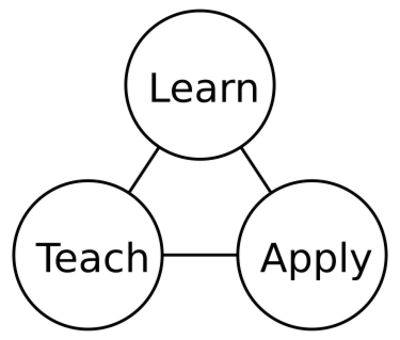
However it won't remain like that for long, because it will be migrated to OurBigBook.com, and therefore become a brain dump of society itself.
Ciro Santilli's energy throughout the day varies as follows:
- morning: highest
- 11AM: peak exercise performance
- after lunch: brain death. Possibly due to Ciro's partial Spanish descent?
- late afternoon and evening: can do some stuff
Ciro has low tolerance to sleep deprivation which makes him very irritable, and low ability to sleep if there is any light. It must have to do with those damned ganglion cell photoreceptors. On the other hand, Ciro Santilli's wife can sleep without any problems with some morning light! It is definitely genetic. Ciro conjectures that people from very Northern parts of the world must have a gene that allows them to sleep even if there is some light, while more equatorial people don't. Maybe: pubmed.ncbi.nlm.nih.gov/33049062/
Ciro has mild olfactory synesthesia for star anise (八角, bajiao), which is widely used in Chinese cuisine and makes Ciro think uncontrollably of the color blue. Ciro does not have any other known synesthesias. He is also prone to nerd sniping form time to time.
Ciro is a reptilian-like being with cold hands and feet and low blood pressure. For this reason he believes that he will die of cancer or some respiratory problem. If the Chinese government doesn't get him first that is. This also partly explains why Ciro is not a big fan of swimming.
Besides Chinese food, Ciro really likes eating fruits and roasted nuts, maybe partly because he was born in Brazil, and partly because of monkey nature, see his Chinese name. At home he is known as "水果大王" (the big king of the fruits). Ciro is also a sucker for yoghurt (natural without added sugars and full fat, fat-tree yoghurt is terrible, often eaten with fruits). Ciro's "favorite drink" could be tonic water with freshly squeezed lemon. Tied with fresh fruit juices. Chocolate-wise, although not a huge fanatic, a Lindt dark chocolate with whole hazelnut pieces bar will do the job.
Ciro does not like receiving or giving gifts on expected social situations like birthdays or Christmas. Ciro believes that every day is equally precious, and can be a day to give, be it through awesome open source software contributions, or if you find something that your friend will like
Ciro has some respiratory allergies. When he was around 5, he had relatively serious asthma crisis which scared his parents to death. Throughout his life, he appears to be allergic at an intermediate level to: mold or dust mites (or whatever it is that old books/pillows have), cats (itching on touch), hay fever (in May in the UK, likely grass pollen). But even outside of hayfever season, Ciro's nose is constantly either running in the cold, or often partially blocked while sleeping throughout the year. Ciro believes however that this also gives him higher resistance to viral infections, since it has been many many years since he had a cold/flu, and when everyone in the office is going down with it, he's just fine. Ciro wonders if his active immune system will actually kill off cancers early, which he ranks as his most likely causes of death, along with respiratory and gastro-intestinal problems. Ciro has low blood pressure and cannot get fat, so cardio vascular problems seem much less likely.
Ciro is generally democrat due to his high compassion level. He believes that politics is highly genetically determined, and that just like you enter a room full of people and immediately like some and dislike others, the same goes for politics. People just vote for whoever they want to see more of because their way of speaking makes them feel good. There is not rationality involved in it at all.
Ciro self diagnoses a slight graphomania in the early 2020's. This is largely what led him to create OurBigBook.com, and contribute to Stack Overflow. Literature Nobel Prize laureate Naguib Mahfouz also suffers from the condition however, so maybe good can also come out of it:
When Ciro was quite young, maybe around 7-10, when he got very angry or sad for some stupid reason (bullying perhaps? Ciro forgot), he would have a psychosomatic manifestation: his spine would become visibly curved sideways (scoliosis). While writing this paragraph, Ciro Googled it, and found e.g. medium.com/@michaelrosen_94192/the-root-cause-of-scoliosis-5c461002b634 that describes:so it is a somewhat well known thing! Incredible. Can you imagine the level of the passions that lead to such physical deformations? But of course, it was all for nothing.
The Root Cause of Idiopathic Scoliosis
Ciro Santilli never did any illegal drugs, because he:so don't expect any amazing stories here.
- doesn't want to help fund organized crime. Notably, Ciro is for complete legalization of drugs of all drugs
- already has better more sustainable drugs like love, cycling, learning the natural sciences and fame. He (or more realistically, the world) chose life for him.
Like LDS believers, Ciro never drinks coffee nor smokes, and only drinks alcohol and tea sparingly, because they are all addictive drugs and bring no net increase of energy and concentration.
Ciro prefers to only enjoy a glass of tea when going out cycling on a cold day (Earl gray, with milk, no sugar), or get a half pint of beer when going out with friends to a pub.
Ciro only got reasonably drunk twice on his life:
- once when he was quite young, likely pre-10 years old, while visiting an uncle's home, and adults were having a very nice sweet and thick type of alcoholic cocktail, and Ciro drank a bit too much and that made him really really stupid
- once while studying at University of São Paulo, somehow someone was giving free beers at one of the parties (at which Ciro practiced Cirodance). And since Ciro had always been a cheap-ass, he thought, hey, this is a good chance to try it out. Ciro remembers that this made him a bit euphoric, active, very stupid, and a bit horny (though of course, he got no pussy as usual).
Later in life, around the time of his wedding, there were guests around all the time, and he was drinking beer with them all the time. Then one day, during lunch, Ciro felt a weirdly strong desire to drink one more pint. It was at this point that Ciro realized first-hand what mild, but real, alcohol addiction felt like, and he didn't get that drink, and swore from then on to never drink more than one glass a week, and only with friends at a bar after work. Richard Feynman tells a very similar story on his book Surely You're Joking, Mr. Feynman chapter O Americano, Outra Vez!, see: Section "Richard Feynman's drug use".
Maybe Ciro Santilli should do something useful and remarkable so that someone might actually want to read his biography in the first place. But hey, procrastination.
Ciro Santilli was born in Brazil in the small/medium city of Rio Claro, São Paulo (~200k people in 2020) in the State of São Paulo in 1989 AD.
When he was 3, the family moved within Rio Claro to Av. 44 - Parque Universitario, Rio Claro - SP, 13504-360.
In 1995 the family moved to Jundiaí (Rua José Milani, CEP 13207-691) for his father's work. He played a lot on the streets. Ciro learned to cycle there on a slight downhill. He was mildly bullied by some kids on the street. He played NES games that were far too hard for him which made him made and required his parents to call the teenage neighbors to beat. The neighbors had some DOS games which felt like mystery and magic.
In 1997 family finally moved to Santos, São Paulo, Brazil again for his father's work.
At the age of 10, Ciro Santilli spent 10 months in Coventry, United Kingdom, where he greatly improved his English.
After Coventry, Ciro's family went back to Santos, São Paulo, Brazil, which made a deep impression on Ciro, until he Ciro Santilli's undergrad studies at the University of São Paulo in 2007.
In 2010, as mentioned at Section "Ciro Santilli's formal education", Ciro as admitted in a double degree program at the École Polytechnique, France, where he stayed until 2013. Going to France was a mind blowing, life changing event.
Firstly, in 2012, while he was at École Polytechnique, Ciro Santilli was introduced to LaTeX (thank God for French mathematical obsession), and his mind was blown:he though. Why isn't everyone doing that!
One particular event stood out: Ciro made a small change to his teacher's course material, who blessed be him (dude's a legend, Ciro just noticed he has some Chinese publications with another French dude, e.g. www.amazon.co.uk/高效算法-应试与提高必修128例-克里斯托弗-Christoph-Durr/dp/B078SJQPVK "High-efficiency algorithm competitions 128 examples", did he write it the Chinese himself?? Must be of course to complement the notoriously low French professor salaries), made it available, and then Ciro gave him back the .tex file. Ciro was just a bit worried about how the teacher would be able to tell what he had changed in the file to validate the change. The teacher just said of course, "no problem, I'll just use
diff". Ciro had never heard of diff. Let alone Git of course, though yes, this was a bit early in Git's history version control systems had been around since forever of course. This was 2011 or 2012, about 4 or 5 years into a superior education curricula with various courses involving computers, some requiring quite a lot of "fill these empty functions" style programming. Education is a joke. Anyways, this was a prelude to exactly what Ciro wanted to do in OurBigBook.com. This might have been the one actually: webia.lip6.fr/~durrc/Iut/Notes580.pdfNot long afterwards, Ciro started playing with Linux. Until then, Ciro had had some contacts with the mysterious operating system at university, and was a bit puzzled what the point of it was! He clearly remembers:University should be forced to use only open source software and hardware in undergrad teaching courses by law BTW.
- at the University of São Paulo that they had some "UNIX" computers in some classes, and at the library
- at École Polytechnique, he took a course about mathematical analysis and there was a "lab" where students were supposed to use FreeFem, great initiative BTW. And Ciro distinctly remembers being paried with a nice Chilian colleague, and the guy was alreay super at ease with the shell: "cd", "ls", etc. WTF was all that!
Then came an Ubuntu live disk on his own machine, and finally a measly 40GB dual book partition in a Microsoft Windows machine on a laptop. At first, it took a lot of time to learn all the crazy new terminal stuff! Yes, at this point, Ubuntu was already usable enough without the terminal, an accomplishment actually. But as a programmer, Ciro felt obliged to learn. Many hours were spent reading man pages at the library. But it all just felt so right, and sometimes powerful... true wizardry.
And ten years later, Ciro was seriously considering buying a computer without Windows pre-installed. He had not used Windows a single tie on a personal machine even once in those ten years!
Finally, to finish things off Ciro found two websites that changed his life forever, and made be believe that there was an alternative: Stack Overflow and GitHub.
Major projects can be seen at: Section "The most important projects done by Ciro Santilli".
One day, someone will invent a way to take the hash of a piece of hardware and see its history log, like software engineers do with version control. Until then, this is as close as you can get.
Maybe those are genial. Maybe not. Nostalgia is just too strong to discern. Ciro still goes back to them for rest.
Random fun mentions:
- en.wiktionary.org/wiki/roflcopter | knowyourmeme.com/memes/roflcopter
- www.ludd.ltu.se/~vk/pics/ascii/junkyard/misc/who's_who.txt "Who's who in the ascii art world" contains a list of well known artists with their signatures
        z

        ^
        |    *------*
        |   /|      /
        |  / |     /|
top -------*------* |
        |  | *----|-*
        |  |/     | /
        |  |      |/
bottom ----*------*
        |  |      |
        +--|------|-----> y
       /   |      |
      /    |      |
  x  /     |      |
    v
left right Pinned article: Introduction to the OurBigBook Project
Welcome to the OurBigBook Project! Our goal is to create the perfect publishing platform for STEM subjects, and get university-level students to write the best free STEM tutorials ever.
Everyone is welcome to create an account and play with the site: ourbigbook.com/go/register. We belive that students themselves can write amazing tutorials, but teachers are welcome too. You can write about anything you want, it doesn't have to be STEM or even educational. Silly test content is very welcome and you won't be penalized in any way. Just keep it legal!
Intro to OurBigBook
. Source. We have two killer features:
- topics: topics group articles by different users with the same title, e.g. here is the topic for the "Fundamental Theorem of Calculus" ourbigbook.com/go/topic/fundamental-theorem-of-calculusArticles of different users are sorted by upvote within each article page. This feature is a bit like:
- a Wikipedia where each user can have their own version of each article
- a Q&A website like Stack Overflow, where multiple people can give their views on a given topic, and the best ones are sorted by upvote. Except you don't need to wait for someone to ask first, and any topic goes, no matter how narrow or broad
This feature makes it possible for readers to find better explanations of any topic created by other writers. And it allows writers to create an explanation in a place that readers might actually find it.
Figure 1. Screenshot of the "Derivative" topic page. View it live at: ourbigbook.com/go/topic/derivativeVideo 2. OurBigBook Web topics demo. Source. - local editing: you can store all your personal knowledge base content locally in a plaintext markup format that can be edited locally and published either:This way you can be sure that even if OurBigBook.com were to go down one day (which we have no plans to do as it is quite cheap to host!), your content will still be perfectly readable as a static site.
- to OurBigBook.com to get awesome multi-user features like topics and likes
- as HTML files to a static website, which you can host yourself for free on many external providers like GitHub Pages, and remain in full control

Figure 3. Visual Studio Code extension installation.
Figure 4. Visual Studio Code extension tree navigation.
Figure 5. Web editor. You can also edit articles on the Web editor without installing anything locally.Video 3. Edit locally and publish demo. Source. This shows editing OurBigBook Markup and publishing it using the Visual Studio Code extension.Video 4. OurBigBook Visual Studio Code extension editing and navigation demo. Source. 
- Infinitely deep tables of contents:




All our software is open source and hosted at: github.com/ourbigbook/ourbigbook
Further documentation can be found at: docs.ourbigbook.com
Feel free to reach our to us for any help or suggestions: docs.ourbigbook.com/#contact