
As mentioned at Human Compatible by Stuart J. Russell (2019), game theory can be seen as the part of artificial intelligence that deas with scenarios where multiple intelligent agents are involved.
Poet, scientists and warriors all in one? Conquerors of the useless.
A wise teacher from University of São Paulo once told the class Ciro Santilli attended an anecdote about his life:It turned out that, about 10 years later, Ciro ended up following this advice, unwittingly.
I used to want to learn Mathematics.But it was very hard.So in the end, I became an engineer, and found an engineering solution to the problem, and married a Mathematician instead.

It is hard to decide what makes Ciro Santilli more sad: the usage of Greek letters, the invention of new symbols, or the fifty million alternative font styles used.
Only Chinese characters could be worse than that!
Techniques to get numerical approximations to numeric mathematical problems.
The entire field comes down to estimating the true values with a known error bound, and creating algorithms that make those error bounds asymptotically smaller.
Not the most beautiful field of pure mathematics, but fundamentally useful since we can't solve almost any useful equation without computers!
The solution visualizations can also provide valuable intuition however.
Important numerical analysis problems include solving:
Ciro Santilli is actively looking for donations and contracts so he can continue to work full time on OurBigBook.com sustainably, and develop free hardcore university-level STEM education for all ages!
For 1M USD I will quit my job to work on OurBigBook for three more years to try and kickstart The Higher Education Revolution. Status: ~44k / 1M USD. MacArthur fellowship wink. At 4M USD I retire and work on open STEM forever.
I first quit my job 1st June 2024 to work on the project for 1 year after I reached my initial 100k goal mostly via a 1000 Monero donation. In this first year I improved project tech, but didn't go and solve university courses to create super targeted content, and didn't obtain a single contributing user except myself, see a summary at Section "OurBigBook Project Update March 2025". Day job total compensation as of August 2026 for reference: 205k USD/year. This may be inflated by the AI bubble. I try to keep the value up to date on LinkedIn: www.linkedin.com/in/cirosantilli/
For a followup, it would be an interesting experiment to spend on year full time solving as many courses as I can from a world class university in the city where I live in the UK, and adding that as content to the platform to see if that would attract interest, and reaching out directly to course takers at their university environment to try and help them. I intended to do that in year one but my got distracted by tech. It is quite possible that no one has ever done that before in history: a highly motivated technical person with the time and opportunity to do one single thing: help top university students learn their STEM courses better and have more fun doing so. I have in particular identified one course where this would be particularly feasible: the mathematics course, given that much of their course materials, and also their building are quite open. I do sometimes wonder if doing this would be just a waste of my life. But part of me tells me it could generate big interest and is worth a try. It would also be fun for you to watch me continue to commit career seppuku.
At 4M USD I retire and work on open STEM projects forever. At these timelines, I can't guarantee it will be specifically on education technology specifically all the way, but I guarantee that whatever it is it will be open and extremely well explained as usual.
It's necessary to be slightly underemployed if you are to do something significant - James Watson
Total donations to date ~144k USD. Donation breakdown:More details: Section "Accounting method"
- 2024-03-18: $126,352 (!!!): anonymous 1000 Monero donation to self-custody wallet. Further comments: Section "1000 Monero donation"
- 2024-03-13: $1,375: anonymous 10 Monero donation to self-custody wallet
- 2023-11-20: $14.563: anonymous 100 Monero donation to Binance wallet
- 2023-09: $810: anonymous 0.032 Bitcoin donation to Coinbase wallet
- subscriptions up to 2024-01: $143,795
Note to potential anonymous crypto donors: I live in the UK, and after some fun back and forth that included Barclays freezing my account for one week at one point, Barclays finally decided that they do not allow me to receive further anonymous donations. And I'm pretty sure that the same would happen on any other British bank sooner or later. Therefore, while I continue to accept anonymous donations, they will not count towards my "if I get X I do Y"-type donation goals, since I can't reliably spend that money. If you want to donate in crypto, and clearly give me your real identity and an explanation of how you got the money, then that is fine, it can count. Just be warned that I will need to give that information to my bank and clear it with them beforehand, and if they are still not happy with it, I'll just give it all back. Your identity does not have to be publicly disclosed, only the dates and amounts. But my bank has to know. Now, if you still want to donate a "retirement level amount" and treat me as a guinea pig in "find the best country for money laundering", well, go for it. But I make no promises! I don't want my children to grow up in shitcountries.
How to give:And if you have a different preferred payment mechanism not listed above, please contact Ciro, and he will set it up.
- one time donations:
- cryptocurrency: note that Ciro is not a regular crypto user, so you might want to make a smaller test donation and confirm that it worked by contacting Ciro before going for colossal amounts (one can dream):
- Monero address: 4A1KK4uyLQX7EBgN7uFgUeGt6PPksi91e87xobNq7bT2j4V6LqZHKnkGJTUuCC7TjDNnKpxDd8b9DeNBpSxim8wpSczQvzf. Secret view key: 7ccaf885ff5540b0ff18927e6ac5da30130afb1eaee09ad95d3c4536a6337e0f. This is a self-custody wallet on a "clean" dedicated Monero laptop connected the Internet. I check for incoming transactions from my dirty main laptop via a view-only wallet each weekend. The cash out method used is latest simplest thing that wasn't yet blocked in my country on a given week, the last time that was centralized swappers[ref]. The fact that the cash out method changes weekly confirms that Monero privacy hadn't yet been broken by countries and that Monero is still one of the most useful cryptocurrencies: Section "Are cryptocurrencies useful?". For transparency, I announce all non-trivial transactions on social media, and the full list of transactions can be seen by anyone with the secret view key provided. I previously had different addresses, so pre-existing donations on older addresses will not be visible there.
- Bitcoin address: 3KRk7f2JgekF6x7QBqPHdZ3pPDuMdY3eWR. This is a Coinbase wallet, off-chain transactions with no transaction fees accepted from other Coinbase users. This method has been tested, I have been able to receive funds from this address in 2023. Fees: non-fixed trading fees[ref] + 0% withdrawal fee on top of any Bitcoin network for on-chain transactions[ref]
- Ethereum address: 0x44cF8C9C015F46d3b2Df730b6492823FD7A91044. Test transaction recommended.
- Solana address: DjdaGawoVFdqxJEqpBGsSWuR4G4MVFNiNkAEu89HuKcE. Test transaction recommended.
- USDC address: 0x1dFABf2cdE6384f6Fdd4e6Dae3B9FA2d323e6F95
- TransferWise tag: wise.com/pay/me/cirod3. No fees apparently? Love it!
- PayPal: paypal.me/cirosantilli. Note that dots in Gmail address are ignored, and it is perfectly normal if the email you see has some extra dots in it. Fees: 2.9% + 0.30 GBP[ref].
- bank transfer: prove you are rich and you can have my bank details :-)
- cryptocurrency: note that Ciro is not a regular crypto user, so you might want to make a smaller test donation and confirm that it worked by contacting Ciro before going for colossal amounts (one can dream):
- monthly subscriptions of 1$/month or more on either:Symbolic 1 dollar/month donation are extremely welcome to signal your interest! This way if a certain critical mass of sponsors is ever reached (~100?), Ciro can start to more actively asking slightly higher amounts to really try to achieve full time self sufficiency.
- GitHub Sponsors: github.com/sponsors/cirosantilli. Fees: 0% for individuals, up to 6% for organizations[ref]
- Patreon: www.patreon.com/cirosantilli. Fees: 8% pro plan + 1% PayPal withdrawal capped at 20 USD[ref]. We are waiting to reach the cap to withdraw!
- larger grants/contracts from filthy rich individuals or organizations: contact Ciro as mentioned at: Section "How to contact Ciro Santilli" to discuss.Ciro is interested in contracts/voluntary work that would be compatible/synergic with the OurBigBook.com project. Some possibilities include:
- interacting directly with classes of university students to help them learn the class subject, while at the same time spreading the university knowledge outside of the university walls
- one-to-one mentoring of individuals of any age that are looking to make an impact in the world, and not just pass their exams
- fixing specific bugs in related projects Ciro has experience in. These could be either via one-off contracts, or on platforms such as:
Ciro's current ambitions require him to remain in developed countries, because Ciro wants to document advanced science and technology by liaising with top universities, and there is not nearly as much high technology in poor countries. Remaining in developed countries is also a required due to family reasons.
If you would like public acknowledgement for your support, Ciro will very gladly give it, just let Ciro know how you'd prefer it. Due to Ciro Santilli's campaign for freedom of speech in China, many supporters have chosen to be anonymous, and that is totally fine, not everyone is interested in politics, or has a situation where going public is acceptable, so we don't have a standard setup yet, let's build it together. A acknowledgement section at the bottom of this page would be a minimum, but I for larger donations we could add a your advertisement in a locations such as:
- near the top of of the accounts controlled by Ciro Santilli, e.g. one of Ciro Santilli's Twitter accounts, github.com/cirosantilli or stackoverflow.com/users/895245
- near the top of cirosantilli.com
The problem with education by Ciro Santilli
. Source. In this video Ciro Santilli exposes his fundamental philosophy regarding why Education is broken. This philosophy was the key motivation behind the failed OurBigBook Project.Intro to the OurBigBook Project
. Source. 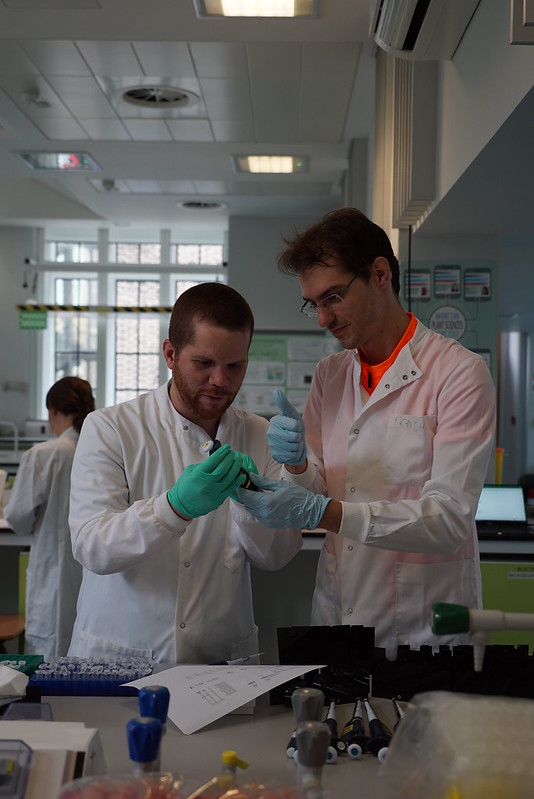
Maybe if he ever gets enough credibility, such opportunities would actually materialize. It could be a bit like Periodic Videos, but for molecular biology and physics, and backed by OurBigBook text/tree with minimal openly licensed videos. The fact that such opportunities are essentially impossible outside of the boredom of the university system is something we should really change about education.
Ciro Santilli has sometimes wasted time with low impact projects such as those listed at Ciro Santilli's minor projects instead of doing higher impact projects such as those mentioned at: Section "The most important projects Ciro Santilli wants to do".
But maybe "Everything you did brought you where you are now." applies, maybe it is during the "low impact activities" that one gets the inspiration and experience required for the "high impact ones".
Top one: OurBigBook.com.
If you are going to live, you might as well chase one of them.
You might not achieve them in your lifetime, but you never know. At some point, the pieces just "fall into place", and they happen.
And they will all come from deep tech.
Ciro Santilli would like to contribute to them. but this is a bit less realistic than software projects.
And one can at least have some fun by learning deeply about those subjects.
These are the best articles ever authored by Ciro Santilli, most of them in the format of Stack Overflow answers.
Ciro posts update about new articles on his Twitter accounts.
Some random generally less technical in-tree essays will be present at: Section "Essays by Ciro Santilli".
- Trended on Hacker News:
- CIA 2010 covert communication websites on 2023-06-11. 190 points, a mild success.
- x86 Bare Metal Examples on 2019-03-19. 513 points. The third time something related to that repo trends. Hacker news people really like that repo!
- again 2020-06-27 (archive). 200 points, repository traffic jumped from 25 daily unique visitors to 4.6k unique visitors on the day
- How to run a program without an operating system? on 2018-11-26 (archive). 394 points. Covers x86 and ARM
- ELF Hello World Tutorial on 2017-05-17 (archive). 334 points.
- x86 Paging Tutorial on 2017-03-02. Number 1 Google search result for "x86 Paging" in 2017-08. 142 points.
- x86 assembly
- What does "multicore" assembly language look like?
- What is the function of the push / pop instructions used on registers in x86 assembly? Going down to memory spills, register allocation and graph coloring.
- Linux kernel
- What do the flags in /proc/cpuinfo mean?
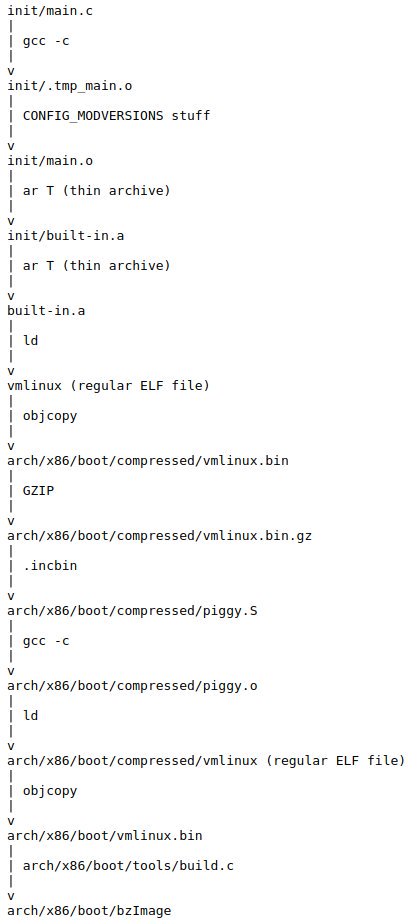
- How does kernel get an executable binary file running under linux?
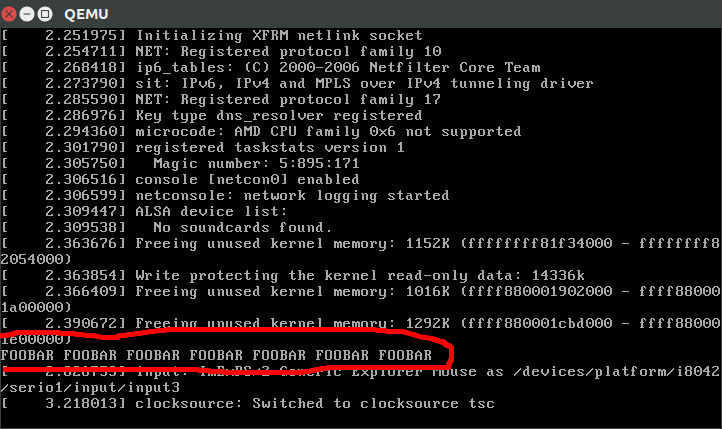
- How to debug the Linux kernel with GDB and QEMU?
- Can the sys_execve() system call in the Linux kernel receive both absolute or relative paths?
- What is the difference between the kernel space and the user space?
- Is there any API for determining the physical address from virtual address in Linux?
- Why do people write the
#!/usr/bin/envpython shebang on the first line of a Python script? - How to solve "Kernel Panic - not syncing: VFS: Unable to mount root fs on unknown-block(0,0)"?
- Single program Linux distro
- QEMU
- gcc and Binutils:
- How do linkers and address relocation works?
- What is incremental linking or partial linking?
- GOLD (
-fuse-ld=gold) linker vs the traditional GNU ld and LLVM ldd - What is the -fPIE option for position-independent executables in GCC and ld? Concrete examples by running program through GDB twice, and an assembly hello world with absolute vs PC relative load.
- How many GCC optimization levels are there?
- Why does GCC create a shared object instead of an executable binary according to file?
- C/C++: almost all of those fall into "disassemble all the things" category. Ciro also does "standards dissection" and "a new version of the standard is out" answers, but those are boring:
- What does "static" mean in a C program?
- In C++ source, what is the effect of
extern "C"? - Char array vs Char Pointer in C
- How to compile glibc from source and use it?
- When should
static_cast,dynamic_cast,const_castandreinterpret_castbe used? - What exactly is
std::atomicin C++?. This answer was originally more appropriately entitled "Let's disassemble some stuff", and got three downvotes, so Ciro changed it to a more professional title, and it started getting upvotes. People judge books by their covers. notmain.o 0000000000000000 0000000000000017 W MyTemplate<int>::f(int) main.o 0000000000000000 0000000000000017 W MyTemplate<int>::f(int)Code 1.. From: What is explicit template instantiation in C++ and when to use it?nmoutputs showing that objects are redefined multiple times across files if you don't use template instantiation properly
- IEEE 754
- What is difference between quiet NaN and signaling NaN?
- In Java, what does NaN mean?
Without subnormals:

          +---+---+-------+---------------+-------------------------------+
exponent  | ? | 0 |   1   |       2       |               3               |
          +---+---+-------+---------------+-------------------------------+
          |   |   |       |               |                               |
          v   v   v       v               v                               v
          -----------------------------------------------------------------
floats    *    **** * * * *   *   *   *   *       *       *       *       *
          -----------------------------------------------------------------
          ^   ^   ^       ^               ^                               ^
          |   |   |       |               |                               |
          0   |   2^-126  2^-125          2^-124                          2^-123
              |
              2^-127

With subnormals:

          +-------+-------+---------------+-------------------------------+
exponent  |   0   |   1   |       2       |               3               |
          +-------+-------+---------------+-------------------------------+
          |       |       |               |                               |
          v       v       v               v                               v
          -----------------------------------------------------------------
floats    * * * * * * * * *   *   *   *   *       *       *       *       *
          -----------------------------------------------------------------
          ^   ^   ^       ^               ^                               ^
          |   |   |       |               |                               |
          0   |   2^-126  2^-125          2^-124                          2^-123
              |
              2^-127
- Computer science
- Algorithms
- Is it necessary for NP problems to be decision problems?
- Polynomial time and exponential time. Answered focusing on the definition of "exponential time".
- What is the smallest Turing machine where it is unknown if it halts or not?. Answer focusing on "blank tape" initial condition only. Large parts of it are summarizing the Busy Beaver Challenge, but some additions were made.
- Algorithms
- Git
| 0 | 4 | 8 | C | |-------------|--------------|-------------|----------------| 0 | DIRC | Version | File count | ctime ...| 0 | ... | mtime | device | 2 | inode | mode | UID | GID | 2 | File size | Entry SHA-1 ...| 4 | ... | Flags | Index SHA-1 ...| 4 | ... |tree {tree_sha} {parents} author {author_name} <{author_email}> {author_date_seconds} {author_date_timezone} committer {committer_name} <{committer_email}> {committer_date_seconds} {committer_date_timezone} {commit message}- How do I clone a subdirectory only of a Git repository?
- Python
- Web technology
- OpenGL
- Node.js
- Ruby on Rails
- POSIX
- What is POSIX? Huge classified overview of the most important things that POSIX specifies.
- Systems programming
- What do the terms "CPU bound" and "I/O bound" mean?
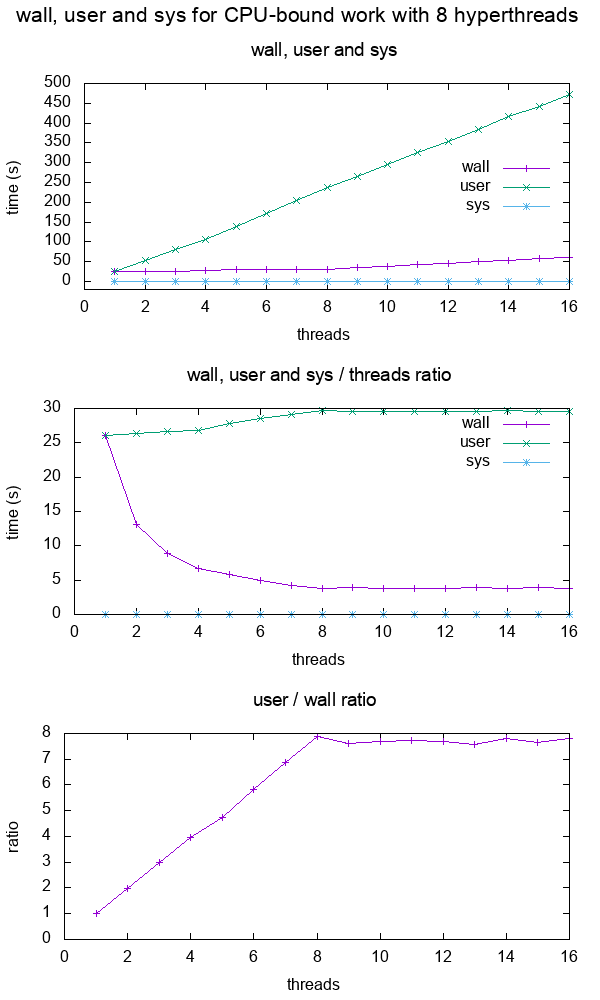
Figure 12. Plot of "real", "user" and "sys" mean times of the output of time for CPU-bound workload with 8 threads. Source. From: What do 'real', 'user' and 'sys' mean in the output of time?+--------+ +------------+ +------+ | device |>---------------->| function 0 |>----->| BAR0 | | | | | +------+ | |>------------+ | | | | | | | +------+ ... ... | | |>----->| BAR1 | | | | | | +------+ | |>--------+ | | | +--------+ | | ... ... ... | | | | | | | | +------+ | | | |>----->| BAR5 | | | +------------+ +------+ | | | | | | +------------+ +------+ | +--->| function 1 |>----->| BAR0 | | | | +------+ | | | | | | +------+ | | |>----->| BAR1 | | | | +------+ | | | | ... ... ... | | | | | | +------+ | | |>----->| BAR5 | | +------------+ +------+ | | | ... | | | +------------+ +------+ +------->| function 7 |>----->| BAR0 | | | +------+ | | | | +------+ | |>----->| BAR1 | | | +------+ | | ... ... ... | | | | +------+ | |>----->| BAR5 | +------------+ +------+Code 5.Logical struture PCIe device, functions and BARs. From: What is the Base Address Register (BAR) in PCIe?
- Electronics
- Raspberry Pi

Figure 13. . Image from answer to: How to hook up a Raspberry Pi via Ethernet to a laptop without a router? 
Figure 14. . Image from answer to: How to hook up a Raspberry Pi via Ethernet to a laptop without a router? 
Figure 15. . Image from answer to: How to emulate the Raspberry Pi 2 on QEMU? 
Figure 16. . Image from answer to: How to run a C program with no OS on the Raspberry Pi?
- Raspberry Pi
- Computer security
- Media
Video 2. . Source. The original question was deleted, lol...: How to programmatically synthesize music?- How to resize a picture using ffmpeg's sws_scale()?
- Is there any decent speech recognition software for Linux? ran a few examples manually on
vosk-apiand compared to ground truth.
- Eclipse
- Computer hardware
- Scientific visualization software
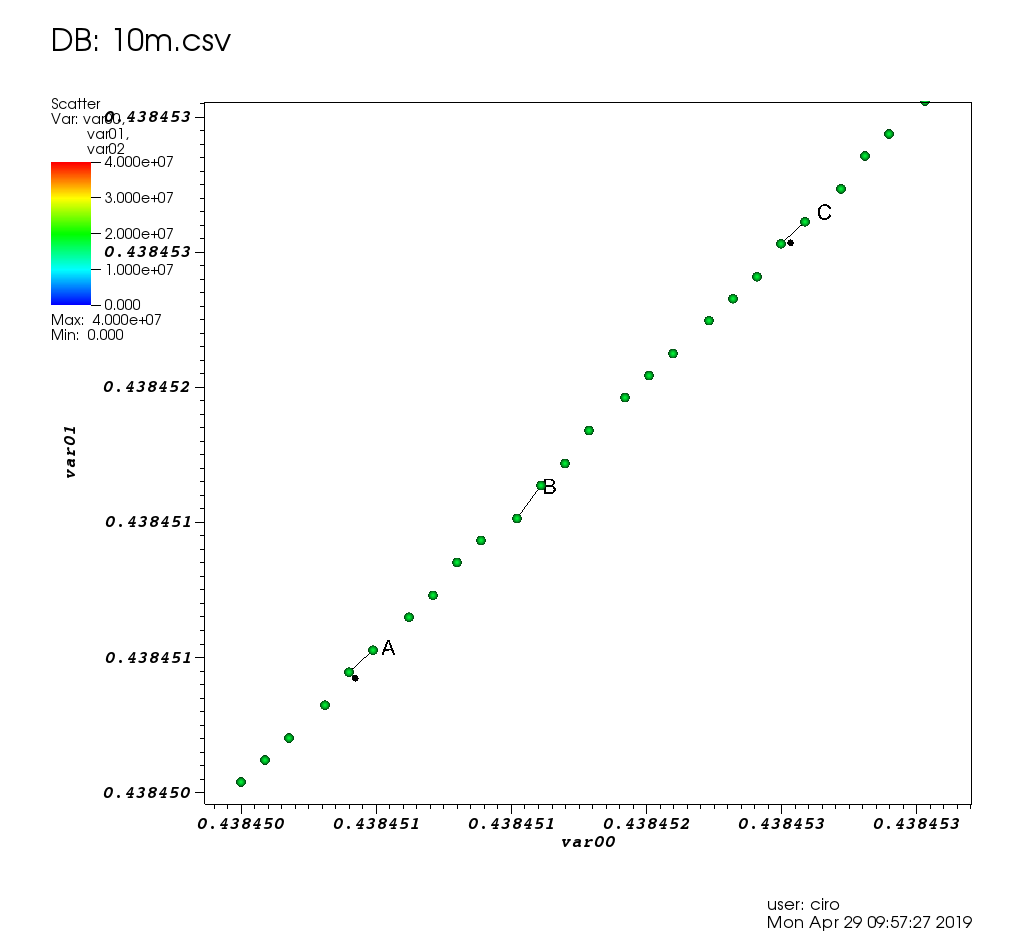
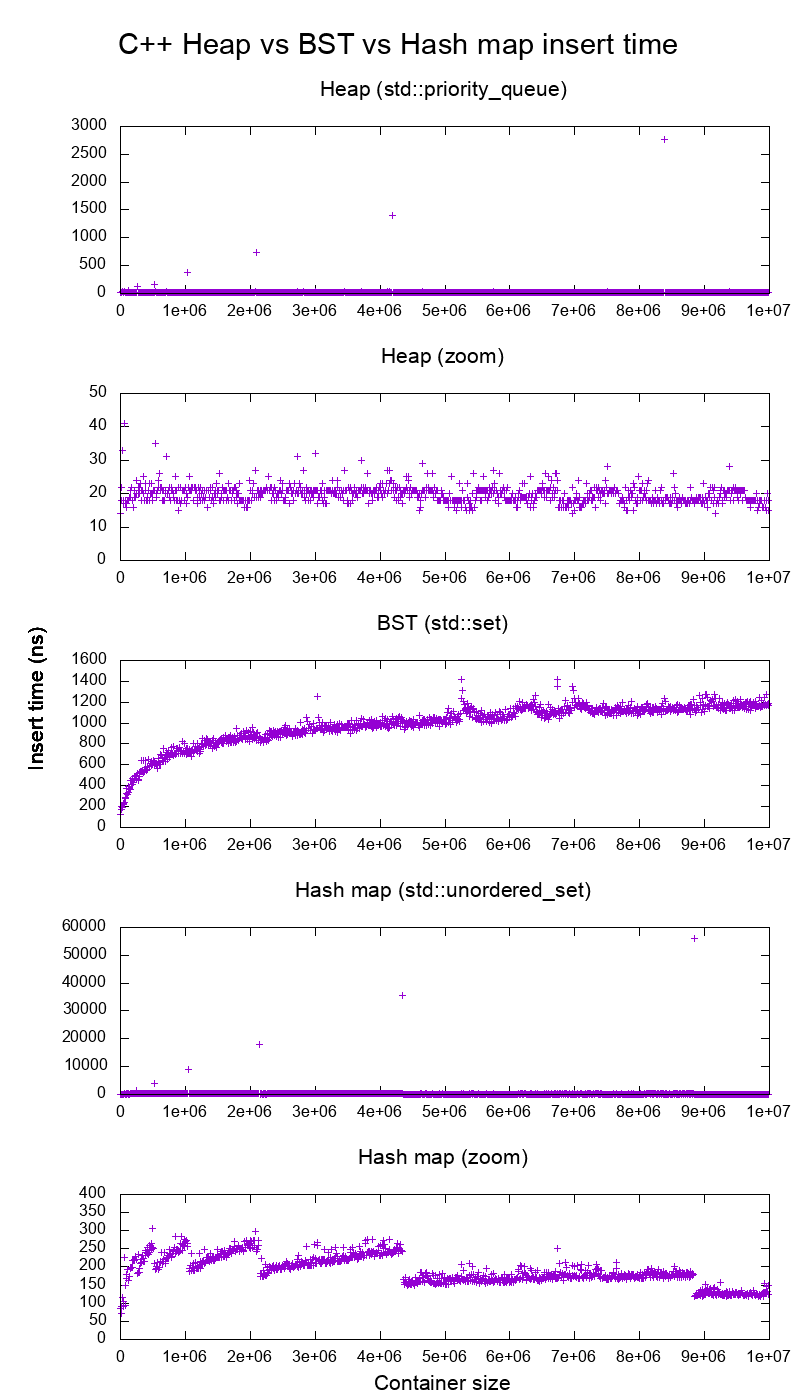
Figure 17. VisIt zoom in 10 million straight line plot with some manually marked points. Source. From: Section "Survey of open source interactive plotting software with a 10 million point scatter plot benchmark by Ciro Santilli"
- Numerical analysis
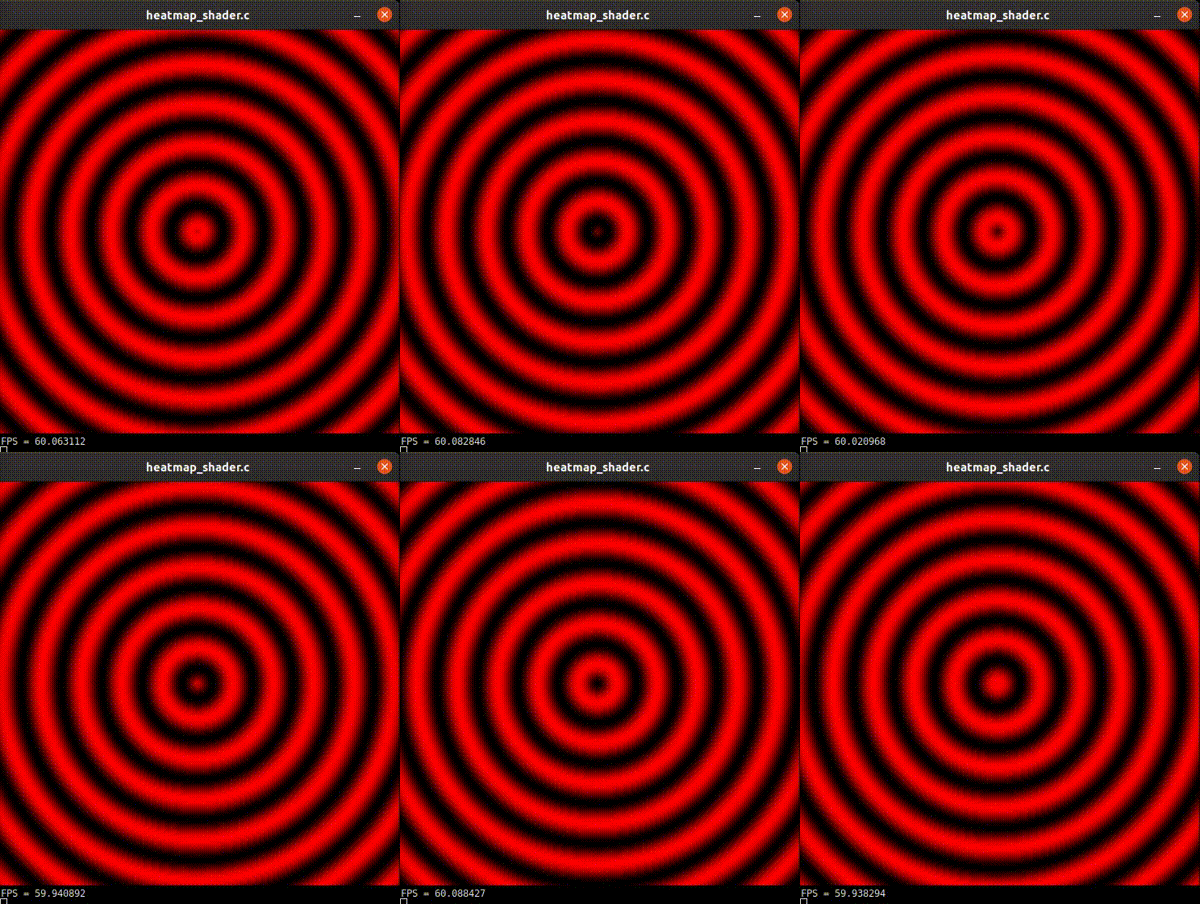
Video 3. Real-time heat equation OpenGL visualization with interactive mouse cursor using relaxation method by Ciro Santilli (2016)Source.
- Computational physics
- Register transfer level languages like Verilog and VHDL
- Verilog:
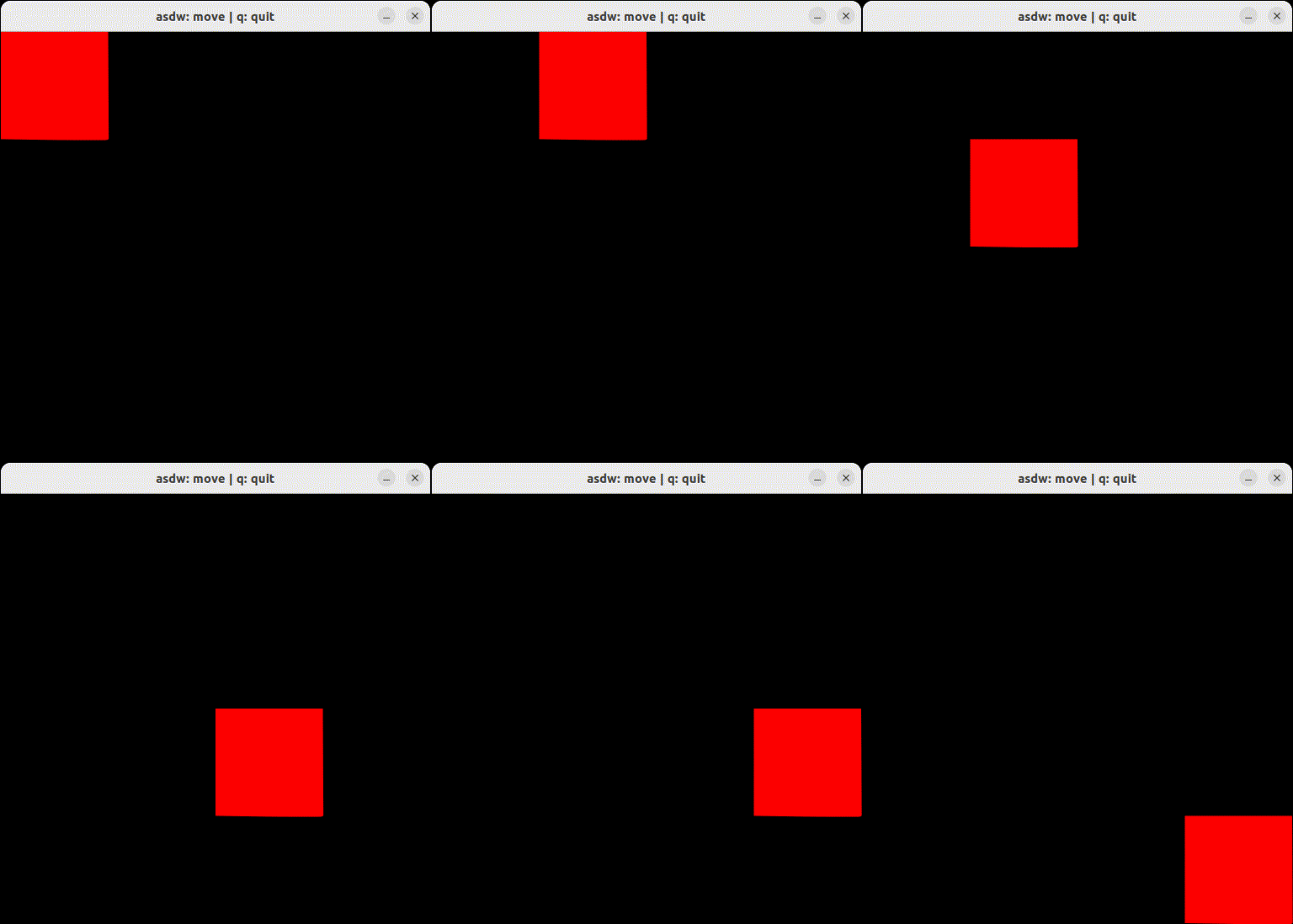
Figure 19. . See also: Section "Verilator interactive example"
- Verilog:
- Android
- Debugging
- Program optimization
- What is tail call optimization?

Figure 21. . Source. The answer compares gprof, valgrind callgrind, perf and gperftools on a single simple executable.
- Data
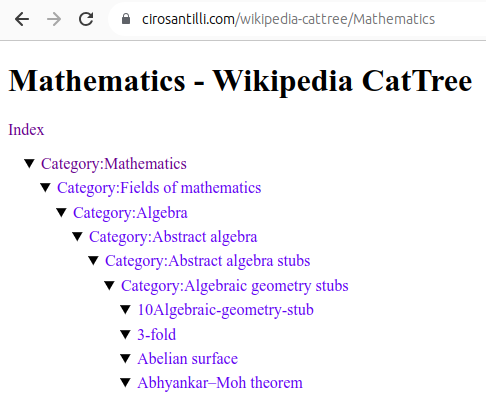
Figure 22. Mathematics dump of Wikipedia CatTree. Source. In this project, Ciro Santilli explored extracting the category and article tree out of the Wikipedia dumps.
- Mathematics
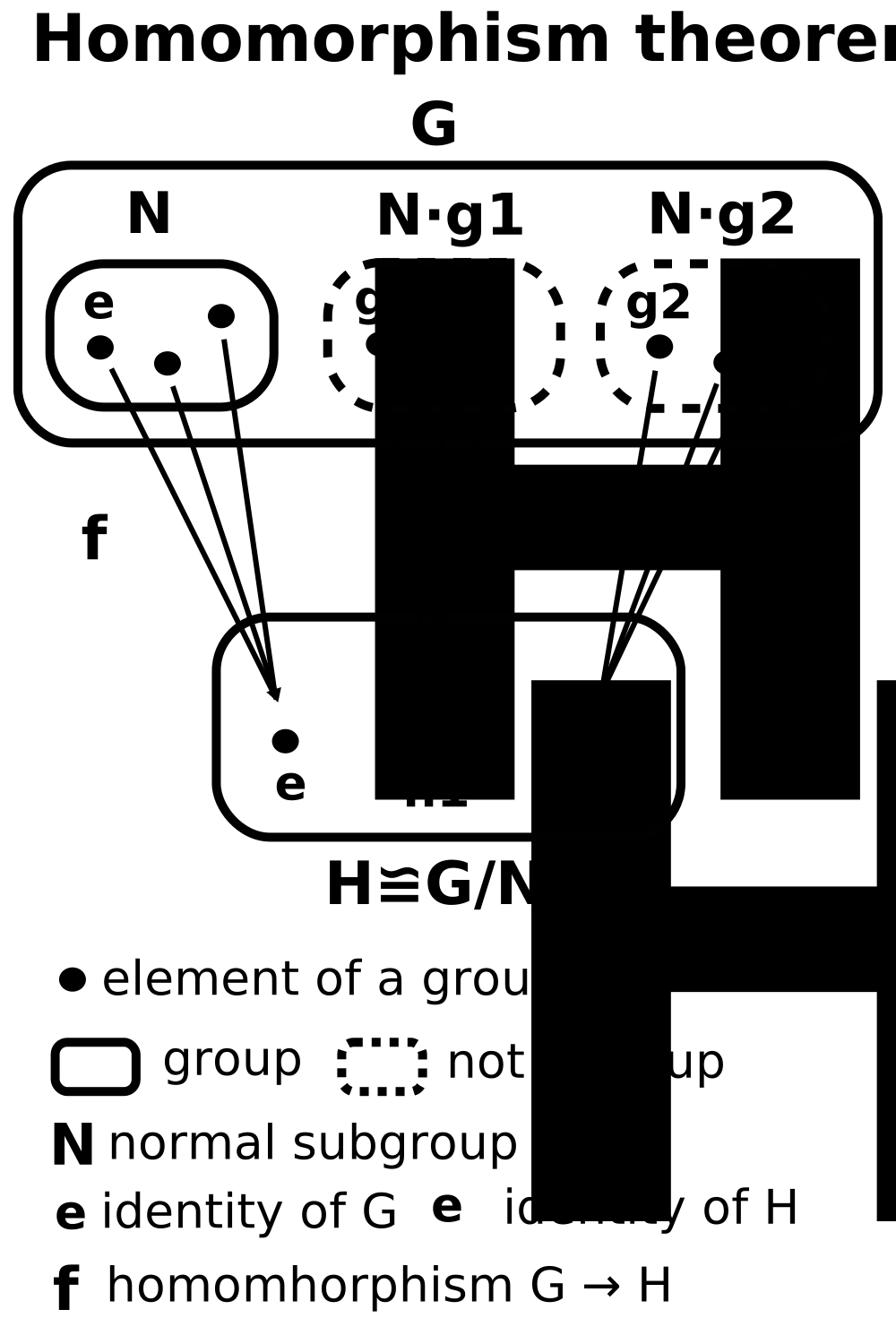
Figure 23. Diagram of the fundamental theorem on homomorphisms by Ciro Santilli (2020)Shows the relationship between group homomorphisms and normal subgroups.- Section "Formalization of mathematics": some early thoughts that could be expanded. Ciro almost had a stroke when he understood this stuff in his teens.

Figure 24. Simple example of the Discrete Fourier transform. Source. That was missing from Wikipedia page: en.wikipedia.org/wiki/Discrete_Fourier_transform!
- Network programming
- Physics
- Biology
- Quantum computing
- Section "Quantum computing is just matrix multiplication"
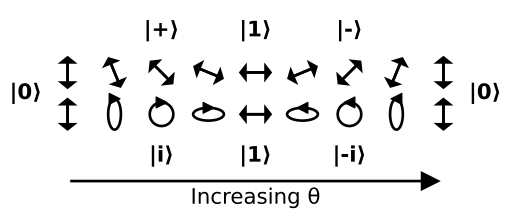
Figure 28. Visualization of the continuous deformation of states as we walk around the Bloch sphere represented as photon polarization arrows. From: Understanding the Bloch sphere.
- Bitcoin
- GIMP

Figure 29. GIMP screenshot part of how to combine two images side-by-side in GIMP?.
- Home DIY

Figure 30. Total_Blackout_Cassette_Roller_Blind_With_Curtains.Source. From: Section "How to blackout your window without drilling"
- China








Ciro Santilli is very happy to meet people with related interests, he really loves his like-minded online friends. Even if you don't have something a specific goal in mind for the contact, please just say hi.
To contact Ciro publicly about any general subject that is not covered in a more specific GitHub repository, including saying hi or suggestions about his website either:
- create a GitHub issue at: github.com/cirosantilli/cirosantilli.github.io/issues/new or Giscus thread
- at mention Ciro's main Twitter account
For comments about China, first read:
and then create a GitHub issue at: github.com/cirosantilli/china-dictatorship/issues/new
Publicly viewable contact is preferred if possible to more effectively share Ciro's wisdom with the world.
But if you feel more comfortable with private contact, no problem, either:
- email: username
cirosantilliwith provider ProtonMail which has domain nameproton.me. Note that Ciro also controls the Gmail address with that same username, and keep in mind that dots are ignored in Gmail addresses. But ProtonMail preferred because why should we give our private minds to the CIA by default? Push notifications disabled. - Signal: username
cirosantilli.89signal.me/#eu/BuJjV0enXYTOnFFc1FZV5LFcWodL1a2Oy9VZ5uyQU7xrYxqw+npIcaHBqghWudrI. 89 is a reference to Ciro Santilli's birth year 1989. Push notifications enabled, but treat like email unless we are actively chatting back and forth.
For other less good methods that will also likely work, use direct messages of the following profiles from under Section "Accounts controlled by Ciro Santilli":Ciro's Twitter DMs are also open, but note that Ciro receives endless Chinese language SPAM there which Twitter is doing nothing to combat, so it's not as reliable.
- LinkedIn: www.linkedin.com/in/cirosantilli
- Reddit: www.reddit.com/user/cirosantilli
- Facebook: www.facebook.com/cirosantilli
- Telegram: telegram.me/cirosantilli. Note that end-to-end encryption is present on secret chats only, which don't have device sync. Ridiculous.
If you are a privacy freak or are going to tell Ciro state secrets Ciro has this GNU Privacy Guard public key: pubkey.gpg, but it's not something that he has ever really used.
Disqus comments were removed from his website in 2019-05-04, a manual dump is available here, removal rationale at: why Ciro Santilli removed Disqus comments from his website in 2019-05-04.
Ciro Santilli controls the following accounts.
With non-trivial activity:
- github.com/cirosantilli on GitHub
- stackoverflow.com/users/895245 on Stack Overflow
- www.linkedin.com/in/cirosantilli on LinkedIn
- www.youtube.com/c/CiroSantilli on YouTube
- Twitter: see Section "Ciro Santilli's Twitter accounts"
- archive.org/details/@cirosantilli2 on the Internet Archive. Was archive.org/details/@cirosantilli but got deleted due to an "admin error" and the old username cannot be restored![ref]
- en.wikipedia.org/wiki/User:Cirosantilli2 and commons.wikimedia.org/wiki/User:Cirosantilli2: Ciro tries to upload all educational CC content he creates to Wikimedia Commons as an extra backup and sometimes to use in Wikipedia pages
- www.facebook.com/cirosantilli/ Ciro accepts all friend requests there, but expect a few non-technical posts. Unless you look like a massive honeypot account, please send context in advance in that case.
- www.quora.com/profile/Ciro-Santilli
- www.reddit.com/user/cirosantilli/ is Ciro's Reddit account, mostly computer and China topics
- maps.app.goo.gl/npV35XTppSBTmNqC8: Google Maps. Ciro Santilli likes to make additions to certain niche topics that are missing, having reached Local Guide Level 6 as of 2024. He can't do as much as he'd like so as to not reveal his current city however.
Trivial or no activity:
- seqanswers.com/forums/member.php?u=90053
- answers.gazebosim.org/users/2289/cirosantilli/
- 4programmers.net/Profile/86786
- 500px.com/p/cirosantilli
- 9gag.com/u/cirosantilli
- addons.mozilla.org/en-US/firefox/user/cirosantilli/
- agoradesk.com/user/cirosantilli
- anaconda.org/cirosantilli
- androidforums.com/members/ciro-santilli.1918307
- app.element.io/#/user/@cirosantilli:matrix.org. Proof: matrix.to/#/!OisxJPszSYdWdwXrrL:matrix.org/$YbrChbGFvlgYiDM5E2OgWXSp0vy7ayLfGkCXftAUyTI?via=matrix.org
- archive.org/details/@ciro_santilli_ourbigbook created during the account deletion mess.
- ask.libreoffice.org/en/users/2352/cirosantilli/
- bbs.archlinux.org/profile.php?id=116270
- bitcointalk.org/index.php?action=profile
- brilliant.org/profile/ciro-il1uxz/
- bsky.app/profile/cirosantilli.bsky.social
- bugzilla.gnome.org/page.cgi?id=describeuser.html&login=ciro.santilli@gmail.com
- cirosantilli.blogspot.com/
- cirosantilli.itch.io
- cirosantilli.livejournal.com/profile
- cirosantilli.medium.com/ on Medium
- cirosantilli.substack.com/ and substack.com/@cirosantilli
- cirosantilli.wordpress.com/ on WordPress
- codeberg.org/cirosantilli
- codeforces.com/profile/cirosantilli reverse proof codeforces.com/blog/entry/98393
- coderwall.com/Ciro%20Santilli Note that space on the username. Beauty.
- community.arm.com/people/cirosantilli
- community.atlassian.com/t5/user/viewprofilepage/user-id/680821
- community.fandom.com/wiki/User:Cirosantilli
- community.openai.com/u/cirosantilli
- community.plos.org/people/cirosantilli
- community.skype.com/t5/user/viewprofilepage/user-id/2646858
- community.zimbra.com/members/cirosantilli
- connect.mozilla.org/t5/user/viewprofilepage/user-id/46889
- del.icio.us/cirosantilli
- dev.to/cirosantilli
- developer.mbed.org/users/cirosantilli/
- devtalk.nvidia.com/member/2118846/
- droit-finances.commentcamarche.net/profile/user/cirosantilli
- en.gravatar.com/cirosantilli
- en.wikipedia.org/wiki/User:Ciro.santilli also belongs to Ciro, but he lost the password
- eternagame.org/web/player/260828/
- exercism.org/profiles/cirosantilli
- figshare.com/authors/Ciro_Santilli/656781
- forums.developer.nvidia.com/u/cirosantilli
- forum.osdev.org/memberlist.php?mode=viewprofile&u=16372
- forum.pine64.org/member.php?action=profile&uid=17386
- forum.videolan.org/memberlist.php?mode=viewprofile&u=173503
- forum.xda-developers.com/member.php?u=7116837
- forums.androidcentral.com/members/cirosantilli-2734491
- forums.lenovo.com/user/viewprofilepage/user-id/1561639
- forums.hardwarezone.com.sg/members/cirosantilli.875544/
- framasphere.org/people/78a975c0b6c40133a3032a0000053625 framasphere.org/posts/1519871
- freesound.org/people/cirosantilli
- gitlab.com/u/cirosantilli
- hackaday.io/cirosantilli
- hinative.com/en-US/profiles/5276462
- home.gamer.com.tw/homeindex.php?owner=cirosantilli but can't post anything publicly because cannot verify phone in many countries
- huggingface.co/cirosantilli
- identity.kde.org/index.php?r=people/view&uid=cirosantilli
- imgur.com/user/cirosantilli/about: Proof: imgur.com/gallery/mexv1Bk/comment/1734086983
- jsfiddle.net/user/cirosantilli/
- kiwifarms.net/members/cirosantilli.82011/
- knockout.chat/user/22882
- launchpad.net/~cirosantilli
- leanprover.zulipchat.com/#user/1019866
- leanpub.com/u/cirosantilli
- leetcode.com/cirosantilli/
- makandracards.com/ciro-santilli
- mastodon.social/@cirosantilli
- nanohub.org/members/146301/
- next-episode.net/user/cirosantilli/
- openclipart.org/artist/cirosantilli. TODO but not yet able to login after the "first upload". But it did get uploaded: openclipart.org/artist/cirosantilli.
- opencollective.com/ciro-santilli
- open.spotify.com/user/cirosantilli
- orcid.org/0000-0003-2895-7763
- parler.com/profile/cirosantilli/posts
- paypal.me/cirosantilli. United Kingdom account.
- peerj.com/cirosantilli/
- profile.edx.org/u/ciro_santilli
- profiles.3dgames.com.ar/profiles/1002278
- protonmail.uservoice.com/users/6491333990-ciro-santilli
- pypi.org/user/cirosantilli/
- raidforums.com/User-cirosantilli
- rubygems.org/profiles/cirosantilli
- software.intel.com/en-us/user/1090688
- soundcloud.com/cirosantilli
- sourceforge.net/u/cirosantilli/profile/
- stackshare.io/cirosantilli
- steamcommunity.com/id/cirosantilli/
- subreply.com/cirosantilli
- support.discord.com/hc/en-us/profiles/427813342894 on the Discord forum
- support.mozilla.org/en-US/user/cirosantilli
- tabmixplus.org/forum/memberlist.php?mode=viewprofile&u=59846
- talk.commonmark.org/users/cirosantilli
- talk.jekyllrb.com/users/cirosantilli
- talks.cam.ac.uk/user/show/81142
- tatoeba.org/eng/user/profile/cirosantilli
- telegram.me/cirosantilli on Telegram
- trac.ffmpeg.org/wiki/Waveform?action=history username
cirosantilli - tuleap.net/users/cirosantilli
- tuleap.ring.cx/users/cirosantilli
- twittercommunity.com/users/cirosantilli/activity
- wefunder.com/cirosantilli
- wise.com/pay/me/cirod3. The name shows as "Ciro Duran Santilli" and that's correct.
- wiki.qemu.org/User:Cirosantilli
- www.airbnb.com/users/show/45794827
- www.behance.net/cirosantilli
- www.bibsonomy.org/user/cirosantilli
- www.biostars.org/u/50170/
- www.bountysource.com/people/25676-ciro-santilli
- www.bulletphysics.org/Bullet/phpBB3/memberlist.php?mode=viewprofile&u=11704
- www.codewars.com/users/cirosantilli
- www.codingame.com/profile/cddd0a711c22d97e8264361f7c8205567563841
- www.coursera.org/user/f65b08c191d792eb809fe2808d771ee7
- www.dailymotion.com/cirosantilli
- www.deviantart.com/cirosantilli
- www.digitalocean.com/community/users/cirosantilli
- www.ebay.com/usr/cirosantilli
- www.edaboard.com/member587087.html
- www.flickr.com/people/cirosantilli/. Account auto deleted tested as of 2025. Created: flickr.com/photos/202496646@N08/. Was something nicer, tried to change username to
cirosantilli2but got hat instead. Alsocirosantilliwas marked taken. What a bullshit website! Poor Canadians, sold off to Yahoo and let their baby be mutilated. - www.freecodecamp.org/fcc8f660b91-167c-4b04-a8da-5d50cdb46def
- www.f6s.com/cirosantilli
- www.f6s.com/cirosantilli1
- www.gitbook.com/@cirosantilli
- www.hackerrank.com/cirosantilli
- www.hackster.io/cirosantilli
- www.html5gamedevs.com/profile/30103-cirosantilli/
- www.imdb.com/user/ur59802249 on IMDb
- www.instagram.com/cirosantilli/ Impossible to disable their notifications without removing your email. So all their notifications go to trash.
- www.kaggle.com/cirosantilli
- www.lesswrong.com/users/ciro-santilli on LessWrong
- www.linux.org/members/ciro-santilli.62540/
- www.linuxquestions.org/questions/user/cirosantilli-688439/
- www.meetup.com/members/252568305/
- www.mentebinaria.com.br/profile/1987-ciro-santilli/
- www.metacritic.com/user/cirosantilli
- www.metaculus.com/accounts/profile/163587/
- www.mohu.rocks/people/cirosantilli
- www.mudhut.com/user/1995000
- www.myopportunity.com/en/profile/ciro-santilli
- www.npmjs.com/~cirosantilli
- www.opengl.org/discussion_boards/member.php/40269-cirosantilli
- www.openstreetmap.org/user/Ciro%20Santilli
- www.patreon.com/cirosantilli
- www.physicsforums.com/members/cirosantilli.422056/
- www.pixiv.net/en/users/64347194
- www.plurk.com/cirosantilli
- www.raspberrypi.org/forums/memberlist.php?mode=viewprofile&u=273389
- www.shadertoy.com/user/cirosantilli
- www.strava.com/athletes/47913768
- www.tastekid.com/ciro.santilli
- www.ted.com/profiles/5822760
- www.threads.com/@cirosantilli
- www.thestudentroom.co.uk/member.php?u=5930160
- www.tiktok.com/@cirosantilli2
- www.transifex.com/user/profile/cirosantilli
- www.tripadvisor.com/members/cirosantilli
- www.twitch.tv/cirosantilli
- www.whatdotheyknow.com/user/ciro_santilli/profile "Banned for spamming" as of 2024. One of those idiotic websites where you can't add a link to your homepage to your own profile page.
Lost or deleted:
- projecteuler.net/profile/cirosantilli.png Blocked 2025-10-01 due to their stupid policy that you can't give away answers within 12 hours of: github.com/lucky-bai/projecteuler-solutions/pull/94
Accounts in Chinese websites. These accounts might be banned or altered or offer other limitations, so Ciro only communicates briefly through them. All communication through those channels should obviously be assumed to be compromised:
- bbs.nibaedu.com/index.php?m=space&uid=70
- www.renren.com/338003848/profile
- www.tianya.cn/109285544 (can't post, no cell phone)
- hacpai.com/member/cirosantilli unable to login as of 2019-10-12, reason unclear, either ban or website too crappy.
- pincong.rocks/people/cirosantilli Lost account tested as of 2022-11 and likely much earlier. Last existing password not working, and there doesn't seem to be a reset password button. Creating cirosantilli2
- pincong.rocks/people/cirosantilli2
- tieba.baidu.com/home/main?id=5cd56369726f73616e74696c6c69c944
- v2ex.com/member/cirosantilli: Ciro was blocked and or account deleted on 2020-07-23: cirosantilli.com/china-dictatorship/v2ex
- v2ex.com/member/cirosantilli2: was created by someone else most likely and cannot be re-registered. Also blocked.
- v2ex.com/member/cirosantilli3: Ciro created this new account November 2023, let's see how long it lasts.
- www.zhihu.com/people/cirosantilli. Ciro was prevented from posting in 2018-06-25, and the account and all content mentioning him were taken down in 2019-11-03.
- www.weibo.com/p/1005055601627311: started requiring a cell phone to login in 2020, and Ciro didn't want to give his cell phone number to the CCP and didn't have the patience to manage a secondary phone number, so he is not logging in for now. The account was blocked in 2021: cirosantilli.com/china-dictatorship/ciro-santillis-weibo-block
Dead websites:
- www.citeulike.org/user/cirosantilli (2019-05)
Cirism is totally not a cult, has been officially verified to be compatible with all major world religions.
Enlightened Cirists donate money to the cause at: Section "Sponsor Ciro Santilli's work on OurBigBook.com". It is totally optional of course, your soul will just be eternally damned if you don't.
Ciro Santilli once proclaimed:
Thou shalt eat thy watermelon in the morning, and thy melon in the evening. Thou shalt not eat thy watermelon in the evening, nor shalt thou eat thy melon in the morning.
However it won't remain like that for long, because it will be migrated to OurBigBook.com, and therefore become a brain dump of society itself.
Pinned article: Introduction to the OurBigBook Project
Welcome to the OurBigBook Project! Our goal is to create the perfect publishing platform for STEM subjects, and get university-level students to write the best free STEM tutorials ever.
Everyone is welcome to create an account and play with the site: ourbigbook.com/go/register. We belive that students themselves can write amazing tutorials, but teachers are welcome too. You can write about anything you want, it doesn't have to be STEM or even educational. Silly test content is very welcome and you won't be penalized in any way. Just keep it legal!
Intro to OurBigBook
. Source. We have two killer features:
- topics: topics group articles by different users with the same title, e.g. here is the topic for the "Fundamental Theorem of Calculus" ourbigbook.com/go/topic/fundamental-theorem-of-calculusArticles of different users are sorted by upvote within each article page. This feature is a bit like:
- a Wikipedia where each user can have their own version of each article
- a Q&A website like Stack Overflow, where multiple people can give their views on a given topic, and the best ones are sorted by upvote. Except you don't need to wait for someone to ask first, and any topic goes, no matter how narrow or broad
This feature makes it possible for readers to find better explanations of any topic created by other writers. And it allows writers to create an explanation in a place that readers might actually find it.
Figure 1. Screenshot of the "Derivative" topic page. View it live at: ourbigbook.com/go/topic/derivativeVideo 2. OurBigBook Web topics demo. Source. - local editing: you can store all your personal knowledge base content locally in a plaintext markup format that can be edited locally and published either:This way you can be sure that even if OurBigBook.com were to go down one day (which we have no plans to do as it is quite cheap to host!), your content will still be perfectly readable as a static site.
- to OurBigBook.com to get awesome multi-user features like topics and likes
- as HTML files to a static website, which you can host yourself for free on many external providers like GitHub Pages, and remain in full control

Figure 3. Visual Studio Code extension installation.
Figure 4. Visual Studio Code extension tree navigation.
Figure 5. Web editor. You can also edit articles on the Web editor without installing anything locally.Video 3. Edit locally and publish demo. Source. This shows editing OurBigBook Markup and publishing it using the Visual Studio Code extension.Video 4. OurBigBook Visual Studio Code extension editing and navigation demo. Source. 
- Infinitely deep tables of contents:




All our software is open source and hosted at: github.com/ourbigbook/ourbigbook
Further documentation can be found at: docs.ourbigbook.com
Feel free to reach our to us for any help or suggestions: docs.ourbigbook.com/#contact