The dual norm is a concept from functional analysis, particularly in the context of normed vector spaces. It extends the idea of a norm from a vector space to its dual space, which consists of all continuous linear functionals on that vector space.
Articles by others on the same topic

A dual norm measures how strongly a bounded linear functional can respond to a unit-sized input. If is a bounded linear functional on a normed vector space , write and defineIt is the operator norm of when its scalar output is measured by absolute value. On , represent using a coefficient vector . The unit ball is symmetric, so maximizing gives the same value as maximizing : negate an input whenever its output is negative.[ref]
Convex Optimization by Stephen Boyd and Lieven Vandenberghe. §A.1.6, printed p. 636: dual norm and scalar operator-norm interpretation
For an original two-coordinate example, fix , so . The input norm changes the allowable unit ball and hence the dual norm:Under the L1 norm, , and attains the bound. Under the Euclidean norm, the Cauchy-Schwarz inequality gives , with equality at the displayed normalized vector. Under the maximum norm, each coordinate can reach unit absolute value, so ; attains it. Thus the dual norms of these three vector norms are respectively the maximum norm, the Euclidean norm, and the L1 norm. For , Lp norms on a finite coordinate space pair with their Holder conjugate exponents.[ref]
Convex Optimization by Stephen Boyd and Lieven Vandenberghe. §A.1.6, printed p. 637: Euclidean self-duality and one-, infinity- and p-norm duality; the numerical vector and maximizing points here are independent examples
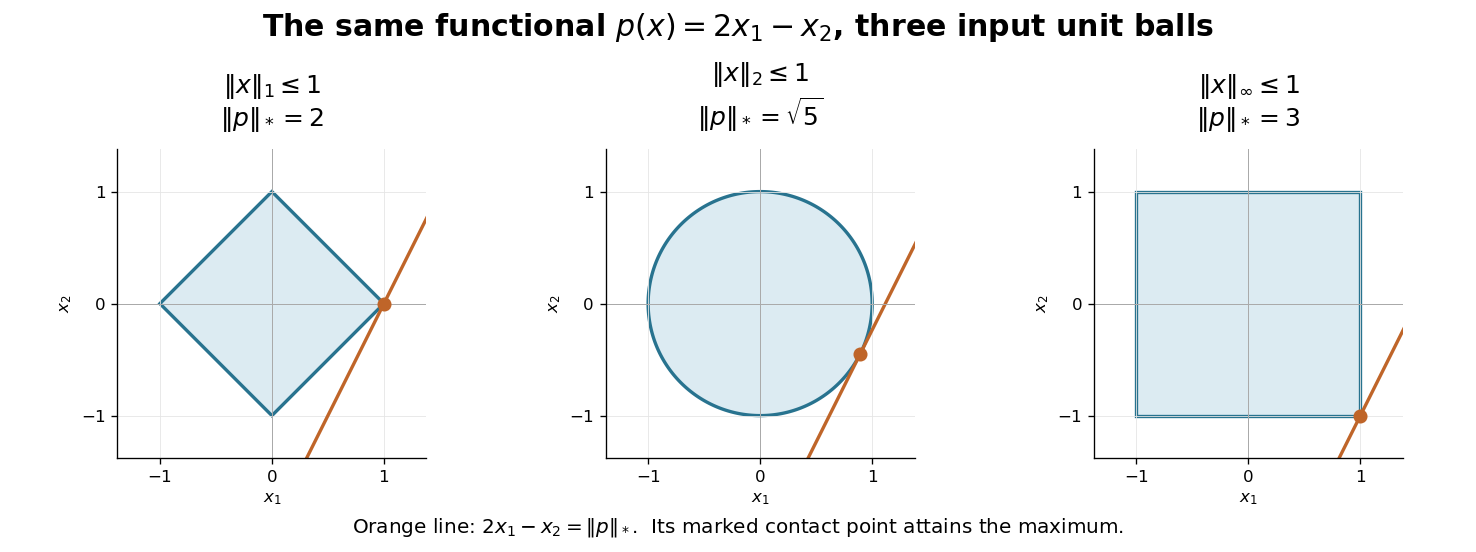

This geometry explains the usefulness of a dual norm: it translates a bound on inputs into the sharp bound on a linear output. The support function of the unit ball gives its value in the coefficient direction . Changing the input budget changes the set of possible inputs; the three different answers do not conflict. In finite dimensions a closed unit ball is compact, so a continuous linear functional achieves its maximum absolute value. In an infinite-dimensional normed vector space, the supremum remains the definition and need not be achieved.