The Householder transformation is a linear algebra technique used to perform orthogonal transformations of vectors and matrices. It is particularly useful in numerical linear algebra for QR decomposition and in other applications where one needs to reflect a vector across a hyperplane defined by another vector.
Articles by others on the same topic

A Householder transformation is a reflection that leaves every direction in a chosen hyperplane fixed and reverses its normal direction. For a real unit vector , its matrix isTo understand the formula, decompose any vector into its orthogonal projection onto the normal and a perpendicular component:Then . Subtracting twice the normal component changes its sign while retaining everything parallel to the mirror. A nonzero normal gives the equivalent formula , so normalization can be deferred.
For example, take . Its mirror is the straight line , andThe midpoint of these two vectors is , which lies on the mirror; their connecting segment is parallel to its normal. Both vectors have Euclidean norm five.
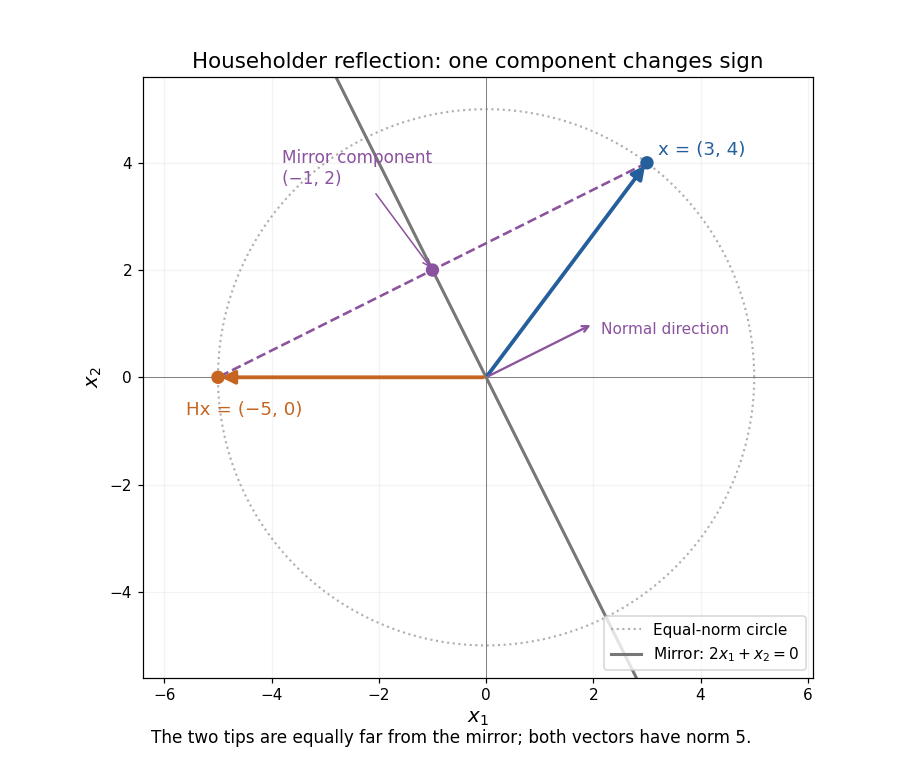
A Householder reflection reverses the normal component and preserves the mirror component
. The mirror is . The vector becomes ; their midpoint is the orthogonal projection onto the mirror. Details.
Several useful properties follow from this decomposition. The Householder reflection is a symmetric matrix and an orthogonal matrix:Reflecting twice restores the original vector; Euclidean norms and inner products are preserved. The eigenvalue is along and on , so . A reflection reverses orientation even though it preserves lengths.
The computational payoff is that the mirror can be chosen to send a whole vector onto one coordinate axis, eliminating several entries at once. Householder QR decomposition repeats this operation on the remaining parts of successive columns. For a real symmetric matrix, applying the same Householder reflection on both sides gives a matrix similarity that preserves symmetry and eigenvalues; this is the basis of Householder tridiagonalization.
Alston S. Householder's 1958 paper Unitary Triangularization of a Nonsymmetric Matrix develops this elimination method. Its motivation includes reducing the arithmetic needed for triangularization while retaining the conditioning advantages of orthogonal transformations. [ref]
https://web.stanford.edu/class/cme324/classics/householder.pdf. Householder (1958), Journal of the ACM 5(4), pp. 339–342: original paper
Over the complex numbers, for a unit is Hermitian and unitary, with the star denoting the conjugate transpose; the coordinate-axis construction below is stated for real vectors.