An ion trap is a device used to confine charged particles, known as ions, using electromagnetic fields. It allows researchers to isolate and manipulate individual ions or groups of ions for a variety of applications, including fundamental physics experiments, quantum computing, spectroscopy, and the study of chemical reactions. ### Types of Ion Traps 1. **Paul Trap**: This type of ion trap uses an oscillating electric field to confine ions in three dimensions.
Articles by others on the same topic

An ion trap confines an ion using electromagnetic fields, allowing repeated interrogation of the same particle. The name also covers related traps for an electron. A Paul trap uses an oscillating electric quadrupole field; a Penning trap combines a static electric quadrupole field with a static magnetic field. Confinement creates time to measure an energy level, frequency or magnetic dipole moment; it does not itself cool the particle or identify its internal quantum state.
The obstacle is Earnshaw's theorem. In a charge-free neighbourhood the static electric potential obeys Laplace's equation, . For a particle of fixed nonzero electric charge , the potential energy is also a harmonic function. The maximum principle for harmonic functions excludes a strict interior minimum. For a quadratic example, the Hessian matrix has zero trace; it cannot have three positive eigenvalues. A static purely electric field therefore cannot supply three-dimensional stable confinement of a free point electric charge. Time variation in a Paul trap, and the velocity-dependent Lorentz force in a Penning trap, change the assumptions of this argument.
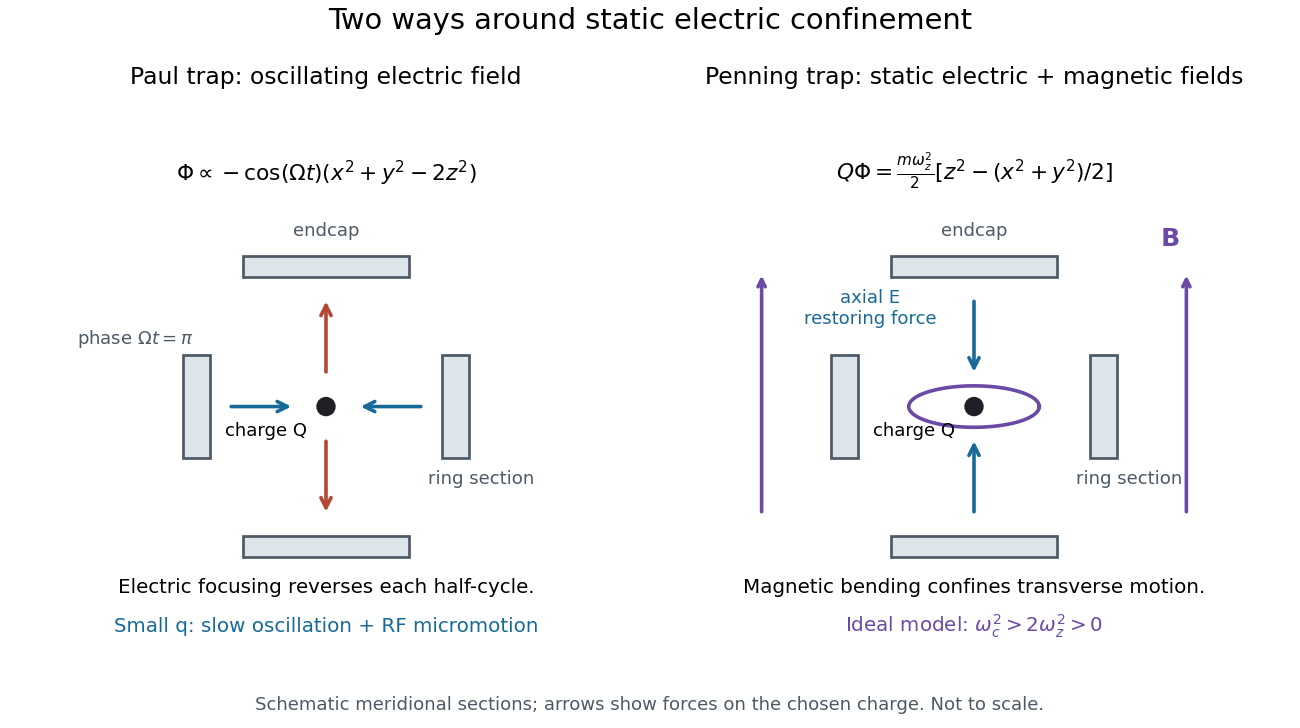
Paul and Penning traps use different confinement mechanisms
. Original comparison of the ideal fields derived below. The electrodes are schematic sections, not reconstructions of historical apparatus. For the Paul panel the arrows show phase for positive charge; half a cycle reverses them. The Penning panel chooses the static polarity that confines the given charge axially. Details.
