Membrane potential refers to the difference in electric potential across a cell membrane due to the distribution of ions inside and outside of the cell. This difference in charge creates a voltage difference, which is crucial for various cellular functions, including the generation and propagation of electrical signals in neurons and muscle cells. The membrane potential is typically measured in millivolts (mV) and is usually negative in a resting state, often around -70 mV in neurons.
Articles by others on the same topic

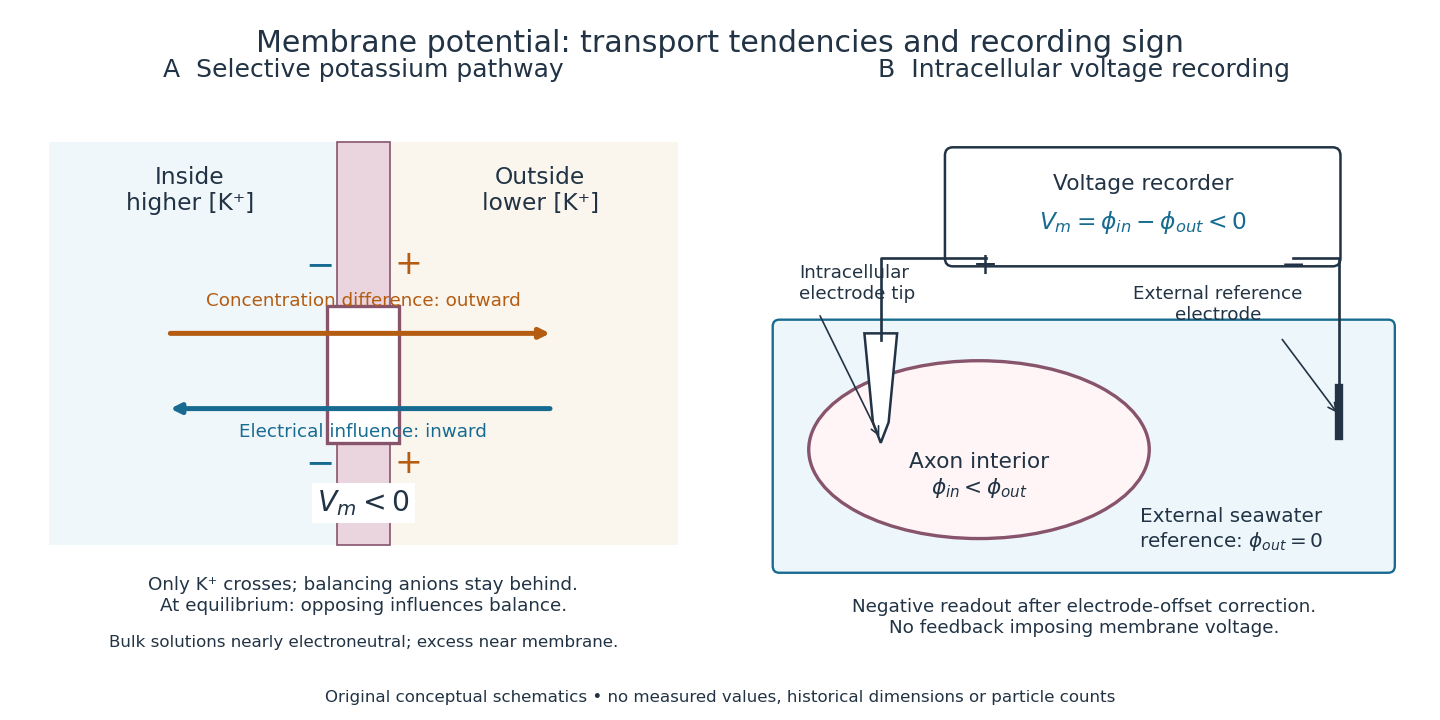
A membrane potential is an electric potential difference across a cell membrane. We use the conventionTaking the external electric potential as zero makes mean that the inside is at lower electric potential. “Negative inside” describes a difference, not an absolute electric potential, and does not imply that the entire cytosol has a large net negative electric charge.
Consider a cell membrane permeable only to potassium ions, with higher potassium concentration inside. Diffusion initially favors outward transport. If balancing negative ions cannot follow, that loss of positive electric charge produces a small inner excess of negative electric charge and an outer positive excess. The resulting electric field favors inward potassium transport. At the Nernst equilibrium potential, chemical and electrical contributions to electrochemical potential balance; ions still cross both ways, with zero net transport.[ref]
Ion Channels and the Electrical Properties of Membranes. Molecular Biology of the Cell, 4th edition by Bruce Alberts and others; The Resting Membrane Potential Is Determined Mainly by K+ Leak Channels in Most Animal Cells: selective potassium passage and opposing electrical influence

In living biological cells, several ions can permeate and pumps maintain their concentration differences through active transport. Pumps transporting net electric charge also contribute electric current. Thus is a special limit, not a universal rule; membrane potential need not always be negative.[ref]
Ion Channels and the Electrical Properties of Membranes. Molecular Biology of the Cell, 4th edition by Bruce Alberts and others; K+ leak-channel discussion; The Resting Potential Decays Only Slowly When the Na+-K+ Pump Is Stopped; action-potential discussion
The existing reversal potential example shows how opposing electric currents can balance without each ion reaching thermodynamic equilibrium. This makes selective permeability a way to convert chemical differences into electrical signals: changing the available ion channels changes which electrochemical gradients influence the voltage.