Topics (203k) Articles (205k) Users (298) Discussions (237) Comments (383) Files (715) New article

The bald confident chilled out particle physics guy from Stanford University!
Also one can't stop thinking abot Leonard Hofstadter from The Big Bang Theory upoen hearing his name.

Leonard Susskind lecturing in 2013
. Source. physicist with lots of focus on politically incorrect/Right wing stuff:
- motls.blogspot.com/ his blog
- physics.stackexchange.com/users/1236/lubo%c5%a1-motl he has lots of contributions to Physics Stack Exchange
- settheory.net/crackpot-physics: some comments about him from settheory.net
Like all big names in science, she was at the right place at the right time and with the right interest and passion.
Notably, the man she married, Pierre Curie, happened to be a the world master at precisely the technique that she needed to carefully measure radioactivity: he had the most precise electrometers in the world, which allowed to detect small amounts of radioactivity via the ionization of air by radiation . These used piezoelectricity, which Pierre Curie co-discovered with his brother.

Marie Curie c. 1920
. Source. Well known popular science character. He just looks futuristic and wraps stuff in exciting empty words. When he shows up, you won't be learning much.
Web of Stories 1997 interview playlist: www.youtube.com/playlist?list=PLVV0r6CmEsFxKFx-0lsQDs6oLP3SZ9BlA
The way this dude speaks. He exhales incredible intelligence!!!
In the interviews you can see that he pronounces names in all languages amazingly, making acute effort to do so, to the point of being notable. His passion for linguistics is actually mentioned on Genius: Richard Feynman and Modern Physics by James Gleick (1994).
Maybe this obsession is partly due to his name which no English speaking person knows how to pronounce from the writing.
This passion also led in part for his names to some physics terminology he worked on winning out over alternatives by his collaborators, most notably in the case of the naming of the quark.

One of the leading figures of the early development of quantum electrodynamics.

Eccentric nerdy slow speaking physicist mostly based in University of Cambridge.
Created the Dirac equation, what else do you need to know?!
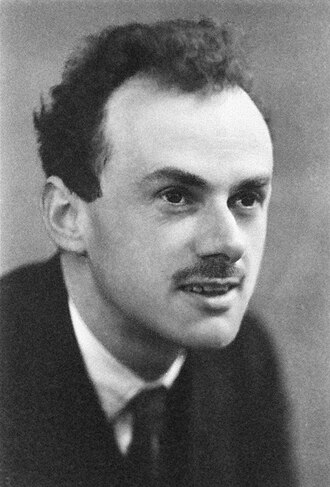
QED and the men who made it: Dyson, Feynman, Schwinger, and Tomonaga by Silvan Schweber (1994) chapter 1.3 "P.A.M. Dirac and the Birth of Quantum Electrodynamics" quotes Dirac saying how being at high school during World War I was an advantage, since all slightly older boys were being sent to war, and so the younger kids were made advance as fast as they could through subjects. Exactly the type of thing Ciro Santilli wants to achieve with OurBigBook.com, but without the need for a world war hopefully.
Dirac was a staunch atheist having said during the Fifth Solvay Conference (1927)[ref]:
If we are honest - and scientists have to be - we must admit that religion is a jumble of false assertions, with no basis in reality. The very idea of God is a product of the human imagination. It is quite understandable why primitive people, who were so much more exposed to the overpowering forces of nature than we are today, should have personified these forces in fear and trembling. But nowadays, when we understand so many natural processes, we have no need for such solutions. I can't for the life of me see how the postulate of an Almighty God helps us in any way. What I do see is that this assumption leads to such unproductive questions as why God allows so much misery and injustice, the exploitation of the poor by the rich and all the other horrors He might have prevented. If religion is still being taught, it is by no means because its ideas still convince us, but simply because some of us want to keep the lower classes quiet. Quiet people are much easier to govern than clamorous and dissatisfied ones. They are also much easier to exploit. Religion is a kind of opium that allows a nation to lull itself into wishful dreams and so forget the injustices that are being perpetrated against the people. Hence the close alliance between those two great political forces, the State and the Church. Both need the illusion that a kindly God rewards - in heaven if not on earth - all those who have not risen up against injustice, who have done their duty quietly and uncomplainingly. That is precisely why the honest assertion that God is a mere product of the human imagination is branded as the worst of all mortal sins.
Some of Feynman's key characteristics are:
- obsession with understanding the experiments well, see also Section "How to teach and learn physics"
- when doing more mathematical stuff, analogous obsession about starting with a concrete example and then generalizing that into the theory
- liked to teach others. At Surely You're Joking, Mr. Feynman for example he mentions that one key problem of the Institute for Advanced Study is that they didn't have to teach, and besides that making you feel useless when were not having new ideas, it is also the case that student's questions often inspire you to look again in some direction which sometimes happens to be profitableHe hated however mentoring others one to one, because almost everyone was too stupid for him
- interest in other natural sciences, and also random art and culture (and especially if it involves pretty women)
Some non-Physics related ones, mostly highlighted at Genius: Richard Feynman and Modern Physics by James Gleick (1994):
- Feynman was a huge womanizer during a certain period of his life
- he hated pomp, going as far as seeming uneducated to some people in the way he spoke, or going out of his way to look like that. This is in stark contrast to "rivals" Murray Gell-Mann and Julian Schwinger, who were posh/snobby.
Even Apple thinks so according to their Think different campaign: www.feynman.com/fun/think-different/
quantum electrodynamics lectures:
Feynman was apparently seriously interested/amused by computer:
- Video "Los Alamos From Below by Richard Feynman (1975)" see description for the human emulator
- quantum computers as experiments that are hard to predict outcomes was first attributed to Feynman
- www.youtube.com/watch?v=EKWGGDXe5MA Richard Feynman Computer Heuristics Lecture (1986)
Two official websites?
- www.richardfeynman.com/ this one has clearly superior scientific information.
- www.feynman.com/
In 1948 he published his reworking of classical quantum mechanics in terms of the path integral formulation: journals.aps.org/rmp/abstract/10.1103/RevModPhys.20.367 Space Time Approach to nonrelativistic quantum mechanics (paywalled 2021)
Sean's series The Biggest Ideas in the Universe has some merit, but it's just to math-light falling a bit below the missing link between basic and advanced.
While learning black-hole stuff is not on top of Ciro Santilli's priorities, Hawking's spirit is to be admired.
An ex-physicist colleague who had met Hawking told an anecdote. Hawking was around in the department one day, they said hi and all. But then Hawking wanted to tell a joke. It took like 5 minutes of typing, and you can imagine that things were pretty awkward and the joke's timing was "a bit off". But Hawking did tell the joke nonetheless.
This is also suggested in the The Theory of Everything (2014) film, and therefore likely the biographies.
Ciro Santilli feels a bit like this guy:
- he's also an idealist, even more than Ciro. So cute. Notably, he he also dumps his brain online into pages that no-one will ever read
- he also thinks that the 2010's education system is bullshit, e.g. settheory.net/learnphysics
- trust-forum.net/ some kind of change the world website. But:is a sin to Ciro. Planning a change the world thing behind closed doors? Really? Decentralized, meh.
- antispirituality.net/ his atheism website
singlesunion.org/ so cute, he's looking for true love!!! This is something Ciro often thinks about: why it is so difficult to find love without looking people in the eye. The same applies to jobs to some extent. He has an Incel wiki page: incels.wiki/w/Sylvain_Poirier :-)

Sylvain's photo from his homepage.
Source. He's not ugly at all! Just a regular good looking French dude.Why learn Physics by yourself by Sylvain Poirier (2013)
Source. Pinned article: Introduction to the OurBigBook Project
Welcome to the OurBigBook Project! Our goal is to create the perfect publishing platform for STEM subjects, and get university-level students to write the best free STEM tutorials ever.
Everyone is welcome to create an account and play with the site: ourbigbook.com/go/register. We belive that students themselves can write amazing tutorials, but teachers are welcome too. You can write about anything you want, it doesn't have to be STEM or even educational. Silly test content is very welcome and you won't be penalized in any way. Just keep it legal!
Intro to OurBigBook
. Source. We have two killer features:
- topics: topics group articles by different users with the same title, e.g. here is the topic for the "Fundamental Theorem of Calculus" ourbigbook.com/go/topic/fundamental-theorem-of-calculusArticles of different users are sorted by upvote within each article page. This feature is a bit like:
- a Wikipedia where each user can have their own version of each article
- a Q&A website like Stack Overflow, where multiple people can give their views on a given topic, and the best ones are sorted by upvote. Except you don't need to wait for someone to ask first, and any topic goes, no matter how narrow or broad
This feature makes it possible for readers to find better explanations of any topic created by other writers. And it allows writers to create an explanation in a place that readers might actually find it.
Figure 1. Screenshot of the "Derivative" topic page. View it live at: ourbigbook.com/go/topic/derivativeVideo 2. OurBigBook Web topics demo. Source. - local editing: you can store all your personal knowledge base content locally in a plaintext markup format that can be edited locally and published either:This way you can be sure that even if OurBigBook.com were to go down one day (which we have no plans to do as it is quite cheap to host!), your content will still be perfectly readable as a static site.
- to OurBigBook.com to get awesome multi-user features like topics and likes
- as HTML files to a static website, which you can host yourself for free on many external providers like GitHub Pages, and remain in full control

Figure 2. You can publish local OurBigBook lightweight markup files to either OurBigBook.com or as a static website.
Figure 3. Visual Studio Code extension installation.
Figure 5. . You can also edit articles on the Web editor without installing anything locally. Video 3. Edit locally and publish demo. Source. This shows editing OurBigBook Markup and publishing it using the Visual Studio Code extension. 
- Infinitely deep tables of contents:




All our software is open source and hosted at: github.com/ourbigbook/ourbigbook
Further documentation can be found at: docs.ourbigbook.com
Feel free to reach our to us for any help or suggestions: docs.ourbigbook.com/#contact