Topics (206k) Articles (211k) Users (298) Discussions (237) Comments (383) Files (715) New article
How to blackout your window without drilling Total Blackout Cassette Roller Blind from Order Blinds Online by  Ciro Santilli 40 Updated 2025-07-16
Ciro Santilli 40 Updated 2025-07-16This is my first working setup, done in a rental friendly way without drilling. I am sure that it is possible to do it cheaper, better and with less work, but it the first one that worked for me, so I will document it.
Cost: 150 Dollars for a relatively large 130 x 158 cm window. They do not sell for windows much larger than that.
Bought from www.orderblinds.co.uk on June 2019.
My window faces East, and in summer the sun rises at around 5AM here, and I am a bit light sensitive and was getting destroyed.
This setup, together with:is good enough to allow me to sleep properly, which is priceless.
- the existing sliding curtains which were not enough on their own
- a cheap and comfortable Figure 2. "GO Travel sleeping mask" from the Pharmacy


Demonstration if everything goes exceptionally well:
How to fit a Total Blackout Cassette Roller Blind by Order Blinds Online (2016)
Source. The actual product name appears to be Bloc Blinds or BlocOut, Order Blinds appears to whitelabel them.However, not all will necessarily be fun and games as in that YouTube video, especially if you are doing it for the first time, and the main point of this article is to make you aware of that.
The first problem is that you may have to remove existing useless "privacy blinds" from the way, which can mean putting effort into learning how they work and, has a risk of damaging the property. So be smart and get a chair and a second person to help you out!
Next, fitting the side rails is not going to be that easy. The thing has to be tight to block the light, right? Careful not to scratch the bottom sill!
Then you will notice that, like in the video at youtu.be/cTVVe7codw4?t=106, you are expected to screw the side rails to the bottom wood / plastic sill of the window, which is not rental acceptable! So I didn't to that, but together with the black tape that I will mention next, it held well enough.
The top part requires hammering nails as shown on the video: youtu.be/cTVVe7codw4?t=24 but this is generally rental acceptable, and you can fill the holes afterwards.
Once you have the setup in place, it is likely that there will be some light gaps still, because it is basically impossible to make such large objects fit perfectly. This was especially true for the top of the window, but also for the sides, so I just used some black tape
So I added some wide (50mm) Figure 4. "Diall PVC repairing black tape" between the blind and the wall to completely seal off the light.
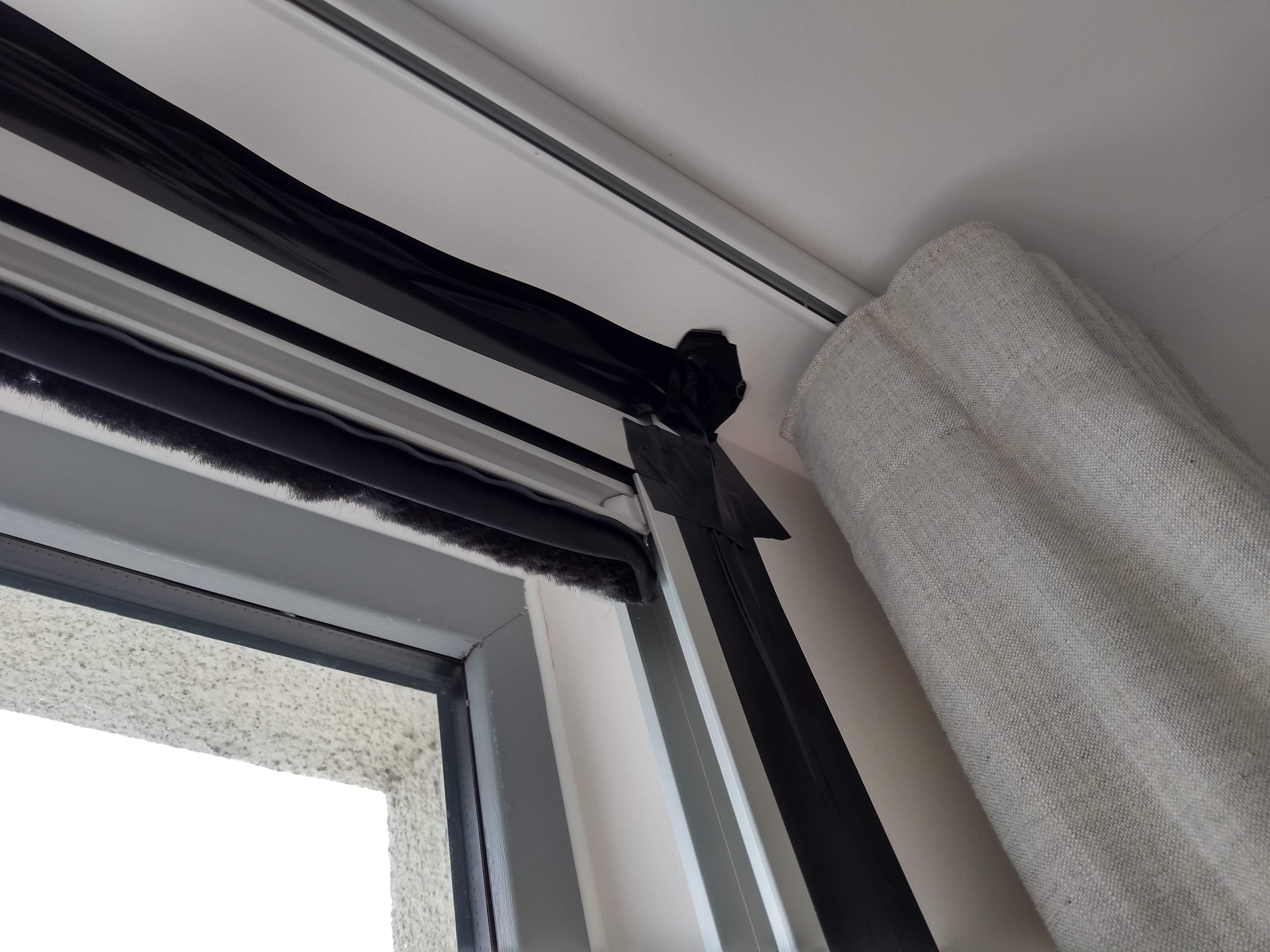

Diall PVC repairing black tape
. Source. This tape made things dark and was durable, but note at Section "Removal wall damage review" that it pulled bits of the plaster out with it during removal. I've since learnt about the existence of "painter’s tape"/masking tape, that might have been a better idea to protect the walls when pulling the tape off. It is worth noting that some of the painter's tape do come with a maximum number of days before you can pull them off, presumably after which wall damage becomes a possibility, e.g. Ciro saw one rateed 14 days. How to blackout your window without drilling Swimming goggles plus sleeping mask hack by Ciro Santilli 40 Updated 2025-07-16
Ciro Santilli 40 Updated 2025-07-16The problem with virtually all sleeping masks on the market is that they leave a lot of room near your nose for light to come in.
Ciro Santilli discovered a useful workaround for that: make the mask tighter with a swimming goggles!
Just make the goggles as loose as possible to not put pressure on your eyes, and then strap them over the sleeping mask.
If you are a back sleeper, put the googles forward as normal. If you are a stomach sleeper, put the googles on the back of your head, and the straps over the mask. This way you wont get your head squished by the goggles and the bed.
Once Ciro understood the idea, Googling "swimming googles sleeping mask" led to: mantasleep.uk/ might be a good option.
How to blackout your window without drilling Previous failed attempts by Ciro Santilli 40 Updated 2025-07-16
Ciro Santilli 40 Updated 2025-07-16Thick cardboard paper and Gorilla Tape: the intense Sun heat made the cardboard bend, and even the Gorilla tape could not hold it, leading to light leakage. Even worse, it started to smell a bit, and I got afraid that it could catch fire, so don't do this! Maybe I will try coating with aluminium foil next time, but I'm afraid it might stick to the glass. In any case, even if those setups work, your room may be permanently very dark depending on how far the window opens, which can lead to other problems such as mold. Another downside of this method is that the tape is extremely sticky, and especially difficult to remove if it touches the glass, where you can't use metallic items to scrape it off without scratching the glass. I had to get a solvent and use a lot of elbow grease to get rid of it.
I have tried a few sleeping masks, but none of them were enough on their own. There is always some light leakage around the nose, especially as you turn around in the night. And some of them are too hot. I have tried:
- Sleep Master (archive): www.amazon.co.uk/gp/product/B0015NZ6FK (archive). Also too hot.
- Muji Eye Mask
I also considered getting one of those "Perfect Fit Blinds" www.blindsdirect.co.uk/perfect-fit-roller-blinds (archive) which fit between the glass and the insulation. This looks like it could work. But I didn't go for it in the end because my window has 3 glass panels, so I would have to get three of those blinds separately.
As of 2022 visible at: www.nature.com/scitable
Apparently they had a separate URL as just scitable.com, so they were somewhat serious about it before shutting it down.
As of 2022 marked:RIP.
This page has been archived and is no longer updated
www.nature.com/scitable/blog/student-voices/ has last entry 2015, so presumably that's the shutdown year.
Self description:so quite related to OurBigBook.com.
Using our platform, you can customize your own eBooks for your students. Create an online classroom. Contribute and share content and connect with networks of colleagues.
Originally at github.com/zadam/trilium, then after development stopped the community took it up at: github.com/TriliumNext/Notes.
Tree based organization at last. Infinitely deep.
Amazing WYSIWYG, including maths and tables, plus insane plugins like canvas mode, and specific file formats like code/mermaid diagrams/drawing mode.
Intentionally or not, they've basically made an open source Notion, with the possible exception that Notion historically started on web and moved to the desktop, while Trillium went the other way round.
Version history with automatic snapshots at intervals. TODO how is it implemented? Do they just ZIP multiple versions?
No multiuser features. Except for that, could have been a good starting point of an online multiuser thing such as OurBigBook.com!
With Book Notes it is possible possible to see more than one page at a time on the output, which his a major feature of OurBigBook. But does it show on HTML export as well?
You can static HTML export any subtree by right clicking on it in the navigation tree.
HTML export keeps all data as HTML is their native format. This may be inherited from CKEditor. The files are mostly visible, but there is some CSS missing, it is not 100% like editor, notably math is broken. There is also a hosted way of exposing: github.com/zadam/trilium/wiki/Sharing.
trilium.rocks however has a very good export, it is just a question of how much they had to hacked things, source at: github.com/zerebos/trilium.rocks
The default tHTML export uses frame navigation, with a toc fixed on the left frame. Efficient, but not of this century.
There is no concept of user created unique text IDs: you can have the same headers in the same folders in the UI. It's not even a matter of scopes. On exports they are differentiated as
1_name, 2_name, etc../Trilium Demo/Books/To read/1_HR.md
./Trilium Demo/Books/To read/2_HR.md
./Trilium Demo/Books/To read/HR.mdMarkdown export warns:
this preserves most of the formatting
Architecture: runs on local SQLite database via better-sqlite3. Data apparently stored in SQLite database at
~/.local/share/trilium-data, no raw files.Markup is stored as HTML as seen from:
sqlite3 document.db 'SELECT * from note_contents'. HTML is their native storage format, quite interesting. But this means it is not source centric, so any source editing would have to go via import/export. It can be done apparently: github.com/zadam/trilium/wiki/Markdown but involves shoving a ZIP around.WYSIWYG based on ckeditor.com/ which is a dependency. It is kind of cool that the view in which you view the output is exactly the same as the one you edit in, and there is no intermediate format, just the HTML.
Math is KaTeX based.
It also runs on the browser via a server: github.com/zadam/trilium/wiki/Server-installation. And they have a paid service for it at: trilium.cc/. Quite impressive.
They have server to from desktop sync: github.com/zadam/trilium/wiki/synchronization. There is no conflict resolution, one of them wins randomly. But they have revision history, and anything lost will be in the revision history. They have so many features it is mind blowing.
Maintainer announced he would be slowing down development since January 2024: github.com/zadam/trilium/issues/4620?ref=selfh.st
Why Wikipedia sucks: Section "Wikipedia".
Best languages:
The most important page of Wikipedia is undoubtedly: en.wikipedia.org/wiki/Wikipedia:Reliable_sources/Perennial_sources which lists the accepted and non accepted sources. Basically, the decision of what is true in this world.
Wikipedia is incredibly picky about copyright. E.g.: en.wikipedia.org/wiki/Wikipedia:Deletion_of_all_fair_use_images_of_living_people because "such portrait could be created". Yes, with a time machine, no problem! This does more harm than good... excessive!
Citing in Wikipedia is painful. Partly because of they have a billion different templates that you have to navigate. They should really have a system where you can easily reuse existing sources across articles! Section "How to use a single source multiple times in a Wikipedia article?"
- youtu.be/_Rt0eAPLDkM?t=113 encyclopedia correction stickers. OMG!
- youtu.be/_Rt0eAPLDkM?t=201 Jimmy was a moderator on MUD games
Inside the Wikimedia Foundation offices by Wikimedia Foundation (2008)
Source. The pre-Eternal September feeling is palpable.
People could freely comment their thoughts and sign below, making it much closer to what Ciro Santilli wants OurBigBook.com to be. But with upvotes ;-)
What poor countries have to do to get richer Teach everyone English by Ciro Santilli 40 Updated 2025-07-16
Ciro Santilli 40 Updated 2025-07-16This is obviously the most efficient investment any non-English speaking country must do, because you need to know English to be able to learn from rich countries and innovate.
Further discussion at: Section "Having more than one natural language is bad for the world".
What poor countries have to do to get richer Make your education system more efficient by Ciro Santilli 40 Updated 2025-07-16
Ciro Santilli 40 Updated 2025-07-16As Ciro has rambled infinitely at Section "University", the school system is hugely inefficient and a waste of time for everyone involved.
Instead, just use Section "OurBigBook.com" instead.
What poor countries have to do to get richer Pick few good bets and invest enough on them by Ciro Santilli 40 Updated 2025-07-16
Ciro Santilli 40 Updated 2025-07-16Therefore, you have to pick a few key the next big thing deep tech bets, and invest on those enough.
Therefore, the bets have to be well selected, because it is useless to make several insufficient investments: you have to pick a few ones, and put enough time and money into each one of them for them to stand any chance. These bets should be made and reevaluated on 5/10 year horizons.
The key things that you have to select are:
- which poor students you will bet on educating. Since you can't give amazing education to everyone, you have to select the most promising poor students somehow, and give those free amazing learning conditions: free gifted education
- which ares to focus on. Ciro believes that molecular biology technologies and quantum computing would be good bets. Focusing on the previous next big things, e.g. classic computers, is always a losing bet on average
And then you only tax those companies heavily when the start to bring in real money. These are startups remember! You only need 5 unicorns a year to call it a success. And countries should not be greedy and invest through equity, but rather recoup their investment through taxation alone.
Ciro's second removed uncle, who was a physicist at the University of Campinas, one of the best universities in the country, told him an anecdote. He had moved from fusion energy research to solar cell research. At some point, there was a research lab that needed 10 million to buy a machinery critical for their experiment. They asked and asked, and finally the government gave them only 2 million. So in the end they spent those 2 million in random ways, but of course did not achieve their research goal and no money came out of it.
He also explained how as a result of the insufficient investments, he felt clearly that some of the semiconductor production facilities related to solar power he saw simply were not able to control the production process adequately to produce consistent silicon. As a result, everything failed sooner or later as people found more and more bugs that they did not have the time to solve.
Another key investment is enticing back experienced exchange-students who have learnt new techniques to be heads of laboratory/founders to back in your country.
A fantastic initiative from Brazil for example is BRASA, which aims to put together Brazilian exchange students to make a difference back in Brazil.
Do not try to forbid external companies from selling in your country. Instead, fund your own companies to be able to fight the external market off. And if they can't, let them die and pick a different bet. Video "How Taiwan Created TSMC by Asianometry (2020)" has a good mention. Protectionism is something that Brazil notably tried to do, and look at what it led, not a single international success.
What poor countries have to do to get richer Don't force international exchange students to come back early by Ciro Santilli 40 Updated 2025-07-16
Ciro Santilli 40 Updated 2025-07-16Many of the student exchange programs Ciro witnessed in the 2010's in Brazil were inefficient because they were requiring students to come back immediately after university or PhD in fear that those students will never come back.
This is useless, because you don't learn anything unique during university: the truly valuable knowledge is obtained when you work for several years as a postdoc in a world class research laboratory or as an engineer in a world class company.
Therefore, Brazil should learn from the Chinese exchange system, which lets students go do whatever they want, and once they are Gods of the domain, entices them back with great positions and pay as heads of laboratory back in China. Just don't do fraudulent stuff like this like China did, or else you will get a bad rep.
To help this university collaboration happen, we should create communication channels between exchange students and professors of the origin country who work on the same domain so that they can discuss the subject. For example, once Ciro Santilli wanted to contact some of his former teachers at the University of São Paulo about "advanced" topics he had been exposed to as part of his job. However, they didn't even reply to his email, and Ciro didn't know who else to contact. This must never happen. We need a way to informally contact several professors of a given domain informally, to increase the chances that at least one might be interested. It is pointless to just let students loose abroad and hope that they will bring things back to their home country: a more cohesive infrastructure is needed to nurture that.
There is basically one sane way to achieve these goals: the exchange programs must be organized at a national level, not in an ad-hoc per-university manner.
Another good idea is to have taxes that depend on your nationality alone and which only start collecting when you reach a very high amount of net worth. So e.g. if someone leaves the country and makes it big, then and only then does the Government starts clawing back the benefits of its investments in the person. Furthermore, such taxes could be reduced if the person brings some of the business back to the country. And mandatory taxes should be charged if the person decides to drop their nationality at some point.
The above points would also be greatly eased by having a national-level exchange program. E.g. in Brazil in the 2010's which Ciro experience, every university had different terms and conditions, which made everything a mess. Exchange programs must be treated as a unified federal policy.
Ciro actually had to return for just six months from the École Polytechnique to the University of São Paulo, to finish a course he had only done the generic Maths/Physics introduction to. Students from other Brazilian universities were forced to return for up to 3 years even to get their Brazilian diplomas! Ciro was lucky that his teachers understood the situation, and allowed him to develop online learning projects instead of his supposed control engineering projects, which hopefully will have led to changing the world with motivation one day. And for this, Ciro is eternally thankful.
This shows the complete and total lack of any Brazilian strategy to send its students abroad to really learn valuable things and then come back. There is no strategy at all. Things have just reached an equilibrium point of bureaucracies, Brazilian universities trying to bring students back to validate useless diploma pieces of paper, and foreign universities no caring about that, and just wanting the students to say abroad forever.
Ciro was once talking about why so few Brazilians go study abroad compared to the Chinese. Besides the likely true "there are a lot of Chinese" argument, his wife made another: good point Brazil is not so bad to live in, because you have good food and freedom, while China only has good food.
But Ciro still fells bad that so few of his University of São Paulo colleagues, who learnt automation and control engineering, are doing deep tech. Nor physical engineering. They have all basically become computer people like Ciro.
This is not their fault. They basically don't have a choice: all physical science and technology is done in rich countries.
Yes, someone has to implement the newest tech to improve local country efficiency in projects that will never spread abroad.
But who will be left then for the next big thing problems that would really make Brazil richer? 6 out of 30 person class ended up working on a gaming company at one point, even though they were not crazy passionate about the field! What could possibly be a worst investment for society?
This lack of technological innovation can also be clearly seen when you research investment options available in Brazil. Huge emphasis is put on fixed return financial products (often inflation adjusted) linked to base non-tech business such as housing market and agriculture. And when you look to the returns of the stock market on s&P 500-analogue backed exchange-traded funds, they do not seem obviously better, especially considering inflation and taxation benefits that exist for some of the other investment possibilities.
When the companies of a country are not clearly the best investment, you know that something is wrong. They are highly specialized money making machines, remember! And housing and agriculture are not such innovative markets where people can hugely influence efficiency.
When it is best to send students is a good question. Undergrad studies could be easily reproduced in poor countries if they had any intelligence at all, since even in rich countries laboratory usage is always limited. Masters and PhD are generally more valuable moments to send people out. The question is if the students will actually have a fighting chance without having been out, in particular in terms of language skills. Ciro feels that Masters are a good focus point for entry, as that is where PhD links are more actively done.
Pinned article: Introduction to the OurBigBook Project
Welcome to the OurBigBook Project! Our goal is to create the perfect publishing platform for STEM subjects, and get university-level students to write the best free STEM tutorials ever.
Everyone is welcome to create an account and play with the site: ourbigbook.com/go/register. We belive that students themselves can write amazing tutorials, but teachers are welcome too. You can write about anything you want, it doesn't have to be STEM or even educational. Silly test content is very welcome and you won't be penalized in any way. Just keep it legal!
Intro to OurBigBook
. Source. We have two killer features:
- topics: topics group articles by different users with the same title, e.g. here is the topic for the "Fundamental Theorem of Calculus" ourbigbook.com/go/topic/fundamental-theorem-of-calculusArticles of different users are sorted by upvote within each article page. This feature is a bit like:
- a Wikipedia where each user can have their own version of each article
- a Q&A website like Stack Overflow, where multiple people can give their views on a given topic, and the best ones are sorted by upvote. Except you don't need to wait for someone to ask first, and any topic goes, no matter how narrow or broad
This feature makes it possible for readers to find better explanations of any topic created by other writers. And it allows writers to create an explanation in a place that readers might actually find it.
Figure 1. Screenshot of the "Derivative" topic page. View it live at: ourbigbook.com/go/topic/derivativeVideo 2. OurBigBook Web topics demo. Source. - local editing: you can store all your personal knowledge base content locally in a plaintext markup format that can be edited locally and published either:This way you can be sure that even if OurBigBook.com were to go down one day (which we have no plans to do as it is quite cheap to host!), your content will still be perfectly readable as a static site.
- to OurBigBook.com to get awesome multi-user features like topics and likes
- as HTML files to a static website, which you can host yourself for free on many external providers like GitHub Pages, and remain in full control

Figure 2. You can publish local OurBigBook lightweight markup files to either OurBigBook.com or as a static website.
Figure 3. Visual Studio Code extension installation.
Figure 5. . You can also edit articles on the Web editor without installing anything locally. Video 3. Edit locally and publish demo. Source. This shows editing OurBigBook Markup and publishing it using the Visual Studio Code extension. 
- Infinitely deep tables of contents:




All our software is open source and hosted at: github.com/ourbigbook/ourbigbook
Further documentation can be found at: docs.ourbigbook.com
Feel free to reach our to us for any help or suggestions: docs.ourbigbook.com/#contact