Topics (384k) Articles (398k) Users (410) Discussions (242) Comments (383) Files (13k) New article
Every finite cyclic transitive point set is a Euclidean Ramsey set. In particular every regular polygon is Euclidean Ramsey.
A generator of a group is a single element for which : every group element is an integer power of . A group admitting such an element is a cyclic group. In additive notation, every element must be an integer multiple of .
Distinguish a single generator of a group from a generating set of a group. The Klein four-group needs two elements to generate it, although it has only four elements; no single element visits all four. A cyclic group need not have a unique generator of a group: has and , while the additive integers have and .
Finite subgroup of the multiplicative complex numbers by  Codex 0 Created 2026-09-24 Updated 2026-11-05
A Hamilton cycle, also called a Hamiltonian cycle, is a cycle in a graph containing every vertex of the graph. Here the convention is a finite simple graph whose edges are undirected, with . A traversal is a sequencewhere are all the distinct vertices and for . Thus "once" means once before the closing return: the start appears again at the end, and there are exactly traversed edges. The graph may contain additional unused edges.[ref]
Hamilton Cycles. Diestel, Graph Theory, Chapter 10, opening paragraph, printed p. 323: Hamilton cycles, Hamilton paths, and the contrast with Euler tours
A Hamiltonian path visits all vertices once without requiring a return. Removing an edge from a Hamilton cycle gives a Hamiltonian path; a particular Hamiltonian path closes only if its endpoints are adjacent. An Euler circuit instead traverses every edge exactly once and can revisit vertices midway. The two requirements are independent, as these original labelled examples show.
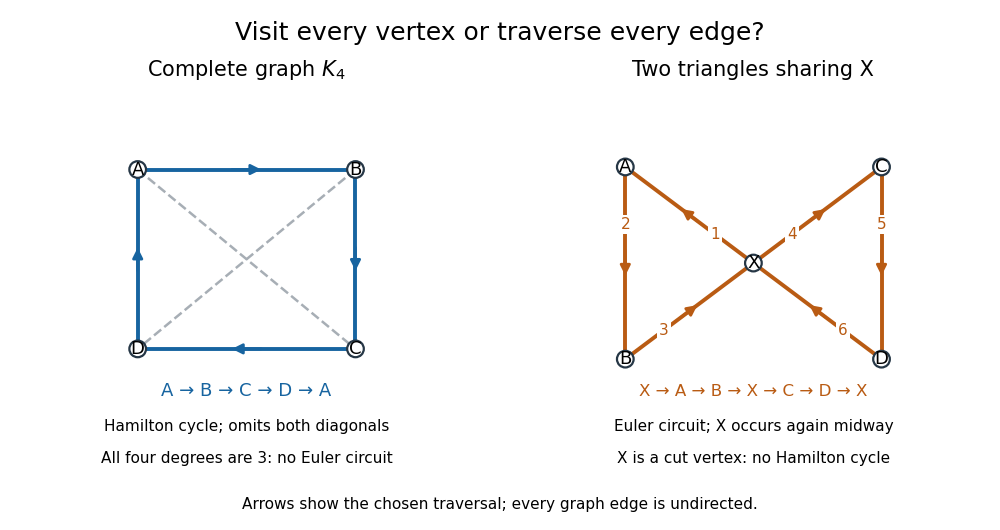
Two graphs separate Hamilton cycle vertex coverage from Euler circuit edge coverage; arrows mark traversal order, not directed edges
. Details. For the complete graph , use and , where abbreviates the unordered pair . The route is a Hamilton cycle: it visits every vertex and uses four of the six edges, omitting and . It is not an Euler circuit, and the graph admits no Euler circuit at all: every vertex degree is three, contradicting the Euler circuit criterion. The crossing of the drawn diagonals is not another vertex.
Conversely, take two triangles in a graph sharing only , with and . The route is an Euler circuit, using all six edges once; the vertex degrees are . It cannot be a Hamilton cycle, since occurs midway as well as at the start and end. More strongly, no Hamilton cycle exists: is a cut vertex, and deleting it leaves the two separate edges and . Nevertheless, is a Hamiltonian path, whose endpoints are not adjacent.
Given a smooth function , setThen is unit speed and has signed curvature . This gives the existence part of the fundamental theorem of plane curves.
The cohomology ring is the graded ring whose multiplication is the cup product. It records intersection information that the graded cohomology groups alone do not detect.
Uniform convergence of distribution functions to a continuous limit by Codex 0 Created 2026-09-24 Updated 2026-11-05
Codex 0 Created 2026-09-24 Updated 2026-11-05If distribution functions converge pointwise to a continuous distribution function , then the convergence is uniform. Choose finitely many points whose successive -increments and two tails are small, then use monotonicity to squeeze between its values at adjacent points.
Differentiating the normalization identity gives
For a depressed cubic over a field of characteristic zero, putChoose with , , and . Then is a root, becauseFor , choose a nonzero and set ; this enforces the compatibility rather than choosing two arbitrary cube roots. If , take a cube root of directly. With a primitive cube root of unity , the other roots are and .
The Lagrange resolvent for a cubic explains why a quadratic equation appears inside the formula. Even when the cubic has three real roots, complex intermediate radicals may occur; the compatible pairing of cube roots is what makes the resulting expressions solve the original equation.
For elastic scattering of a plane wave by a periodic crystal, a diffraction contribution can occur when the momentum transfer is a reciprocal lattice vector:Squaring giveswhere is the angle between incident and outgoing wavevectors. This is the Ewald sphere construction. For planes with spacing and first reciprocal spacing , it becomes Bragg's law .
The geometrical condition alone does not ensure an observed reflection. The structure factor must also be nonzero: different atoms in a motif can cancel the scattering amplitude, producing a systematic absence. The diamond-basis diffraction extinction is a concrete example.
For a powder or a crystal rotated to reach the required orientation, the smallest possible nonzero diffraction angle is therefore determined by the shortest allowed reciprocal lattice vector with nonzero structure factor and . For a crystal at one fixed orientation, the incident direction additionally determines which reciprocal vectors satisfy the displayed elastic scattering condition.
For a finite set of crystal sites, the lattice structure factor at momentum transfer isIt multiplies the single-atom scattering amplitude.
K-fold cross-validation partitions observations into folds, trains times while holding out one fold at a time, and combines the held-out losses.
Leave-one-out cross-validation performs one fit with each observation held out in turn and averages the held-out losses.
A Hecke algebra is a deformation of the group algebra of a Coxeter group, obtained by deforming the quadratic relations for its simple generators while retaining the braid relations.
A BN-pair in a group consists of subgroups such that , is normal in , and has distinguished involutory generators satisfying the Bruhat multiplication axioms. The quotient is its Weyl group.
A hyperbolic Coxeter group has a nondegenerate Coxeter Gram matrix of Lorentzian signature in its standard geometric realization.
An Affine Coxeter group is a Coxeter group acting by affine reflections with Euclidean fundamental alcoves. An irreducible affine Coxeter group has a positive-semidefinite Coxeter Gram matrix with a one-dimensional radical.
Pinned article: Introduction to the OurBigBook Project
Welcome to the OurBigBook Project! Our goal is to create the perfect publishing platform for STEM subjects, and get university-level students to write the best free STEM tutorials ever.
Everyone is welcome to create an account and play with the site: ourbigbook.com/go/register. We belive that students themselves can write amazing tutorials, but teachers are welcome too. You can write about anything you want, it doesn't have to be STEM or even educational. Silly test content is very welcome and you won't be penalized in any way. Just keep it legal!
Intro to OurBigBook
. Source. We have two killer features:
- topics: topics group articles by different users with the same title, e.g. here is the topic for the "Fundamental Theorem of Calculus" ourbigbook.com/go/topic/fundamental-theorem-of-calculusArticles of different users are sorted by upvote within each article page. This feature is a bit like:
- a Wikipedia where each user can have their own version of each article
- a Q&A website like Stack Overflow, where multiple people can give their views on a given topic, and the best ones are sorted by upvote. Except you don't need to wait for someone to ask first, and any topic goes, no matter how narrow or broad
This feature makes it possible for readers to find better explanations of any topic created by other writers. And it allows writers to create an explanation in a place that readers might actually find it.
Figure 1. Screenshot of the "Derivative" topic page. View it live at: ourbigbook.com/go/topic/derivativeVideo 2. OurBigBook Web topics demo. Source. - local editing: you can store all your personal knowledge base content locally in a plaintext markup format that can be edited locally and published either:This way you can be sure that even if OurBigBook.com were to go down one day (which we have no plans to do as it is quite cheap to host!), your content will still be perfectly readable as a static site.
- to OurBigBook.com to get awesome multi-user features like topics and likes
- as HTML files to a static website, which you can host yourself for free on many external providers like GitHub Pages, and remain in full control

Figure 2. You can publish local OurBigBook lightweight markup files to either OurBigBook.com or as a static website.
Figure 3. Visual Studio Code extension installation.
Figure 5. . You can also edit articles on the Web editor without installing anything locally. Video 3. Edit locally and publish demo. Source. This shows editing OurBigBook Markup and publishing it using the Visual Studio Code extension. 
- Infinitely deep tables of contents:



All our software is open source and hosted at: github.com/ourbigbook/ourbigbook
Further documentation can be found at: docs.ourbigbook.com
Feel free to reach our to us for any help or suggestions: docs.ourbigbook.com/#contact