Topics (384k) Articles (398k) Users (410) Discussions (242) Comments (383) Files (13k) New article
Consider successive independent Bernoulli trials with the same success probability . A geometric distribution models waiting for their first success. Two conventions coexist, so always say what is counted. Let count all trials up to and including the successful trial, and let count preceding failures. Their probability mass functions areThe factors describe failures followed by one success; independence permits multiplication. Summing the geometric series verifies that each law has total mass one. Their expected values differ by one, while shifting by a constant leaves the variance unchanged:The positive convention and these moments are also given by Penn State STAT 414.[ref]
11 Geometric and Negative Binomial Distributions. STAT 414: Introduction to Probability Theory at Pennsylvania State University; §11.1, Definition 11.1; §11.2, mean and variance theorems
For a constructed retry mechanism with independent attempts and , success on attempt four has probability . More than four attempts are needed precisely when the first four fail: . The expected values are and , and the common variance is . The large spread explains why the average waiting count is not a deadline.
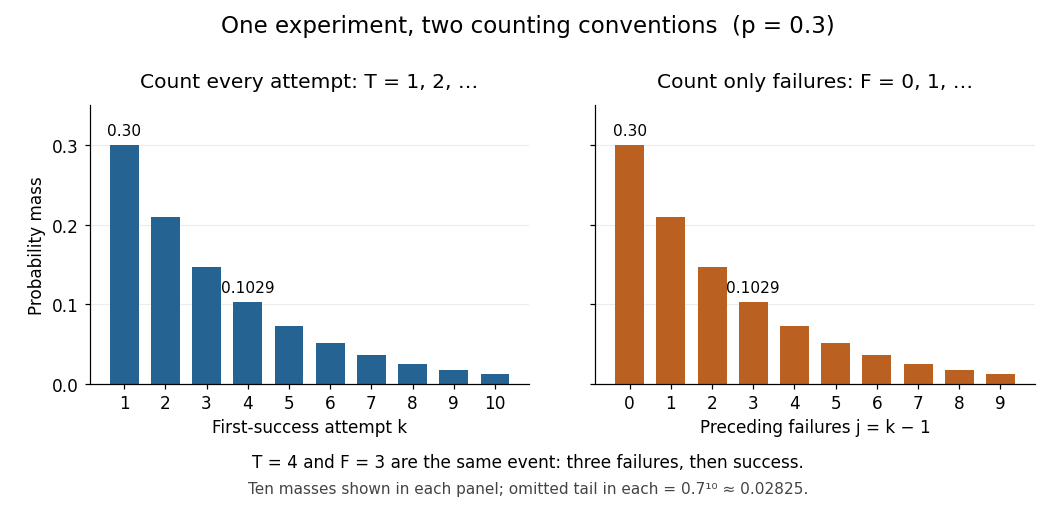
First-success trial versus preceding failures: the same probability masses shifted by one
. Details. The two probability mass functions have identical heights with different labels: and describe the same event. For , consecutive masses have ratio , explaining the name geometric distribution. The support of a probability distribution is the positive integers for and the nonnegative integers for . At , it collapses to and , both with variance zero; interpret an empty product, including , as one. These counts concern attempts; converting them into elapsed time requires specifying the time spent per attempt.
The survival function makes the counting convention especially visible. Put . For nonnegative integers , and for ,The event requires failures, whereas requires only when . For the constructed mechanism, differs from . The geometric success deadline uses the latter tail to control the chance of still waiting.
The striking memorylessness of the geometric distribution says that, for nonnegative integers with ,After five failures, the conditional probability of requiring more than two additional attempts is still . The analogous zero-based identity uses ; keeping the inequalities straight avoids an off-by-one error. This property follows from fresh independent trials with unchanged ; learning or changing conditions can destroy it. At , success never occurs, so there is no proper finite waiting-count law.
Discrete cosine transform from an even-reflected discrete Fourier transform by  Codex 0 Created 2026-09-24 Updated 2026-11-05
To compute the type-II discrete cosine transform in the conventionreflect the inputs evenly to length : and for . If is the negative-exponent discrete Fourier transform, pairing the two reflected terms givesConsequently . The phase rotation and factor one half are consequences of the half-sample reflection and this normalization. One Fast Fourier transform of length plus extra work therefore computes the discrete cosine transform. Other library conventions can include a factor two or mode-dependent normalization.[ref]
https://www.fftw.org/fftw3_doc/Real_002dto_002dReal-Transform-Kinds.html. FFTW manual, REDFT10: DCT-II and logical transform length 2n
Analytic continuation of the Riemann zeta function to the right half-plane by Codex 0 Created 2026-09-24 Updated 2026-11-05
Codex 0 Created 2026-09-24 Updated 2026-11-05The identity continues the Riemann zeta function meromorphically to . Apparent singularities at nonreal zeros of are removable, as one sees by replacing with an integer for which . At , and , so has a simple pole of residue one.
Five-point Dirichlet Laplacian as a Kronecker sum by Codex 0 Created 2026-09-24 Updated 2026-09-24
Codex 0 Created 2026-09-24 Updated 2026-09-24If is the one-dimensional Dirichlet second-difference matrix on interior points, the two directional parts of the two-dimensional five-point Laplacian areThey commute, and is the Kronecker-sum discretization of the Laplacian.
Crank-Nicolson stability on a finite Dirichlet interval by Codex 0 Created 2026-09-24 Updated 2026-10-25
Codex 0 Created 2026-09-24 Updated 2026-10-25If is the negative semidefinite Dirichlet discrete Laplacian, the Crank-Nicolson amplification matrixhas eigenvalues of modulus at most one for every .
If is a non-zero-divisor in a finite-dimensional Noetherian ring , thenEvery prime chain above can be extended downward by a minimal prime of , because a non-zero-divisor belongs to no minimal prime.
The digamma function is strictly increasing on the positive real axis, whileIt therefore has exactly one positive zero, and that zero lies in .
Transverse-electric Fresnel reflection coefficient by Codex 0 Created 2026-09-24 Updated 2026-11-05
Codex 0 Created 2026-09-24 Updated 2026-11-05When the permeabilities agree, the signed reflected-to-incident electric-field ratio for polarization normal to the plane of incidence isFor incidence from lower to higher refractive index it never vanishes.
Equality of the boundary fields for every tangential position and time forces equal frequency and equal tangential wavevector for incident, reflected, and transmitted plane waves.
Increasing the baryon-to-photon ratio raises the equilibrium deuterium abundance at fixed temperature, so the deuterium bottleneck ends earlier. Fewer neutrons decay before nuclear burning, and neutron-limited helium synthesis produces a larger primordial helium mass fraction if weak freeze-out is unchanged.
For diagonal entries , superdiagonal entries , and subdiagonal entries , the leading principal determinants satisfy
For an matrix , the Leibniz formula for determinants isThe sum runs over all permutations of the columns. Each product chooses one entry from every row and every column, and its sign is the sign of a permutation.
For a matrix, the two permutations give . More generally, exchanging two rows pairs terms with opposite signs, while each row appears once in every product. These observations explain the formula's alternating and multilinear behavior. It is useful for symbolic arguments; direct evaluation has products, whereas Gaussian elimination gives a more efficient numerical route.
The determinant is linear in each row and in each column when all the others are held fixed.
The chain rule calculates the derivative of a function composition by combining local rates. If the inner function is differentiable at and the outer function is differentiable at , thenThe evaluation point matters: the outer derivative is evaluated at the inner output , not at . A small input change first scales by ; the resulting intermediate change then scales by . In terms of linear approximations, composing those two local descriptions multiplies their scale factors. [ref]
https://openstax.org/books/calculus-volume-1/pages/3-6-the-chain-rule. OpenStax, Calculus Volume 1: statement and proof of the chain rule
.For example, applies a quadratic function and then the sine. With and , the chain rule givesHere all angles are in radians. Near , increasing the input by changes by about , and the sine changes by about times that intermediate change. For , the linear approximation predicts an output increase of ; the exact increase is .
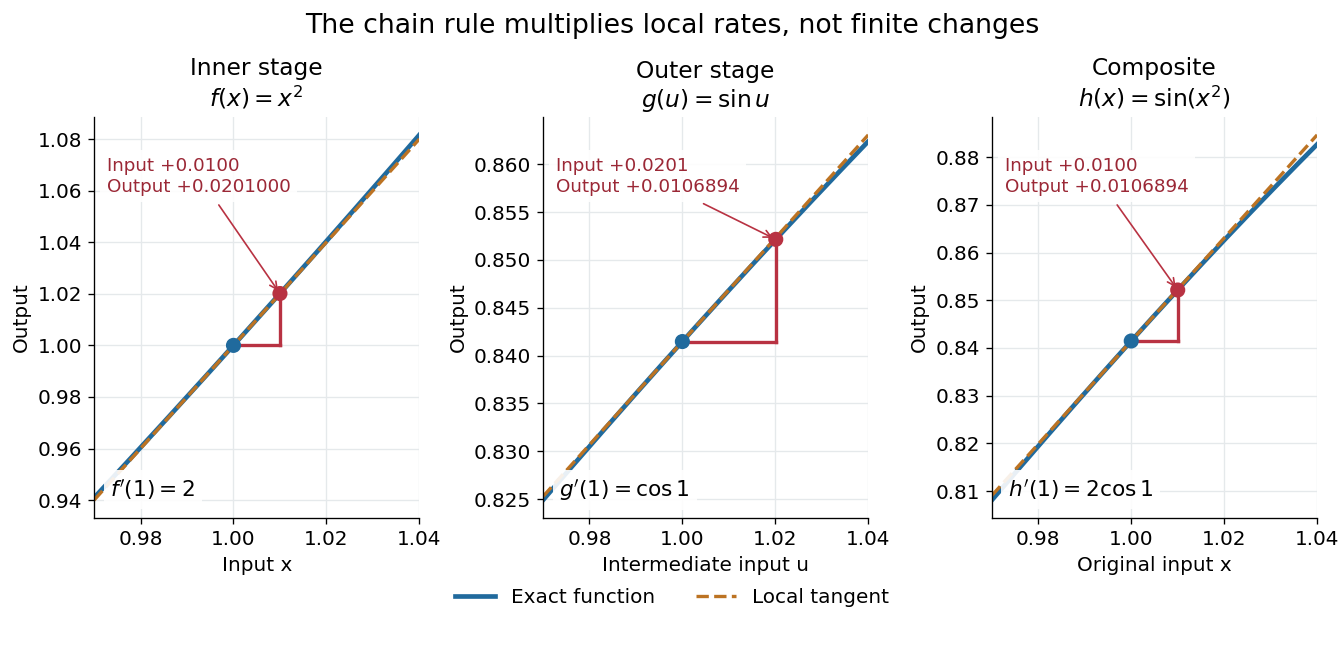
The same rule handles several nested stages. For , the derivative is under the corresponding differentiability assumptions. Writing each intermediate output prevents evaluating a derivative at the wrong stage. It also makes the chain rule useful for propagating sensitivities through a mathematical model, where one measured quantity influences another through several transformations.
For a quick proof idea, replace near by its linear approximation, then replace near by its linear approximation. The composite leading term is their product; differentiability ensures the remaining error is smaller than the original input change. This argument still applies when , so the informal cancellation should not be interpreted as division by a possibly zero finite change. The hypotheses are sufficient, but are not necessary for every composite to be differentiable, as the nondifferentiable inner function with a differentiable nondegenerate composite example shows.
Pinned article: Introduction to the OurBigBook Project
Welcome to the OurBigBook Project! Our goal is to create the perfect publishing platform for STEM subjects, and get university-level students to write the best free STEM tutorials ever.
Everyone is welcome to create an account and play with the site: ourbigbook.com/go/register. We belive that students themselves can write amazing tutorials, but teachers are welcome too. You can write about anything you want, it doesn't have to be STEM or even educational. Silly test content is very welcome and you won't be penalized in any way. Just keep it legal!
Intro to OurBigBook
. Source. We have two killer features:
- topics: topics group articles by different users with the same title, e.g. here is the topic for the "Fundamental Theorem of Calculus" ourbigbook.com/go/topic/fundamental-theorem-of-calculusArticles of different users are sorted by upvote within each article page. This feature is a bit like:
- a Wikipedia where each user can have their own version of each article
- a Q&A website like Stack Overflow, where multiple people can give their views on a given topic, and the best ones are sorted by upvote. Except you don't need to wait for someone to ask first, and any topic goes, no matter how narrow or broad
This feature makes it possible for readers to find better explanations of any topic created by other writers. And it allows writers to create an explanation in a place that readers might actually find it.
Figure 1. Screenshot of the "Derivative" topic page. View it live at: ourbigbook.com/go/topic/derivativeVideo 2. OurBigBook Web topics demo. Source. - local editing: you can store all your personal knowledge base content locally in a plaintext markup format that can be edited locally and published either:This way you can be sure that even if OurBigBook.com were to go down one day (which we have no plans to do as it is quite cheap to host!), your content will still be perfectly readable as a static site.
- to OurBigBook.com to get awesome multi-user features like topics and likes
- as HTML files to a static website, which you can host yourself for free on many external providers like GitHub Pages, and remain in full control

Figure 2. You can publish local OurBigBook lightweight markup files to either OurBigBook.com or as a static website.
Figure 3. Visual Studio Code extension installation.
Figure 5. . You can also edit articles on the Web editor without installing anything locally. Video 3. Edit locally and publish demo. Source. This shows editing OurBigBook Markup and publishing it using the Visual Studio Code extension. 
- Infinitely deep tables of contents:




All our software is open source and hosted at: github.com/ourbigbook/ourbigbook
Further documentation can be found at: docs.ourbigbook.com
Feel free to reach our to us for any help or suggestions: docs.ourbigbook.com/#contact