Topics (384k) Articles (398k) Users (410) Discussions (242) Comments (383) Files (13k) New article

A European call option gives its holder the right, without an obligation, to buy one unit of an underlying financial asset at the strike price on the expiry date . European describes exercise timing, not geography: exercise is allowed only at . Here the underlying is one stock share, is its price at expiry, and the financial payoff is expressed as a cash amount. Physical exercise delivers a share against payment of ; immediate resale gives the same net amount under the assumed frictionless market.
The holder exercises only when buying at the strike price is advantageous. Writing for the positive part, the terminal financial payoff isThe European call option is a reusable building block for claim replication: its financial payoff is zero below the strike price and rises by one unit for each unit of stock price above it. The corner at lets combinations of European call options construct other payoff shapes, as in static replication on a finite terminal support.
For strike price , the following are deterministic calculations conditional on each displayed terminal stock price. They assign no probabilities to the three scenarios. The European put option has the opposite exercise right and the financial payoff .
| Terminal stock price | European call option | European put option | Difference |
|---|---|---|---|
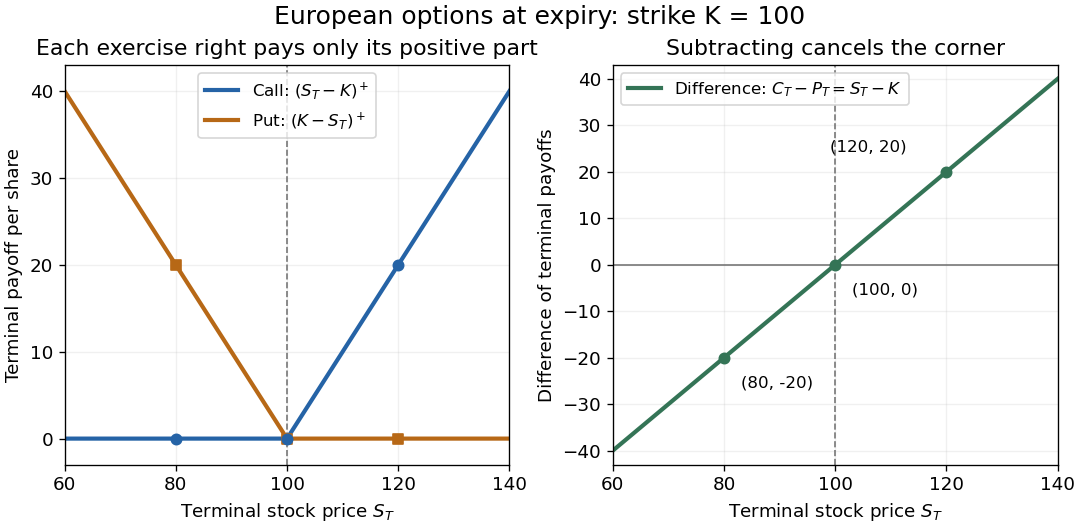
A financial payoff excludes the initial contract price. If the illustrative European call option costs , its financial payoff at is , and subtracting its initial cost gives . If that cost is instead borrowed for one year at the constant continuously compounded interest rate , the terminal net amount is . At or , the corresponding net amount is . Keeping all cash amounts at the same date avoids confusing a financial payoff with a financed gain.
Robert Shiller's Options Markets lecture, Yale ECON 252 (2011) introduces these exercise rights and payoff shapes.
Let be the state-by-asset matrix of discounted gains. There exists with exactly whenfor every satisfying . This is the finite-dimensional cone-separation, or Farkas-duality, form of superhedging.
A retarded fundamental solution is supported in a chosen forward region, such as for an ordinary differential operator.
Every nonzero constant-coefficient linear partial differential operator has a distributional fundamental solution.
For the closed orientable surface of genus ,In particular, the sphere has trivial fundamental group and the torus has fundamental group .
Let be an open cover such that , and are nonempty and path-connected, and choose a base point . The inclusions induce a pushout of groups:The maps from the overlap need not be injective. The amalgamated free product here means the universal group receiving the two inclusion-induced homomorphisms with their overlap relations.
A loop can be subdivided into pieces in or ; connecting their endpoints through the path-connected overlap expresses its class using the two local fundamental groups. Subdividing a homotopy shows that the overlap relations are exactly the identifications needed.
The overlap condition matters. Two open arcs can cover a circle while their intersection has two components. Both arcs have trivial fundamental group, but the circle has fundamental group . The displayed single-basepoint formula cannot be applied to that disconnected overlap; a groupoid version keeps the extra component information.
Concatenating two based homotopies proves that loop concatenation depends only on based-homotopy classes. Endpoint-fixing reparametrizations provide associativity and the identity laws on classes.
A Lagrangian is a function or density whose stationary integral encodes an extremization problem. In Lagrangian mechanics its action gives the equations of motion; in geometry it describes geodesics and minimal surfaces.
A finite-dimensional optimization Lagrangian combines an objective function with Lagrange multiplier terms for its constraints.
An energy functional assigns an integral energy to a function. Minimization of a suitable energy is the basis of the Dirichlet principle. For the modified Helmholtz equation, a natural example is
A periodic function repeats exactly after a nonzero shift of its input. For , a positive period of a function satisfiesOne interval of length therefore determines the whole function. For another domain of a function , a period must also preserve the domain, ; equality only where two domains happen to overlap is weaker. Periodicity is an exact translation of a function symmetry, rather than merely two similar-looking pieces of its graph.
The sine has fundamental period one. The function repeats after half a unit: the sine changes sign under that shift, but squaring removes the sign. The mixed function again has fundamental period one. All positive integer multiples of a period are periods, so specifying one period need not identify the shortest repetition.
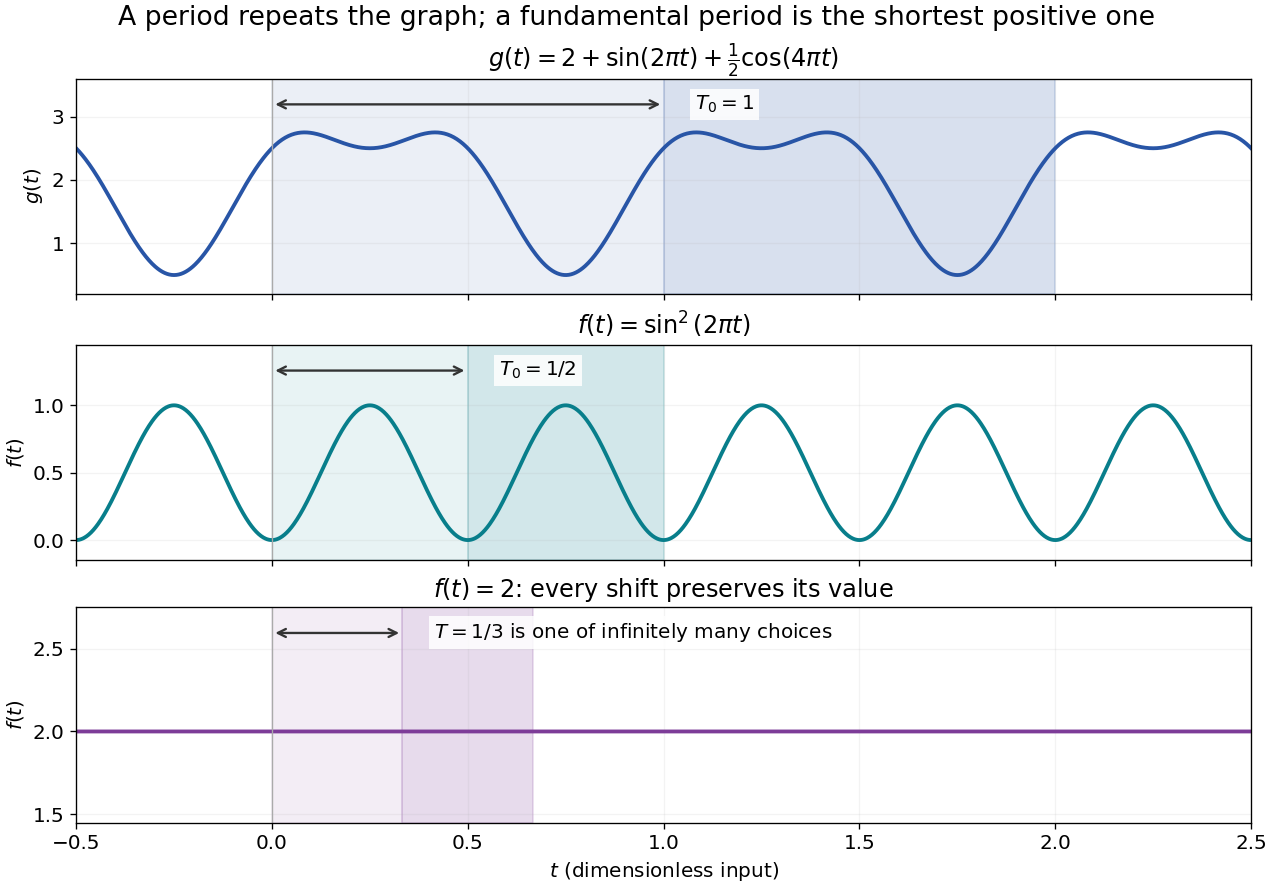
If the input is time and is the fundamental period, the frequency is and the angular frequency is . Repetition lets a Fourier series describe a cycle using sines and cosines; the period average separates the reference level from the oscillating terms. Strang develops this representation and its Fourier coefficients in §4.1 of Computational Science and Engineering by Gilbert Strang.[ref]
Fourier Series for Periodic Functions. §4.1; pp. 317
This connection grew out of a physical problem. In his 1822 book Théorie analytique de la chaleur by Joseph Fourier, Joseph Fourier used periodic functions to extend profiles beyond their initial interval while treating heat conduction. Chapter III, §§233–234 combines even functions and odd functions into sine–cosine expansions and rescales their period.[ref] A modern Fourier series interpretation still requires the appropriate convergence conditions.
A constant function has every real shift as a period and no fundamental period. Without continuity, even a nonconstant periodic function can lack a smallest positive period; periodic function without a least positive period gives a concrete example. The period group of a function organizes all these possibilities.
A bijection is a function that is both injective and surjective: each element of its codomain is the output of exactly one element of its domain of a function. The two requirements exclude unused targets and merged inputs respectively. The finite example , , is a bijection from to , whereas adding an unused target makes that same rule fail surjectivity.
A bijection gives an inverse function by reversing every pairing. Conversely, a two-sided inverse function implies a bijection, as the proof under inverse function shows. This is useful for transporting structures without losing or identifying elements. It also defines equality of cardinality: two sets have equal cardinality exactly when a bijection pairs them. An infinite example is from the integers to the even integers, with inverse on that specified codomain. A proper subset can therefore have the same cardinality as an infinite set. [ref]
https://discrete.openmathbooks.org/preview/sec_intro-functions.html. Levin, functions: injections, surjections and bijections
.A real-valued function takes each function input to a real number. Its codomain can be all of or a specified subset. Thus on the real line is a real-valued function and has image , whether the declared target is that interval or all of .
The inputs need not be real numbers: the cardinality of a finite set and the squared norm of a vector are also real-valued functions. The adjective describes outputs, while scalar-valued function allows outputs in other fields, notably the complex numbers.
On a nonempty domain of a function , a constant function has one fixed value in its codomain:For example, on the real line is a horizontal graph. Its image of a function is the singleton even though its domain of a function has infinitely many inputs. A constant function from the real line to the real numbers has derivative zero and every nonzero real period of a function; there is no smallest positive period. It supplies a reference level from which variation can be measured.
A constant map between vector spaces is a linear map only when its value is the zero vector, since a linear map must preserve zero. A nonzero constant map is still an affine map. In a Fourier series, the constant term records the period average, while the other terms describe oscillation around that level.
A real- or complex-valued function is bounded when one finite constant controls all its values:For example, is bounded by one on the real line. The reciprocal is bounded by one on , but is an unbounded function on , showing that the domain of a function matters. Each value at an allowed input may be finite even when no common bound exists.
A piecewise linear function agrees with an affine function on each member of a finite or locally finite family of subsets partitioning its domain of a function. On the real line the pieces are intervals; in higher dimensions each piece can be a polyhedron. Here the conventional word “linear” permits a constant offset within each piece.
For example, the absolute value function satisfies for and for . Both branches agree at zero, so the resulting function is continuous, although its derivative changes there. Joining sampled values by linear interpolation gives another common construction. If the partition pieces meet, their formulas must agree on overlaps to define a single function; allowing separate pieces across a jump is a convention that should be stated.
The identity function on a set maps each to itself: . It changes no information. For every function , function composition satisfies and . The subscripts specify the appropriate source or target set. An inverse function reverses a bijection exactly when the two possible compositions are these identity functions.
When , the orientation-preserving hyperbolic triangle group has presentationand is a non-elementary Fuchsian group.
This is the orientation-preserving hyperbolic member of the broader triangle group construction.
A nonidentity orientation-preserving isometry of the hyperbolic plane is parabolic when it has one fixed point on the ideal boundary and none in the plane. In the upper half-plane model, every parabolic isometry is conjugate to a nonzero horizontal translation.
Pinned article: Introduction to the OurBigBook Project
Welcome to the OurBigBook Project! Our goal is to create the perfect publishing platform for STEM subjects, and get university-level students to write the best free STEM tutorials ever.
Everyone is welcome to create an account and play with the site: ourbigbook.com/go/register. We belive that students themselves can write amazing tutorials, but teachers are welcome too. You can write about anything you want, it doesn't have to be STEM or even educational. Silly test content is very welcome and you won't be penalized in any way. Just keep it legal!
Intro to OurBigBook
. Source. We have two killer features:
- topics: topics group articles by different users with the same title, e.g. here is the topic for the "Fundamental Theorem of Calculus" ourbigbook.com/go/topic/fundamental-theorem-of-calculusArticles of different users are sorted by upvote within each article page. This feature is a bit like:
- a Wikipedia where each user can have their own version of each article
- a Q&A website like Stack Overflow, where multiple people can give their views on a given topic, and the best ones are sorted by upvote. Except you don't need to wait for someone to ask first, and any topic goes, no matter how narrow or broad
This feature makes it possible for readers to find better explanations of any topic created by other writers. And it allows writers to create an explanation in a place that readers might actually find it.
Figure 1. Screenshot of the "Derivative" topic page. View it live at: ourbigbook.com/go/topic/derivativeVideo 2. OurBigBook Web topics demo. Source. - local editing: you can store all your personal knowledge base content locally in a plaintext markup format that can be edited locally and published either:This way you can be sure that even if OurBigBook.com were to go down one day (which we have no plans to do as it is quite cheap to host!), your content will still be perfectly readable as a static site.
- to OurBigBook.com to get awesome multi-user features like topics and likes
- as HTML files to a static website, which you can host yourself for free on many external providers like GitHub Pages, and remain in full control

Figure 2. You can publish local OurBigBook lightweight markup files to either OurBigBook.com or as a static website.
Figure 3. Visual Studio Code extension installation.
Figure 5. . You can also edit articles on the Web editor without installing anything locally. Video 3. Edit locally and publish demo. Source. This shows editing OurBigBook Markup and publishing it using the Visual Studio Code extension. 
- Infinitely deep tables of contents:




All our software is open source and hosted at: github.com/ourbigbook/ourbigbook
Further documentation can be found at: docs.ourbigbook.com
Feel free to reach our to us for any help or suggestions: docs.ourbigbook.com/#contact