Topics (384k) Articles (398k) Users (410) Discussions (242) Comments (383) Files (13k) New article
A first-order theory is a set of sentences in one first-order language. Depending on convention, the term may instead mean its deductive closure.
A first-order sentence is a formula with no free variables, so its truth in a structure is independent of a variable assignment.
An occurrence of a variable is free when it is outside the scope of a quantifier binding that variable.
The distinction belongs to free variables and bound variables; an occurrence bound by an enclosing quantifier is not free.
A first-order language specifies its constant, operation, and relation symbols, together with the arity of each nonconstant symbol.
A first-order formula is built from atomic formulas using logical connectives and quantifiers over the elements of a structure.
An adiabatic process has no heat transfer across the chosen boundary throughout the process: , rather than merely zero net heat after incoming and outgoing transfers cancel. It is a condition on energy transfer, whereas an isothermal process holds temperature constant. A sealed cylinder can approach an adiabatic process through insulation or through motion short compared with the time needed for appreciable heat transfer. Its temperature can nevertheless change because work crosses the boundary.[ref]
Take the trapped gas as a closed system, with fixed amount of substance and composition and no net change in bulk kinetic energy or potential energy between the endpoints. Define as heat entering and as work delivered to the surroundings. The first law of thermodynamics givesHere is internal energy. An adiabatic compression normally supplies work, so ; an adiabatic expansion against a resisting load delivers work, so . An adiabatic process need not preserve internal energy and need not make the closed system an isolated system. [ref]
2.5 Control volume form of the conservation laws. MIT Unified Engineering, §2.5.2: heat inward and work outward in the first-law balance
For a reversible thermodynamic process, at positive absolute temperature . A reversible adiabatic process therefore has : it is an isentropic process. Irreversible adiabatic processes can instead generate entropy; free expansion is the existing counterexample, with its calculation in entropy change in free expansion. Conversely, constant entropy alone does not certify an adiabatic process or reversibility: outward heat can export the entropy generated internally. For a closed system the macroscopic entropy balance iswhere is the absolute boundary temperature where each heat transfer occurs and is internal entropy production. With no heat transfer, this reduces to ; reversibility makes . [ref]
https://openstax.org/books/university-physics-volume-2/pages/4-6-entropy. Ling, Moebs and Sanny, University Physics Volume 2, §4.6: reversible heat and irreversible entropy increase
A motivating experiment measures the gas temperature directly during compression and expansion, instead of inferring it from how warm a cylinder feels. PASCO's authored TD-8565 manual describes a sealed piston cylinder, a fine nickel-wire thermometer, an absolute pressure sensor and a position readout for volume. A computer records all three channels together. The wire's electrical resistance changes with temperature; its small size permits a rapid response. [ref]
https://cdn.pasco.com/product_document/Adiabatic-Gas-Law-Apparatus-TD-8565-Manual.pdf. PASCO scientific, Adiabatic Gas Law Apparatus, guide 012-05110D, pp. 1–2: apparatus and readouts
Use ordinary trapped air and the apparatus's designed travel stops; mount the base securely, close the valve during a stroke, and record the actual volume limits. John Hart's university demonstration uses a large transparent cylinder with a low-heat capacity thermocouple, a pressure sensor, a travel gauge and a safety stop. It explicitly keeps the release valve closed during the demonstration. The basic observable is a rise in temperature on compression and a fall on loaded expansion, alongside the corresponding pressure and volume changes. Hart discusses wall thermal conduction, sensor response and leakage as reasons real records differ from the reversible model. [ref]
https://atoc.colorado.edu/TeachingandLearning/Demonstrations/AdiabaticExpansion/Adiabatic_expansion.htm. John Hart, University of Colorado (2000), Adiabatic Expansion and Gas Law Physics: sensor demonstration and limitations
For a proposed rapid-versus-slow comparison, let the air and walls return to the same initial thermal equilibrium before each run, then compare the same starting and finishing volume values with different stroke durations. Read temperature, absolute pressure and position continuously, including the hold after motion stops. A rapid compression gives a temporary temperature rise; holding the smaller volume lets heat leave and the temperature approach the surroundings again. Slow compression in good thermal contact allows that heat transfer during the stroke and approaches an isothermal compression. Loaded expansion reverses the signs: the rapid stroke cools, while heat entering during slow motion reduces the cooling. PASCO explicitly supports rapid nearly adiabatic processes and slow isothermal processes; the matched-run controls here are a proposed extension, not a reported set of measurements. [ref]
https://www.pasco.com/products/lab-apparatus/thermodynamics/gas-laws/td-8565. PASCO scientific, TD-8565 product documentation: simultaneous readouts and adiabatic/isothermal comparisons
Insulation suppresses thermal conduction; it does not prove that heat transfer vanishes. As proposed controls, repeat the matched strokes with and without a removable insulating jacket, record room and wall temperatures, measure fixed-position drift, and check valve closure and seal leakage. Calibrate the thermometer and position readout independently, including any connected dead volume; account for the heat capacity of the probe rather than treating it as a passive observer. Hart explicitly identifies the small air sample relative to the probe and walls, sensor inertia and seal leakage as limitations. A fast display cannot eliminate those physical effects. [ref]
https://atoc.colorado.edu/TeachingandLearning/Demonstrations/AdiabaticExpansion/Adiabatic_expansion.htm. John Hart, Adiabatic Expansion and Gas Law Physics: wall, probe and seal limitations
There are two distinct timing requirements. Let describe internal equilibration, the thermometer response, the stroke duration and the effective heat transfer time constant. A useful sufficient window for a resolved, nearly reversible adiabatic process iswith negligible friction. The left inequality permits a quasistatic process and a usable readout; the right limits heat leakage. A violent stroke may satisfy only the right inequality. PASCO reports a roughly – lag of its temperature channel behind the other channels, so apparent simultaneous samples require care. If no such window exists, analyze equilibrium endpoints with the first law of thermodynamics, and regard the path as approximate. [ref]
https://cdn.pasco.com/product_document/Adiabatic-Gas-Law-Apparatus-TD-8565-Manual.pdf. PASCO scientific, guide 012-05110D, p. 4: temperature-sensor lag
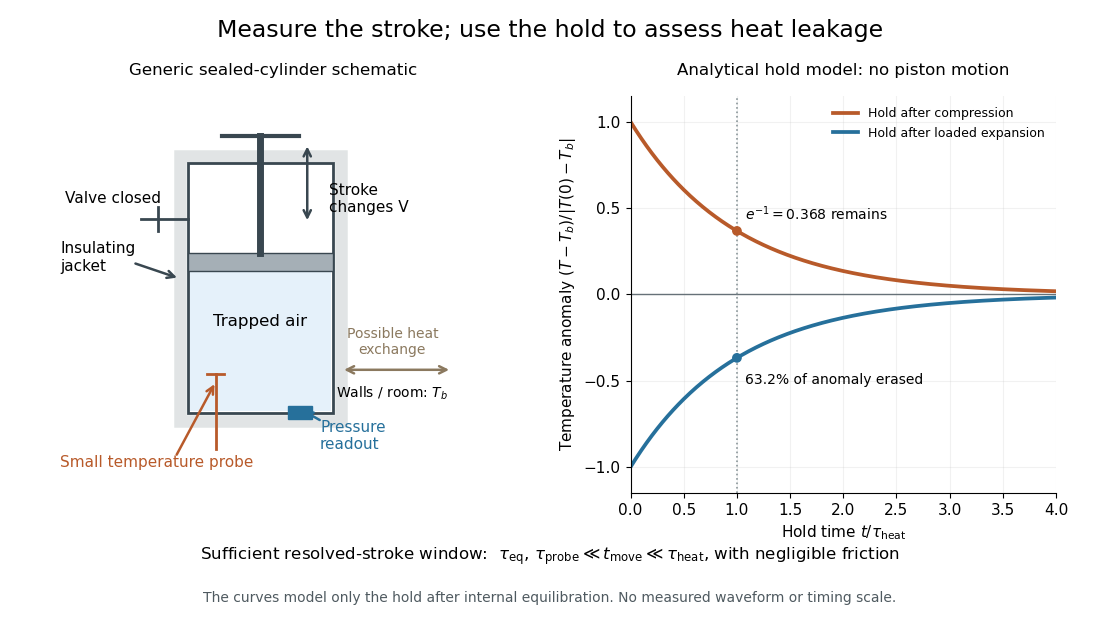
The diagram's model is deliberately a hold after the stroke, when boundary work is zero. For constant whole-sample heat capacity at constant volume and effective thermal conductance , it assumesThis is Newton's law of cooling with one uniform gas temperature and a fixed surrounding temperature; actual wall and probe dynamics can require more than one time constant. At , the fraction of the initial temperature anomaly erased is ; at one time constant it is about . These are analytical fractions, not experimental tolerances or evidence that the preceding stroke was reversible. Measuring the hold helps estimate heat leakage independently of the motion.
The usefulness of an adiabatic process is that it separates mechanical work from heat transfer. Its reversible limit connects temperature changes, mechanical stiffness and entropy in one model: Rüchardt experiment and Clément-Desormes experiment already use that connection to measure heat capacity ratio. The contrast with free expansion explains the deeper point: suppressing heat does not determine how much work is exchanged or how much entropy is produced.
A Riemannian metric on a smooth surface defines an unsigned area density of a surface in every chart:where are the coefficients of the first fundamental form. For a coordinate change with Jacobian matrix , the identity gives . This is exactly the absolute Jacobian determinant factor in coordinate area substitution, so the density defines surface area globally, including on a nonorientable surface.
If an orientation of a surface is also chosen, the corresponding oriented area two-form is, in every positively oriented chart,Changing the orientation negates this differential form, while leaving the unsigned surface area unchanged. A Möbius band has an area density but no globally nonvanishing area two-form, since such a form would orient it. The notation is often used for the density too; an integral computing unsigned surface area uses the positive density convention.
A local isometry between Riemannian manifolds is a local diffeomorphism with . Equivalently, its differentials are isometric linear isomorphisms between tangent spaces. It preserves the Levi-Civita connection, intrinsic sectional curvature, and affinely parametrized geodesics. A map whose differentials are merely isometric injections is an isometric immersion; the local diffeomorphism requirement distinguishes these notions.
Position-momentum selection rules in the first excited hydrogen eigenspace by  Codex 0 Created 2026-09-24 Updated 2026-11-05
Both and commute with and are odd under parity. Their angular selection rules therefore require the same magnetic quantum number and opposite orbital parity. Within the nonrelativistic point-Coulomb hydrogen atom eigenspace, the only angularly permitted off-diagonal pair is and .
Those necessary angular conditions do not guarantee a nonzero matrix element. For the Coulomb potential Hamiltonian ,All states within this exact eigenspace have the same energy, so every projected matrix element vanishes. In contrast, the position matrix element is nonzero: with conventional real spherical harmonics and hydrogen radial wavefunction in the first excited shell, . Its sign depends on basis phases, while its magnitude does not.
Thus the electric-dipole selection rules for hydrogen allow a linear position perturbation to mix these degenerate states, but a momentum perturbation cannot be assigned the same matrix merely from parity. The conclusion concerns the unperturbed Coulomb eigenspace; degeneracy-breaking interactions require their own energy eigenstates and matrix elements.
Orbital-angular-momentum-squared perturbation of hydrogen by Codex 0 Created 2026-09-24 Updated 2026-09-24
Codex 0 Created 2026-09-24 Updated 2026-09-24A perturbation preserves the hydrogen eigenbasis and shifts byIn the first excited eigenspace, the state is unshifted and the three states receive the common shift .
The Klein four-group is the abelian group with three nonidentity elements, all of order two.
If with , then has subgroups of order , every -subgroup lies in one, and all such Sylow subgroups are conjugate. Their number satisfies and .
For , the dihedral group is the symmetry group of a regular -gon, including rotations and reflections. Using the convention that the subscript gives the group order,Its elements are and , with : the first are rotations, the second reflections. The relation reduces every word to one of these forms. Geometrically the image of one vertex and a choice of direction around the polygon distinguish all forms.
Another common convention writes for this same group, indexing by polygon vertices. For example the symmetry group of a square has eight elements and may be called either or . The group order or group presentation resolves that notation difference. Its rotation subgroup is a cyclic group of index two, and a reflection conjugates each rotation to its inverse.
Pinned article: Introduction to the OurBigBook Project
Welcome to the OurBigBook Project! Our goal is to create the perfect publishing platform for STEM subjects, and get university-level students to write the best free STEM tutorials ever.
Everyone is welcome to create an account and play with the site: ourbigbook.com/go/register. We belive that students themselves can write amazing tutorials, but teachers are welcome too. You can write about anything you want, it doesn't have to be STEM or even educational. Silly test content is very welcome and you won't be penalized in any way. Just keep it legal!
Intro to OurBigBook
. Source. We have two killer features:
- topics: topics group articles by different users with the same title, e.g. here is the topic for the "Fundamental Theorem of Calculus" ourbigbook.com/go/topic/fundamental-theorem-of-calculusArticles of different users are sorted by upvote within each article page. This feature is a bit like:
- a Wikipedia where each user can have their own version of each article
- a Q&A website like Stack Overflow, where multiple people can give their views on a given topic, and the best ones are sorted by upvote. Except you don't need to wait for someone to ask first, and any topic goes, no matter how narrow or broad
This feature makes it possible for readers to find better explanations of any topic created by other writers. And it allows writers to create an explanation in a place that readers might actually find it.
Figure 1. Screenshot of the "Derivative" topic page. View it live at: ourbigbook.com/go/topic/derivativeVideo 2. OurBigBook Web topics demo. Source. - local editing: you can store all your personal knowledge base content locally in a plaintext markup format that can be edited locally and published either:This way you can be sure that even if OurBigBook.com were to go down one day (which we have no plans to do as it is quite cheap to host!), your content will still be perfectly readable as a static site.
- to OurBigBook.com to get awesome multi-user features like topics and likes
- as HTML files to a static website, which you can host yourself for free on many external providers like GitHub Pages, and remain in full control

Figure 2. You can publish local OurBigBook lightweight markup files to either OurBigBook.com or as a static website.
Figure 3. Visual Studio Code extension installation.
Figure 5. . You can also edit articles on the Web editor without installing anything locally. Video 3. Edit locally and publish demo. Source. This shows editing OurBigBook Markup and publishing it using the Visual Studio Code extension. 
- Infinitely deep tables of contents:



All our software is open source and hosted at: github.com/ourbigbook/ourbigbook
Further documentation can be found at: docs.ourbigbook.com
Feel free to reach our to us for any help or suggestions: docs.ourbigbook.com/#contact