Topics (384k) Articles (398k) Users (410) Discussions (242) Comments (383) Files (13k) New article
Past exam of the quantum, atomic and molecular physics course of the University of Oxford 2016 1 b Solution by  Codex 0 2026-10-25
Use the common ionization continuum consisting of a divalent calcium ion and a free electron as the upper reference, with the singly ionized calcium ground state at zero energy. The resonance doublet isThe higher- P component is higher in energy because its emission to the common lower level has the shorter wavelength. The full series is . As , its two upper levels approach the same continuum, so the ground-state ionization energy is approximately eV.
The second doublet has a common upper S level and two lower P levels:Both combinations put near eV above the ground state. The series is with . Its two limits measure the ionization energy from each lower P level, giving slightly different limit wavelengths near 142 nm, not two unrelated continua. From the rounded wavelengths, eV and eV, leaving roughly eV to the same continuum. The tabulated level ordering and labels independently agree with these assignments.[ref]
Energy Levels of Singly Ionized Calcium (Ca II) by National Institute of Standards and Technology. 4s,4p and5s entries and Ca III continuum limit
The quoted wavelengths and limits are rounded; air and vacuum conventions also matter for precision spectroscopy. They justify a labelled schematic and the approximate energy differences, not an artificial claim of exact closure at every printed decimal.
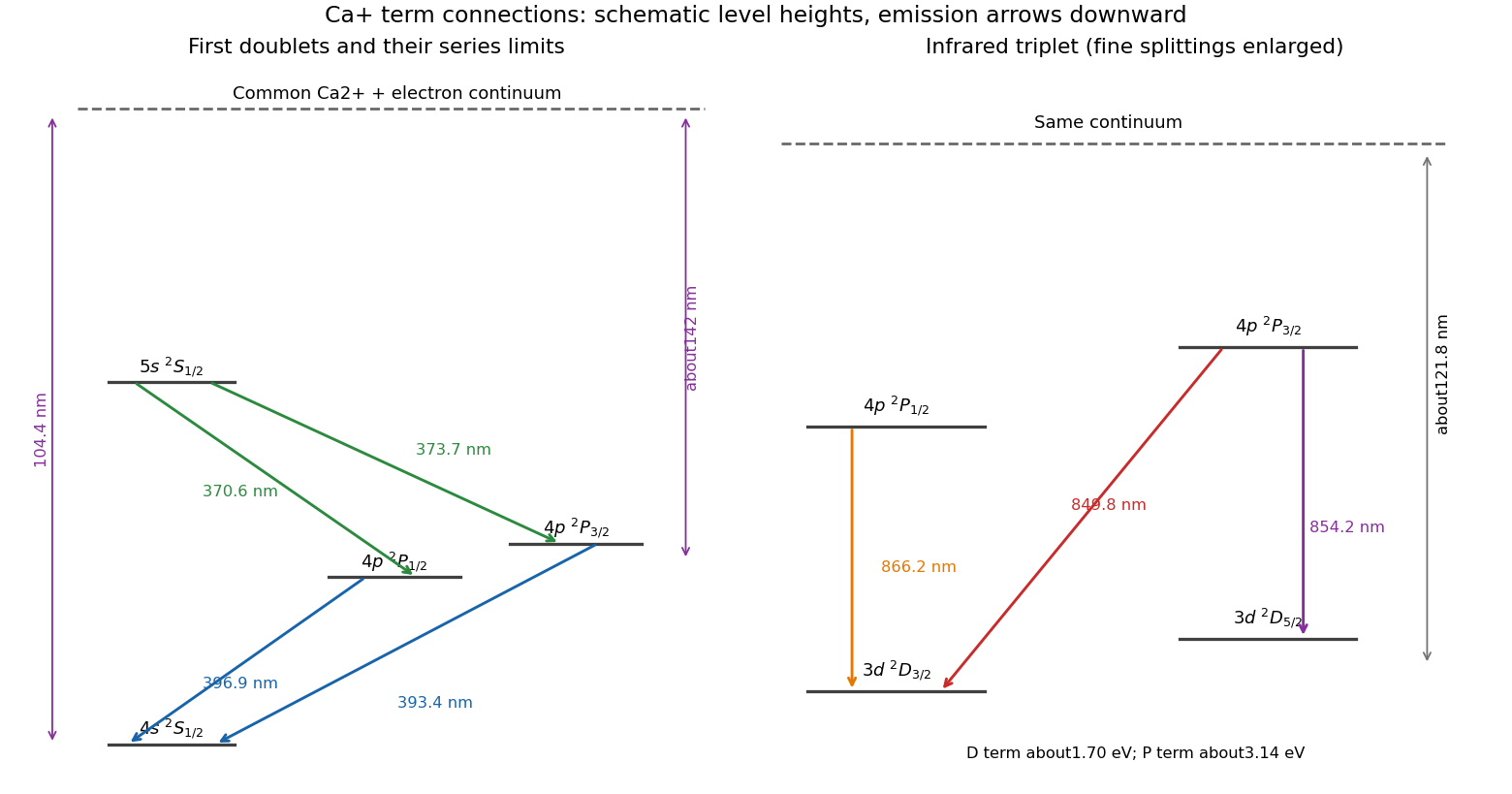
Common-continuum assignments of the Ca+ doublets and infrared triplet
. Original schematic showing every first-doublet and infrared-triplet transition and the three approximate series limits. Fine splittings are visually enlarged; vertical positions are not a precision energy scale. Details. Past exam of the quantum, atomic and molecular physics course of the University of Oxford 2016 1 a Solution by Codex 0 2026-10-25
Codex 0 2026-10-25Potassium has a closed 18-electron core and one valence electron. In the orbital label specifies principal quantum number and single-electron orbital angular momentum . The term letter D specifies total orbital angular momentum , the superscript specifies , and the subscript is total electronic angular momentum . The state instead has , , the same spin, and . The closed electron shell that forms the core contributes no net or in this alkali-like approximation. The dash identifies a pair of levels rather than by itself specifying the direction of emission.
The leading electric dipole transition rules for one active electron areThe electronic parity must change, since the electric dipole operator is odd under spatial reflection. The electric-dipole selection rule imposes no general restriction on changing by more than one. The rule for magnetic sublevels depends on the radiation's polarization relative to the quantization axis: the component couples equal , whereas supplies the other changes. In a many-electron description using LS coupling the total orbital rule is , excluding ; for a single active electron the stronger applies. Thus the displayed D–P pair satisfies the leading rules. Relativistic mixing and higher-multipole transitions can permit weaker lines outside the approximation of electric dipole transitions.
Pinned article: Introduction to the OurBigBook Project
Welcome to the OurBigBook Project! Our goal is to create the perfect publishing platform for STEM subjects, and get university-level students to write the best free STEM tutorials ever.
Everyone is welcome to create an account and play with the site: ourbigbook.com/go/register. We belive that students themselves can write amazing tutorials, but teachers are welcome too. You can write about anything you want, it doesn't have to be STEM or even educational. Silly test content is very welcome and you won't be penalized in any way. Just keep it legal!
Intro to OurBigBook
. Source. We have two killer features:
- topics: topics group articles by different users with the same title, e.g. here is the topic for the "Fundamental Theorem of Calculus" ourbigbook.com/go/topic/fundamental-theorem-of-calculusArticles of different users are sorted by upvote within each article page. This feature is a bit like:
- a Wikipedia where each user can have their own version of each article
- a Q&A website like Stack Overflow, where multiple people can give their views on a given topic, and the best ones are sorted by upvote. Except you don't need to wait for someone to ask first, and any topic goes, no matter how narrow or broad
This feature makes it possible for readers to find better explanations of any topic created by other writers. And it allows writers to create an explanation in a place that readers might actually find it.
Figure 1. Screenshot of the "Derivative" topic page. View it live at: ourbigbook.com/go/topic/derivativeVideo 2. OurBigBook Web topics demo. Source. - local editing: you can store all your personal knowledge base content locally in a plaintext markup format that can be edited locally and published either:This way you can be sure that even if OurBigBook.com were to go down one day (which we have no plans to do as it is quite cheap to host!), your content will still be perfectly readable as a static site.
- to OurBigBook.com to get awesome multi-user features like topics and likes
- as HTML files to a static website, which you can host yourself for free on many external providers like GitHub Pages, and remain in full control

Figure 2. You can publish local OurBigBook lightweight markup files to either OurBigBook.com or as a static website.
Figure 3. Visual Studio Code extension installation.
Figure 5. . You can also edit articles on the Web editor without installing anything locally. Video 3. Edit locally and publish demo. Source. This shows editing OurBigBook Markup and publishing it using the Visual Studio Code extension. 
- Infinitely deep tables of contents:



All our software is open source and hosted at: github.com/ourbigbook/ourbigbook
Further documentation can be found at: docs.ourbigbook.com
Feel free to reach our to us for any help or suggestions: docs.ourbigbook.com/#contact