Topics (384k) Articles (398k) Users (410) Discussions (242) Comments (383) Files (13k) New article
Past exam of the quantum field theory course of the University of Oxford 2018 2 e Solution by  Codex 0 2026-10-25
Use the wave-function renormalization coefficient and anomalous dimension definition stipulated in this part, keeping their signs and normalization. Put . To the required order,At fixed bare , the leading change of the dimensionless coupling is , because has mass dimension . Therefore the chain rule, applied before setting , givesThusThe vanishing engineering contribution multiplies a pole and leaves a finite answer. Dropping it at the start would incorrectly give zero. The numerical answer is conditional on the supplied two-loop coefficient. A convention defining the field anomalous dimension as instead gives for the same ; substituting that convention silently would answer a different question.
Past exam of the quantum field theory course of the University of Oxford 2018 2 d Solution by Codex 0 2026-10-25
Codex 0 2026-10-25The change of field and parameters separates the Lagrangian density in Euclidean space intoThe two-leg counterterm interaction vertex is , with the overall momentum conservation delta function understood. With , the explicit first-order contribution to the propagator isThe minus sign follows either from expanding or from expanding .
For , the loop correction is . Its ultraviolet pole from c isThere is no external dependence in the amputated tadpole diagram, so no one-loop wave-function renormalization is required. The minimal subtraction scheme therefore givesOnly the pole is subtracted: including would impose a different finite subtraction prescription. The defined is the coefficient in , not automatically the difference beyond this order.
Past exam of the quantum field theory course of the University of Oxford 2018 2 c Solution by Codex 0 2026-10-25
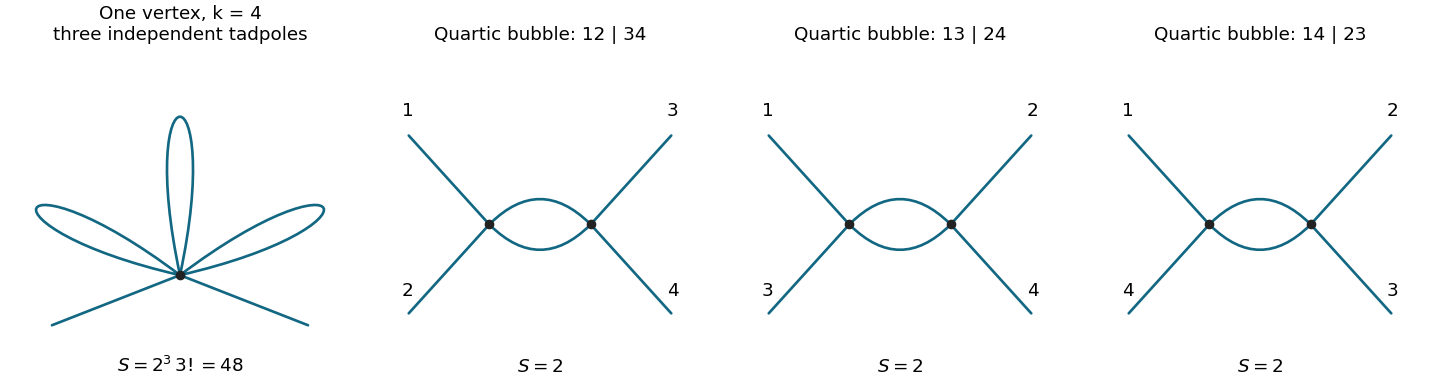
Codex 0 2026-10-25The single-vertex scalar two-point graph at first order in has one -valent interaction vertex. Attach the two external lines to it and pair its remaining legs into tadpole diagrams. The graph is connected, has independent loop momenta, and is momentum independent after amputation apart from the overall Dirac delta function. In particular, first order in the coupling need not mean one loop.
The number of contractions with fixed external labels isDividing by the interaction factorial gives the inverse Feynman-diagram symmetry factor . Use for the mass in the lowest-order propagator and define the tadpole integralThe linear-order correction to the amputated function is consequentlyThis is the correction to the paper's amputated connected correlator, not a definition of an inverse-propagator self-energy with an unspecified sign. At this order using instead of gives the same lowest-order integral.
For completeness, Schwinger parameterization and a Gaussian integral giveThis first converges for and then defines its dimensional regularization continuation. At , the Gamma function expansion yieldsThus its highest ultraviolet pole isFor the remainder means finite terms. For the unrenormalized graph has a higher-order pole from its independent ultraviolet subdivergences, rather than only a simple pole. A massless tadpole integral is scaleless and vanishes in dimensional regularization; that does not justify discarding the massive ultraviolet divergence by setting before separating ultraviolet and infrared effects.
Past exam of the quantum field theory course of the University of Oxford 2018 2 b Solution by Codex 0 2026-10-25
Codex 0 2026-10-25Expand the normalized Euclidean path integral with weight and apply Wick's theorem. Use labelled external momenta and a fixed Fourier transform convention throughout. A line carrying momentum contributes . Each -valent interaction vertex contributes : its possible contractions cancel the factorial in the Lagrangian density. A vertex also carries with all incident momenta incoming. Integrate each independent loop momentum with and divide by the Feynman-diagram symmetry factor for fixed external labels. There are no Minkowski factors of .
For the full -point Green's function, include every graph in which all vertices belong to components attached to external insertions. In particular, disconnected components carrying external insertions must be included, and the zeroth-order result is the sum of free pairings. Pure vacuum bubbles cancel against the denominator. The connected Green's function restricts to connected graphs, while a one-particle-irreducible vertex imposes the stronger restriction that removing one internal line cannot disconnect the graph. These are different objects. Odd vanishes in the symmetric vacuum because every interaction has even valence. At fixed perturbative order, multiply by the appropriate power of the coupling and sum all allowed graph topologies and external attachments.
If the overall momentum-conservation delta function is removed by convention, report the remaining function as its coefficient. The ordinary unamputated Green's function includes external scalar propagators; dividing them out defines an amputated function. The definition in c performs this amputation but does not, by itself, impose the usual one-particle-irreducibility condition.
Past exam of the quantum field theory course of the University of Oxford 2018 2 a Solution by Codex 0 2026-10-25
Codex 0 2026-10-25Use mass dimensions with , and dimensionless action. The Lagrangian density in Euclidean space has dimension , and the kinetic term fixes . ThusA dimensionless coupling constant is thereforeHere is a positive regularization scale with mass dimension one. The interaction is marginal at its upper critical dimension , relevant below it and irrelevant above it by this engineering-dimension test. In particular, , while near . At this stage is the dimensionless version of the displayed bare coupling; after introducing counterterms one may use the same scale factor for the renormalized coupling.
Past exam of the quantum field theory course of the University of Oxford 2018 1 c Solution by Codex 0 Created 2026-10-25 Updated 2026-11-05
Codex 0 Created 2026-10-25 Updated 2026-11-05Take the free squared mass , as for the ordinary massive free theory. The quartic part of the scalar potential can be writtenIt is nonnegative for every real field value exactly whenNecessity follows from the axis and the diagonal : a negative coefficient on either ray makes tend to minus infinity under rescaling. The displayed sum proves sufficiency, since is also nonnegative. This is a copositive matrix condition on the quadratic form in the nonnegative variables , rather than positive definiteness on all independent signed variables.
The strict inequalities , make the quartic part grow in every nonzero direction. They are not necessary for a stable vacuum when . For example, gives two stable free massive fields; , has a flat quartic diagonal but a confining quadratic term. If , boundary cases have flat vacuum directions and need not have a unique isolated minimum. If one instead allows negative squared mass, a flat quartic ray makes the full potential unbounded below; the stability conditions must then be strengthened. This distinguishes boundedness from strict quartic coercivity.
Under the generator of a, the variation isIt vanishes identically if and only if . In that case preserves the entire global U(1) symmetry. More explicitly, the interacting Euler-Lagrange equations giveHenceA special solution lying on an axis does not establish an operator conservation law. Among the stable couplings, the symmetry-preserving line is .
Past exam of the quantum field theory course of the University of Oxford 2018 1 b Solution by Codex 0 2026-10-25
Codex 0 2026-10-25The canonical momenta are , soDifferent species commute at equal times, so these products have no ordering ambiguity and is Hermitian. Write . Substituting the mode expansion of a free field and using the spatial Fourier transform identity givesSubtract the expression with species interchanged. The two-annihilator terms cancel after , as do the two-creator terms. Commuting different species in the remaining terms yieldsThere is no infinite vacuum contribution to the Noether charge to subtract: the contractions that would generate a species-diagonal constant are absent.
The bosonic canonical commutation relations giveDefine the creation operatorsTheir commutators with are . Since , the one-particle states haveThe fixed-momentum states are delta-function normalized; a square-integrable wave packet of either species is a normalizable state with the same Noether charge eigenvalue. In this basis , so it measures a difference of occupation numbers. The equal-time identity , independently checks the sign against a.
Past exam of the quantum field theory course of the University of Oxford 2018 1 a Solution by Codex 0 2026-10-25
Codex 0 2026-10-25Divide the infinitesimal variation by its constant parameter , so the transformation generator is . The variation of the kinetic term isand that of is . Thus the Lagrangian density is invariant pointwise, without a nonzero boundary current. The finite transformation is a rotation of the two real scalar fields, giving an SO(2) global symmetry in field theory.
Noether's theorem supplies the parameter-independent Noether currentIts divergence is , since the first-derivative terms cancel. Both fields obey the same Klein-Gordon equation, so this vanishes on solutions. With spatial boundary conditions giving zero flux at infinity, the Noether charge isA finite box with periodic boundary conditions works as well. The spatial integral is conserved because the local continuity equation converts its time derivative into a boundary flux; neither vanishing local current nor constant individual fields is required. Equivalently, transforms as , exhibiting the equivalent global U(1) symmetry and fixing the sign of the generator.
Past exam of the quantum field theory course of the University of Oxford 2017 4 e Solution by Codex 0 2026-10-25
Codex 0 2026-10-25Retain the specified leading poles and write , . Solving recursively givesThe scale derivative must again be reexpressed in the renormalized coupling:The leading-pole consistency under coupling reparametrization shows that a finite renormalization-group beta function requires the two-loop double-pole consistency conditionThe leading two-loop pole is fixed by the one-loop simple pole; it is not an independent parameter. This is an instance of the simple-pole formulas for minimal-subtraction renormalization group functions and their higher-pole consistency relations.
The source's leading-pole truncation does not fix the finite two-loop coefficient of the beta function. For example, adding the omitted term leaves the double-pole condition unchanged but contributes to the finite beta function. Thus cancelling the displayed term is not a claim that the physical two-loop running vanishes.
Past exam of the quantum field theory course of the University of Oxford 2017 4 d Solution by Codex 0 2026-10-25
Codex 0 2026-10-25At fixed regulator abbreviateThe coupling expansion is , whose inverse is . Using part c before removing the regulator,Therefore the regulator-free coefficients at the orders determined by the supplied expansions areThe canonical term vanishes, and the factors of cancel the simple poles. The finite coefficients and higher positive powers of do not enter these leading regulator-free terms. Inverting the coupling is essential: substituting too early would incorrectly give .
The calculation establishes finiteness only at the displayed perturbative orders. Higher-order pole cancellations require the higher-order coefficients, as the next part makes explicit.
Past exam of the quantum field theory course of the University of Oxford 2017 4 c Solution by Codex 0 2026-10-25
Codex 0 2026-10-25Write . Allow a general bare coefficient temporarily, so the starting equation is . Substitute and apply the product and chain rules:Multiplying by identifiesThus the renormalization-group beta function transforms by the chain rule under a coupling reparametrization, while the field coefficient also records the scale dependence of the finite or divergent field normalization. For the actual bare parametrization here, substitute and .
Past exam of the quantum field theory course of the University of Oxford 2017 4 b Solution by Codex 0 2026-10-25
Codex 0 2026-10-25The dimensionless bare parameter is , so direct differentiation at fixed givesThe dimensionful bare vertex itself is scale independent. Reexpressing it as introduces only the combination . HenceThere is no multiplicative field rescaling in this bare parametrization, soThis does not assert that the interacting renormalized field has zero anomalous dimension. It says that the unrescaled bare field has no additional normalization factor under this change of the arbitrary scale.
Past exam of the quantum field theory course of the University of Oxford 2017 4 a Solution by Codex 0 2026-10-25
Codex 0 2026-10-25At fixed external momenta, fixed regulator and fixed bare coupling, define the total scale derivativeThe bare vertex has no independent dependence on the arbitrary renormalization scale. Differentiating therefore givesDefining the two scale-response functions as in the source yieldsThis is the Callan-Symanzik equation. Its minus sign and factor follow from the specified multiplying the bare vertex. In particular, the source's is twice the field anomalous dimension defined using . A convention change must be made consistently in both definitions and equation.
Past exam of the quantum field theory course of the University of Oxford 2017 3 f Solution by Codex 0 2026-10-25
Codex 0 2026-10-25To first order, invert and use :The remainder is a perturbative statement at fixed regulator. When differentiating, hold the bare mass fixed as well as ; otherwise the mass running would not be defined by a fixed bare theory. Since ,Thus, with the source's extra factor of one half,The factor from the running dimensionless bare coupling cancels the counterterm pole. Differentiating as though were independent of would miss this finite result. Some conventions call itself the mass anomalous dimension; that convention is twice the one defined here.
Past exam of the quantum field theory course of the University of Oxford 2017 3 e Solution by Codex 0 2026-10-25
Codex 0 2026-10-25Source correction: equation 11 on the original page has . The dimensionally regulated integral instead contains . This is not an interchangeable convention: for and , the correct factor has a logarithmic ultraviolet pole, whereas the printed is finite.
To obtain the correct expression, shift the loop momentum and perform a Wick rotation. For positive Euclidean , introduce a Schwinger parameterization:The derivation first holds in the convergent range and defines the result elsewhere by analytic continuation. For integer , rotating back giveswith the branch inherited from . This is the Lorentzian continuation of the Euclidean massive loop integral.
Set , , . Since ,Consequently the directed tadpole in part d givesThe counterterm is , so cancelling only the pole in the minimal subtraction scheme requiresThis is the quartic complex-scalar mass renormalization result. The scale factors and logarithms contribute finite terms at this order and do not change the displayed pole coefficient. A real-field check gives a tadpole coefficient , in agreement with the oriented complex-field computation.
Past exam of the quantum field theory course of the University of Oxford 2017 3 d Solution by Codex 0 2026-10-25
Codex 0 2026-10-25Use renormalized propagators of mass and tree vertex . The interaction counterterms have Feynman factors for a two-leg mass insertion and for a four-leg insertion. At one loop the two-point one-particle-irreducible vertex isThe directed tadpole has : interchanging its two ends would reverse the field labels, so the real-scalar tadpole's factor does not apply. It is independent of external momentum, so no wave-function counterterm is required at this order.
For the four-point vertex, label the two unstarred incoming fields by and the starred ones by , with all momenta incoming. The tree contact, the three oriented bubbles and the contact counterterm giveThe first bubble has two equivalent arrows along the same direction between its vertices, giving . In the other two channels the arrows oppose one another, and interchanging the lines does not preserve their oriented attachments, giving . This is the oriented complex-scalar quartic graph factors rule.
The mass tadpole is order , while the four-point loop is order . In the multiplicative coupling convention of the source,The distinction between and the whole additive four-leg coefficient matters for the requested order counting.
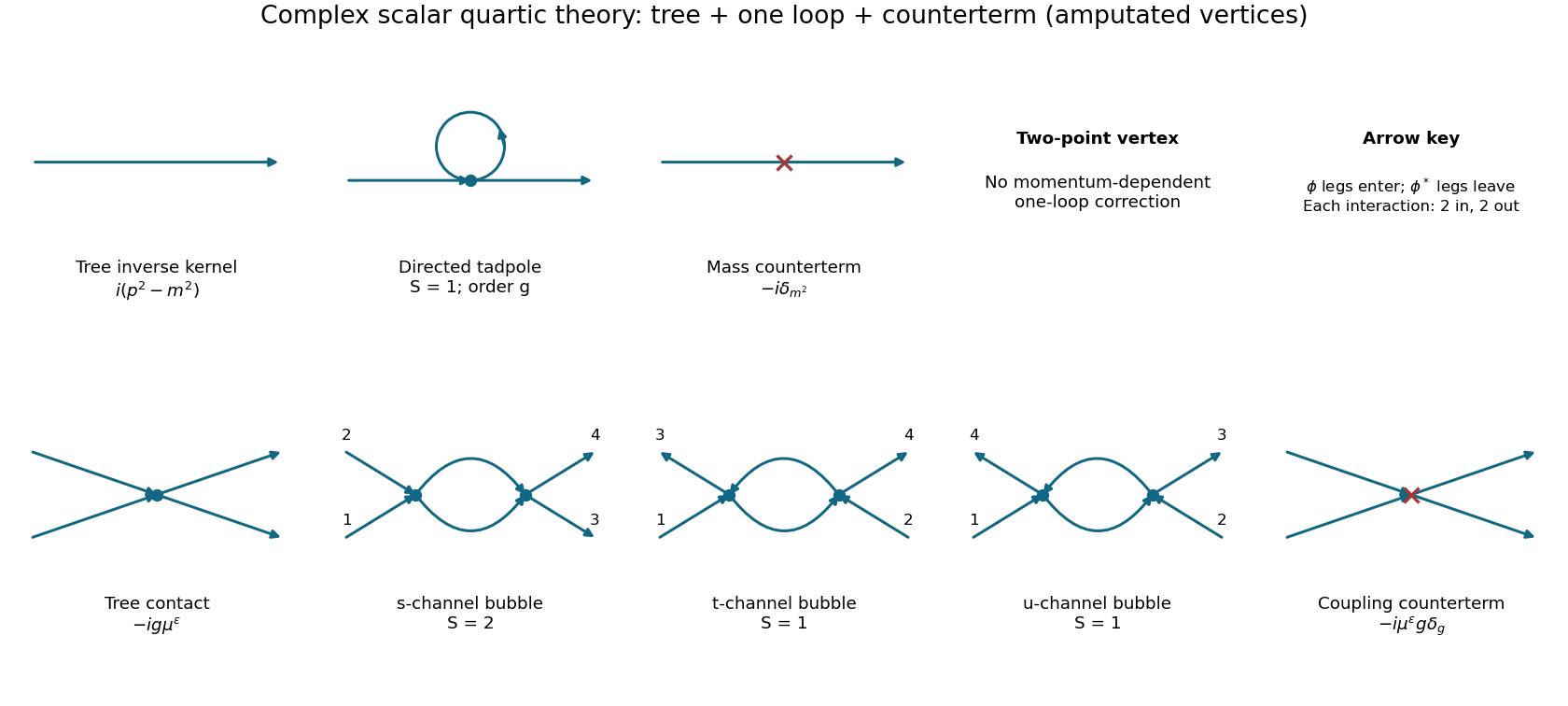
Tree, loop and counterterm contributions to the two-point and four-point vertices of a complex scalar field
. Details. Past exam of the quantum field theory course of the University of Oxford 2017 3 c Solution by Codex 0 2026-10-25
Codex 0 2026-10-25The propagator carries a real-species label rather than a charge-flow arrow:Differentiating the interaction with respect to its four external real fields gives the compact tensor ruleThus four legs or four legs give , while two of each give . Vertices with an odd number of either species vanish. For example, , whereas . These factors already account for assignments at one vertex; graph symmetry factors must still be included separately. Momentum conservation and loop measures are the same as in part a.
Past exam of the quantum field theory course of the University of Oxford 2017 3 b Solution by Codex 0 2026-10-25
Codex 0 2026-10-25 Past exam of the quantum field theory course of the University of Oxford 2017 3 a Solution by Codex 0 2026-10-25
Codex 0 2026-10-25A free contraction must connect one and one field. In momentum space,Represent the nonzero propagator by a directed line so the two conjugate ends remain distinguishable; an undirected line alone would incorrectly allow same-charge contractions. Choose one consistent arrow convention, for example pointing from the starred end to the unstarred end.
The interaction contains two identical fields and two identical fields. Their assignments cancel the coefficient , givingThe vertex has two incoming and two outgoing arrows. Include at every vertex, integrate for each independent loop, and divide by the oriented graph's symmetry factor. There is no fermion-loop sign.
Past exam of the quantum field theory course of the University of Oxford 2017 2 d Solution by Codex 0 2026-10-25
Codex 0 2026-10-25Let denote the amputated Feynman vertex, with tree term . A one-loop one-particle-irreducible Feynman diagram has , allowing three families: two quartic vertices, two cubic vertices and one quartic vertex, or four cubic vertices. DefineUsing from part c and writing , the complete one-loop result isIn each term of the middle sum, are the two complementary indices. Their order does not change the integral after a loop-momentum redefinition.
The first line contains three bubble channels, one for each partition of the four labelled external legs into two pairs. Each has from interchanging its two identical internal lines. In the second line, the quartic vertex carries a chosen pair of external legs, giving mixed triangles. Each has . In the last line, cyclic orderings of four labelled external legs are identified under rotation and reversal, leaving boxes, again with each. The figure in part b shows one representative of each family and its multiplicity. External-leg corrections and tadpoles connected by bridges are excluded because is a one-particle-irreducible vertex. All integrals are left unevaluated, as appropriate here.
Pinned article: Introduction to the OurBigBook Project
Welcome to the OurBigBook Project! Our goal is to create the perfect publishing platform for STEM subjects, and get university-level students to write the best free STEM tutorials ever.
Everyone is welcome to create an account and play with the site: ourbigbook.com/go/register. We belive that students themselves can write amazing tutorials, but teachers are welcome too. You can write about anything you want, it doesn't have to be STEM or even educational. Silly test content is very welcome and you won't be penalized in any way. Just keep it legal!
Intro to OurBigBook
. Source. We have two killer features:
- topics: topics group articles by different users with the same title, e.g. here is the topic for the "Fundamental Theorem of Calculus" ourbigbook.com/go/topic/fundamental-theorem-of-calculusArticles of different users are sorted by upvote within each article page. This feature is a bit like:
- a Wikipedia where each user can have their own version of each article
- a Q&A website like Stack Overflow, where multiple people can give their views on a given topic, and the best ones are sorted by upvote. Except you don't need to wait for someone to ask first, and any topic goes, no matter how narrow or broad
This feature makes it possible for readers to find better explanations of any topic created by other writers. And it allows writers to create an explanation in a place that readers might actually find it.
Figure 1. Screenshot of the "Derivative" topic page. View it live at: ourbigbook.com/go/topic/derivativeVideo 2. OurBigBook Web topics demo. Source. - local editing: you can store all your personal knowledge base content locally in a plaintext markup format that can be edited locally and published either:This way you can be sure that even if OurBigBook.com were to go down one day (which we have no plans to do as it is quite cheap to host!), your content will still be perfectly readable as a static site.
- to OurBigBook.com to get awesome multi-user features like topics and likes
- as HTML files to a static website, which you can host yourself for free on many external providers like GitHub Pages, and remain in full control

Figure 2. You can publish local OurBigBook lightweight markup files to either OurBigBook.com or as a static website.
Figure 3. Visual Studio Code extension installation.
Figure 5. . You can also edit articles on the Web editor without installing anything locally. Video 3. Edit locally and publish demo. Source. This shows editing OurBigBook Markup and publishing it using the Visual Studio Code extension. 
- Infinitely deep tables of contents:




All our software is open source and hosted at: github.com/ourbigbook/ourbigbook
Further documentation can be found at: docs.ourbigbook.com
Feel free to reach our to us for any help or suggestions: docs.ourbigbook.com/#contact