Topics (384k) Articles (398k) Users (410) Discussions (242) Comments (383) Files (13k) New article
Past exam of the quantum field theory course of the University of Oxford 2020 1 a Solution by  Codex 0 2026-10-25
For four-momentum flowing along the fermion flow, the momentum space Feynman rules areThe scalar propagator and Dirac propagator invert their respective quadratic kernels. The interaction vertex follows by expanding , fixing its sign. Species is conserved along each open fermion line; there is no vertex changing species 1 into species 2.
An interaction vertex carries with inward four-momenta. Impose momentum conservation and integrate each independent loop momentum with . Include the closed fermion loop sign for every fermion loop, the relevant fermionic signs when rearranging external states, and the Feynman-diagram symmetry factor. External incoming and outgoing fermions carry and ; incoming and outgoing antifermions carry and . An external real scalar field leg has factor 1 in an amputated scattering amplitude. The Feynman i-epsilon prescription specifies the poles.
Past exam of the quantum field theory course of the University of Oxford 2019 3 e Solution by Codex 0 2026-10-25
Codex 0 2026-10-25A continuous Lorentz transformation in one spatial dimension must preserve . In the component connected to the identity, take the image of the time axis to have velocity , with , and write . Preservation of the Minkowski norm gives , so . The spacelike column must be orthogonal to the timelike column and have squared Minkowski norm ; continuity fixes it to . ThusHere denotes the coordinate pair. This is the positive off-diagonal convention in the source; describing a passive frame moving at instead reverses the sign of .
Define the rapidity . The hyperbolic function identities giveIn light-cone coordinates, and . Therefore the derivatives transform oppositely:Use the field-transformation convention . The component action in c is invariant underIndeed, the right-component kinetic term gains , and the left-component kinetic term gains . The two factors in each Dirac mass term cancel as well. Finally , so and the whole action is unchanged. These are the chiral boost weights in two spacetime dimensions.
In spinor notation, satisfies and , so . These identities directly verify covariance of the Dirac equation and the Lorentz invariance of its action. The matrices are not unitary with respect to the ordinary component norm; the Dirac adjoint supplies the invariant bilinear.
The statement about there being only Lorentz boosts applies to the identity component of the One-dimensional Lorentz group. The full Lorentz group also has discrete transformations: the concrete spatial reflection preserves the Minkowski metric but has determinant , so it cannot equal any displayed , whose determinant is .
Past exam of the quantum field theory course of the University of Oxford 2019 3 d Solution by Codex 0 2026-10-25
Codex 0 2026-10-25Continue with . Along a characteristic , the chain rule givesThus the initial wave packet evolves as . Similarly, along , the left component is constant, givingA feature initially at therefore appears at for the right component and for the left component. The profiles translate without changing shape at the speed of light, which is 1 in these units. For positive-energy plane waves, the right component has and the left component has , another way to identify their propagation directions.
The conclusion concerns the massless Dirac equation. For , the components couple as in c, and a positive-energy packet has group velocity , rather than a universal speed . For example, a massive positive-energy rest solution has and , so neither component alone describes an independently moving light-speed packet.
Past exam of the quantum field theory course of the University of Oxford 2019 3 c Solution by Codex 0 2026-10-25
Codex 0 2026-10-25In the chirality basis of a, the two rows of the Dirac Hamiltonian equation giveThe Dirac mass term thus couples the two opposite chirality components. In particular, the Lagrangian density isFor , the coupling disappears and the massless Dirac equation splits into the independent transport equationsThese are the two chiral transport equations in two spacetime dimensions. The chiral projectors are and ; in this basis they simply select the upper and lower components.
Past exam of the quantum field theory course of the University of Oxford 2019 3 b Solution by Codex 0 2026-10-25
Codex 0 2026-10-25Variation of the action with respect to the independent Dirac adjoint gives . The gamma matrices chosen in a make the Dirac equationMultiplication by gives the equivalent Dirac Hamiltonian formFor a plane wave , where is the signed one-dimensional momentum, the equation isA nonzero spinor exists precisely when the determinant vanishes:For , one possible unnormalized spinor solution is . Alternatively, follows from the Pauli matrix multiplication law, proving the same relativistic energy-momentum relation. Acting on the Dirac equation with also shows that each component satisfies , the Klein-Gordon equation.
Past exam of the quantum field theory course of the University of Oxford 2019 3 a Solution by Codex 0 2026-10-25
Codex 0 2026-10-25With , the Clifford algebra gives , , and . Henceso . Its square isChoose the following gamma matrices, expressed using the Pauli matrices:These satisfy , and . The chirality eigenvalues are therefore , and we order the spinor as throughout. Its Dirac adjoint is . No additional factor of multiplies in this spacetime dimension. This realizes a Dirac field in two spacetime dimensions.
Past exam of the quantum field theory course of the University of Oxford 2019 2 b Solution by Codex 0 2026-10-25
Codex 0 2026-10-25Let denote the incoming four-momenta and the outgoing four-momenta. Thus , and . Define the Mandelstam variables and exchanged four-momenta byThe leading connected four-point scattering amplitude uses two cubic interaction vertices. There are four tree-level Feynman diagrams: and exchange of with two vertices, and and exchange of with two vertices.
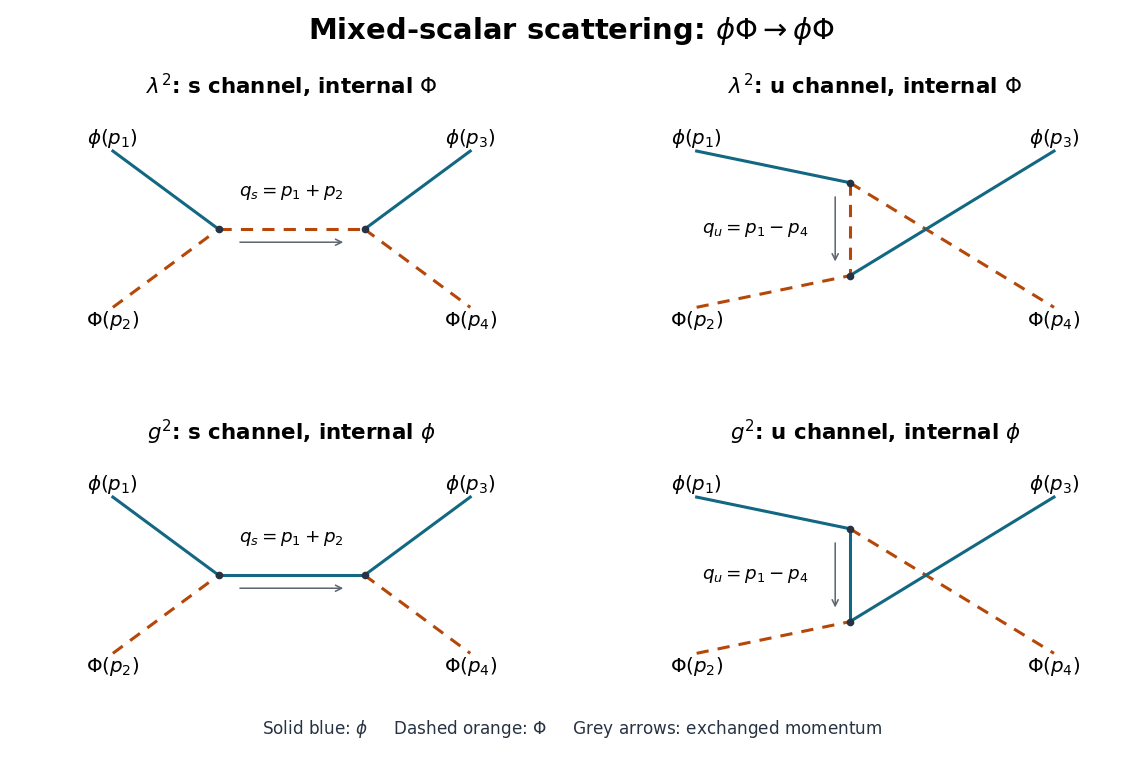
The four tree channels for mixed-scalar scattering. Blue solid lines represent and orange dashed lines . External momenta are incoming on the left and outgoing on the right; crossings have no vertex.
Details. There is no term proportional to : one vertex of each kind has three field slots of each species altogether, whereas the external state uses two of each. This leaves one and one to contract internally, and their mixed scalar propagator is zero. There is also no channel: grouping both external legs at one vertex would require a vertex with an internal , while grouping both external legs at the other would require a vertex with an internal .
Define after removing the overall momentum conservation delta function. The nonderivative exchange givesFor the derivative channel, the incoming four-momenta at the first vertex are , and at the second they are . The two interaction vertices are therefore and . The same reasoning with applies to the channel, givingThe mass shell conditions and momentum conservation implyCombining the four Feynman diagrams therefore yieldsEach displayed tree-level Feynman diagram has Feynman-diagram symmetry factor 1 for fixed external species and labels. The result is of order ; if both couplings are scaled by a common parameter , the next connected corrections begin at order . A four-point cubic Feynman diagram has , so its vertex count is even. The internal lines remain off shell throughout: imposing an on-shell relation on an exchanged four-momentum would incorrectly change the derivative vertices.
Past exam of the quantum field theory course of the University of Oxford 2019 2 a Solution by Codex 0 2026-10-25
Codex 0 2026-10-25Use the Fourier transform convention , and similarly for . All four-momenta at an interaction vertex are incoming. The quadratic terms are diagonal, so the scalar propagators areThe field interaction terms are and . The two identical field slots cancel the factor at either cubic interaction vertex. Expanding therefore givesIn the second rule are specifically the two four-momenta; there is no derivative acting on the leg. Indeed the two derivatives give , fixing the minus sign. This is a mixed scalar derivative cubic vertex. For arbitrary off-shell legs one may equivalently write , but may not replace the squared four-momenta by squared masses unless those legs are on their mass shells.
Each interaction vertex also carries for momentum conservation. Integrate independent loop momenta with and divide by the Feynman-diagram symmetry factor. An amputated external scalar leg has factor 1. The Feynman i-epsilon prescription fixes the propagator poles. As a dimensional check in four spacetime dimensions, , and in mass dimensions; the two powers of momentum in the derivative rule restore mass dimension one for its cubic interaction vertex.
Past exam of the quantum field theory course of the University of Oxford 2019 1 c Solution by Codex 0 2026-10-25
Codex 0 2026-10-25Define and . The Hermitian quantum field has the mode expansion of a free fieldwhere the annihilation operators and creation operators obey the bosonic canonical commutation relationsBecause , its mode expansion of a free field isThe two nonzero cross commutators then giveand the equal-time field-field and momentum-momentum commutators vanish. This verifies the factor without requiring Lorentz invariance.
Substitution into the Hamiltonian, followed by normal ordering, yieldsConsequently : one application of a creation operator adds precisely the required quasiparticle energy. Before normal ordering there is the usual constant zero-point vacuum energy. If , the exactly zero-momentum mode has and is a free canonical coordinate, not an oscillator with a normalizable oscillator vacuum state; in a finite box handle that mode separately or introduce a small positive mass. The formula applies directly to all modes with .
Past exam of the quantum field theory course of the University of Oxford 2019 1 b Solution by Codex 0 2026-10-25
Codex 0 2026-10-25For a Lagrangian density depending on , , and , direct variation givesTake to have compact support, so every boundary term vanishes. One integration by parts for the first-derivative terms and two for the second-derivative term yield the Euler-Lagrange field equation with second derivativesThe plus sign on the last term is essential. For the action in a, it is particularly transparent to vary the Laplacian directly:Thus the classical equation of motion isHere is the biharmonic operator. Substitution of the plane wave givesA real classical solution combines complex-conjugate plane waves. Quantization assigns the positive branch to the excitation energy, giving the required dispersion relation. The negative-frequency branch supplies the creation operator part of the field, rather than negative excitation energy. Independently, the Hamiltonian in a gives , , confirming the same sign.
Past exam of the quantum field theory course of the University of Oxford 2019 1 a Solution by Codex 0 2026-10-25
Codex 0 2026-10-25A real scalar field suffices to describe one neutral species of bosonic quasiparticle. Let be its canonical momentum. In three spatial dimensions, choose the positive classical HamiltonianThe same construction works in any number of spatial dimensions by replacing appropriately. Under a spatial Fourier transform, becomes , so the Hamiltonian is a collection of independent quantum harmonic oscillators with squared angular frequency . The usual reality condition pairs opposite momenta; it does not introduce a second species.
The canonical action is . Varying gives ; eliminating it by the Legendre transform givesThis Lagrangian density is local: only the field and finitely many derivatives at the same point occur. It contains second spatial derivatives but only first time derivatives, so no extra canonical time data are needed. A square root of a differential operator in the classical Hamiltonian is unnecessary. The fourth-order spatial term breaks Lorentz invariance while preserving spatial rotations and translations. This is a free scalar field with quartic spatial dispersion.
Past exam of the quantum field theory course of the University of Oxford 2018 4 c Solution by Codex 0 2026-10-25
Codex 0 2026-10-25Work in the symmetric vacuum and continue with the action-consistent kernel . Under global U(1) symmetry, a correlator with fields and fields picks up a phase . Invariance for every requires . Consequently ten of the sixteen ordered field-type choices vanish, and the six placements with two fields of each type can be nonzero. This is the charge selection rule for complex scalar correlators, not an assertion about a symmetry-breaking vacuum with a nonzero one-point function.
Choose external fields . Its zeroth-order full correlator is and is disconnected; its connected part starts at order . DefineThe tree term has Feynman-diagram symmetry factor 1 and is .
At second order, a connected graph has two quartic vertices, two internal lines and one loop. The three bubble integrals areThe oriented complex-scalar quartic graph factors distinguish the channels. In the two internal lines have the same orientation and can be interchanged, giving symmetry factor . In each mixed channel the two orientations are opposite; interchanging them is not an oriented graph automorphism, so . Equality of the numerical scalar kernels does not erase the field-slot distinction used in counting contractions.
There are also four connected external-leg tadpole diagrams. They must be included because a connected correlation function is neither amputated nor restricted to one-particle-irreducible Feynman diagrams. Representative integrals, with the other two obtained by the indicated external permutations, areEach oriented external-leg graph has symmetry factor 1: a directed self-loop has no independent reversal symmetry. Altogether,These expressions retain every external propagator. The physical normalization is explicit: each is , not . Equivalently set ; its quadratic action has unit mixed propagator and its interaction is , giving vertex . Multiplying a four- correlator by four converts it to the four- correlator, confirming the powers of two.
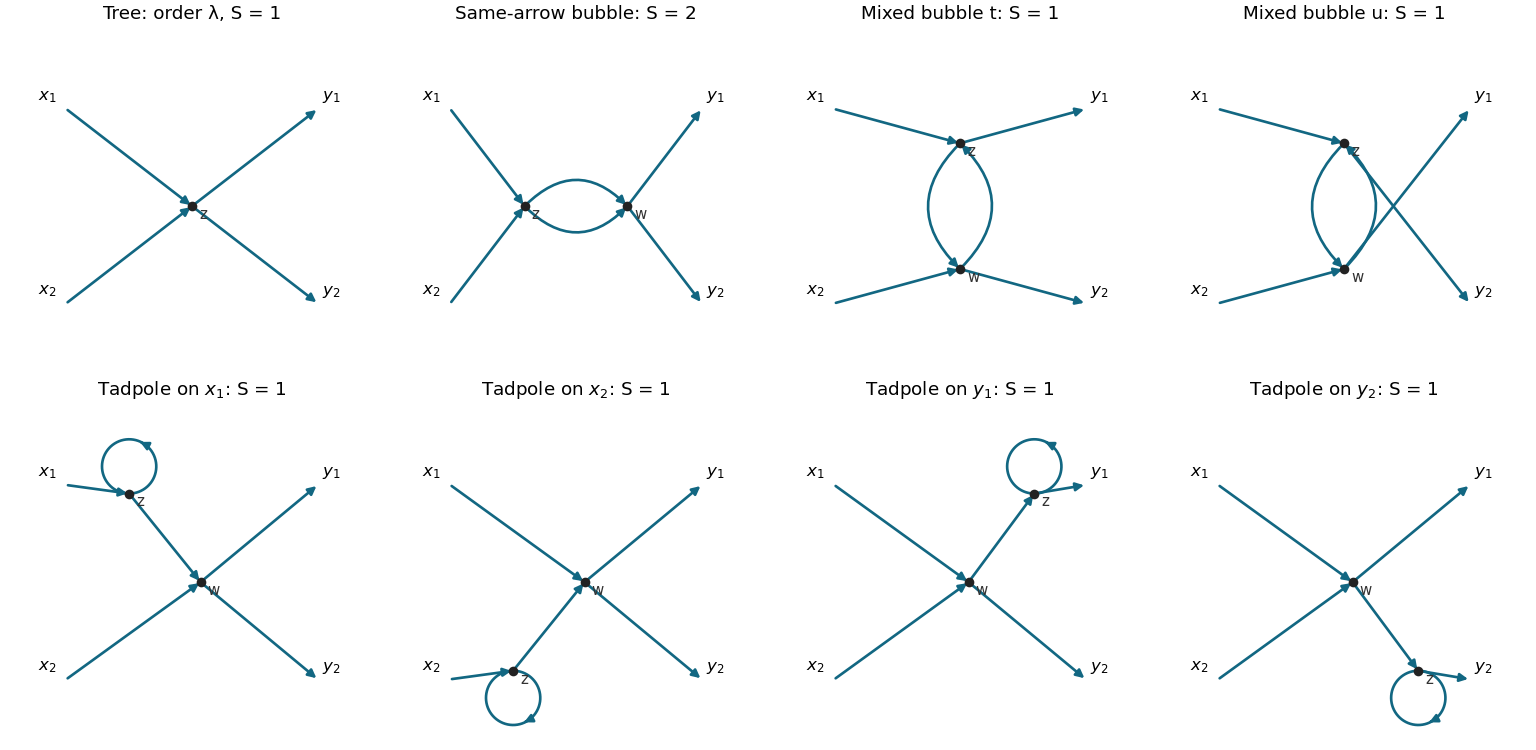
All connected four-point graphs through second order: one tree, three bubbles and four external-leg tadpoles
. Arrows follow C(u,v) from its first argument to its second. The same-orientation bubble has symmetry factor two; the other seven displayed graphs have symmetry factor one. Details.Completeness can also be seen without a picture. With two vertices and four external legs, . Connectivity allows either two intervertex lines with a two-and-two external split, or one bridge and one self-loop with a one-and-three split. The charge assignments give exactly the three bubble attachments and four leg choices above. Direct labelled Wick contraction counting gives respectively contractions. Dividing by the expansion denominator reproduces . Vacuum factors cancel, and there are no additional connected topologies at this order.
Past exam of the quantum field theory course of the University of Oxford 2018 4 b Solution by Codex 0 2026-10-25
Codex 0 2026-10-25Let be the action-consistent free propagator established in a. Write and putThe perturbative expansion isDivide numerator and denominator by the same free vacuum functional . For , they becomeFor , abbreviate and . Since only opposite-charge fields contract, Wick's theorem givesandThe first multiplicity is internal pairings. In the connected term, there are two choices for the vertex's contracted to the external and two for its contracted to the external ; the remaining pair forms a tadpole diagram. ThereforeExpanding the inverse denominator cancels the free-line times vacuum bubble term, leavingThe local quartic interaction vertex has factor , since cancels its denominator 4. The oriented tadpole diagram has Feynman-diagram symmetry factor 1; the isolated two-loop vacuum vertex has factor in its coefficient. Coincident kernels and the integrals require a common regularization; none is being assigned a finite numerical value here.
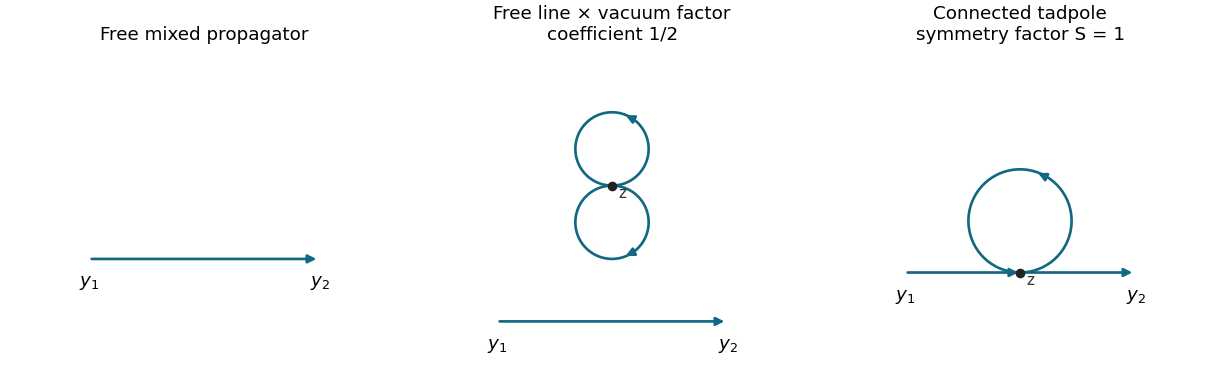
More generally, vacuum bubbles exponentiate and factor from every numerator. Here global U(1) symmetry also makes all one-point functions zero. Thus a surviving graph with the two external insertions in separate connected components would have a component with one unbalanced charge and vanish. This proves that only connected graphs contribute to this particular two-point function to all perturbative orders. Vacuum normalization alone would not remove disconnected components containing external legs in a general four-point function. If one formally chooses a different free kernel, the displayed Wick multiplicities are unchanged; replacing by gives a formal oscillator series, not the Gaussian integral of the action as printed.
Past exam of the quantum field theory course of the University of Oxford 2018 4 a Solution by Codex 0 2026-10-25
Codex 0 2026-10-25The displayed oscillator expansion and the displayed action require two separate corrections to describe one conventional positive-energy theory. First compute what the oscillator algebra literally implies. Assume the two oscillator species commute with each other and annihilate the vacuum. Same-charge contractions vanish, soFor the two mixed contractions the printed phases give the same kernel, with :Thus . In dimensions replace and by and ; the source's explicit three-dimensional spatial measure is the specialization. The covariant integral is manifestly Lorentz invariant. Withwe have . This reversed-frequency scalar contraction has the opposite pole prescription to the usual positive-energy Feynman propagator. For a single zero-momentum mode at positive time separation, the printed contraction is , while is : this is a concrete phase counterexample, rather than an immaterial change of integration variable.
There is also a normalization of a complex scalar propagator conflict independent of those phases. The displayed Lagrangian density gives the canonical momentum . Substituting the printed modes yieldsinstead of the canonical . Reversing the mode phases repairs the sign but leaves , so it does not repair the normalization. The complex scalar field convention with unit mixed propagator normally has no in its quadratic action.[ref]
Quantum Field Theory by David Tong. §2.5, equations (2.67)–(2.73): complex-field kinetic normalization and canonical commutators
To retain the actual action in the paper, use with canonically normalized real components, or equivalently replace its mode expansion byThe corresponding path integral with the usual Feynman i-epsilon prescription haswith the two same-charge propagators still zero. This action-consistent kernel is used in b and c. Keeping conventional unit modes instead would require removing the quadratic factors from the action as well as reversing the phases. Those are distinct theories unless the field and its coupling are rescaled together.
Past exam of the quantum field theory course of the University of Oxford 2018 3 d Solution by Codex 0 2026-10-25
Codex 0 2026-10-25For a fixed point with , put . To first order in the displacement,Hence means ultraviolet attraction, since as ; means infrared attraction, since as . If the derivative vanishes, the linear test is inconclusive and higher terms determine the direction of flow.
For and , the retained beta function is . Its two zeros and slopes areThus the positive interacting Wilson-Fisher fixed point isand is infrared attractive in the coupling direction. Couplings between zero and increase towards when the scale decreases; those just above decrease towards it. The Gaussian fixed point is ultraviolet attractive for .
The conclusion is local and perturbative. For , is small, making the expansion controlled; extrapolation far below four dimensions requires more information. It is also a statement about the displayed coupling flow, not stability against every possible deformation of the full theory. In particular, the mass term is a relevant perturbation of the critical theory and must be tuned to reach the massless critical surface. Calling this fixed point infrared stable must not erase that additional relevant direction.
Past exam of the quantum field theory course of the University of Oxford 2018 3 c Solution by Codex 0 2026-10-25
Codex 0 2026-10-25In four dimensions set and retain the one-loop beta function . On an interval where , differentiate its inverse:Integrating between and yieldsThe solution is identically zero and is also the continuous limit of this expression. Expanding the denominator gives , directly checking the perturbative sign.
For positive , the running coupling decreases towards the infrared and increases towards the ultraviolet. The one-loop expression has a Landau pole atThis is the scale where the truncated solution diverges, not a controlled perturbative prediction of a physical singularity at arbitrarily strong coupling. The formula is quantitatively reliable while the running coupling remains small enough that omitted higher-loop terms are negligible. It resums the leading logarithms of that approximate renormalization group equation; it is not the exact all-orders solution of the theory.
Past exam of the quantum field theory course of the University of Oxford 2018 3 b Solution by Codex 0 2026-10-25
Codex 0 2026-10-25Let and . Since changing the arbitrary renormalization scale must leave the bare theory fixed,Write . Substitution gives, through order ,Therefore , and the specified residue gives the renormalization-group beta functionThe derivative is at fixed bare parameters. It does not say the physical theory changes when changes; the running coupling compensates the scale used to describe it. The coefficient also depends on defining the derivative with respect to , rather than ; using the latter would divide both terms by two.
Past exam of the quantum field theory course of the University of Oxford 2018 3 a Solution by Codex 0 2026-10-25
Codex 0 2026-10-25A phi-fourth theory interaction has mass dimension , so its bare coefficient must contain a renormalization scale factor when expressed through a dimensionless renormalized coupling. The tree-level four-leg interaction vertex is linear in that coupling. At the next order, two quartic vertices form the three one-loop bubble diagram graphs shown in c, with external pairings , and .
For each pairing there are two identical internal lines and Feynman-diagram symmetry factor 2. The loop integral has the large-momentum behaviourIt is logarithmically divergent in four dimensions. Dimensional regularization represents that local divergence by a simple pole proportional to . Its residue is independent of external momenta, so a local quartic counterterm cancels it. The three graphs sum to one constant coefficient; this argument establishes its structure without requiring its value.
The relation consequently has the formThe sign of incorporates the chosen pole denominator and vertex convention. In particular, a negative here corresponds to a positive coefficient of in the bare coupling. Finite pieces depend on the renormalization scheme; a pure-pole relation is natural in minimal subtraction scheme. One-loop two-point tadpole diagrams contribute mass renormalization, but not the momentum-dependent field renormalization that could change this coupling relation at order . The four-point object relevant here is the amputated one-particle-irreducible vertex; external-leg self-energy insertions are dealt with separately.
Pinned article: Introduction to the OurBigBook Project
Welcome to the OurBigBook Project! Our goal is to create the perfect publishing platform for STEM subjects, and get university-level students to write the best free STEM tutorials ever.
Everyone is welcome to create an account and play with the site: ourbigbook.com/go/register. We belive that students themselves can write amazing tutorials, but teachers are welcome too. You can write about anything you want, it doesn't have to be STEM or even educational. Silly test content is very welcome and you won't be penalized in any way. Just keep it legal!
Intro to OurBigBook
. Source. We have two killer features:
- topics: topics group articles by different users with the same title, e.g. here is the topic for the "Fundamental Theorem of Calculus" ourbigbook.com/go/topic/fundamental-theorem-of-calculusArticles of different users are sorted by upvote within each article page. This feature is a bit like:
- a Wikipedia where each user can have their own version of each article
- a Q&A website like Stack Overflow, where multiple people can give their views on a given topic, and the best ones are sorted by upvote. Except you don't need to wait for someone to ask first, and any topic goes, no matter how narrow or broad
This feature makes it possible for readers to find better explanations of any topic created by other writers. And it allows writers to create an explanation in a place that readers might actually find it.
Figure 1. Screenshot of the "Derivative" topic page. View it live at: ourbigbook.com/go/topic/derivativeVideo 2. OurBigBook Web topics demo. Source. - local editing: you can store all your personal knowledge base content locally in a plaintext markup format that can be edited locally and published either:This way you can be sure that even if OurBigBook.com were to go down one day (which we have no plans to do as it is quite cheap to host!), your content will still be perfectly readable as a static site.
- to OurBigBook.com to get awesome multi-user features like topics and likes
- as HTML files to a static website, which you can host yourself for free on many external providers like GitHub Pages, and remain in full control

Figure 2. You can publish local OurBigBook lightweight markup files to either OurBigBook.com or as a static website.
Figure 3. Visual Studio Code extension installation.
Figure 5. . You can also edit articles on the Web editor without installing anything locally. Video 3. Edit locally and publish demo. Source. This shows editing OurBigBook Markup and publishing it using the Visual Studio Code extension. 
- Infinitely deep tables of contents:




All our software is open source and hosted at: github.com/ourbigbook/ourbigbook
Further documentation can be found at: docs.ourbigbook.com
Feel free to reach our to us for any help or suggestions: docs.ourbigbook.com/#contact