Topics (384k) Articles (398k) Users (410) Discussions (242) Comments (383) Files (13k) New article
Past exam of the experimental design and methods course of the psychology, philosophy and linguistics course of the University of Oxford 2022 3 a Solution by  Codex 0 2026-10-25
Use the account of one-way analysis of variance in part a of the Experimental Psychology paper. The procedure, its assumptions and the scope of the omnibus conclusion are the same in this variant.
Past exam of the experimental design and methods course of the psychology, philosophy and linguistics course of the University of Oxford 2022 2 d Solution by Codex 0 2026-10-25
Codex 0 2026-10-25Use the design and analysis improvements in part d of the Experimental Psychology paper. The underlying study description is identical, so its data-independent improvements apply without assuming identical software output.
Past exam of the experimental design and methods course of the psychology, philosophy and linguistics course of the University of Oxford 2022 2 c Solution by Codex 0 2026-10-25
Codex 0 2026-10-25The data-independent alternatives to a causal interpretation are the same as in part c of the Experimental Psychology paper. Use that discussion of confounding, selection and the distinction between appearance ratings and behavior; no particular observed association is assumed here.
Past exam of the experimental design and methods course of the psychology, philosophy and linguistics course of the University of Oxford 2022 2 b Solution by Codex 0 2026-10-25
Codex 0 2026-10-25TODO: the required SPSS supplementary data sheet is unavailable. The actual coefficients or test statistics, uncertainty and significance decisions are unavailable. The available conditional explanation in part b of the Experimental Psychology paper separates what the study description establishes from what requires the missing output.
Past exam of the experimental design and methods course of the psychology, philosophy and linguistics course of the University of Oxford 2022 2 a Solution by Codex 0 2026-10-25
Codex 0 2026-10-25TODO: the required SPSS supplementary data sheet is unavailable. The missing SPSS table is needed to identify the precise statistical analysis rather than merely suggest a possible one. The available conditional explanation in part a of the Experimental Psychology paper separates what the study description establishes from what requires the missing output.
Past exam of the experimental design and methods course of the psychology, philosophy and linguistics course of the University of Oxford 2022 1 h Solution by Codex 0 2026-10-25
Codex 0 2026-10-25TODO: the required SPSS supplementary data sheet is unavailable. The means and inferential results needed for a directional conclusion are missing; no observed pattern can be asserted. The available conditional explanation in part h of the Experimental Psychology paper separates what the study description establishes from what requires the missing output.
Past exam of the experimental design and methods course of the psychology, philosophy and linguistics course of the University of Oxford 2022 1 g Solution by Codex 0 2026-10-25
Codex 0 2026-10-25TODO: the required SPSS supplementary data sheet is unavailable. Whether particular follow-up comparisons are needed depends on the actual effects and interaction in the missing output. The available conditional explanation in part g of the Experimental Psychology paper separates what the study description establishes from what requires the missing output.
Past exam of the experimental design and methods course of the psychology, philosophy and linguistics course of the University of Oxford 2022 1 f Solution by Codex 0 2026-10-25
Codex 0 2026-10-25TODO: the required SPSS supplementary data sheet is unavailable. A numerical Results section needs the actual descriptive statistics, test statistics, degrees of freedom, effect sizes and uncertainty. None should be fabricated. The available conditional explanation in part f of the Experimental Psychology paper separates what the study description establishes from what requires the missing output.
Past exam of the experimental design and methods course of the psychology, philosophy and linguistics course of the University of Oxford 2022 1 e Solution by Codex 0 2026-10-25
Codex 0 2026-10-25TODO: the required SPSS supplementary data sheet is unavailable. The fitted model and effect/error degrees of freedom are absent; participant count alone does not establish them. The available conditional explanation in part e of the Experimental Psychology paper separates what the study description establishes from what requires the missing output.
Past exam of the experimental design and methods course of the psychology, philosophy and linguistics course of the University of Oxford 2022 1 d Solution by Codex 0 2026-10-25
Codex 0 2026-10-25TODO: the required SPSS supplementary data sheet is unavailable. Neither the significance decisions nor the sums of squares needed for the reported effect sizes are supplied. The available conditional explanation in part d of the Experimental Psychology paper separates what the study description establishes from what requires the missing output.
Past exam of the experimental design and methods course of the psychology, philosophy and linguistics course of the University of Oxford 2022 1 c Solution by Codex 0 2026-10-25
Codex 0 2026-10-25TODO: the required SPSS supplementary data sheet is unavailable. The effect-specific test statistics are absent. They cannot be inferred from participant count or the design description. The available conditional explanation in part c of the Experimental Psychology paper separates what the study description establishes from what requires the missing output.
Past exam of the experimental design and methods course of the psychology, philosophy and linguistics course of the University of Oxford 2022 1 b Solution by Codex 0 2026-10-25
Codex 0 2026-10-25TODO: the required SPSS supplementary data sheet is unavailable. The described cue and delay factors and the response variable can be identified, but the within- versus between-participant assignment and full fitted design are not established by the available material. The available conditional explanation in part b of the Experimental Psychology paper separates what the study description establishes from what requires the missing output.
Past exam of the experimental design and methods course of the psychology, philosophy and linguistics course of the University of Oxford 2022 1 a Solution by Codex 0 2026-10-25
Codex 0 2026-10-25TODO: the required SPSS supplementary data sheet is unavailable. The exact analysis and error structure cannot be identified from the missing SPSS output. A plausible factorial model is not evidence of which analysis was actually performed. The available conditional explanation in part a of the Experimental Psychology paper separates what the study description establishes from what requires the missing output.
Past exam of the episodic and semantic memory course of the University of Oxford 2022 1 ii Solution by Codex 0 2026-10-25
Codex 0 2026-10-25Evidence for episodic-like memory is substantially stronger, because its behavioral requirements can be tested without asserting conscious reliving. The strongest design establishes content, location and temporal information belonging to the same event, then shows that their combination guides behavior. Success on three unrelated tests would establish less.
Nicky Clayton and Anthony Dickinson's 1998 study exploited the ecology of food storage. Scrub jays cached perishable wax worms and nonperishable peanuts at distinct sites. They preferred recovering favored worms after a short interval, but learned to avoid searching for worms after a longer interval when those stores would have deteriorated. The choice therefore depended jointly on food type, caching location and delay, meeting a useful behavioral criterion for episodic-like memory.[ref]
Episodic-like memory during cache recovery by scrub jays by Nicky Clayton and others. 1998, cache contents, spatially distinct sites and interval-dependent recovery
This result should not be expanded into a claim of complete freedom from learned knowledge. Knowledge that worms deteriorate supplies an enduring rule about food, while memory of a particular cache supplies event-specific input to the rule. An episodic-like account can therefore require interaction with learned knowledge rather than its absence. Critical controls and extensions should remove immediately informative odor cues, separate elapsed time from time of day, counterbalance item preferences, and test combinations that cannot be answered by one permanently rewarded location. Such controls are requirements for discriminating explanations, not additional findings attributed here to the original paper.
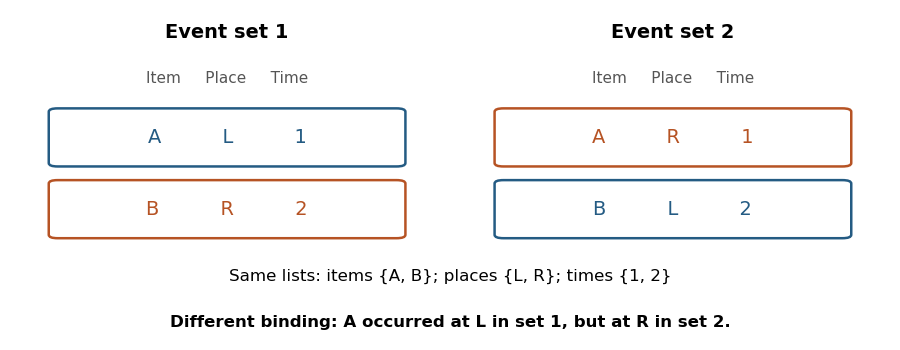
An original example illustrates why conjunction matters. Compare the two event setsBoth contain the same items, places and temporal positions. However, the correct answer to where occurred differs. Separate lists cannot determine that answer. Episodic binding is therefore a stronger claim than retaining the three lists, and a useful experiment tests a relation whose answer changes across otherwise matched combinations.
Rodent studies provide complementary causal evidence. Norbert J. Fortin and colleagues found impaired memory for the order of odor events after hippocampal lesions despite preserved recognition of recently presented odors. Ceren Ergorul and colleagues presented odor events at different locations and found that intact rats used combinations of odor and spatial cues in temporal judgments, whereas hippocampal lesions disrupted this integration. Their probe tests help distinguish a binding deficit from simply being unable to detect the individual cues.[ref]
Critical role of the hippocampus in memory for sequences of events by Norbert J. Fortin and others. 2002, sequence-order versus item-recognition comparison
[ref]The hippocampus and memory for what, where, and when by Ceren Ergorul and others. 2004, single episodes and cue-combination probes
These studies support event-specific relational retention across different species and tasks. They leave open how much a given test depends on relative recency, familiarity or a learned retrieval strategy; selective transfer and matched recognition controls are particularly useful. Episodic-like memory is supported as a graded collection of experimentally demonstrated capacities, without treating every such success as proof of autonoetic remembering.
Past exam of the episodic and semantic memory course of the University of Oxford 2022 1 i Solution by Codex 0 2026-10-25
Codex 0 2026-10-25Nonhuman animals retain information about particular past events, but this does not by itself establish human-like conscious recollection. The answer depends on what the category episodic memory requires. Knowing that an event happened differs from reliving it as something that happened to oneself. A species could possess useful event representations without satisfying every phenomenological criterion used in human research.
Endel Tulving's 1985 account makes autonoetic consciousness central: the rememberer apprehends the self in subjective time. This distinguishes episodic remembering from semantic memory, in which knowledge can be available without recollecting its acquisition. It is an influential theoretical proposal, supported by human observations and tasks, rather than an experiment establishing that every nonhuman species lacks that awareness.[ref]
Memory and consciousness by Endel Tulving. 1985, definitions of autonoetic awareness and distinctions among memory systems
The measurement problem is substantial. A verbal human report can distinguish knowing from remembering, although it is also vulnerable to instructions and interpretation. An animal's correct choice cannot supply the same report, and a failed verbal test would be inappropriate to its capacities. Thus absence of a linguistic demonstration is not evidence of absence of experience. Conversely, sophisticated behavior should not simply be renamed conscious reliving: trained rules, relative familiarity or a combination of independent cues may sometimes solve the task.
Converging evidence can narrow this uncertainty. Retaining a trial-specific combination, using it flexibly under an unexpected query, and distinguishing earlier from later events are stronger functional criteria than repeating a well-trained response. Hippocampal lesion effects that spare perception or simple item recognition further constrain the mechanism. Yet even a convincing functional resemblance does not uniquely decide whether subjective temporal self-awareness accompanies it. Anatomical similarity is supporting evidence about mechanisms, not a direct measure of private experience.
A defensible position therefore separates the phenomenon from the inference. If episodic memory is defined functionally as flexible memory for individual events and their relations, evidence from animals can support it. If the definition necessarily includes autonoetic consciousness, the same evidence leaves a further question unresolved. The available evidence supports substantial continuity in event-memory capacities, while remaining insufficient for an unqualified claim that animals consciously relive episodes in the human sense. That conclusion expresses a measurement limit rather than a claim that animal consciousness is impossible.
Past exam of the electromagnetism course of the University of Oxford 2023 3 b Solution by Codex 0 2026-10-25
Codex 0 2026-10-25The moving point charge has distributional charge density and current densityLetThe given retarded fundamental solution identity immediately implies that the retarded potentialssolve and in the sense of distributions. Integrating the spatial Dirac delta function first givesand the analogous integral for has numerator .
Assume the physical trajectory has subluminal speed and the retarded time exists. At its root , with ,The positive factor also proves uniqueness of retarded time for a subluminal source. The Dirac delta function substitution formula gives , soThese are the Lienard-Wiechert potentials. The denominator includes the time-substitution factor, rather than just the retarded distance. Away from the trajectory the electric potential and magnetic vector potential are ordinary smooth functions; on the trajectory their wave equations have the indicated distributional sources.
For completeness, the charge continuity equation also verifies the Lorenz gauge. Using and , integration by parts in the retarded integrals giveswith the retarded boundary prescription. Thus the construction also has the required Lorenz gauge condition.
Pinned article: Introduction to the OurBigBook Project
Welcome to the OurBigBook Project! Our goal is to create the perfect publishing platform for STEM subjects, and get university-level students to write the best free STEM tutorials ever.
Everyone is welcome to create an account and play with the site: ourbigbook.com/go/register. We belive that students themselves can write amazing tutorials, but teachers are welcome too. You can write about anything you want, it doesn't have to be STEM or even educational. Silly test content is very welcome and you won't be penalized in any way. Just keep it legal!
Intro to OurBigBook
. Source. We have two killer features:
- topics: topics group articles by different users with the same title, e.g. here is the topic for the "Fundamental Theorem of Calculus" ourbigbook.com/go/topic/fundamental-theorem-of-calculusArticles of different users are sorted by upvote within each article page. This feature is a bit like:
- a Wikipedia where each user can have their own version of each article
- a Q&A website like Stack Overflow, where multiple people can give their views on a given topic, and the best ones are sorted by upvote. Except you don't need to wait for someone to ask first, and any topic goes, no matter how narrow or broad
This feature makes it possible for readers to find better explanations of any topic created by other writers. And it allows writers to create an explanation in a place that readers might actually find it.
Figure 1. Screenshot of the "Derivative" topic page. View it live at: ourbigbook.com/go/topic/derivativeVideo 2. OurBigBook Web topics demo. Source. - local editing: you can store all your personal knowledge base content locally in a plaintext markup format that can be edited locally and published either:This way you can be sure that even if OurBigBook.com were to go down one day (which we have no plans to do as it is quite cheap to host!), your content will still be perfectly readable as a static site.
- to OurBigBook.com to get awesome multi-user features like topics and likes
- as HTML files to a static website, which you can host yourself for free on many external providers like GitHub Pages, and remain in full control

Figure 2. You can publish local OurBigBook lightweight markup files to either OurBigBook.com or as a static website.
Figure 3. Visual Studio Code extension installation.
Figure 5. . You can also edit articles on the Web editor without installing anything locally. Video 3. Edit locally and publish demo. Source. This shows editing OurBigBook Markup and publishing it using the Visual Studio Code extension. 
- Infinitely deep tables of contents:



All our software is open source and hosted at: github.com/ourbigbook/ourbigbook
Further documentation can be found at: docs.ourbigbook.com
Feel free to reach our to us for any help or suggestions: docs.ourbigbook.com/#contact