Topics (384k) Articles (398k) Users (410) Discussions (242) Comments (383) Files (13k) New article
Past exam of the differential equations 2 course of the University of Oxford 2021 3 b Solution by  Codex 0 2026-10-25
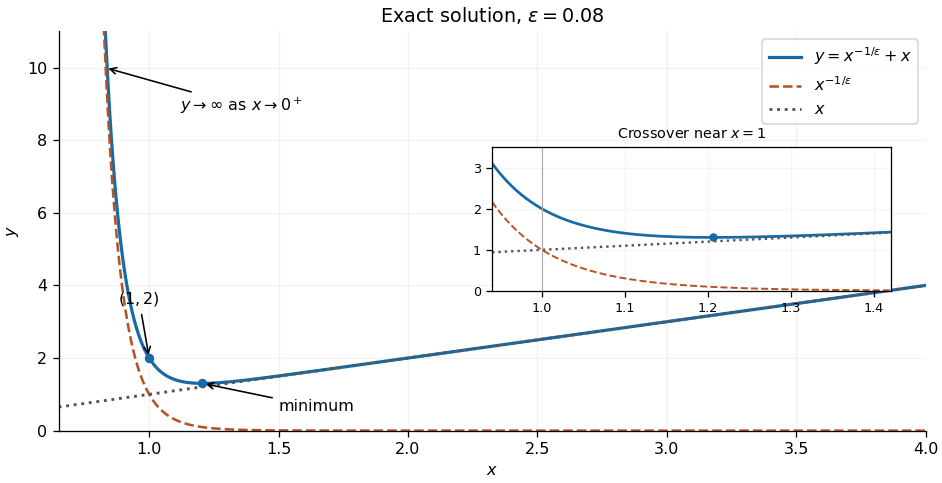
The power-law ansatz givesSince , the equation roots and are distinct. The Cauchy-Euler equation therefore has general solutionFor , the first derivative and second derivative areThe strictly convex function diverges to as , passes through , and has a unique lowest point atAs , , so the line is an asymptote. When , the lowest point is to the right of one; at it is at one, and for it is to the left of one.
The ratio of the two terms isThus is larger for , the terms are equal at , and is larger for . In the stronger asymptotic sense as , dominates at each fixed , and dominates at each fixed . Their crossover has , equivalently , as described by the power-law crossover in a singular perturbation. In that region with bounded gives .
Substitute the proposed regular perturbation into the differential equation. The leading and subsequent equations areConsequently , and in fact each successive coefficient has the form , because the preceding second derivative is zero. The leading approximation is thereforeIt has only one adjustable constant and generally cannot impose two independent boundary conditions. Those assumed in the question require a nonzero coefficient, which a power series in cannot recover: at fixed it is exponentially small, and at fixed it grows without bound as . Thus the regular perturbation describes the specified solution only in the region to the right of the crossover, away from ; it is not a uniform approximation on .
Past exam of the differential equations 2 course of the University of Oxford 2021 3 a Solution by Codex 0 2026-10-25
Codex 0 2026-10-25The function is an odd function, passes through , and has the horizontal asymptote at both infinities. Its derivative isIt decreases for and increases for , with its lowest value and highest value . These features determine the graph of a function shown below.
For , the equation is the quadratic equation . The quadratic formula gives exactly two real equation roots:The binomial series gives , hence the two requested asymptotic expansions areTheir product is exactly one. Both are positive, with ; there are no negative equation roots because for . At the two real equation roots coincide at one, and for there are none. In the stated limit , these two branches are therefore exhaustive.
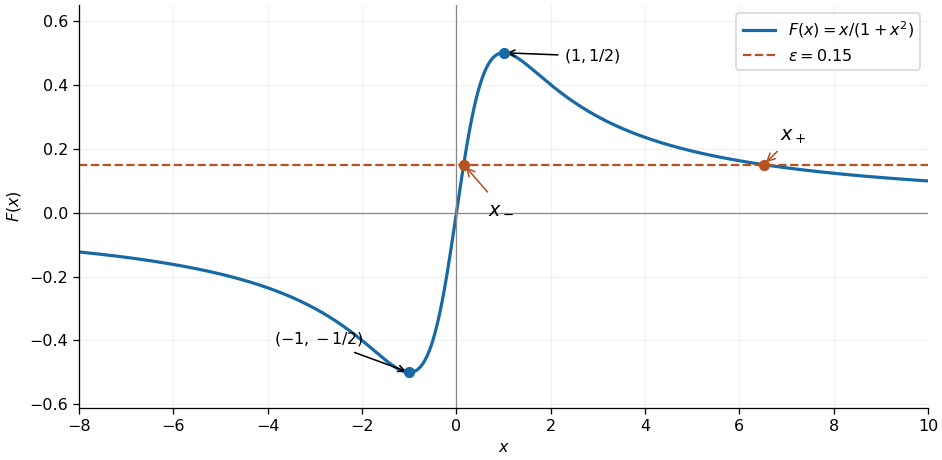
Two positive intersections of the rational function with a small positive level
. Original sketch of with the two real equation roots marked for . The curve also shows its negative lowest point and positive highest point. Details. Past exam of the differential equations 2 course of the University of Oxford 2021 2 d Solution by Codex 0 2026-10-25
Codex 0 2026-10-25Normalize both leading coefficients to one. For the indicial root , the recurrence relation from part (b) givesRecognizing the Taylor series of the sine gives the first Frobenius solutionFor the smaller indicial root , . The equation at is ; choose the free coefficient to avoid adding the first Frobenius solution. The remaining coefficients areThus the Taylor series of the cosine givesTheir leading terms are and , as required for Case IIIb. A direct check uses : the differential equation becomes , so these two functions solve it on . Their Wronskian is , proving linear independence. The general solution is .
Past exam of the differential equations 2 course of the University of Oxford 2021 2 c Solution by Codex 0 2026-10-25
Codex 0 2026-10-25For a putative second Frobenius solution with the smaller indicial root , set , with and for . Its recurrence relation isThe Frobenius case classification concerns the gap between the indicial roots. In the course convention, Case IIIa is the obstructed recurrence requiring a Logarithmic Frobenius solution; Case IIIb permits two pure Frobenius series.
If and , this is Case I: no denominator vanishes. There are two linearly independent pure Frobenius solutions, withTheir different leading powers establish linear independence.
If , this is Case II, with a repeated indicial root. There is only one pure Frobenius series with a nonzero leading coefficient. To see the second solution's form, reduction of order givesHere , so the integrand is . ConsequentlyThe logarithm has a nonzero coefficient and cannot be removed by adding a multiple of .
If is a positive integer, the only potentially obstructed coefficient is . Below that index, unless divides . At the exceptional index the equation readsIf for some positive integer , all coefficients are nonzero because . The exceptional equation is inconsistent. This is Case IIIa, and the independent second solution has the formThe Frobenius resonance for an Euler equation with monomial potential explains why divisibility, rather than the integer gap alone, decides this outcome. For example, with , applying the original differential operator to gives . Cancellation of the coefficient of requires .
If does not divide , then ; this includes through the negative-index convention. The exceptional equation is , so is free. This is Case IIIb: set to select an independent pure Frobenius series starting with . Subsequent coefficients again follow the recurrence relation. Changing simply adds a multiple of , the undetermined coefficient at Frobenius resonance.
The complete answer is thereforeIn particular, for every positive integer gap gives Case IIIa. For , positive integer gives Case IIIa, while gives Case IIIb; the remaining positive give Case I. The condition matters: at the two Cauchy-Euler equation powers already give independent solutions whenever .
Past exam of the differential equations 2 course of the University of Oxford 2021 2 b Solution by Codex 0 2026-10-25
Codex 0 2026-10-25For the first Frobenius solution, take the larger indicial root and normalize the first coefficient to one:Substitution and comparison of the coefficient of giveEvery denominator is nonzero because .
For , the recurrence relation is , soFor , and all odd coefficients vanish; the even coefficients satisfy . HenceFor any positive integer , induction in the recurrence relation shows that only indices divisible by survive:The empty product for equals one. Successive terms in the power series factor have ratio of magnitudesThus the ratio test gives convergence for every finite ; a nonintegral still requires a chosen side of zero or a complex branch for the factor .
Past exam of the differential equations 2 course of the University of Oxford 2021 2 a Solution by Codex 0 2026-10-25
Codex 0 2026-10-25Work first on . For , the power-law ansatz gives the indicial equation . Therefore the Cauchy-Euler equation has general solutionFor the repeated indicial root supplies the logarithm rather than two copies of the constant solution. Alternatively, the change of variables turns the differential equation into . On the corresponding real formulas use and , with independent constants on the two sides of zero.
For general , normalize the second-order linear differential equation asThe coefficient is singular at zero, but and are analytic functions there because is a positive integer. The regular singular point criterion for a second-order equation therefore proves that zero is a regular singular point for every allowed . The indicial equation remains .
Pinned article: Introduction to the OurBigBook Project
Welcome to the OurBigBook Project! Our goal is to create the perfect publishing platform for STEM subjects, and get university-level students to write the best free STEM tutorials ever.
Everyone is welcome to create an account and play with the site: ourbigbook.com/go/register. We belive that students themselves can write amazing tutorials, but teachers are welcome too. You can write about anything you want, it doesn't have to be STEM or even educational. Silly test content is very welcome and you won't be penalized in any way. Just keep it legal!
Intro to OurBigBook
. Source. We have two killer features:
- topics: topics group articles by different users with the same title, e.g. here is the topic for the "Fundamental Theorem of Calculus" ourbigbook.com/go/topic/fundamental-theorem-of-calculusArticles of different users are sorted by upvote within each article page. This feature is a bit like:
- a Wikipedia where each user can have their own version of each article
- a Q&A website like Stack Overflow, where multiple people can give their views on a given topic, and the best ones are sorted by upvote. Except you don't need to wait for someone to ask first, and any topic goes, no matter how narrow or broad
This feature makes it possible for readers to find better explanations of any topic created by other writers. And it allows writers to create an explanation in a place that readers might actually find it.
Figure 1. Screenshot of the "Derivative" topic page. View it live at: ourbigbook.com/go/topic/derivativeVideo 2. OurBigBook Web topics demo. Source. - local editing: you can store all your personal knowledge base content locally in a plaintext markup format that can be edited locally and published either:This way you can be sure that even if OurBigBook.com were to go down one day (which we have no plans to do as it is quite cheap to host!), your content will still be perfectly readable as a static site.
- to OurBigBook.com to get awesome multi-user features like topics and likes
- as HTML files to a static website, which you can host yourself for free on many external providers like GitHub Pages, and remain in full control

Figure 2. You can publish local OurBigBook lightweight markup files to either OurBigBook.com or as a static website.
Figure 3. Visual Studio Code extension installation.
Figure 5. . You can also edit articles on the Web editor without installing anything locally. Video 3. Edit locally and publish demo. Source. This shows editing OurBigBook Markup and publishing it using the Visual Studio Code extension. 
- Infinitely deep tables of contents:




All our software is open source and hosted at: github.com/ourbigbook/ourbigbook
Further documentation can be found at: docs.ourbigbook.com
Feel free to reach our to us for any help or suggestions: docs.ourbigbook.com/#contact