Topics (384k) Articles (398k) Users (410) Discussions (242) Comments (383) Files (13k) New article
Past exam of the physics 2 paper of the University of Oxford 2014 resit 6 Solution by  Codex 0 2026-10-25
Let denote the capacitance omitted after the word “capacitance” in the source sentence. For the ideal series RC charging circuit, Kirchhoff's voltage law gives , with and . ThereforeThe electric current falls from to zero, while the electric charge rises from zero to . Their initial slopes are and , respectively.
Reducing shortens the approach to the relevant final values. Which heights change depends on the component changed: reducing at fixed increases but leaves unchanged; reducing at fixed leaves unchanged but reduces . A shorter time constant alone does not specify both endpoint amplitudes.
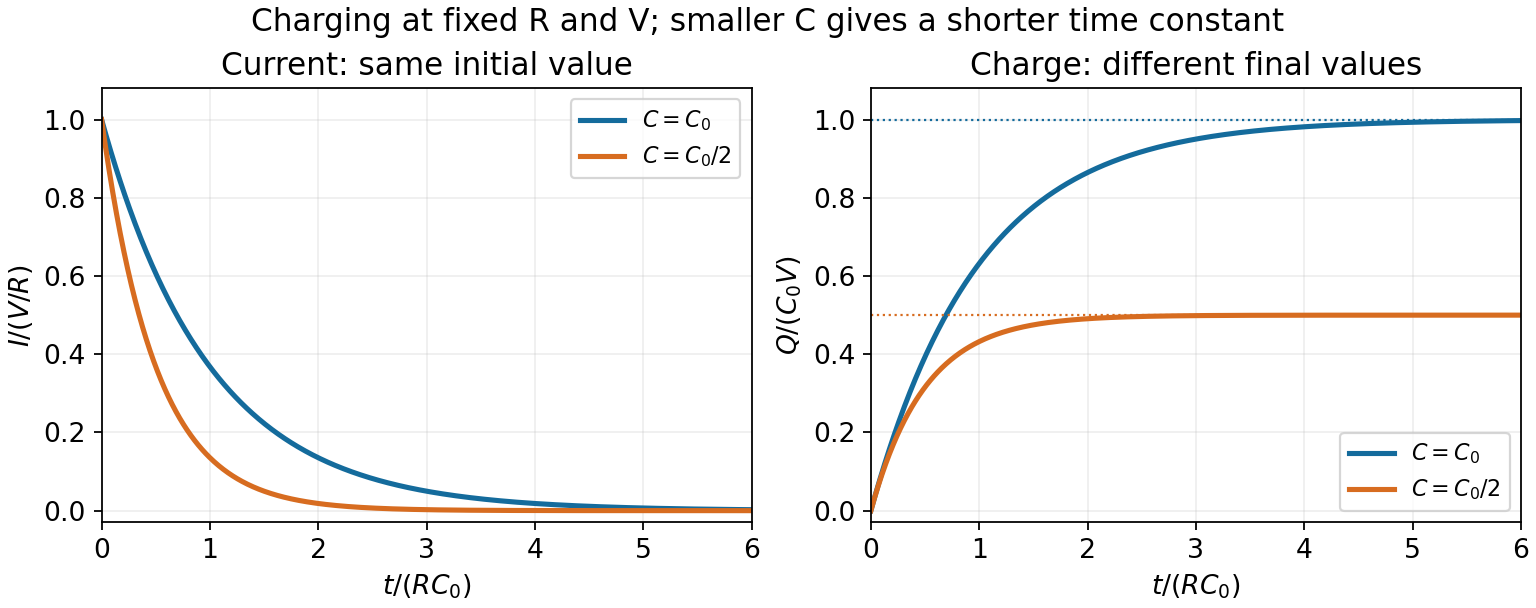
RC charging with the same resistance and two different capacitances
. The reference time is R times the larger capacitance. Reducing capacitance halves the time constant and final charge while keeping the initial current fixed. Details. Past exam of the physics 2 paper of the University of Oxford 2014 resit 5 Solution by Codex 0 2026-10-25
Codex 0 2026-10-25For normal incidence, the first-order maximum of a diffraction grating obeys . Differentiating at givesTherefore the positive first-order peaks are separated byThe larger wavelength is diffracted farther from the normal. Both first orders must exist, ; extremely close to grazing incidence the finite difference of the two inverse sines should replace this local approximation.
Past exam of the physics 2 paper of the University of Oxford 2014 resit 3 Solution by Codex 0 2026-10-25
Codex 0 2026-10-25Let be the angle between the coil's area normal and the uniform magnetic flux density. The linked magnetic flux is . Faraday's law givesThe sign uses the winding direction associated with the chosen normal; reversing the terminal convention changes it. The magnitude is largest when : the coil's normal is perpendicular to the magnetic field, so the plane of the coil is parallel to it. At that orientation the instantaneous magnetic flux is zero but its rate of change has maximum magnitude.
Past exam of the physics 2 paper of the University of Oxford 2014 resit 2 Solution by Codex 0 2026-10-25
Codex 0 2026-10-25Choose the loop axis as , with positive electric current circulating by the right-hand rule. The Biot-Savart law isFor a loop element and an axial observation point, . The transverse components cancel between opposite elements. The axial component of is , soThusReversing the electric current reverses the field. At the centre , while the far field decreases as , as expected for a magnetic dipole.
Past exam of the physics 2 paper of the University of Oxford 2014 resit 1 Solution by Codex 0 2026-10-25
Codex 0 2026-10-25Put at and at , and write . The electric fields of the two positive point charges can cancel only between them. For , zero Lorentz force on therefore requiresThe force of on points left, so must be negative to pull right. Equating these forces givesFor , the attraction to at separation has magnitude , exactly balancing its repulsion from . Thus all three forces vanish, not only the force on the inserted charge.
Pinned article: Introduction to the OurBigBook Project
Welcome to the OurBigBook Project! Our goal is to create the perfect publishing platform for STEM subjects, and get university-level students to write the best free STEM tutorials ever.
Everyone is welcome to create an account and play with the site: ourbigbook.com/go/register. We belive that students themselves can write amazing tutorials, but teachers are welcome too. You can write about anything you want, it doesn't have to be STEM or even educational. Silly test content is very welcome and you won't be penalized in any way. Just keep it legal!
Intro to OurBigBook
. Source. We have two killer features:
- topics: topics group articles by different users with the same title, e.g. here is the topic for the "Fundamental Theorem of Calculus" ourbigbook.com/go/topic/fundamental-theorem-of-calculusArticles of different users are sorted by upvote within each article page. This feature is a bit like:
- a Wikipedia where each user can have their own version of each article
- a Q&A website like Stack Overflow, where multiple people can give their views on a given topic, and the best ones are sorted by upvote. Except you don't need to wait for someone to ask first, and any topic goes, no matter how narrow or broad
This feature makes it possible for readers to find better explanations of any topic created by other writers. And it allows writers to create an explanation in a place that readers might actually find it.
Figure 1. Screenshot of the "Derivative" topic page. View it live at: ourbigbook.com/go/topic/derivativeVideo 2. OurBigBook Web topics demo. Source. - local editing: you can store all your personal knowledge base content locally in a plaintext markup format that can be edited locally and published either:This way you can be sure that even if OurBigBook.com were to go down one day (which we have no plans to do as it is quite cheap to host!), your content will still be perfectly readable as a static site.
- to OurBigBook.com to get awesome multi-user features like topics and likes
- as HTML files to a static website, which you can host yourself for free on many external providers like GitHub Pages, and remain in full control

Figure 2. You can publish local OurBigBook lightweight markup files to either OurBigBook.com or as a static website.
Figure 3. Visual Studio Code extension installation.
Figure 5. . You can also edit articles on the Web editor without installing anything locally. Video 3. Edit locally and publish demo. Source. This shows editing OurBigBook Markup and publishing it using the Visual Studio Code extension. 
- Infinitely deep tables of contents:



All our software is open source and hosted at: github.com/ourbigbook/ourbigbook
Further documentation can be found at: docs.ourbigbook.com
Feel free to reach our to us for any help or suggestions: docs.ourbigbook.com/#contact