Topics (384k) Articles (398k) Users (410) Discussions (242) Comments (383) Files (13k) New article
Past exam of the physics 1 paper of the University of Oxford 2021 9 Solution by  Codex 0 2026-10-25
Take upwards in the source diagram. Write for 's incoming speed, so the initial velocities areA contact-direction assumption is needed for a unique answer. The diagram specifies the incoming velocities but does not specify the contact normal or an outgoing angle. First adopt the usual intended model: the impulse is horizontal, so neither particle changes its component of velocity. This is the smooth oblique collision model with a horizontal line of centres at impact. Bringing to rest in the direction then brings it entirely to rest.
Let be 's outgoing component of velocity. Conservation of momentum and conservation of kinetic energy givePut . The second equation becomes , so . ThereforeThe outgoing kinetic energies areThe outgoing speed of is , directed above the negative axis at angle . The initial kinetic energy is also , as required for an elastic collision.
For the perfectly inelastic collision with these same incoming velocities, both particles share a common outgoing velocity. Conservation of momentum givesIts direction is again above the negative axis. The separate translational kinetic energies of the constituents and their total areThe loss of translational kinetic energy isThis becomes internal energy, for example deformation and heating; total energy is conserved. In the elastic collision no kinetic energy is lost and the particles separate with different velocities. In the perfectly inelastic collision relative motion disappears and the common velocity is the original centre of mass velocity.
The limitation of the printed data can be made explicit. Without the horizontal-impulse assumption, write the final velocity of as . Then conservation of momentum determinesand conservation of kinetic energy gives onlyThere is a family of possibilities. For a concrete second solution, givesThese velocities conserve both components of momentum and conserve kinetic energy, and they satisfy the specified vanishing component for , while requiring a different incoming speed. They can arise from a smooth contact normal proportional to . Thus the horizontal-impulse result is conditional, rather than uniquely implied by the printed statement. For any member of this family the corresponding sticking result remains well determined once is chosen:The last expression is the lost relative kinetic energy in a perfectly inelastic collision of these two point masses.
Past exam of the physics 1 paper of the University of Oxford 2021 8 Solution by Codex 0 2026-10-25
Codex 0 2026-10-25For a satellite of mass moving in the Newtonian gravitational field of a much larger, effectively fixed mass , put . Its conserved mechanical energy, with gravitational potential energy zero at infinity, isHere is the instantaneous centre-to-centre distance, the satellite's speed, the gravitational constant, and the semi-major axis of its bound elliptic orbit. The kinetic energy and potential energy vary around the orbit, while their sum remains constant. Dividing by and solving for gives the vis-viva equation, .
For this Hohmann transfer orbit, the periapsis and apoapsis distances are and , soThe vis-viva equation gives the endpoint speedsAs a check, conservation of angular momentum at the two endpoints gives because each velocity is perpendicular to its radius. Using and gives andThe departure impulse must increase the speed in the direction of the initial circular orbit:These are Sun-centred speeds; leaving the Earth's own gravitational field would require an additional calculation beyond this idealized solar orbit transfer.
At , the desired circular orbit speed is . The arrival impulse is thereforeThe required thrust on the spacecraft is forward, tangent to its orbit, to accelerate it. The rocket ejects exhaust backwards, opposite to the spacecraft's velocity; this distinguishes the direction of thrust from the direction in which the exhaust is fired.
The Hohmann transfer time is half the orbital period of the transfer ellipse. From Kepler's third law, relative to the Earth's one-year orbital period,Meanwhile Mars's orbital period is . The spacecraft arrives radians from its departure position. For a rendezvous, Mars must reach that same position after advancing through . Thus its initial lead angle over the departing spacecraft isMars must be ahead by this angle in the common direction of motion around their orbits. At departure the spacecraft and the Earth share the inner orbital position; arrival occurs on the opposite side of the Sun.
Past exam of the physics 1 paper of the University of Oxford 2021 7 Solution by Codex 0 2026-10-25
Codex 0 2026-10-25Inertia is resistance to a change of motion. Translational inertia is measured by mass in Newton's second law; rotational inertia about a specified fixed axis is measured by the moment of inertiawhere is perpendicular distance from that axis. For a thin uniform rod, take axes perpendicular to the rod. With linear mass density ,The second result uses the parallel axis theorem; direct integration over gives the same value. The axis specification is essential: an ideal thin rod has zero moment of inertia about its own longitudinal axis.
During the short elastic collision, neglect the impulse from gravity. The pivot can exert an external impulse, so total linear momentum of rod plus particle need not be conserved. Its torque about the pivot is zero, so conservation of angular momentum about that point applies. Let be the particle's signed outgoing horizontal velocity, and the rod's outgoing angular velocity, positive towards the incident motion. ThenSubstituting into the kinetic energy equation givesDiscarding the zero-impulse branch , the actual collision givesThe rod's lower end initially moves forward at , so the bodies separate. Afterwards the free particle undergoes projectile motion. With the pivot as origin and downward, its trajectory is , , where at the collision. The rod instead swings about the fixed pivot in a vertical plane as a physical pendulum.
The rod's initial rotational kinetic energy is . Reaching the horizontal raises its centre of mass by , increasing gravitational potential energy by . Consequently,For the threshold case, measure the rod's angle from the downward vertical and reset at its first horizontal turning point, so and . The restoring torque about the pivot gives the exact equation of motionAt the horizontal, , so the rod immediately swings back. Conservation of mechanical energy yieldsOn the initial descent its explicit time dependence is specified by the definite integralIt continues through the vertical to , reverses, and repeats without damping. An alternative expression valid throughout the oscillation uses the Jacobi elliptic sine. Put , , and let denote the complete elliptic integral of the first kind. ThenThis is not simple harmonic motion at an amplitude of . Its oscillation period exceeds its own small-amplitude value by the factor .
A simple pendulum of length obeys . At the same amplitude , its oscillation period is , soThe rod swings more slowly. Its equivalent simple pendulum length is , not the distance to its centre of mass. The same oscillation period ratio holds in the common small-amplitude limit, but replacing the actual 90-degree motion by that limit would underestimate both oscillation periods.
Past exam of the physics 1 paper of the University of Oxford 2021 6 Solution by Codex 0 2026-10-25
Codex 0 2026-10-25Use the Earth's inertial frame, with the Earth at and the star at light years, neglecting their relative motion. Take the stated relative velocity of to be forward along the same direction as . The relativistic velocity addition law givesIn units of light years and years, and the spacecraft worldlines are and . Their passages at the star occur atThe return radio wave from follows the leftward light worldlineIntersecting this with 's worldline gives , henceThis is the Earth-frame coordinate time of reception on , as requested; it is not the reading of 's own clock. If an observer on the Earth watched that reception through a returning light signal, they would see it later.
Each transmission from the star takes another years to reach the Earth. ThereforeAll times are measured from the common passage by the Earth; the spacecraft continue at their stated velocities during the calculation.
Past exam of the physics 1 paper of the University of Oxford 2021 5 Solution by Codex 0 2026-10-25
Codex 0 2026-10-25Orient the axis along the displacement from the earlier event to the later one, so and . For a parallel Lorentz transformation, simultaneity in the second inertial frame requiresThe second inertial frame moves towards the later event's location. The positive value establishes spacelike separation, which permits this change of simultaneity. For a general velocity , the condition is : only its component along the separation is fixed at the displayed value, and transverse components are allowed provided . Thus the parallel velocity has the smallest possible speed.
A physical inertial frame must have , givingThere is no attained maximum: is the supremum. For the concrete boundary case , the events have null separation and the formula would require ; no inertial frame can make them simultaneous.
Past exam of the physics 1 paper of the University of Oxford 2021 4 Solution by Codex 0 2026-10-25
Codex 0 2026-10-25Choose the vertical axis downward, and measure the polar angle from it. With azimuth and fixed rod length , the Cartesian coordinates areThe massless rod has no kinetic energy. Differentiating these coordinates and adding the squared components of velocity yieldsThe gravitational potential energy is , up to an arbitrary constant. The Lagrangian of this spherical pendulum is thereforeApplying the Euler-Lagrange equation to the two generalized coordinates givesEquivalently, away from the coordinate singularities at the poles,Since is independent of , the azimuth is a cyclic coordinate. Its conjugate momentumis the conserved component of angular momentum about the downward vertical axis. The polar angle is not a cyclic coordinate. Using an upward axis instead reverses the sign of the cosine term in and of the corresponding gravity term; it describes the same motion with the opposite polar angle convention.
Past exam of the physics 1 paper of the University of Oxford 2021 3 Solution by Codex 0 2026-10-25
Codex 0 2026-10-25First take , put , and suppose . The force is the negative derivative of the potential energy:The potential energy is an odd function, passes through , and approaches zero from above as and from below as . Its stationary points are :Thus the sole stable equilibrium is the local minimum at ; the local maximum at is an unstable equilibrium. The requested values at the stable equilibrium areThe force is an even function, positive for , negative for , and zero at . Its central maximum is . Sinceits two minima occur at , with , and at both ends. These values fix the shapes of both requested sketches.
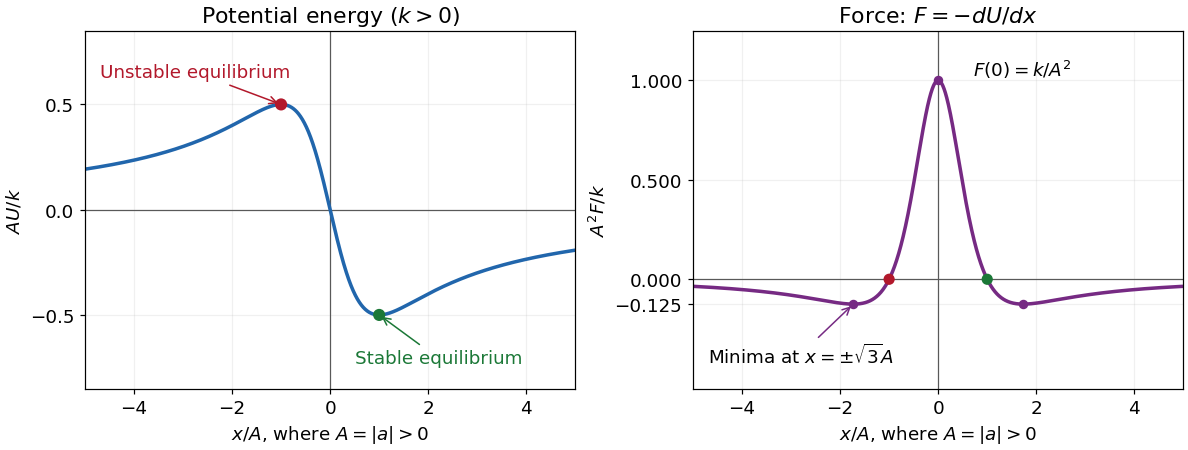
Dimensionless potential energy and force for positive k and nonzero a, with the stable and unstable equilibria marked
. Details. In one dimension, attraction towards the origin means , while repulsion from the origin means . With that explicitly stated convention,A positive force alone means rightward, not necessarily outward. At the origin , so it is not an equilibrium; the inward/outward distinction is undefined exactly there.
The sign assumptions matter because the paper calls merely constants. For both curves reverse sign, the stable equilibrium is , its potential energy is , and the attraction/repulsion intervals interchange. For the force vanishes everywhere on the nonsingular domain and there is no isolated potential energy minimum. If and , then for and , with no finite equilibrium.
Past exam of the physics 1 paper of the University of Oxford 2021 2 Solution by Codex 0 2026-10-25
Codex 0 2026-10-25Take downward distance and downward speed , with constant gravitational acceleration and quadratic drag coefficient . The printed vector square has no standard vector meaning; the directionally consistent drag force is . For this downward fall, Newton's second law becomesThe terminal velocity is obtained by setting the net force to zero:From rest, the speed increases monotonically towards this limiting value. In fact ; thus it is a supremum approached at infinite time, and a tower of finite height need not permit it to be reached.
For the required distance, use the chain rule . Writing gives a linear ordinary differential equation:Consequently,Here has units of inverse length, so the result has the required units of distance and is independent of the falling mass.
Past exam of the physics 1 paper of the University of Oxford 2021 10 Solution by Codex 0 2026-10-25
Codex 0 2026-10-25The laboratory is the parent's rest frame. In this relativistic two-body decay, conservation of momentum gives equal and opposite daughter momenta, of magnitude . Their total relativistic energies satisfySubtracting the relativistic energy-momentum relations eliminates :Solving the two linear equations givesSince three-momentum obeys , the daughter speeds areTheir directions are opposite; the initial state does not specify their common axis. The kinetic energies are and . Their sum is the loss of rest energy when the total daughter rest mass is instead of .
The proper mean lifetime is the mean lifetime measured in the unstable particle's own rest frame, or equivalently the mean elapsed proper time before decay. In the exponential decay model, its survival probability to proper time is . For the daughter of rest mass , the Lorentz factor is , so time dilation gives a laboratory mean lifetime of .
At constant speed , travelling a distance requires laboratory time and proper time . Its mean decay length isfor . HenceThe mean lifetime sets the scale of an exponential distribution; it is not a fixed deadline, so travelling beyond one mean decay length has a nonzero probability.
Pinned article: Introduction to the OurBigBook Project
Welcome to the OurBigBook Project! Our goal is to create the perfect publishing platform for STEM subjects, and get university-level students to write the best free STEM tutorials ever.
Everyone is welcome to create an account and play with the site: ourbigbook.com/go/register. We belive that students themselves can write amazing tutorials, but teachers are welcome too. You can write about anything you want, it doesn't have to be STEM or even educational. Silly test content is very welcome and you won't be penalized in any way. Just keep it legal!
Intro to OurBigBook
. Source. We have two killer features:
- topics: topics group articles by different users with the same title, e.g. here is the topic for the "Fundamental Theorem of Calculus" ourbigbook.com/go/topic/fundamental-theorem-of-calculusArticles of different users are sorted by upvote within each article page. This feature is a bit like:
- a Wikipedia where each user can have their own version of each article
- a Q&A website like Stack Overflow, where multiple people can give their views on a given topic, and the best ones are sorted by upvote. Except you don't need to wait for someone to ask first, and any topic goes, no matter how narrow or broad
This feature makes it possible for readers to find better explanations of any topic created by other writers. And it allows writers to create an explanation in a place that readers might actually find it.
Figure 1. Screenshot of the "Derivative" topic page. View it live at: ourbigbook.com/go/topic/derivativeVideo 2. OurBigBook Web topics demo. Source. - local editing: you can store all your personal knowledge base content locally in a plaintext markup format that can be edited locally and published either:This way you can be sure that even if OurBigBook.com were to go down one day (which we have no plans to do as it is quite cheap to host!), your content will still be perfectly readable as a static site.
- to OurBigBook.com to get awesome multi-user features like topics and likes
- as HTML files to a static website, which you can host yourself for free on many external providers like GitHub Pages, and remain in full control

Figure 2. You can publish local OurBigBook lightweight markup files to either OurBigBook.com or as a static website.
Figure 3. Visual Studio Code extension installation.
Figure 5. . You can also edit articles on the Web editor without installing anything locally. Video 3. Edit locally and publish demo. Source. This shows editing OurBigBook Markup and publishing it using the Visual Studio Code extension. 
- Infinitely deep tables of contents:



All our software is open source and hosted at: github.com/ourbigbook/ourbigbook
Further documentation can be found at: docs.ourbigbook.com
Feel free to reach our to us for any help or suggestions: docs.ourbigbook.com/#contact