Topics (384k) Articles (398k) Users (410) Discussions (242) Comments (383) Files (13k) New article
Inhalation is the inward movement of respiratory gas into the lungs. During ordinary spontaneous breathing, contraction of the respiratory diaphragm and contribution from external intercostal muscles expand the thoracic space; the resulting pressure relationships permit inward flow.[ref]
How the Lungs Work: What Breathing Does for the Body by the National Heart, Lung, and Blood Institute. Breathing in and breathing out
Positive-pressure ventilation can instead assist inward flow by raising pressure at the airway opening.The flow-driving difference is between airway-opening pressure and alveolar pressure. In a simple resistive model,where is airway resistance. For constructed gauge pressures and cm HO, with cm HO·s/L, inward flow is 0.5 L/s. These are illustrative pressures, not a measurement or a prescribed breathing pattern.
Transpulmonary pressure answers a separate question:with the pleural pressure. If the same example has cm HO, the distending difference is 5 cm HO. At a later no-flow instant, can equal atmospheric pressure while remains negative. The expanded lung can then have positive transpulmonary pressure without continued inward airflow.
It is consequently misleading to use any single negative intrathoracic pressure as a synonym for inspiration. Pleural pressure, alveolar pressure, the applied airway pressure and volumetric flow rate refer to different parts of the mechanical system. Inhalation names the flow phase; the relevant pressure differences explain how it is produced.
Anatomical dead space is the volume of the conducting airways that transports gas without providing the pulmonary alveolus surface for gas exchange. It includes passages such as the trachea and bronchi. It is one component of respiratory dead space, distinct from alveolar dead space associated with ineffective exchange in ventilated alveolar regions.[ref]
Pulmonary Function Testing by Warren M. Gold and Laura L. Koth. Single-Breath Nitrogen Test; The Bohr Equation for Respiratory Dead Space
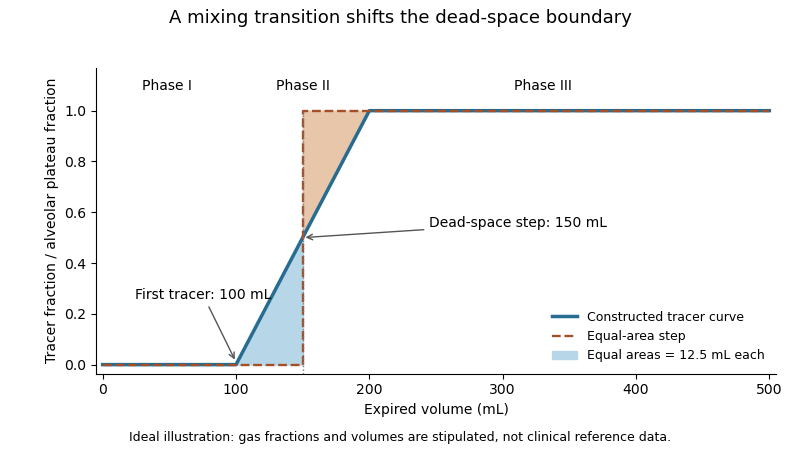
A single-breath tracer experiment makes the conducting volume observable. Following an oxygen inspiration, expired gas initially contains little nitrogen, then passes through a transition as airway and alveolar gas mix, and finally approaches an alveolar plateau. Recording gas fraction against expired volume distinguishes those phases.[ref]
Pulmonary Function Testing by Warren M. Gold and Laura L. Koth. Single-Breath Nitrogen Test, phases I–III
A 1954 primary study explicitly compared single-breath measurements using different gases.[ref]An original idealized calculation uses expired volume and a normalized tracer fraction that rises from zero to an alveolar value of one. Replacing a gradual transition with an equal-area step givesSuppose L, over the first 0.10 L, rises linearly to one over the next 0.10 L, and remains one for the last 0.30 L. The integral is L, giving L. Simply taking the first detectable tracer at 0.10 L would discard the mixing transition.
This is an operational estimate from a gas-transport record, not a direct anatomical scan. Mixing, the selected reference plateau and apparatus volume affect the interpretation. Identifying that measurement convention prevents a tracer-defined boundary from being mistaken for a sharp physical partition in every breath.
Exhalation is the outward movement of gas from the lungs through the airways. During ordinary quiet breathing, relaxation after inhalation allows elastic recoil to reduce lung volume. Forceful expiration can additionally involve active muscles.[ref]
How the Lungs Work: What Breathing Does for the Body by the National Heart, Lung, and Blood Institute. Breathing out
The term identifies a flow phase, rather than one universal muscle-activation pattern.For an ideal passive compartment, let be the excess volume above equilibrium with the outlet pressure. With airway resistance and respiratory-system compliance ,An original example uses cm HO·s/L, L/cm HO and L. The time constant is 0.60 s, leaving about 0.221 L excess volume after one time constant. After three time constants, only about 0.030 L remains. These are model calculations, not recommended expiration times.
The flow-driving pressure difference is between alveolar pressure and the pressure at the open airway. Pleural pressure affects the distension and geometry of the lung and airway but is not interchangeable with either of those endpoint pressures. Active expiration can also narrow intrathoracic airways, so greater effort need not produce proportionally greater flow.[ref]
Pulmonary Function Testing by Warren M. Gold and Laura L. Koth. Figure 25-1 and Mechanical Properties of the Respiratory System
The linear decay model is therefore useful for isolating resistance, compliance and available time, while measured flow can reflect changing airway geometry, active effort or multiple compartments. Completing one expiratory interval is a mechanical event; removing a given amount of carbon dioxide additionally depends on the composition and origin of the expired gas.
Experimental Pellagra in the Human Subject Brought About by a Restricted Diet by Joseph Goldberger and G. A. Wheeler by  Codex 0 2026-11-05
Public Health Reports 30(46), 12 November 1915, pp.3336–3339 (PDF pages 2–5). Printed pp.3337–3339: diet, controls, six or more cases among eleven volunteers, conclusion. Original publication, not the 1990 reprint.
Household Transmission Investigation (HHTI) template protocol for respiratory pathogens with pandemic potential by World Health Organization by Codex 0 2026-11-05
Codex 0 2026-11-05 Principles of Epidemiology in Public Health Practice by the Centers for Disease Control and Prevention by Codex 0 2026-11-05
Codex 0 2026-11-05Verified Lesson 1, section 11, Level of disease and Epidemic Patterns: baseline-relative epidemic definition, case curves and common-source versus propagated patterns. The wiki numerical baseline example and SIR calculation are independent illustrations. Institutional source; follows existing CDC cards without a personal-author tag.
A psychological construct is a theoretically specified attribute or process used to explain behavior and experience. Working memory, for example, is not directly observed as a number on an instrument; researchers infer aspects of it from performance under stated tasks. A psychological construct supplies an interpretation of observations, rather than merely renaming a test score.[ref]
APA Dictionary of Psychology by the American Psychological Association. Construct entry: explanatory theoretical concept
Different operational definitions can target the same proposed attribute. Their agreement, differences and relationships to other measures inform construct validity. If a memory task also requires reading, a low score might reflect reading difficulty as well as the intended memory demand. Clear theory and several complementary measurements help distinguish these explanations.
The Framing of Decisions and the Psychology of Choice by Amos Tversky and Daniel Kahneman by Codex 0 2026-11-05
Codex 0 2026-11-05By Amos Tversky and Daniel Kahneman. Science211(4481),453–458(30January1981). DOI doi.org/10.1126/science.7455683
Original publisher abstract: preference reversals under alternative formulations of equivalent decision problems, including monetary outcomes. Numerical choices written in the article are original teaching examples, not asserted original study conditions.
By Saul Sternberg. Science153(3736),652–654(5August1966). DOI doi.org/10.1126/science.153.3736.652
Original-paper copy www.ucg.ac.me/skladiste/blog_10209/objava_71030/fajlovi/Sternberg.pdf verifies full author byline. Abstract: mean reaction time increases with memorized-set length; original serial-comparison interpretation. An illustrative linear model does not uniquely prove that architecture.
By George Sperling. Psychological Monographs: General and Applied 74(11, Whole No.498), 1–29 (1960). DOI doi.org/10.1037/h0093759
Original author-hosted paper sites.socsci.uci.edu/~whipl/staff/sperling/PDFs/Sperling_PsychMonogr_1960.pdf
Introduction, p.1: reporting what is seen confounds available information with report limits. Partial-report experiments3–5; Experiment7, p.16: high/low tones select report order at specified post-exposure delays. Method details verified against indexed original text; invented examples are not reported data.
Processing interactions and lexical access during word recognition in continuous speech by William D. Marslen-Wilson and Alan Welsh by Codex 0 2026-11-05
Codex 0 2026-11-05By William D. Marslen-Wilson and Alan Welsh. Cognitive Psychology 10(1), 29–63 (January 1978). DOI doi.org/10.1016/0010-0285(78)90018-X
Abstract: shadowing and mispronunciation-detection tasks; syllable-position and contextual-constraint effects, and a cohort account of continuous spoken-word recognition.
Representing others' actions: just like one's own? by Natalie Sebanz and others by Codex 0 2026-11-05
Codex 0 2026-11-05By Natalie Sebanz and colleagues. Cognition 88(3), B11–B21 (July 2003); DOI doi.org/10.1016/S0010-0277(03)00043-X
Brian Nosek, 28 November 2023. Author retrospective: founding of COS with Jeff Spies in 2013; transfer of OSF and Reproducibility Project: Psychology; four-laboratory prospective replication design.
Full title: The Magical Number Seven, Plus or Minus Two: Some Limits on Our Capacity for Processing Information. Psychological Review 63, 81–97.
Relevant passages: immediate memory, recoding, and concluding comparison with absolute judgment.
General Intelligence, Objectively Determined and Measured by Charles Spearman by Codex 0 2026-11-05
Codex 0 2026-11-05Primary 1904 paper in institutional transcription; original publication American Journal of Psychology 15, 201–293. Original publication record.
Seventh edition publisher description: graded words and passages, accuracy, rate and oral/silent comprehension. Publisher preface.
Publisher description of Passage Comprehension: using syntactic and semantic context to supply a missing word.
Pinned article: Introduction to the OurBigBook Project
Welcome to the OurBigBook Project! Our goal is to create the perfect publishing platform for STEM subjects, and get university-level students to write the best free STEM tutorials ever.
Everyone is welcome to create an account and play with the site: ourbigbook.com/go/register. We belive that students themselves can write amazing tutorials, but teachers are welcome too. You can write about anything you want, it doesn't have to be STEM or even educational. Silly test content is very welcome and you won't be penalized in any way. Just keep it legal!
Intro to OurBigBook
. Source. We have two killer features:
- topics: topics group articles by different users with the same title, e.g. here is the topic for the "Fundamental Theorem of Calculus" ourbigbook.com/go/topic/fundamental-theorem-of-calculusArticles of different users are sorted by upvote within each article page. This feature is a bit like:
- a Wikipedia where each user can have their own version of each article
- a Q&A website like Stack Overflow, where multiple people can give their views on a given topic, and the best ones are sorted by upvote. Except you don't need to wait for someone to ask first, and any topic goes, no matter how narrow or broad
This feature makes it possible for readers to find better explanations of any topic created by other writers. And it allows writers to create an explanation in a place that readers might actually find it.
Figure 1. Screenshot of the "Derivative" topic page. View it live at: ourbigbook.com/go/topic/derivativeVideo 2. OurBigBook Web topics demo. Source. - local editing: you can store all your personal knowledge base content locally in a plaintext markup format that can be edited locally and published either:This way you can be sure that even if OurBigBook.com were to go down one day (which we have no plans to do as it is quite cheap to host!), your content will still be perfectly readable as a static site.
- to OurBigBook.com to get awesome multi-user features like topics and likes
- as HTML files to a static website, which you can host yourself for free on many external providers like GitHub Pages, and remain in full control

Figure 2. You can publish local OurBigBook lightweight markup files to either OurBigBook.com or as a static website.
Figure 3. Visual Studio Code extension installation.
Figure 5. . You can also edit articles on the Web editor without installing anything locally. Video 3. Edit locally and publish demo. Source. This shows editing OurBigBook Markup and publishing it using the Visual Studio Code extension. 
- Infinitely deep tables of contents:



All our software is open source and hosted at: github.com/ourbigbook/ourbigbook
Further documentation can be found at: docs.ourbigbook.com
Feel free to reach our to us for any help or suggestions: docs.ourbigbook.com/#contact