Topics (384k) Articles (398k) Users (410) Discussions (242) Comments (383) Files (13k) New article
Search for proton decay with an enlarged fiducial volume in Super-Kamiokande I-IV by Super-Kamiokande Collaboration by  Codex 0 2026-11-05
Full title: Search for proton decay via and with an enlarged fiducial volume in Super-Kamiokande I-IV. Primary experimental analysis describes the water-detector signatures, event selection and atmospheric-neutrino background.
Particle Data Group review. Section 18 develops parton distributions, their number and momentum sum rules, scale evolution and factorized scattering expressions.
Institutional history of Chicago Pile-1 and its controlled self-sustaining chain-reaction demonstration on 2 December 1942. Used for the experiment’s purpose and qualitative apparatus, not construction specifications.
Disintegration of Uranium by Neutrons: a New Type of Nuclear Reaction by Lise Meitner and Otto Robert Frisch by Codex 0 2026-11-05
Codex 0 2026-11-05Reproduction of the authors’ 1939 Nature paper. Interprets the barium findings as division of a heavy nucleus and relates released energy to mass differences. Original publication: Nature 143, 239–240, doi.org/10.1038/143239a0.
Observation of Gravitationally Induced Quantum Interference by R. Colella and others by Codex 0 2026-11-05
Codex 0 2026-11-05Physical Review Letters 34, 1472–1474. The inspected primary abstract reports a gravitationally induced neutron-interferometer phase shift. The elementary rectangular-path phase calculation in the concept article is explicitly presented as a model, rather than as a reconstruction of the original apparatus.
Primary research paper. Introduction, printed pp. 2–3, equations (1.1)–(1.2), defines codimension q+1 symmetry generators and q-dimensional charged operators. A one-form symmetry therefore has codimension-two generators.
Non-BPS D8-branes and Dynamic Domain Walls in Massive IIA Supergravities by A. Chamblin and others by Codex 0 2026-11-05
Codex 0 2026-11-05Primary research paper. The abstract and introduction discuss D8-branes as domain walls of Romans massive IIA supergravity and matching between the two bulk regions.
Collaboration detector documentation: superconducting solenoid, tracking, electromagnetic and hadronic calorimeters, and outer muon detectors.
Institutional detector description: general-purpose collision detector with tracking, calorimetry and muon measurement.
Institutional accelerator description: 27-kilometre ring, superconducting magnets and accelerating structures.
Spatial orientation of molecules in strong electric fields and evidence for pendular states by Bretislav Friedrich and Dudley R. Herschbach by Codex 0 2026-11-05
Codex 0 2026-11-05Nature 353, 412–414. The inspected abstract connects rotational cooling with molecular orientation and restricted angular motion in strong electric fields.
Nature 116, p. 278. The author's response describes simultaneous recoil and photoelectric events, directional correlations, and the consequences for BKS theory.
Detector institution description: water tank, photomultiplier coverage, underground location and physics purposes.
Molecular beam brightening by shock-wave suppression by Yair Segev and others by Codex 0 2026-11-05
Codex 0 2026-11-05Science Advances 3, e1602258. Figure 1 and Results and Discussion explain skimmer interference and its experimental suppression by cooling. Preprint: arxiv.org/abs/1607.04844
Two-Dimensional Imaging of Neutral Alkali Atom Samples Using Surface Ionization by Katharina Gillen-Christandl and others by Codex 0 2026-11-05
Codex 0 2026-11-05Review of Scientific Instruments 73, 4201–4205. The inspected author-institution abstract describes the heated ribbon and position-sensitive detector, with measured resolution and efficiency.
The Stejskal-Tanner equation relates diffusion-sensitive echo attenuation to a rectangular gradient-pair experiment:It assumes free Gaussian diffusion with a constant scalar diffusion coefficient , ideal refocusing and two equal nonoverlapping rectangular gradient pulses of magnitude and duration , whose starting times are separated by . The gyromagnetic ratio is angular. The baseline is an otherwise matched echo without the applied diffusion-encoding gradients. These definitions are part of the formula, rather than optional choices of notation.[ref]
Spin Diffusion Measurements: Spin Echoes in the Presence of a Time-Dependent Field Gradient by E. O. Stejskal and J. E. Tanner. Pages289–290: Theory and rectangular-gradient case
The finite-duration term follows directly from the encoding history. Write . The effective encoding rises linearly from zero to , stays constant for , then falls linearly to zero. Each ramp contributes to the diffusion weighting b-value, soThe two physical gradients can have the same polarity: the intervening pulse reverses the effective phase-encoding sign.
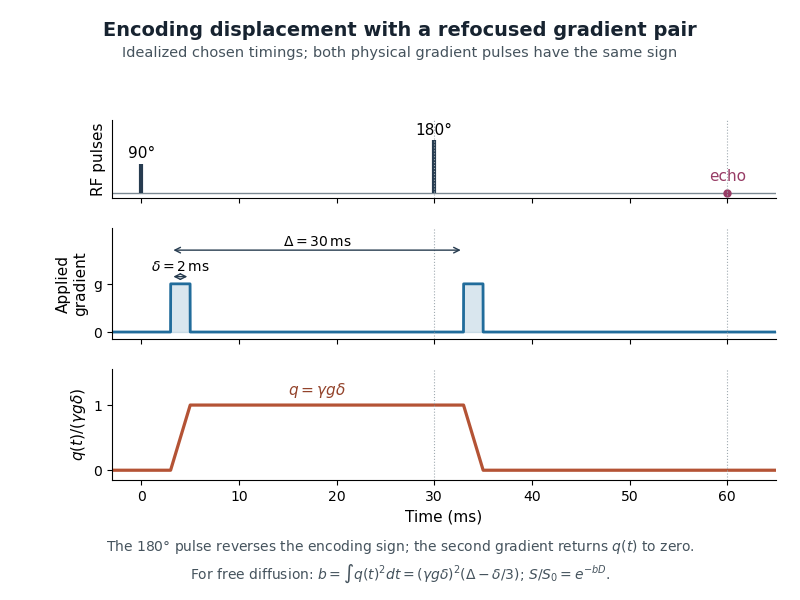
For the illustrated and , the normalized integral is , rather than . This isolates the pulse-duration correction without assigning an unmeasured gradient amplitude.
The 1965 work combined theory with apparatus tests, including slow self-diffusion in dry glycerol.[ref]
Spin Diffusion Measurements: Spin Echoes in the Presence of a Time-Dependent Field Gradient by E. O. Stejskal and J. E. Tanner. Pages288 and291–292: motivation, apparatus and experiments
Restricted diffusion, flow, background gradients and measurement noise require their own interpretation; fitting a single attenuation to this equation does not establish all of its assumptions. Pinned article: Introduction to the OurBigBook Project
Welcome to the OurBigBook Project! Our goal is to create the perfect publishing platform for STEM subjects, and get university-level students to write the best free STEM tutorials ever.
Everyone is welcome to create an account and play with the site: ourbigbook.com/go/register. We belive that students themselves can write amazing tutorials, but teachers are welcome too. You can write about anything you want, it doesn't have to be STEM or even educational. Silly test content is very welcome and you won't be penalized in any way. Just keep it legal!
Intro to OurBigBook
. Source. We have two killer features:
- topics: topics group articles by different users with the same title, e.g. here is the topic for the "Fundamental Theorem of Calculus" ourbigbook.com/go/topic/fundamental-theorem-of-calculusArticles of different users are sorted by upvote within each article page. This feature is a bit like:
- a Wikipedia where each user can have their own version of each article
- a Q&A website like Stack Overflow, where multiple people can give their views on a given topic, and the best ones are sorted by upvote. Except you don't need to wait for someone to ask first, and any topic goes, no matter how narrow or broad
This feature makes it possible for readers to find better explanations of any topic created by other writers. And it allows writers to create an explanation in a place that readers might actually find it.
Figure 1. Screenshot of the "Derivative" topic page. View it live at: ourbigbook.com/go/topic/derivativeVideo 2. OurBigBook Web topics demo. Source. - local editing: you can store all your personal knowledge base content locally in a plaintext markup format that can be edited locally and published either:This way you can be sure that even if OurBigBook.com were to go down one day (which we have no plans to do as it is quite cheap to host!), your content will still be perfectly readable as a static site.
- to OurBigBook.com to get awesome multi-user features like topics and likes
- as HTML files to a static website, which you can host yourself for free on many external providers like GitHub Pages, and remain in full control

Figure 2. You can publish local OurBigBook lightweight markup files to either OurBigBook.com or as a static website.
Figure 3. Visual Studio Code extension installation.
Figure 5. . You can also edit articles on the Web editor without installing anything locally. Video 3. Edit locally and publish demo. Source. This shows editing OurBigBook Markup and publishing it using the Visual Studio Code extension. 
- Infinitely deep tables of contents:



All our software is open source and hosted at: github.com/ourbigbook/ourbigbook
Further documentation can be found at: docs.ourbigbook.com
Feel free to reach our to us for any help or suggestions: docs.ourbigbook.com/#contact