Topics (384k) Articles (398k) Users (410) Discussions (242) Comments (383) Files (13k) New article
Past exam of the beliefs, behaviours and biology course of the University of Oxford 2022 6 Solution by  Codex 0 2026-10-25
Goffman's claim is illuminating as an account of how stigma can deny full personhood, but it should not be treated as a literal universal belief held by everyone who encounters a psychosis diagnosis. Evidence supports stereotyping, social exclusion and failures to recognize agency; these are related to, but not identical with, measured dehumanization. The important implications concern how labels change relationships, expectations and opportunities, alongside the genuine benefits that assessment and diagnosis can provide.
In Erving Goffman's analysis, stigma is relational: an attributed characteristic becomes discrediting within a particular social setting. Reducing a person to a marked identity can make their other qualities, perspective and ordinary claims to participation seem less important. The quoted passage captures this moral reduction. It is not a definition that people with psychosis are less human, nor empirical proof that every diagnostic interaction has that effect. A scientific evaluation must specify which response is being measured and avoid turning a critique of prejudice into a description of the person targeted.[ref]
Stigma: notes on the management of spoiled identity by Erving Goffman. 1963; Stigma and Social Identity, including the passage identified in this examination
Several constructs need separation. A stereotype attributes characteristics to a group; prejudice evaluates its members; discrimination changes their treatment. Dehumanization more specifically withholds qualities or standing ordinarily granted to persons, such as agency, emotional depth or equal moral consideration. Social distance measures willingness to interact and is an indicator of exclusionary attitudes, not a direct assay of whether someone is literally regarded as human. The distinction matters because evidence for one construct cannot automatically be cited as decisive proof of all the others.
Bernice A. Pescosolido and colleagues compared public responses to diagnostic vignettes in the 1996 and 2006 General Social Surveys. Biological understandings and treatment endorsement increased, but stigma indicators did not show corresponding improvement. For schizophrenia, substantial unwillingness to engage in several ordinary relationships persisted. This challenges the assumption that greater recognition of a biological condition automatically dissolves social exclusion. Repeated population surveys describe change and associations; they cannot isolate the causal effect of a public campaign or a biological explanation from all concurrent social changes.[ref]
A disease like any other? A decade of change in public reactions to schizophrenia, depression, and alcohol dependence by Bernice A. Pescosolido and others. 2010; repeated vignette surveys, biological attributions and social-distance outcomes
The implication is not that biological knowledge is intrinsically stigmatizing. A biological explanation can reduce moral blame yet be heard as evidence of permanent difference or incapacity. Whether it emphasizes change, individual variation and retained agency therefore matters. Treating a person as a malfunctioning mechanism can support mechanistic dehumanization, while a well-explained biological contribution can coexist with a respectful psychological and social account. The relevant empirical question concerns the framing and consequences of an explanation, rather than whether biology or psychology is the morally acceptable level of science.
Matthew S. Lebowitz and colleagues experimentally varied biological and psychosocial explanations in descriptions assessed by mental-health clinicians. Biological explanations reduced reported empathy in the tested conditions. Random allocation strengthens a causal conclusion about the immediate effect of the explanatory framing on that outcome. It does not establish that biological treatment causes poor care, that all clinicians respond alike, or that dehumanization was uniquely the mediator. Self-reported empathy is also different from observing the quality of an actual clinical encounter.[ref]
Effects of biological explanations for mental disorders on clinicians' empathy by Matthew S. Lebowitz and others. 2014; explanation manipulations and clinician-reported empathy
Evidence from people receiving diagnoses is especially important because exclusion is not exhausted by public opinions. Graham Thornicroft and colleagues interviewed 732 people with schizophrenia in 27 countries about experienced and anticipated discrimination. Reports concerned relationships, work and other ordinary domains; many participants also anticipated exclusion and felt a need to conceal their diagnosis. The study establishes the breadth of reported disadvantage and distinguishes anticipation from experience. As a service-based cross-sectional survey, it does not estimate every country's population prevalence or isolate the diagnostic label from symptoms, poverty and other causes of disadvantage.[ref]
Global pattern of experienced and anticipated discrimination against people with schizophrenia: a cross-sectional survey by Graham Thornicroft and others. 2009; face-to-face interviews and separate experienced/anticipated discrimination measures
Anticipation can itself restrict opportunities even before a particular rejection occurs. Concealment may protect against a real threat while making support harder to obtain. Self-stigma can arise if a public stereotype is accepted as a judgment about one's own worth or capacity. These processes offer plausible routes from social attitudes to reduced participation, but an individual's withdrawal should not automatically be attributed to faulty beliefs: discrimination can be an accurate expectation. A formulation that ignores structural constraints risks blaming the person for adapting to an exclusionary environment.
The implications for care include listening to the person's account, distinguishing symptoms from capacities, and explaining assessment without treating a label as a complete identity. Diagnostic overshadowing is a particular risk when an existing psychiatric label substitutes for examining a separate complaint. These are testable practice concerns, not conclusions that every clinician commits those errors. A diagnosis can also validate distress, enable access to effective support and provide a shared vocabulary. Evaluating labeling therefore requires comparing both benefits and harms instead of assuming that abandoning all diagnostic language would remove stigma.
Intervention evidence gives a reason to reject inevitability. Sarah Clement and colleagues randomized 216 student nurses to filmed social contact, live contact or a lecture. The contact conditions involved accounts from service users and carers; combined contact conditions improved some attitude and intended-behavior measures relative to the lecture, with the intended-behavior difference maintained at four months. The study supports contact-based approaches beyond simply adding factual information. Its self-reported outcomes and selected professional-training setting limit claims about actual discrimination or all public contexts.[ref]
Filmed v. live social contact interventions to reduce stigma: randomised controlled trial by Sarah Clement and others. 2012; randomized contact formats, lecture comparison and four-month follow-up
An intervention should consequently be judged on consequential treatment and participation as well as knowledge scores. Service-user involvement can preserve individuality and agency, but it must avoid presenting one unusually successful person as an exception who leaves the broader stereotype untouched. Organizational policies, accountability and access to work or housing may matter even when personal attitudes improve. Conversely, institutional rules alone may leave everyday interactions hostile. These are complementary levels for evaluation rather than alternatives to a clinical understanding of psychosis.
The evidence supports Goffman's warning about the reduction of personhood, while opposing a deterministic reading of it. Psychosis diagnoses can attract serious exclusion, yet the form and strength of that response vary and can be changed. A humane and scientifically adequate response combines effective care with recognition of agency, individual variation and equal social standing, measuring whether those commitments alter people's actual opportunities.
Past exam of the beliefs, behaviours and biology course of the University of Oxford 2022 5 Solution by Codex 0 2026-10-25
Codex 0 2026-10-25Auditory verbal hallucinations are associated with psychotic disorders but are neither sufficient for schizophrenia nor confined to people with a mental disorder. Their clinical significance depends on the wider pattern of experience, distress, functioning, context and risk. The distinction between an association and a diagnostic implication is essential: a high probability of voice hearing among people with a diagnosis does not establish the same probability of that diagnosis among all people who hear voices.
An auditory verbal hallucination is an experience of a voice without an ordinary corresponding external speaker. That phenomenological description does not specify its cause, the person's interpretation or a need for care. Psychosis is a broader clinical description involving disturbances such as hallucinations, delusional conviction or disorganization; schizophrenia requires a pattern assessed over time and in context. A single perceptual experience should therefore not be treated as a miniature diagnosis. Equally, locating an experience outside a diagnostic category does not mean that distress or support needs are unreal.
Population research illustrates the importance of context and definition. Maurice M. Ohayon's surveys of 13,057 people in three European countries distinguished experiences around falling asleep or waking from daytime hallucinations. Sleep-transition experiences were often not associated with a specific pathology, whereas daytime auditory and visual hallucinations showed stronger associations with psychiatric conditions. Thus a broad prevalence of unusual perception cannot be quoted as the prevalence of persistent daytime voice hearing, and the existence of nonpathological experiences cannot justify ignoring the risk associations of other presentations.[ref]
Prevalence of hallucinations and their pathological associations in the general population by Maurice M. Ohayon. 2000; representative telephone surveys, timing and pathological associations
More directly, Kirstin Daalman and colleagues compared 118 clinical and 111 otherwise healthy people who reported recurrent auditory verbal hallucinations. Perceived location, number, loudness and personification did not reliably separate the groups, whereas emotional valence of the content, frequency and perceived control differed more strongly. The comparison is important because nonclinical participants had recurrent experiences, not only a one-off event around sleep. It undermines a simple rule that an externally located or vivid voice establishes psychotic disorder.[ref]
The same or different? A phenomenological comparison of auditory verbal hallucinations in healthy and psychotic individuals by Kirstin Daalman and others. 2011; recurrent voice-hearer groups and phenomenological dimensions
The findings do not mean that the groups are identical. Negative content, distress and reduced control can be clinically important even if loudness is shared. Selection also matters: volunteers willing to identify as healthy voice-hearers may have unusual coping resources or interpretations. A cross-sectional contrast cannot show that every currently nonclinical participant will remain well, nor that one dimension has the same predictive value in an unselected population. The in-sample classification performance of a feature should not be treated as a validated universal diagnostic test.
Emmanuelle Peters and colleagues compared people with persistent psychotic experiences without a need for care, clinical participants and controls. The nonclinical group could report marked unusual experiences while differing from the clinical group in functioning, emotional problems, appraisals and social circumstances. Childhood trauma occurred in both experience groups, so its presence did not uniquely identify clinical status. This supports examining protective factors and the consequences of an experience alongside its occurrence. It does not establish that one protective factor causally prevents illness.[ref]
Clinical, socio-demographic and psychological characteristics in individuals with persistent psychotic experiences with and without a need for care by Emmanuelle Peters and others. 2016; clinical, nonclinical persistent-experience and control-group characterization
An appraisal account proposes that the meaning assigned to an experience helps determine distress and action. A voice interpreted as an omnipotent persecutor may have different consequences from an equally vivid experience understood as manageable. That difference should not be reduced to whether an explanation is simply “internal” or “external”: personal threat, perceived power, control and context may be more informative. Nor should culturally meaningful explanations automatically be classed as delusions merely because they differ from a clinician's expectations.
Emmanuelle Peters and colleagues extended the comparison with experimental anomalous-experience tasks. These included computer-based apparent thought interference and manipulated headphone sounds, followed by appraisal measures. Clinical participants made more threatening interpretations than the nonclinical experience group, which was closer to controls on these tasks. Presenting comparable events strengthens the argument that interpretation contributes beyond naturally different experiences. However, the groups were not randomly assigned clinical status and the tasks were analogues; the study does not prove that appraisal alone caused later illness.[ref]
Clinical relevance of appraisals of persistent psychotic experiences in people with and without a need for care: an experimental study by Emmanuelle Peters and others. 2017; three induced-experience tasks, interviews and appraisal comparisons
Biological observations do not restore a one-to-one diagnostic mapping. Kelly M. J. Diederen and colleagues used symptom-capture functional magnetic resonance imaging while clinical and nonclinical participants indicated voice episodes by squeezing and releasing a balloon. The study found substantial similarities in hallucination-associated activity. A process can therefore have a neural correlate without being specific to a disorder. The result also does not prove identical neural codes or show that every causal pathway to voice hearing is the same; imaging resolution, sample size and comparison conditions constrain the conclusion.[ref]
Auditory hallucinations elicit similar brain activation in psychotic and nonpsychotic individuals by Kelly M. J. Diederen and others. 2012; symptom-capture imaging, balloon-squeeze/release episode indication and group comparison
This distinction between experience and disorder has two-sided implications. Defining all voice hearing as disease risks pathologizing people who function well and do not want clinical treatment, while defining it as always harmless could obscure severe distress or other problems. Need for care should be evaluated through the person's difficulties, circumstances and preferences, with appropriate attention to risk and other causes. Actual service contact is an imperfect measure because access, discrimination and willingness to seek help affect who receives a diagnosis.
A stronger evidence base would follow representative voice-hearers over time, measure multiple dimensions separately and record changes in functioning as well as diagnostic outcomes. It would test whether appraisal predicts later distress beyond baseline severity and whether changing a proposed process improves meaningful outcomes. Cultural comparison also requires equivalent questions rather than assuming that the same word for a voice has the same interpretation everywhere. These designs could distinguish a broad continuum of experience from the more specific processes that lead to disabling difficulties.
Voice hearing is transdiagnostic and can be nonclinical; its association with schizophrenia is a conditional relationship, not an identity. The appropriate scientific task is to explain which dimensions, contexts and interacting processes make an experience distressing or disabling. This retains the value of diagnostic assessment while avoiding the inference that one unusual experience determines a person's mental health or humanity.
Past exam of the beliefs, behaviours and biology course of the University of Oxford 2022 4 Solution by Codex 0 2026-10-25
Codex 0 2026-10-25Valuing health does not entail interpreting every sensation as evidence of grave disease. Intense health anxiety depends on how probability, consequences, coping and uncertainty are appraised, and on whether attention and safety behavior create a self-confirming cycle. Understanding ordinary calibration suggests treatment targets that preserve sensible health care while reducing disabling certainty seeking. The contrast is between ways of responding to uncertainty, not between caring about health and being indifferent to it.
Bodily signals are ambiguous. A change may have several explanations, and a very serious possible outcome can still be unlikely given a particular cue. The severity of a consequence and the conditional probability of its occurrence are distinct quantities. In a simple Bayesian illustration, let be an imaginary illness and an ambiguous signal. ThenIf, purely for illustration, , and , the posterior probability is about . These invented values are not estimates for any actual symptom or illness. They show why knowing that a disease can produce a signal does not establish that the signal probably means that disease.
Ordinary calibration also involves alternatives, changing information and coping. People can judge a symptom worth evaluating without assuming that only a guarantee of safety would permit normal activity. They may interpret a sensation in the context of recent activity, retain a distinction between possibility and probability, and revise their belief when appropriate evidence arrives. These are functional contrasts, not an assertion that everyone without severe health anxiety performs explicit Bayesian calculations or is always accurate. Neither realistic risk nor a prior medical experience automatically produces disabling anxiety.
The cognitive model of health anxiety identifies a different pattern: an illness interpretation increases anxiety and somatic hypervigilance; those responses increase the salience of sensations; further sensations are treated as corroboration. Reassurance seeking, repeated checking or avoidance can provide immediate relief while leaving the underlying interpretation untested. Hilary Warwick and colleagues proposed this maintenance account as an alternative to conceptualizing the difficulty merely as insufficient medical information. It explains why adding another statement of reassurance may not have the same effect as changing how evidence is interpreted.[ref]
Hypochondriasis by Hilary Warwick and others. 1990; proposed attentional, interpretive and behavioral maintenance processes
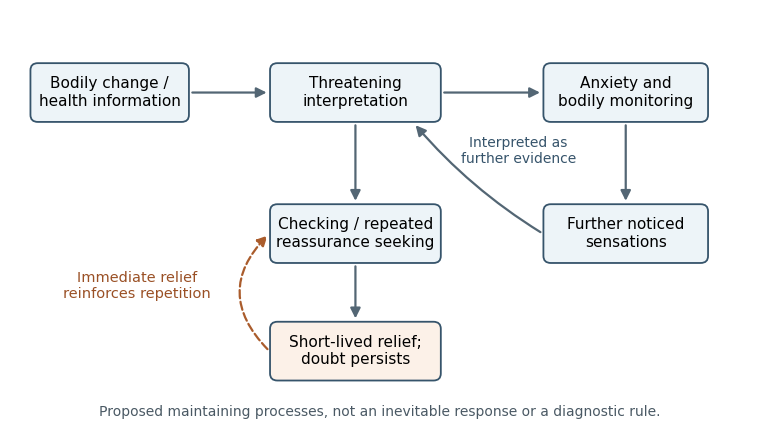
A proposed maintenance cycle for health anxiety; arrows represent testable processes, not inevitable responses to bodily changes
. Details. Intolerance of uncertainty can raise the required standard of evidence beyond what medical investigation can supply. If every residual possibility demands another check, a negative result can be reinterpreted as the wrong test, the wrong time or a missed condition. This account predicts repeated doubt despite short-term relief, rather than the absence of genuine concern or comprehension. It also explains a possible paradox: a response chosen to reduce anxiety can maintain the demand for certainty. The person's reason for the behavior must be established; the same observable action could be proportionate care in another context.
An appropriate formulation therefore distinguishes the presence of physical illness, the degree of concern and the pattern of maintaining responses. These are not mutually exclusive categories. Paul Salkovskis and colleagues developed the Health Anxiety Inventory to measure health anxiety across relevant clinical and medical samples rather than simply counting bodily symptoms. The validation studies compared several anxiety presentations, examined sensitivity to change and included people seeking help for physical illness. This supports measuring the psychological response separately from a conclusion about whether a disease exists. A questionnaire still does not replace clinical assessment.[ref]
The Health Anxiety Inventory: development and validation of scales for the measurement of health anxiety and hypochondriasis by Paul Salkovskis and others. 2002; clinical comparisons, treatment sensitivity and physical-illness samples
Treatment implications follow as hypotheses about learning. Collaborative cognitive behavioral therapy can identify the feared interpretation, the alternative account and what would distinguish them. A behavioral experiment should test a specified prediction about attention or a safety behavior, rather than require the person to prove that future illness is impossible. Attention can be examined as a process that changes experience, not as a declaration that every sensation is caused by attention. Likewise, reducing a repetitive reassurance cycle is different from withholding a needed explanation or discouraging appropriate medical evaluation.
The therapeutic stance is consequently important. Dismissing a symptom can reinforce the belief that the danger has not been understood. A shared formulation can instead acknowledge the sensation, explain how anxiety may amplify it and leave room to revise the account. Appropriate information may be useful, but the aim is a more flexible standard for updating and coping. This also makes the account falsifiable: if the predicted relationship between a response and the difficulty is not observed, the formulation should be reconsidered rather than blaming the person for failing to improve.
Erik Hedman and colleagues randomized 81 people with severe health anxiety to therapist-guided internet cognitive behavioral therapy or an attention-control condition over 12 weeks. The treatment produced a substantially greater reduction in health anxiety on the study measures. This gives evidence beyond the intuitive plausibility of the model and suggests that extensive face-to-face contact is not necessary for every effective delivery format. The trial does not isolate every treatment component or show that internet delivery suits every patient, and a selected trial sample limits generalization.[ref]
Internet-based cognitive-behavioural therapy for severe health anxiety: randomised controlled trial by Erik Hedman and others. 2011; masked-assessment randomized comparison, attention control and Health Anxiety Inventory outcome
The CHAMP medical-outpatient trial provides a complementary setting in which physical illness was permitted. Its health anxiety benefit reinforces the distinction between addressing an anxious maintenance cycle and denying medical disease. However, symptom improvement, functioning, costs and quality of life are different outcomes and should not be collapsed into one claim of success. The model should also accommodate social circumstances and access to care: repeated concern in a setting where appropriate assessment is unavailable cannot simply be assumed to reflect an internal cognitive bias.[ref]
Cognitive-behaviour therapy for health anxiety in medical patients (CHAMP): a randomised controlled trial with outcomes to 5 years by Peter Tyrer and others. 2017; medical eligibility, symptom follow-up and distinct economic endpoints
The useful clue from ordinary responding is the ability to combine concern with proportionate interpretation, evidence updating and tolerable uncertainty. A mechanistic treatment account aims to restore those functions by testing interpretations and changing maintaining responses, with appropriate medical collaboration. It does not promise certainty, identify all bodily symptoms as benign, or treat anxiety as evidence that a person's health concern is invalid.
Past exam of the beliefs, behaviours and biology course of the University of Oxford 2022 3 Solution by Codex 0 2026-10-25
Codex 0 2026-10-25Panic disorder and social anxiety disorder illustrate a shared feedback architecture with different feared outcomes and sources of apparent evidence. Treatment can share collaborative cognitive behavioral methods while changing the experiments, attentional targets and safety behaviors according to the formulation. In both, an anxiety response can become part of the perceived proof of danger. A diagnosis indicates a pattern of difficulty; it does not establish that all cases have an identical maintaining process.
In panic disorder, recurrent unexpected panic attacks are followed by concern or behavioral change related to further attacks. The cognitive account emphasizes catastrophic misinterpretation of bodily sensations: an acceleration of heart rate, dizziness or altered breathing may be interpreted as imminent collapse, loss of control or another catastrophe. The interpretation increases anxiety, which generates further sensations, reinforcing the threat interpretation. Avoidance and safety behaviors can prevent learning that the sensations would have changed without the precaution. Appropriate assessment remains necessary because a cognitive formulation does not determine the medical origin of any individual symptom.
David M. Clark's original account specifies this feedback process rather than equating panic with generally high stress. It predicts that the meaning assigned to a sensation should matter more than its physical presence alone. The same sensation could be frightening in one interpretive context and relatively unremarkable in another. This explanatory distinction is useful because it suggests testable comparisons between predictions, rather than relying solely on relaxation or a verbal assurance that nothing dangerous will occur. The original paper is a model, not itself a randomized demonstration of every link.[ref]
A cognitive approach to panic by David M. Clark. 1986; proposed catastrophic-interpretation feedback account
Social anxiety disorder instead centers on feared scrutiny and negative evaluation. In an interaction, self-focused attention can shift processing from the actual conversation to sensations and an imagined view of oneself. A negative self-image may be treated as if it were an observer's report. Safety behaviors such as mentally rehearsing every sentence or restricting engagement can reduce spontaneity, obscure the evidence needed to test a prediction and sometimes change how the interaction develops. Post-event processing can then select apparent failures and preserve the threatening impression for the next encounter.
The disorders therefore share an interpretive loop but differ in what would count as disconfirming evidence. In panic, the feared event may concern the immediate meaning of a bodily sensation. In social anxiety, it may concern another person's appraisal, an uncertain social consequence or the belief that anxiety is visibly unacceptable. Simply remaining in a situation is not an adequate experimental description: someone may remain while attributing safety to a precaution, directing attention inward or interpreting an ambiguous response as rejection.
Experimental evidence tests this functional argument. Paul Salkovskis and colleagues manipulated safety-seeking behavior during exposure in panic disorder with agoraphobia. The study supports examining what the person does during exposure rather than treating exposure duration as its only relevant feature. It does not imply that every protective behavior is unnecessary, nor that an effect in a short task demonstrates the complete mechanism of long-term recovery. The prediction being tested and the person's explanation of the outcome remain important.[ref]
An experimental investigation of the role of safety-seeking behaviours in the maintenance of panic disorder with agoraphobia by Paul Salkovskis and others. 1999; experimental manipulation of safety-seeking behavior during exposure
For social anxiety, Freda McManus and colleagues first assessed safety behaviors by interview and then manipulated safety behaviors and self-focus experimentally. Greater safety behavior use characterized high social anxiety, and the manipulation supported adverse effects of the combined maintaining processes. The interview association alone would allow reverse causation; the experimental contrast provides stronger evidence of an immediate influence. Because attention and behavior were manipulated together, it is less decisive about their independent effects. Brief arranged interactions also cannot establish the magnitude of lasting treatment benefit.[ref]
Why social anxiety persists by Freda McManus and others. 2008; interview study and experimental safety behavior/self-focus manipulation
Both treatments can begin with a shared clinical formulation, specified predictions and behavioral experiments. In panic, interoceptive exposure can make relevant sensations available for testing while changing the safety behavior that would otherwise be credited with preventing catastrophe. The learning question concerns the predicted consequence and the meaning of the sensation, not merely whether anxiety eventually declines. In social anxiety, experiments can redirect attention to the interaction and test predicted evaluations while reducing relevant safety behaviors. The content is matched to social interpretation rather than transferred mechanically from a bodily-sensation exercise.
Video feedback is particularly pertinent when a person treats a negative self-image as an accurate external view. Preparing a clear prediction about appearance and then comparing it with the recording creates a more interpretable test than simply asking the person to watch themselves. A recording is still a limited sample, and the person's selective interpretation of it needs examination. Social experiments may also test how others respond to ordinary imperfections rather than making perfect performance the criterion for safety. These principles follow from the proposed maintaining process and should remain open to outcome evaluation.
Treatment comparisons provide evidence at a broader level. David M. Clark and colleagues' panic trial compared cognitive therapy, applied relaxation and imipramine, with self-exposure homework shared across conditions. The cognitive therapy findings support the package, but common homework means that differences cannot be attributed to exposure being present in one arm and absent in all others. Therapist effects, credibility, dose and follow-up are also relevant when interpreting comparative outcomes.[ref]
A comparison of cognitive therapy, applied relaxation and imipramine in the treatment of panic disorder by David M. Clark and others. 1994; treatment conditions, shared self-exposure homework and follow-up
In social phobia, David M. Clark and colleagues randomized participants to cognitive therapy, exposure with applied relaxation or a waiting condition. Cognitive therapy showed a stronger outcome than the exposure/relaxation package on the principal comparisons. This is evidence against treating all interventions that contain exposure as interchangeable. It does not establish that a single feature, such as video feedback, explains the difference, because the packages differ on multiple dimensions. A dismantling study or a carefully specified mediation design would be needed for that narrower causal claim.[ref]
Cognitive therapy versus exposure and applied relaxation in social phobia: a randomized controlled trial by David M. Clark and others. 2006; randomized package comparison and follow-up
Treatment planning also needs the person's goals, comorbidity and constraints. A ritualized breathing strategy, inward monitoring or avoidance can serve different functions in different cases; its name does not determine its effect. Outcomes should include functioning and flexibility alongside symptom scores, and tests of maintenance should examine whether feared situations can be approached without recreating the same safety rules. This is why a transdiagnostic process can justify shared principles without requiring a single standardized sequence for everyone.
The shared targets are threatening interpretation, self-confirming attention and safety behavior that obstructs updating; the specific targets depend on whether bodily catastrophe or social evaluation organizes the difficulty. Evidence for package efficacy and evidence for a proposed mechanism answer different questions. Effective comparison requires both, with the limits of the experimental manipulation kept distinct from those of the clinical trial.
Pinned article: Introduction to the OurBigBook Project
Welcome to the OurBigBook Project! Our goal is to create the perfect publishing platform for STEM subjects, and get university-level students to write the best free STEM tutorials ever.
Everyone is welcome to create an account and play with the site: ourbigbook.com/go/register. We belive that students themselves can write amazing tutorials, but teachers are welcome too. You can write about anything you want, it doesn't have to be STEM or even educational. Silly test content is very welcome and you won't be penalized in any way. Just keep it legal!
Intro to OurBigBook
. Source. We have two killer features:
- topics: topics group articles by different users with the same title, e.g. here is the topic for the "Fundamental Theorem of Calculus" ourbigbook.com/go/topic/fundamental-theorem-of-calculusArticles of different users are sorted by upvote within each article page. This feature is a bit like:
- a Wikipedia where each user can have their own version of each article
- a Q&A website like Stack Overflow, where multiple people can give their views on a given topic, and the best ones are sorted by upvote. Except you don't need to wait for someone to ask first, and any topic goes, no matter how narrow or broad
This feature makes it possible for readers to find better explanations of any topic created by other writers. And it allows writers to create an explanation in a place that readers might actually find it.
Figure 1. Screenshot of the "Derivative" topic page. View it live at: ourbigbook.com/go/topic/derivativeVideo 2. OurBigBook Web topics demo. Source. - local editing: you can store all your personal knowledge base content locally in a plaintext markup format that can be edited locally and published either:This way you can be sure that even if OurBigBook.com were to go down one day (which we have no plans to do as it is quite cheap to host!), your content will still be perfectly readable as a static site.
- to OurBigBook.com to get awesome multi-user features like topics and likes
- as HTML files to a static website, which you can host yourself for free on many external providers like GitHub Pages, and remain in full control

Figure 2. You can publish local OurBigBook lightweight markup files to either OurBigBook.com or as a static website.
Figure 3. Visual Studio Code extension installation.
Figure 5. . You can also edit articles on the Web editor without installing anything locally. Video 3. Edit locally and publish demo. Source. This shows editing OurBigBook Markup and publishing it using the Visual Studio Code extension. 
- Infinitely deep tables of contents:



All our software is open source and hosted at: github.com/ourbigbook/ourbigbook
Further documentation can be found at: docs.ourbigbook.com
Feel free to reach our to us for any help or suggestions: docs.ourbigbook.com/#contact