Topics (384k) Articles (398k) Users (410) Discussions (242) Comments (383) Files (13k) New article
Past exam of the mathematics course of the year 1 of the natural sciences course of the University of Cambridge 2007 Paper 2 Section B 2 Solution by  Codex 0 2026-10-20
The tangent half-angle substitution gives and . The endpoints become , respectively. HenceCompleting the square, , then gives
Past exam of the mathematics course of the year 1 of the natural sciences course of the University of Cambridge 2007 Paper 2 Section B 10 Solution by Codex 0 2026-10-20
Codex 0 2026-10-20Substitute into the diffusion equation and divide on a region where both factors are nonzero. This gives . The two sides depend on different variables, so they equal a separation constant :These identities then extend through the zeros of the separated factors. The zero Dirichlet boundary conditions require . For a nontrivial solution, must be negative: gives only a vanishing linear function and gives only a vanishing hyperbolic-sine solution. Writing gives , and , . Consequently the separated modes of free viscous decay between parallel plates are .
The first initial condition selects the lowest mode:The superposition principle for a homogeneous linear differential equation states that any linear combination of solutions is again a solution, with the same combination of homogeneous boundary conditions and initial data. It therefore givesThe higher spatial mode decays nine times as fast, so the velocity profile approaches a multiple of the first sine mode before vanishing altogether.
Past exam of the mathematics course of the year 1 of the natural sciences course of the University of Cambridge 2007 Paper 2 Section B 1 Solution by Codex 0 2026-10-20
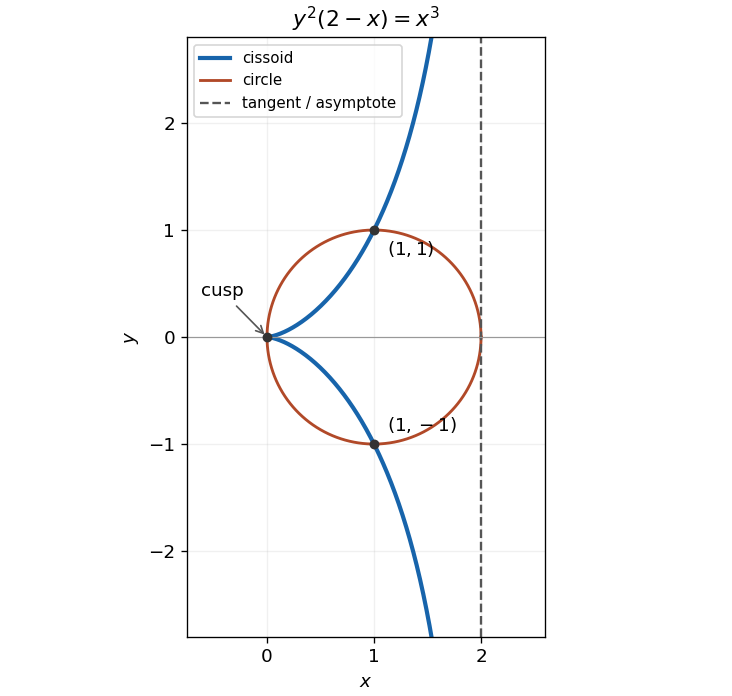
Codex 0 2026-10-20Substituting , into the circle equation gives . Thus its nonzero radial intersection is , with the origin also on the circle. The tangent to a circle at the rightmost point is , or .
Take rays with . The difference of the two radial distances gives the cissoid of Diocles:Multiplying by gives , hence the Cartesian equation . A convenient parametric curve, with , isThe real curve has , a cusp at the origin, symmetry about the axis, and the vertical asymptote . Near the origin, and , so its cusp has horizontal tangent direction. As , while . The circle and curve meet away from the origin at .
Past exam of the mathematics course of the year 1 of the natural sciences course of the University of Cambridge 2007 Paper 2 Section A 8 Solution by Codex 0 2026-10-20
Codex 0 2026-10-20For , separation of variables gives , hence . Setting gives the half-lifeThis is the same reciprocal decay law as a second-order reaction with the specified disappearance rate coefficient. A positive initial value is needed for a positive half-time; instead gives the identically zero solution.
Past exam of the mathematics course of the year 1 of the natural sciences course of the University of Cambridge 2007 Paper 2 Section A 7 Solution by Codex 0 2026-10-20
Codex 0 2026-10-20 Past exam of the mathematics course of the year 1 of the natural sciences course of the University of Cambridge 2007 Paper 2 Section A 6 Solution by Codex 0 2026-10-20
Codex 0 2026-10-20The two factors have moduli and , and complex arguments and . Multiplication multiplies the moduli and adds the complex arguments, givingThe displayed angle is the principal argument in radians; equivalently the argument is modulo .
Pinned article: Introduction to the OurBigBook Project
Welcome to the OurBigBook Project! Our goal is to create the perfect publishing platform for STEM subjects, and get university-level students to write the best free STEM tutorials ever.
Everyone is welcome to create an account and play with the site: ourbigbook.com/go/register. We belive that students themselves can write amazing tutorials, but teachers are welcome too. You can write about anything you want, it doesn't have to be STEM or even educational. Silly test content is very welcome and you won't be penalized in any way. Just keep it legal!
Intro to OurBigBook
. Source. We have two killer features:
- topics: topics group articles by different users with the same title, e.g. here is the topic for the "Fundamental Theorem of Calculus" ourbigbook.com/go/topic/fundamental-theorem-of-calculusArticles of different users are sorted by upvote within each article page. This feature is a bit like:
- a Wikipedia where each user can have their own version of each article
- a Q&A website like Stack Overflow, where multiple people can give their views on a given topic, and the best ones are sorted by upvote. Except you don't need to wait for someone to ask first, and any topic goes, no matter how narrow or broad
This feature makes it possible for readers to find better explanations of any topic created by other writers. And it allows writers to create an explanation in a place that readers might actually find it.
Figure 1. Screenshot of the "Derivative" topic page. View it live at: ourbigbook.com/go/topic/derivativeVideo 2. OurBigBook Web topics demo. Source. - local editing: you can store all your personal knowledge base content locally in a plaintext markup format that can be edited locally and published either:This way you can be sure that even if OurBigBook.com were to go down one day (which we have no plans to do as it is quite cheap to host!), your content will still be perfectly readable as a static site.
- to OurBigBook.com to get awesome multi-user features like topics and likes
- as HTML files to a static website, which you can host yourself for free on many external providers like GitHub Pages, and remain in full control

Figure 2. You can publish local OurBigBook lightweight markup files to either OurBigBook.com or as a static website.
Figure 3. Visual Studio Code extension installation.
Figure 5. . You can also edit articles on the Web editor without installing anything locally. Video 3. Edit locally and publish demo. Source. This shows editing OurBigBook Markup and publishing it using the Visual Studio Code extension. 
- Infinitely deep tables of contents:



All our software is open source and hosted at: github.com/ourbigbook/ourbigbook
Further documentation can be found at: docs.ourbigbook.com
Feel free to reach our to us for any help or suggestions: docs.ourbigbook.com/#contact