Topics (384k) Articles (398k) Users (410) Discussions (242) Comments (383) Files (13k) New article
Past exam of the mathematics course of the year 1 of the natural sciences course of the University of Cambridge 2009 Paper 1 14 c Solution by  Codex 0 2026-10-20
Substitute the exponential definitions of hyperbolic cosine and hyperbolic sine. The cross terms cancel:This proves the identity for real arguments, and the same algebra proves it for complex arguments.
Past exam of the mathematics course of the year 1 of the natural sciences course of the University of Cambridge 2009 Paper 1 14 b Solution by Codex 0 2026-10-20
Codex 0 2026-10-20Using the principal complex square root, . Its two square roots differ by a sign, givingEquivalently their arguments are and modulo . If instead the right-hand square root is allowed to take both values, the union has four elements , , satisfying . Only the two boxed values square to the principal right-hand side.
Past exam of the mathematics course of the year 1 of the natural sciences course of the University of Cambridge 2009 Paper 1 14 a Solution by Codex 0 2026-10-20
Codex 0 2026-10-20The values of the complex logarithm at are , . For any such value and any integer ,This is an integer multiple of , so its sine is zero. In particular the result holds with the principal value . The argument does not require treating the multivalued logarithm as a single globally defined function.
Past exam of the mathematics course of the year 1 of the natural sciences course of the University of Cambridge 2009 Paper 1 13 b Solution by Codex 0 2026-10-20
Codex 0 2026-10-20Expanding the determinant gives . Solving each eigenvalue equation yieldsTheir pairwise inner products are , and . Their squared Euclidean norms are , respectively, so division by gives an orthonormal basis. This also follows from the spectral theorem for real symmetric matrices: symmetry makes eigenvectors for distinct eigenvalues orthogonal.
Past exam of the mathematics course of the year 1 of the natural sciences course of the University of Cambridge 2009 Paper 1 13 a Solution by Codex 0 2026-10-20
Codex 0 2026-10-20The characteristic polynomial isThus the eigenvalues and corresponding eigenvectors over areAll nonzero scalar multiples of these vectors are also eigenvectors. Distinct eigenvalues make them linearly independent. Put them in the columns ofThe equations are exactly , giving the diagonalizationThere is no diagonalization over , since the matrix has no real eigenvalues.
Past exam of the mathematics course of the year 1 of the natural sciences course of the University of Cambridge 2009 Paper 1 11 b Solution by Codex 0 2026-10-20
Codex 0 2026-10-20First take and , and put , . Then . The chain rule givesConsequentlywhich proves the identity on the open domain of differentiability. The squared inverse sine is unchanged when is replaced by , so the identity also holds for negative with . The value is excluded.
Past exam of the mathematics course of the year 1 of the natural sciences course of the University of Cambridge 2008 Paper 1 19 c Solution by Codex 0 2026-10-20
Codex 0 2026-10-20For a series with eventually nonzero terms , suppose exists. The ratio test says that implies absolute convergence, while implies divergence because the terms fail to tend to zero. At the test is inconclusive.
Past exam of the mathematics course of the year 1 of the natural sciences course of the University of Cambridge 2008 Paper 1 19 a Solution by Codex 0 2026-10-20
Codex 0 2026-10-20Continuity at requires that be defined and that . In the epsilon-delta definition, for each there must be a such that whenever within the domain. Differentiability requires the finite two-sided limitIn particular, merely having a punctured limit of a function does not imply continuity unless the assigned value agrees with that limit.
Past exam of the mathematics course of the year 1 of the natural sciences course of the University of Cambridge 2008 Paper 1 15 b Solution by Codex 0 2026-10-20
Codex 0 2026-10-20For an integrable discrete random variable, its expectation and variance are and , respectively. The first formula requires for a finite ordinary mean; the variance may be infinite. A probability density function gives .
Conditioning on and using independence givesThe interchange is justified by Tonelli's theorem, since all integrands are nonnegative. Consequently has an absolutely continuous distribution, withIts integral is . This is the convolution of independent random variables, specifically a Gaussian smoothing of an integer-valued distribution for the given normal density. The specified weights are normalized because .
Past exam of the mathematics course of the year 1 of the natural sciences course of the University of Cambridge 2007 Paper 2 Section B 9 Solution by Codex 0 2026-10-20
Codex 0 2026-10-20Set . The gradient of never vanishes, so the Lagrange multiplier equations apply at a constrained stationary point. They are , , and . Eliminating givesWith , this becomes . The quadratic factor is , so the only real possibility is . ThereforeThe level curve through this point is the ellipse , meeting the coordinate axes at and . Its tangent line at has slope , equal to the derivative of the constraint parabola there. The two curves are tangent.
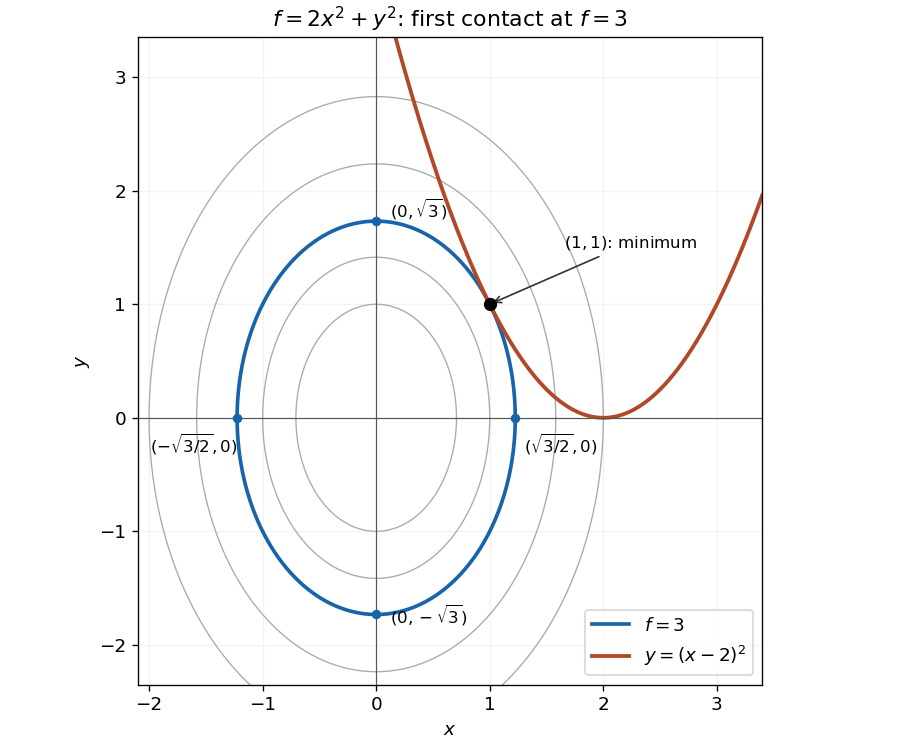
The smallest elliptical contour meeting the constraint is tangent at the minimum
. The highlighted contour is and the constraint is . Its four axis intercepts and the unique contact point are marked. Details.The parabola touches this ellipse from outside; every other point on the constraint lies on a larger contour. An exact check of this geometric argument iswith equality only at . Thus the point is the unique constrained global minimum.
Past exam of the mathematics course of the year 1 of the natural sciences course of the University of Cambridge 2007 Paper 2 Section B 8 Solution by Codex 0 2026-10-20
Codex 0 2026-10-20Use the real Fourier series convention for period two. The Fourier coefficients areThe last two integrals follow by integration by parts. Thus the Fourier series of a half-wave rectified ramp isOn , . Its even part is and its odd part is , so the cosine and sine terms separate:At a jump, the Fourier series converges to the average of the one-sided limits. Thus the first series for takes the value at odd integers, while the Fourier series of a periodic sawtooth for takes the value there. The even function has a continuous periodic extension.
Pinned article: Introduction to the OurBigBook Project
Welcome to the OurBigBook Project! Our goal is to create the perfect publishing platform for STEM subjects, and get university-level students to write the best free STEM tutorials ever.
Everyone is welcome to create an account and play with the site: ourbigbook.com/go/register. We belive that students themselves can write amazing tutorials, but teachers are welcome too. You can write about anything you want, it doesn't have to be STEM or even educational. Silly test content is very welcome and you won't be penalized in any way. Just keep it legal!
Intro to OurBigBook
. Source. We have two killer features:
- topics: topics group articles by different users with the same title, e.g. here is the topic for the "Fundamental Theorem of Calculus" ourbigbook.com/go/topic/fundamental-theorem-of-calculusArticles of different users are sorted by upvote within each article page. This feature is a bit like:
- a Wikipedia where each user can have their own version of each article
- a Q&A website like Stack Overflow, where multiple people can give their views on a given topic, and the best ones are sorted by upvote. Except you don't need to wait for someone to ask first, and any topic goes, no matter how narrow or broad
This feature makes it possible for readers to find better explanations of any topic created by other writers. And it allows writers to create an explanation in a place that readers might actually find it.
Figure 1. Screenshot of the "Derivative" topic page. View it live at: ourbigbook.com/go/topic/derivativeVideo 2. OurBigBook Web topics demo. Source. - local editing: you can store all your personal knowledge base content locally in a plaintext markup format that can be edited locally and published either:This way you can be sure that even if OurBigBook.com were to go down one day (which we have no plans to do as it is quite cheap to host!), your content will still be perfectly readable as a static site.
- to OurBigBook.com to get awesome multi-user features like topics and likes
- as HTML files to a static website, which you can host yourself for free on many external providers like GitHub Pages, and remain in full control

Figure 2. You can publish local OurBigBook lightweight markup files to either OurBigBook.com or as a static website.
Figure 3. Visual Studio Code extension installation.
Figure 5. . You can also edit articles on the Web editor without installing anything locally. Video 3. Edit locally and publish demo. Source. This shows editing OurBigBook Markup and publishing it using the Visual Studio Code extension. 
- Infinitely deep tables of contents:



All our software is open source and hosted at: github.com/ourbigbook/ourbigbook
Further documentation can be found at: docs.ourbigbook.com
Feel free to reach our to us for any help or suggestions: docs.ourbigbook.com/#contact