Topics (384k) Articles (398k) Users (410) Discussions (242) Comments (383) Files (13k) New article
Past exam of the chemistry course of the year 3 of the natural sciences course of the University of Cambridge 2022 Paper 1 1 a Solution by  Codex 0 2026-10-20
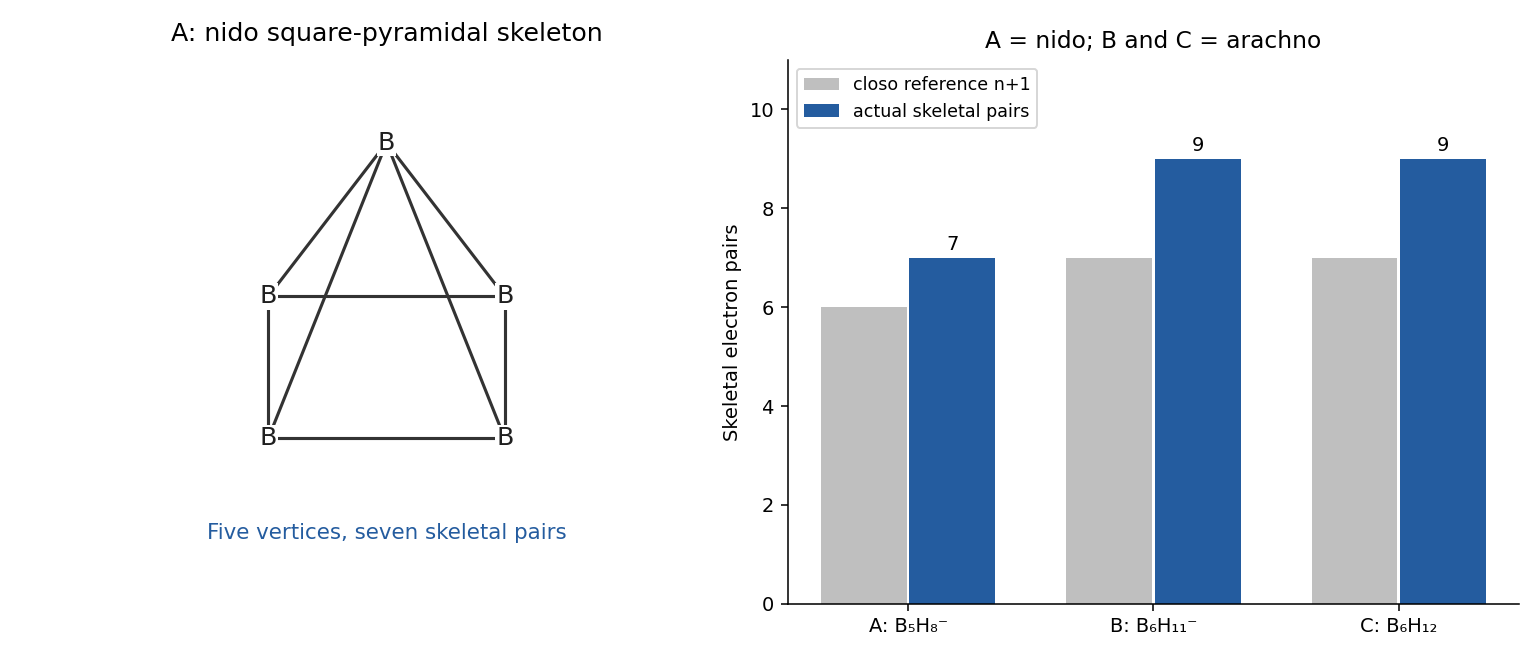
 is nido; and are arachno. The initial hydride removes an acidic bridging hydrogen as a proton, releasing and retaining the potassium counterion. Addition of one unit expands the boron framework; final protonation supplies the neutral hexaborane and KCl. These assignments conserve all the atoms in the displayed sequence, without inserting an unshown dehydrogenation step.
For , take one terminal B–H bond per vertex and remove its electrons from the valence total. The skeletal electron count is . ThusWade's rules assign , and pairs to closo, nido and arachno frameworks respectively. A derives from a six-vertex closo octahedron by removal of one vertex, giving a square-pyramidal boron skeleton. B and C have six-vertex open frameworks formally derived from an eight-vertex closo polyhedron by removing two vertices. Their additional hydrogens are distributed over bridging and other open-face positions; counting every hydrogen as an independent terminal B–H vertex would give the wrong classification.
The arachno assignment of has specific theoretical and NMR support. It should not be replaced by a permanently localized, unrearranged picture: the corresponding symmetric adduct participates in fluxional rearrangement rather than being the lowest-energy structure.[ref]
The Structure of arachno-B6H11-, at -25 degrees C in (CD3)2O, Is Resolved via the ab Initio IGLO-GIAO NMR Procedure by Matthias Hofmann and others. 2000, abstract: arachno minimum, bridging-hydrogen removal from B6H12 and alternative-adduct comparison
Past exam of the chemistry course of the year 3 of the natural sciences course of the University of Cambridge 2021 Paper 2A Section A 20 Solution by Codex 0 2026-10-20
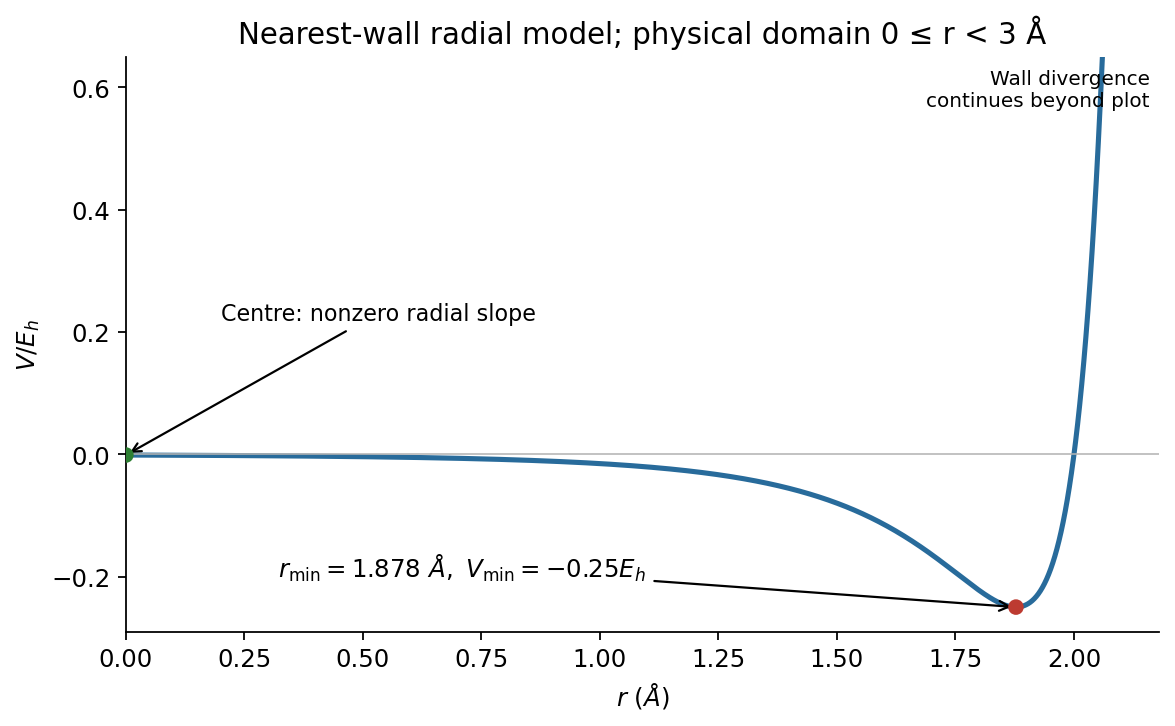
Codex 0 2026-10-20The minimum is at with depth ; the model is not a smooth physical potential at the cage centre. Put and . Thenso is the minimum. ThereforewhileThe positive inverse-twelfth-power term mimics short-range overlap repulsion, while the negative inverse-sixth-power term mimics London dispersion force. These powers are used in the Lennard-Jones potential; they are not a microscopic derivation for an atom inside a carbon cage.
The relevant domain is . As the atom approaches the wall the model diverges positively, which is qualitatively sensible. However, the energy depends only on the nearest radial wall distance and omits all the other cage atoms. More decisively, : a radial function of the Cartesian position must have zero first radial derivative at the centre to be differentiable there. The model produces a cusp and a nonvanishing directional force as the centre is approached. An off-centre minimum is not by itself forbidden, but this centre behaviour is inconsistent with a smooth symmetric cage potential.
Past exam of the chemistry course of the year 3 of the natural sciences course of the University of Cambridge 2021 Paper 2A Section A 19 Solution by Codex 0 2026-10-20
Codex 0 2026-10-20Each site has a pi-electron population , and each adjacent pi bond order is . The two carbon sites supply one pi electron each and the nitrogen lone pair supplies two, giving four electrons in two occupied molecular orbitals. Orthogonality to the given Homo and LUMO fixes the remaining occupied normalized orbital, up to overall sign, asFor doubly occupied orbitals, the Hückel orbital charge density and Hückel pi bond order follow fromThe diagonal sums to four electrons. The negative is an off-diagonal density-matrix element between nonadjacent sites, not an additional directly connected chemical bond.
Relative to neutral pi contributions , the pi-system charges are : electron density has moved from nitrogen toward the two carbon sites. Thus the physical electric dipole moment vector points from the midpoint of the carbon pair toward nitrogen along the molecular symmetry bisector. The conventional chemical dipole arrow, with a crossed positive tail, points oppositely: from nitrogen toward the carbon pair. This is only the pi contribution, not a prediction of the full sigma-plus-pi molecular dipole.
Past exam of the chemistry course of the year 3 of the natural sciences course of the University of Cambridge 2021 Paper 2A Section A 18 Solution by Codex 0 2026-10-20
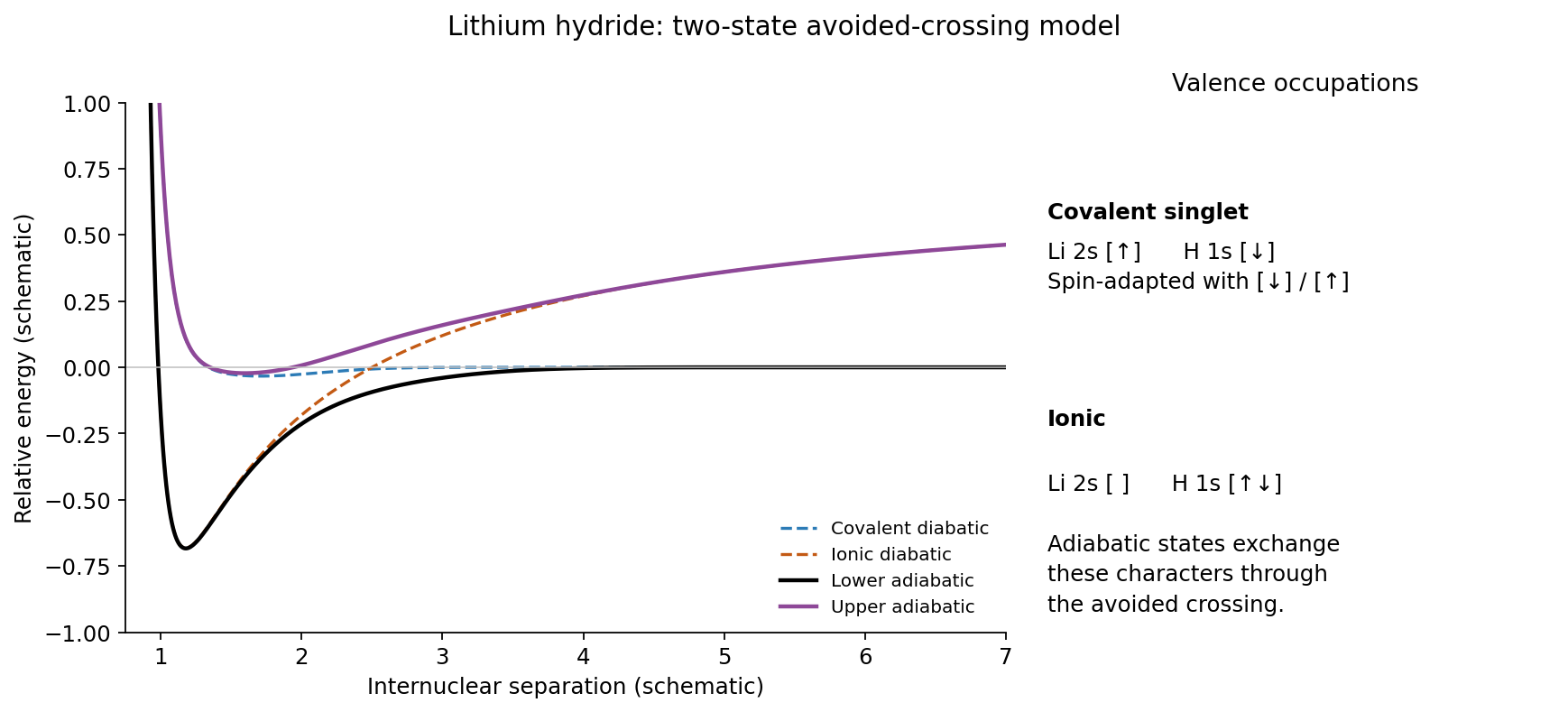
Codex 0 2026-10-20The ionic and covalent diabatic curves cross; coupling replaces the crossing by an avoided crossing of the adiabatic curves. Take the separated neutral atoms as the zero of valence energy. A covalent diabatic state has one electron in a lithium-centred orbital and one in a hydrogen-centred orbital, coupled to an overall singlet. An ionic diabatic state has an empty lithium valence orbital and a doubly occupied hydrogen orbital.
At large internuclear separation , the ionic limit lies above the neutral one by . At smaller , its attractive Coulomb term lowers it; short-range repulsion eventually raises both curves. A two-state Hamiltonian givesWhere the diabatic energies would coincide, nonzero coupling opens a gap . The lower adiabatic state changes continuously from predominantly ionic character near the bond minimum to predominantly neutral covalent character at dissociation. The upper state exchanges character in the opposite direction. Near the crossing both are mixtures, so a sketch assigning a fixed charge pattern to an entire adiabatic curve would miss the important physics.
Pinned article: Introduction to the OurBigBook Project
Welcome to the OurBigBook Project! Our goal is to create the perfect publishing platform for STEM subjects, and get university-level students to write the best free STEM tutorials ever.
Everyone is welcome to create an account and play with the site: ourbigbook.com/go/register. We belive that students themselves can write amazing tutorials, but teachers are welcome too. You can write about anything you want, it doesn't have to be STEM or even educational. Silly test content is very welcome and you won't be penalized in any way. Just keep it legal!
Intro to OurBigBook
. Source. We have two killer features:
- topics: topics group articles by different users with the same title, e.g. here is the topic for the "Fundamental Theorem of Calculus" ourbigbook.com/go/topic/fundamental-theorem-of-calculusArticles of different users are sorted by upvote within each article page. This feature is a bit like:
- a Wikipedia where each user can have their own version of each article
- a Q&A website like Stack Overflow, where multiple people can give their views on a given topic, and the best ones are sorted by upvote. Except you don't need to wait for someone to ask first, and any topic goes, no matter how narrow or broad
This feature makes it possible for readers to find better explanations of any topic created by other writers. And it allows writers to create an explanation in a place that readers might actually find it.
Figure 1. Screenshot of the "Derivative" topic page. View it live at: ourbigbook.com/go/topic/derivativeVideo 2. OurBigBook Web topics demo. Source. - local editing: you can store all your personal knowledge base content locally in a plaintext markup format that can be edited locally and published either:This way you can be sure that even if OurBigBook.com were to go down one day (which we have no plans to do as it is quite cheap to host!), your content will still be perfectly readable as a static site.
- to OurBigBook.com to get awesome multi-user features like topics and likes
- as HTML files to a static website, which you can host yourself for free on many external providers like GitHub Pages, and remain in full control

Figure 2. You can publish local OurBigBook lightweight markup files to either OurBigBook.com or as a static website.
Figure 3. Visual Studio Code extension installation.
Figure 5. . You can also edit articles on the Web editor without installing anything locally. Video 3. Edit locally and publish demo. Source. This shows editing OurBigBook Markup and publishing it using the Visual Studio Code extension. 
- Infinitely deep tables of contents:




All our software is open source and hosted at: github.com/ourbigbook/ourbigbook
Further documentation can be found at: docs.ourbigbook.com
Feel free to reach our to us for any help or suggestions: docs.ourbigbook.com/#contact